
You have finished your BCA. You know the basics of programming, database management and computer applications, and you have probably built a project or two in college. Now comes the harder question: what should you do next to land a software job?
Should you go for Java? Should you go for Python? Will an MCA help your career prospects? Should you simply start applying for jobs after BCA itself?
There is no single answer that fits everyone. The right choice depends on the kind of work you want to do, what you already know, and the skills employers ask for in that role.
This guide walks through the courses you can take after BCA to work towards a software job, and the kind of roles each one prepares you for.
What can you do after BCA?
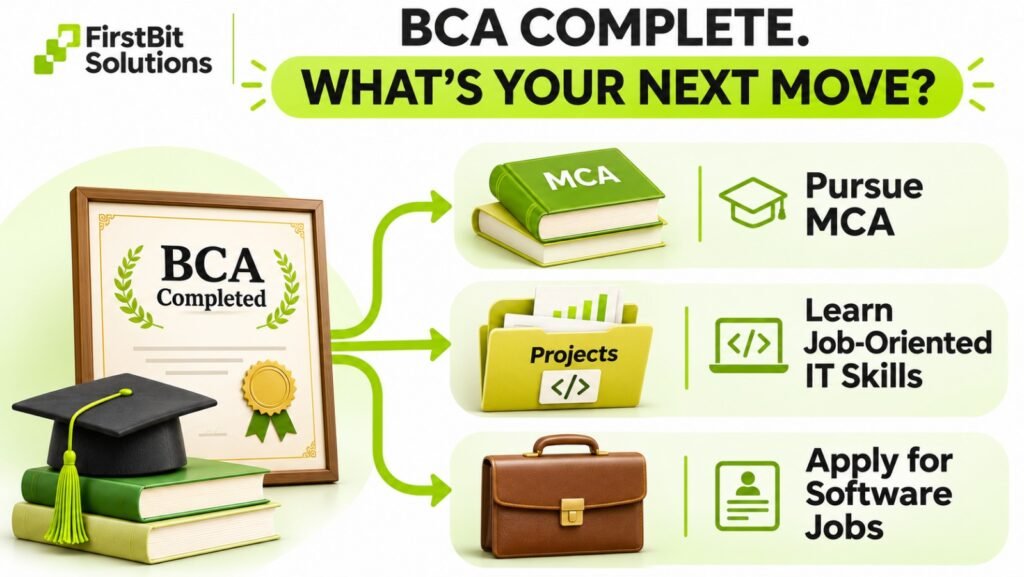
After BCA, you typically have three main choices:
- Look for employment opportunities: if your programming basics are sound and you have some projects behind you, you can start looking for fresher or trainee positions.
- Join higher education: if you want a postgraduate degree along with deeper knowledge of computer applications, you can go for an MCA.
- Master a particular skill: you can opt for practical training in Java Full Stack, Python, software testing, data analytics or any other field that interests you.
These choices do not conflict with each other. You can study for an MCA, learn a technology stack and work on projects at the same time.
The key factor is clarity of purpose. Knowing five programming languages without an objective leaves you with a lot of skills but little confidence about where to use them.
Best courses after BCA for a software job
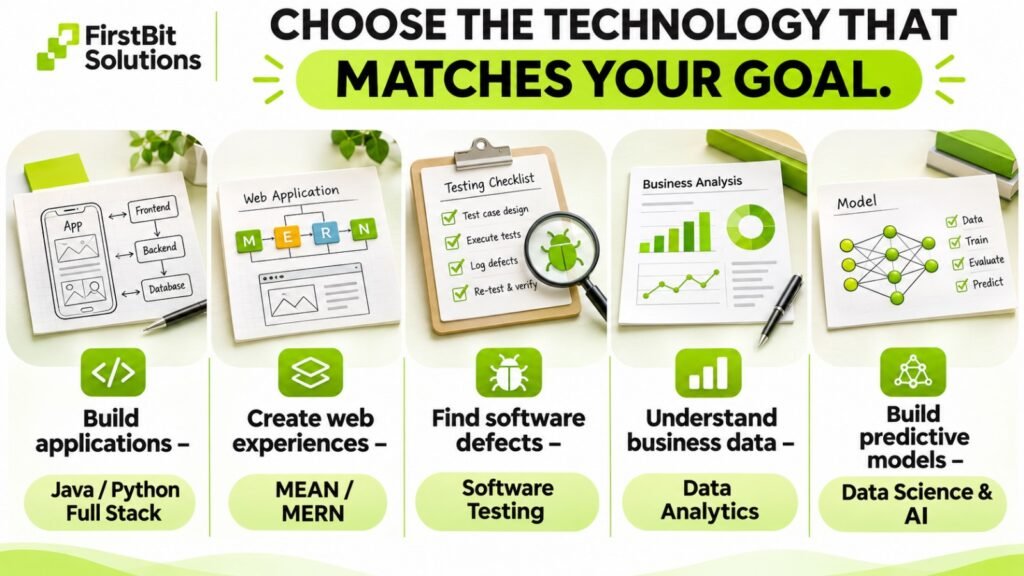
If you want to become a software developer, choose a course where you learn application development. That means programming, databases, front end and back end development, and a few completed projects.
Choosing a field is the same question students face right after school, and the reasoning does not change much. If you want to see how the options line up at that earlier stage, our guide to IT courses after 12th covers the same ground from the beginning.
Here is a list of courses you can consider.
1. Java Full Stack Development
Java Full Stack Development is worth your consideration if you like coding and want to build websites, business applications or other systems.
A full stack developer works on both the front end and the back end of an application. On an online shopping website, the product pages and buttons are part of the front end, while user accounts, order processing and payment transactions are handled on the back end.
A Java Full Stack learning path generally covers:
- Core Java and object-oriented programming.
- SQL and database management.
- HTML, CSS and JavaScript.
- Spring and Spring Boot for backend development.
- Front-end frameworks such as React or Angular.
- REST APIs, Git and application development projects.
What jobs can you target?
- Junior Java Developer
- Java Developer Trainee
- Backend Developer
- Junior Full Stack Developer
You do not need to know everything about every technology before you apply for your first job. Begin with programming basics, learn how databases work, and build an application in the right framework. If you are not sure what to study first, this Java Full Stack learning order sets out a sensible sequence.
If you are unsure whether Java is the right choice, read this comparison of Java Full Stack vs Python Full Stack courses. It explains how the two learning paths differ and the kind of work each one focuses on. You can also look at what a structured Java course in Pune usually covers.
2. Python Full Stack Development
Python is another language that suits BCA graduates who want to work in software development. Its syntax is readable, which makes it easier to pick up, but you still need to be comfortable with programming principles and writing code.
A Python Full Stack programme could include:
- Python basics and object-oriented programming.
- SQL and database principles.
- HTML, CSS and JavaScript.
- Frameworks including Django and Flask.
- Backend development and REST APIs.
- Developing and linking web applications.
What positions can you pursue?
- Junior Python Developer
- Python Web Developer
- Backend Developer
- Software Developer Trainee
One thing worth knowing is that Python is used across more than one career path, including web development, data analysis, automation, machine learning and AI. Our guide to Python career options beyond web development explains where each of those leads.
Learning Python alone will not get you into all of those jobs, though. A Python developer needs application development skills, while a data role asks for more knowledge of statistics and data handling.
So check what a Python course actually concentrates on before you enrol. A Python course in Pune aimed at development will look quite different from one aimed at data work.
3. MEAN or MERN Stack Development
If you like working with websites and want to build applications using JavaScript, consider MEAN or MERN Stack Development.
Both are popular stacks built on JavaScript technologies. The difference is the front end: the MEAN stack uses Angular, while the MERN stack uses React.
With either one, you learn how the front end talks to the back end, how data is stored in the database, and how the different parts of an application fit together.
Which jobs can you apply for?
- Junior Full Stack Developer
- React Developer
- Node.js Developer
- Web Developer
This track makes sense if you already enjoy working with JavaScript or prefer building web applications. Before you start, make sure your JavaScript fundamentals are in place.
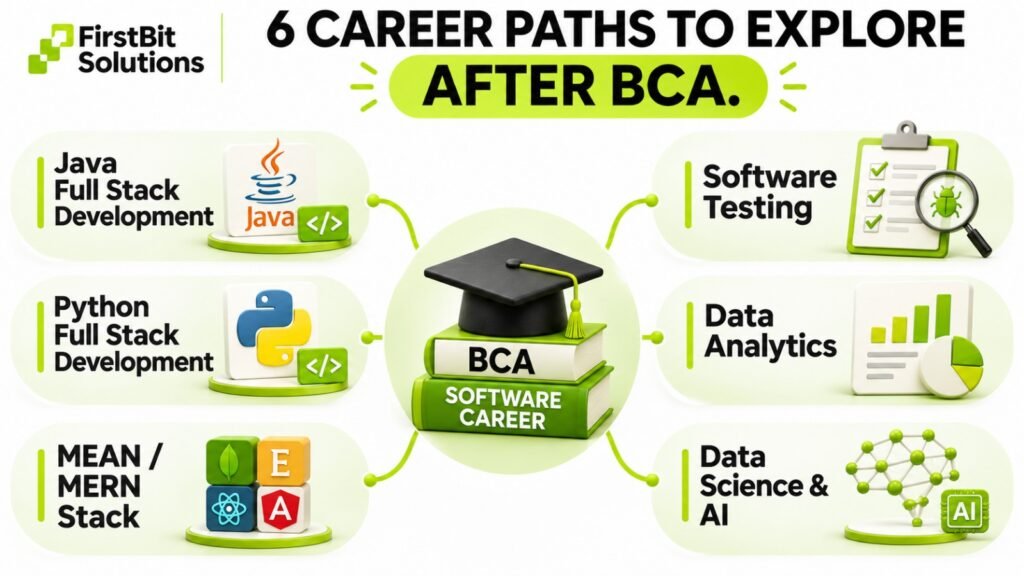
4. Software Testing and Automation Testing
Not every BCA graduate wants to spend the day building applications. Some prefer testing how software behaves, finding bugs and making sure the application works as intended.
That is where software testing comes in. A software tester checks the application against its requirements and reports defects before it reaches end users. If you want a fuller picture of the role, read our guide on why software testing matters.
Some of the things taught in a software testing course are:
- Manual testing concepts.
- Software Testing Life Cycle (STLC).
- Test cases and test scenarios.
- Bug reporting and tracking.
- Functional and regression testing.
- Automation testing using tools such as Selenium.
- API testing.
Which job roles can you target?
- Software Testing Trainee
- QA Tester
- Manual Tester
- Junior Automation Tester
If you want to move into automation testing, a programming background matters. Automation tools such as Selenium are commonly driven with Java or Python.
Manual testing is a reasonable starting point, and automation gives you a broader understanding of how testing works.
5. Data Analytics
Are you comfortable with numbers, organising data and spotting patterns? Then Data Analytics is another path worth considering after BCA.
Think about an online shop. It collects data on orders, customers, items and sales. As a data analyst, you would answer questions such as:
- Which items are selling the most?
- In which months do sales go up?
- Which customer segments buy more often?
- In which areas is the company losing money?
For a career in data analytics, you may need skills in:
- Excel for organising and analysing data.
- SQL for pulling data out of databases.
- Python for cleaning and analysing data.
- Power BI or Tableau for dashboards.
- Statistics and the basics of data visualisation.
What jobs can you target?
- Junior Data Analyst
- Reporting Analyst
- MIS Executive
- Junior Business Intelligence Analyst
Those last few titles overlap more than you might expect. Our comparison of business analyst, data analyst and MIS executive roles sets out what each one actually does.
Data Analytics is not a software development stream. It suits people who enjoy working with data and interpreting it rather than building applications. A structured data analytics course in Pune usually starts with Excel and SQL before moving to Python and dashboards.
If this sounds interesting, explore our guide to data analyst jobs in Pune for freshers to understand the skills, projects and application process involved.
6. Data Science and AI
You have probably seen plenty of programmes promising a career in Artificial Intelligence or Data Science. These are genuinely interesting fields, but it helps to know what the work involves before you commit to it.
Data Science applies programming, statistics and analytical methods to examine data and build models. Machine Learning is one part of it, and involves creating models that learn patterns from data and make predictions.
Topics usually covered in this area include:
- Python programming.
- Statistics and probability.
- Data analysis with Pandas and NumPy.
- Data visualisation.
- Introduction to Machine Learning.
- Training and evaluating models.
- Artificial Intelligence basics and projects.
What kind of jobs can you aim at?
Depending on your qualifications, projects and experience, you can prepare for junior data or analytics positions. Specialisations such as Data Scientist or Machine Learning Engineer ask for deeper mathematical and programming knowledge.
So do not take Data Science just because AI is popular right now. Take it if you are genuinely interested in programming, maths and data itself. If you are coming from a non-engineering background, this look at a data science course for non-engineering students is worth reading first.
After BCA, which course is best for a high salary?
This is probably one of the first things on your mind before you invest in another course.
There is one thing worth remembering: the course you complete will not by itself decide your pay. The skills you build and the projects you finish play their part too.
A Java Full Stack learner who can write a program, work with a database and explain how the backend works may be better prepared for a developer interview than someone holding several certificates but no project to show.
The same holds true across the other paths.
| Career path | Important skills to develop |
|---|---|
| Java Developer | Java, Spring Boot, SQL and APIs |
| Python Developer | Python, Django or Flask, databases and APIs |
| MERN Developer | JavaScript, React, Node.js and MongoDB |
| Software Tester | Testing concepts, Selenium and API testing |
| Data Analyst | Excel, SQL, Python and Power BI |
| Data Science | Python, statistics and Machine Learning |
Salaries differ by company, location, role, experience and how you perform in interviews. Rather than picking a course on salary expectations, read current job postings and see what employers are actually asking for.
What are the job options after BCA?
| Job role | What you may work on |
|---|---|
| Software Developer Trainee | Learning and contributing to development tasks |
| Junior Java Developer | Building and maintaining Java applications |
| Python Developer | Developing Python-based applications |
| Frontend Developer | Creating the user-facing part of websites |
| Junior Full Stack Developer | Working on frontend and backend components |
| Software Tester | Checking application functionality and reporting defects |
| Data Analyst | Analysing data and preparing reports |
| Technical Support Associate | Helping users resolve technical issues |
Can you apply for these jobs straight after BCA? Yes, where you meet the employer’s eligibility criteria and have the required skills.
Some employers accept BCA graduates for entry-level development positions. Others may ask for an MCA, an engineering degree or a particular specialisation. For example, NIELIT’s recruitment eligibility documents list BCA among the qualifications accepted for certain Junior Developer positions.
Always read the qualification requirements in the actual job posting before applying.
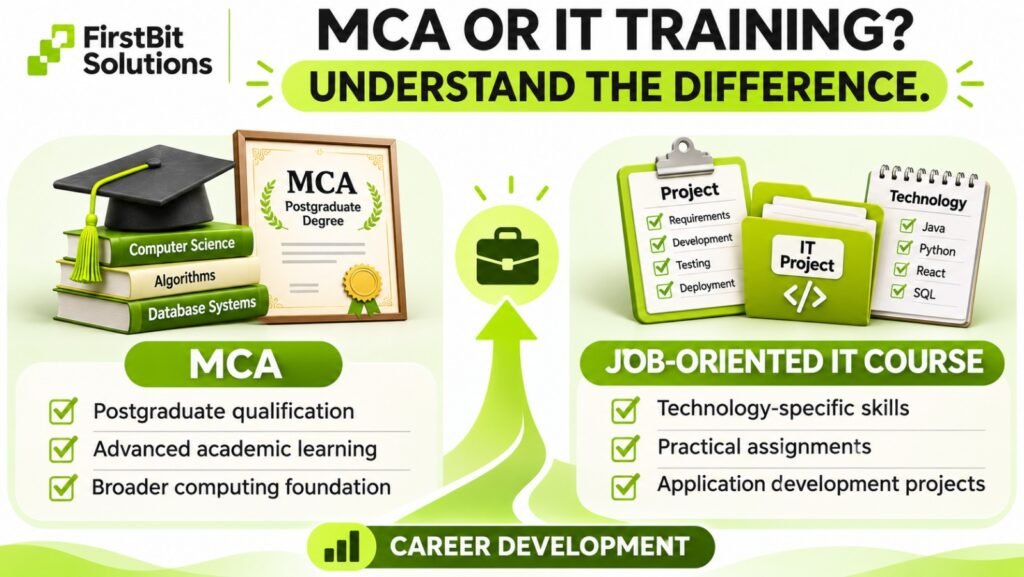
MCA vs a job-oriented IT course: which should you choose after BCA?
This is the other common dilemma. Should you keep studying, or build skills and start applying?
Each choice serves its own purpose.
| Factor | MCA | Job-oriented IT course |
|---|---|---|
| Main purpose | Postgraduate qualification | Practical technology skills |
| Learning focus | Advanced academic and computing concepts | Specific tools, frameworks and projects |
| Duration | Depends on the university | Depends on the programme |
| Best suited for | Students seeking further formal education | Graduates looking to specialise in a technology |
| Outcome | MCA degree | Training certificate and practical learning |
If you want to continue in formal education, or you are aiming at roles that ask for a postgraduate qualification, an MCA could be a good choice.
A specialised IT course helps you gain hands-on knowledge of one area, such as Java Full Stack or Python programming.
You can also do both. An MCA and practical training with projects alongside it is a workable combination.
Remember that a training certificate and a university degree are not interchangeable. If you want to understand this distinction better, read our guide on certificate course vs degree for IT jobs.
How to get a software job after BCA: a practical plan
Choosing a course is only one step. What you do while studying shapes how your applications go.
Here is how to approach it.
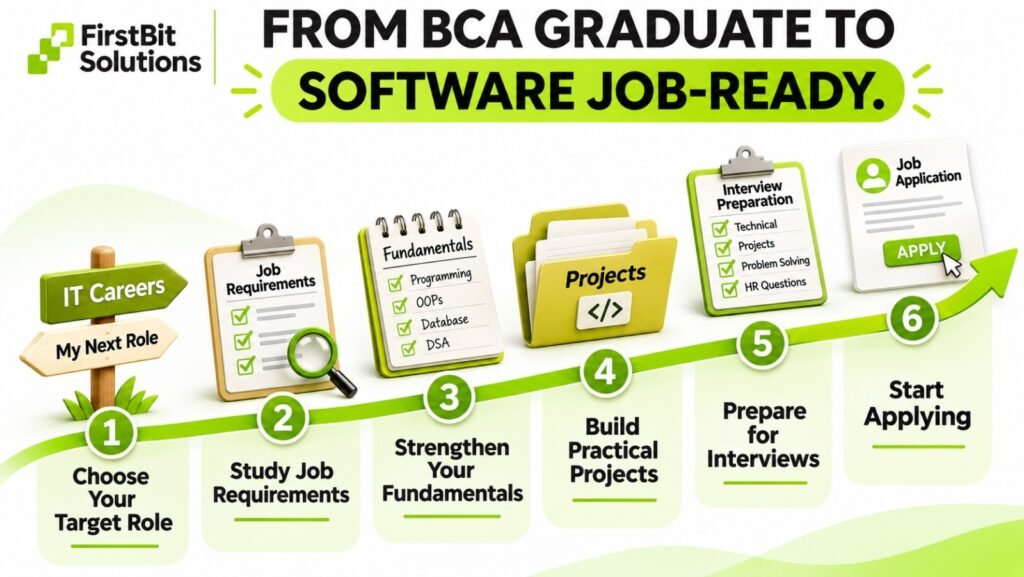
1. Identify which role you want to pursue.
Pick one field: Java developer, Python developer, frontend developer, tester or data analyst. Other technologies can come later.
2. Investigate real job requirements.
Look through fresher and junior vacancies for the role you want and note the qualifications, technical skills and tools listed. That tells you what to study.
3. Get your basics solid.
Do not rush straight into complex frameworks and libraries. Make sure you understand how programming works, what object-oriented programming means, how to solve basic problems and how databases work.
4. Create projects while you learn.
A course shows an employer that you completed training. A project gives them something to examine.
If you are studying Java, build an employee management system or an application that talks to a database. If you are learning data analysis, take a dataset and build a dashboard around a real question. Training that includes an internship or live project work can help here.
You can use our guide on building an IT portfolio for freshers to understand how to present your work.
5. Get ready for technical interviews.
Be prepared to talk about your projects, answer questions on fundamental programming concepts and solve basic coding problems. Know how your projects work and what problems you ran into while building them.
6. Start applying and keep improving.
You do not have to know everything. Once you have learned enough for the role and have a few projects behind you, start applying for fresher jobs. If the replies do not come, this look at why freshers do not get interview calls covers the usual reasons.
How can FirstBit Solutions help you build practical IT skills after BCA?
If you have finished your BCA and want practical experience before applying for software jobs, structured training can help you focus on the skills your chosen career path asks for.
Programmes at FirstBit Solutions that relate to these career paths include:
Java Full Stack Programme: Java programming, databases, web technologies, Spring Boot and frontend development, for people who want to build software applications.
Python Full Stack with Data Science and AI: Python development along with exposure to data science, machine learning and artificial intelligence.
Data Analytics Master Programme: Python, SQL, Excel, data analysis and business intelligence, for people who want to work with data.
The listed programmes run for roughly five to six months, although duration and availability can vary by programme and batch. You can explore the FirstBit IT courses and curriculum before deciding.
Learning does not end with watching lectures. Look for ways to practise coding, work on projects, ask questions and prepare for interviews.
FirstBit also offers resume and mock interview support, along with placement assistance subject to its eligibility criteria. Those criteria include holding a degree, and BCA graduates are among the candidates who qualify.
Still deciding between Java Full Stack, Python and Data Analytics? You can contact the FirstBit team to discuss the programme structure, your learning goals and eligibility before enrolling.
Final thoughts
Finishing your BCA is a good start, and it is natural to feel unsure about the next step. You might like software development but cannot decide between Java and Python. Or you might enjoy working with data and want to take a different path altogether.
It is better not to enrol in a course simply because it is in vogue or because it sounds impressive.
Start with the kind of work you would like to do, look at what employers are asking for, and follow one path properly.
If you want to understand how a training programme works before making a decision, you can book a free demo session with FirstBit Solutions. Use the session to understand the teaching approach, ask questions about the curriculum and decide whether the course fits your career plans.
Frequently asked questions
Java Full Stack, Python Full Stack and MEAN/MERN Stack Development are options worth exploring if you want to work in software development. The best choice depends on your interest, programming fundamentals and the type of applications you want to build.
Yes, BCA graduates can apply for suitable fresher and trainee software roles. However, eligibility differs between employers. You will also need relevant technical skills, problem-solving ability and practical knowledge of the technologies mentioned in the job description.
No, an MCA is not mandatory for every software job. Some employers accept BCA graduates for entry-level positions, while others require an MCA or a specific technical degree. Check the eligibility criteria for the roles you want.
There is no course that guarantees a high salary. Java Full Stack, Python development, Data Science and other specialised paths can lead to different opportunities, but your practical skills, experience and the employer’s requirements influence your earning potential.
Yes. A BCA graduate can work towards a Java Developer role by learning Core Java, object-oriented programming, SQL, Spring Boot and application development. Building projects and practising technical interviews are also important.
Yes, some companies hire fresh BCA graduates for trainee and junior roles. Academic projects, internships, personal projects and practical knowledge can help demonstrate your skills when you do not have full-time work experience.