You use apps every day. You book cabs, order food, make payments and shop on websites. Have you ever wondered who checks whether all of this actually works before an app reaches you?
That is one of the jobs of a software tester.
A software tester checks applications, finds problems and makes sure the product works the way it is supposed to. If you are interested in starting a career in IT but are not sure whether software development is the right path, testing is another option worth exploring.
So how do you become a software tester? Do you need coding skills? What should you learn first? What kind of salary can you expect?
Let us go through it step by step, especially if you are starting from scratch.
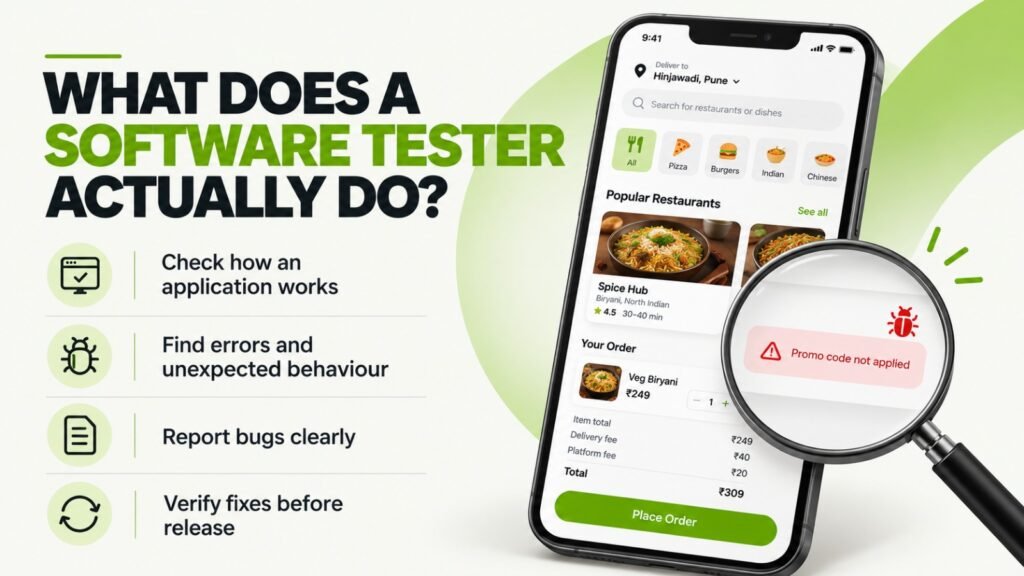
What does a software tester do?
Imagine you are using a food delivery app. You open it, pick a restaurant, add some food to your cart and pay for it.
Everything feels easy, doesn’t it? But what if the app lets you place an order without entering an address? What if the money is taken and the order never arrives? What if the app stops working when a lot of people are using it at the same time?
A software tester looks for these kinds of problems before they reach you.
On a project, a software tester might:
- Check whether the different parts of the app work the way they should.
- Create test cases from the details of the project.
- Try different ways of using the app to uncover mistakes.
- Report the problems they find to the developers, explaining how to reproduce them.
- Confirm that the problems reported earlier have actually been fixed.
- Test the app again to see whether fixing one problem has caused another.
In simple terms, developers build the app and testers make sure it works. Both play a part in making the final product good and dependable.
Is software testing a good career for freshers in India?
It can be a sensible starting point if you enjoy finding problems, understanding how things work and paying attention to small details.
Software testing is used across industries. Banking apps, shopping websites, healthcare platforms, travel applications and business software all need to be tested before and after release.
For freshers, entry-level opportunities may include roles such as:
- Software Testing Trainee
- Manual Testing Engineer
- Junior QA Tester
- Quality Assurance Analyst
- Junior Automation Tester
There is something you need to understand before choosing this career, though.
Learning basic manual testing will help you understand the field, but employers increasingly look for testers who can work with technical tools, APIs, databases and automation. Your career growth will depend on how you build those skills and apply them to real projects.
Software testing is not a shortcut into IT. You will still need to learn, practise and prepare for interviews. If you enjoy analytical work, it is a career path worth considering.
Practical learning helps you understand how technical concepts are used on real projects. You can read more about FirstBit Solutions’ training approach and the practical learning support it describes.
Do you need coding to become a software tester?
This is probably one of the first questions beginners ask.
The short answer: you do not need to be an expert programmer to start learning software testing. Coding does become important as you move towards automation testing.
Here is the difference.
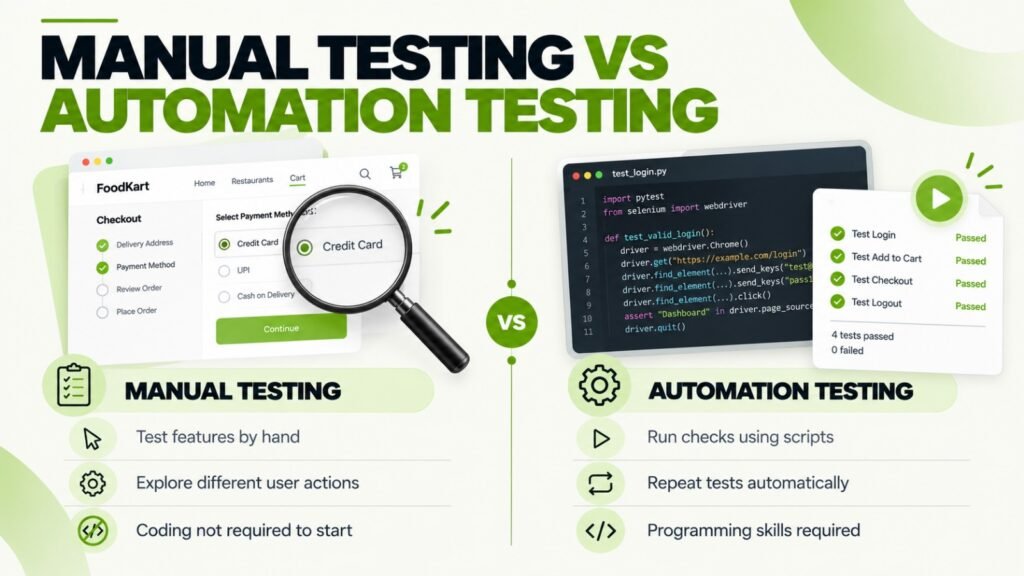
Manual testing: a starting point without coding
In manual testing, you check an application yourself, without writing automation scripts.
You might open a registration page, enter different combinations of details, submit the form and see what happens. Does it accept an invalid email address? Does it show an error when a required field is left empty? Does the password reset option work?
You perform these checks by hand and record the results. What you need is an understanding of testing concepts, the ability to write clear test cases and an eye for problems. Programming is not essential to begin learning these fundamentals.
Automation testing: where coding becomes important
Automation testing uses scripts and tools to run checks for you.
Imagine a shopping website where the login process has to be tested after every update. Instead of repeating the same steps manually, a tester can write a script that does those checks.
Tools such as Selenium help automate browser testing. You will need programming knowledge in Java or Python to write and maintain these scripts.
A sensible approach is to understand testing first, then gradually learn automation.
Manual testing vs automation testing: which should you learn first?
Both matter, but they serve different purposes.
| Manual testing | Automation testing |
|---|---|
| Tests are carried out by a person. | Tests are carried out using scripts and tools. |
| Useful for exploratory and usability testing. | Useful for repeating the same tests regularly. |
| Programming is not required to get started. | Programming knowledge is generally needed. |
| Helps you build testing fundamentals. | Builds on testing fundamentals and coding skills. |
Take the login page on an online shopping site. Testing it manually means checking it yourself: an invalid password, empty fields, the password recovery process.
Automating it means writing a script that runs those same checks every time the website is updated.
So which one should you learn first? If you are new to software testing, start with manual testing. Learn how bugs are found, how test cases are written and how defects are reported. Once that is clear, move on to automation.
This does not mean you have to pick one and ignore the other. It is about the order in which you learn them.
What skills and tools do you need to become a software tester?
You do not need to learn ten tools in your first week. Start with the basics and understand why each skill matters.
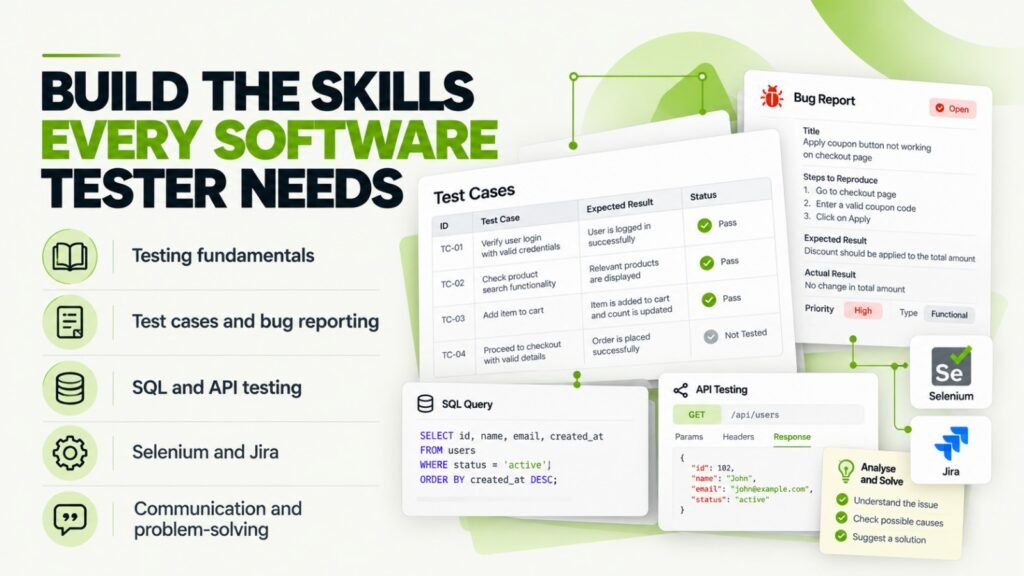
Essential software testing skills
1. SDLC and STLC: learn how software is built and where testing fits in. SDLC stands for Software Development Life Cycle and STLC for Software Testing Life Cycle.
2. Test case preparation: learn how to write step-by-step test cases for a feature. A good test case clearly shows what is being tested and what result is expected.
3. Bug logging: this is not only about finding bugs. It is about writing reports a developer can understand: what the problem is, how to recreate it and what the expected result was.
4. SQL basics: applications store data in databases. You need SQL to check that the right data is being stored and retrieved.
5. A questioning mindset: you need to stay curious and keep asking “what if the user does something unexpected?”
6. Communication skills: testers discuss problems with developers and other team members every single day.
Software testing tools beginners should know
As you progress, you will come across tools used for different testing tasks:
- Jira: used to track bugs, tasks and project progress.
- Selenium: used for automating web application testing.
- Postman: helps you test APIs and check how different systems communicate.
- MySQL: helps you work with databases and check stored information.
- TestNG: a testing framework commonly used with Java-based automation.
You do not need to master all of them straight away. Learn the testing concepts first, then practise with the tools as you go.
Software tester salary in India: what can freshers expect?
Let us talk about the money side. What can you earn after learning software testing?
It depends on your skills, your experience, your location, the company you work for and the type of testing role you take.
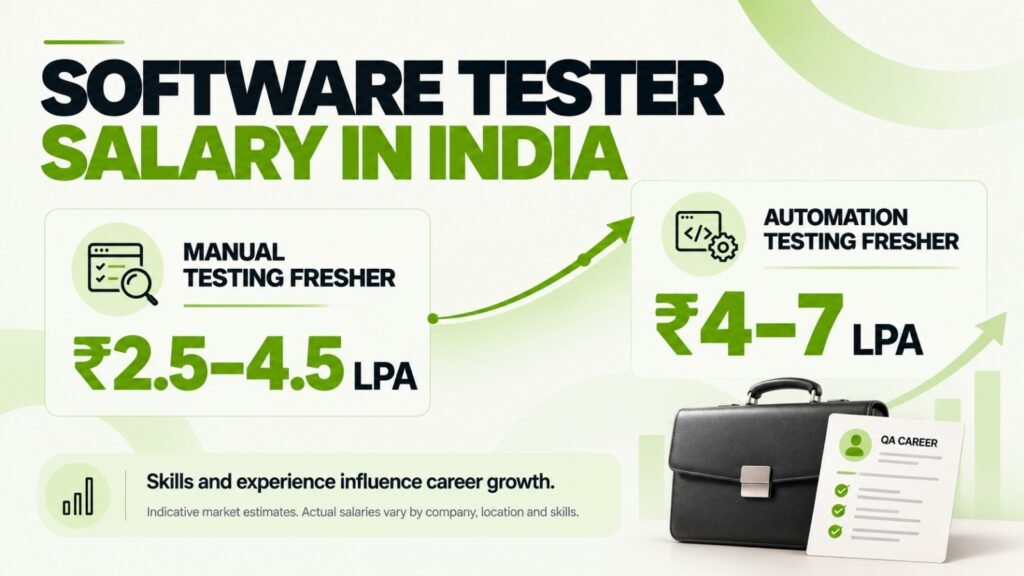
For example, according to 2026 salary estimates in Instahyre’s QA and SDET salary report, a fresher manual testing role may earn around ₹2.5 to 4.5 LPA, and an entry-level automation role around ₹4 to 7 LPA. These are market estimates, not guaranteed starting packages.
Your salary can change as you gain experience and build skills. You could move from a QA role to automation testing engineer, senior QA engineer or QA lead. With strong programming and automation skills, you may also explore Software Development Engineer in Test (SDET) roles.
The important thing is not to choose this career because of a salary figure. Focus on building skills you can actually demonstrate in an interview.
How to become a software tester: a step-by-step roadmap
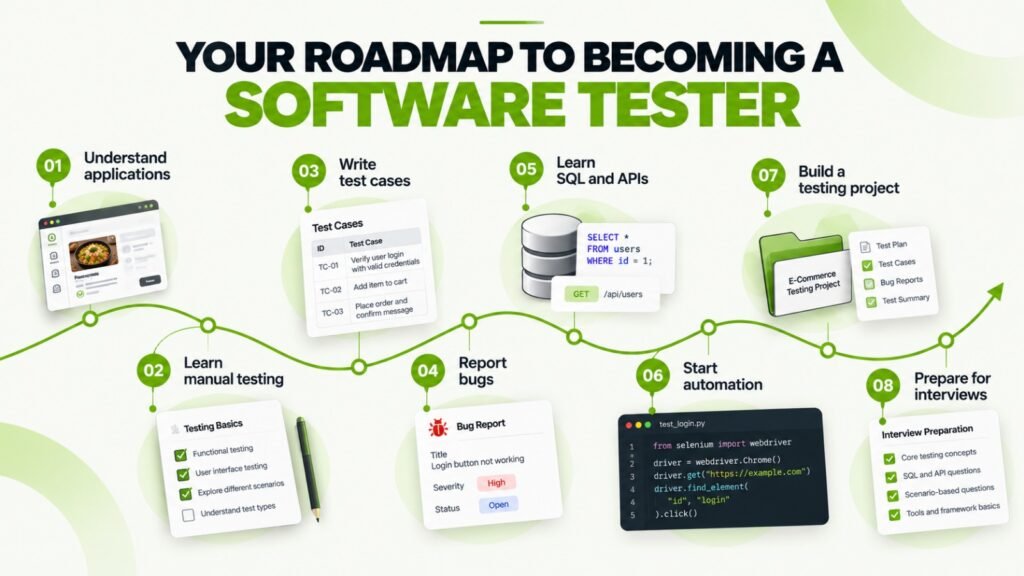
If you are starting from zero, the number of tools and technical terms can feel confusing. Here is a practical order in which to learn them.
Step 1: Understand how applications work
Look at the websites and mobile apps you use every day and notice how they behave. Think about what might fail when someone uses them. Focus on actions like logging in, searching or making a purchase, and ask yourself what could go wrong at each step.
Step 2: Learn manual testing fundamentals
Get familiar with the software development life cycle (SDLC) and the software testing life cycle (STLC). Learn how test scenarios are created and how test cases are written. Study types of testing such as functional, regression and smoke testing, and follow the journey of a bug from discovery to closure.
Step 3: Practise writing test cases
Pick a website you know well, such as a shopping site, and write test cases for login, registration, search and checkout. Test with normal inputs such as a valid password, and with unexpected ones such as special characters or blank fields. Cover both the expected path and the unexpected ones.
Step 4: Learn bug reporting and tracking
Practise writing detailed bug reports: the issue, the steps to reproduce it, the actual result and the expected result. Learn how tools like Jira help teams track bugs, assign them to developers and follow progress until they are fixed.
Step 5: Build your technical knowledge
Start with basic SQL queries and learn how to select, filter and join data. Then explore API testing and understand how requests and responses work using a tool like Postman. Pick a programming language, Java or Python, and learn the basics such as variables, loops and functions. This will help when you start writing automation scripts.
Step 6: Move towards automation testing
Get familiar with Selenium, a tool used to automate web browsers, and learn how to write scripts that automate your test cases. Use a framework such as TestNG to structure your tests. Start by automating a few test cases rather than trying to build a full automation framework straight away.
Step 7: Work on a project
Choose a real website or app and test it from start to finish. Write the test cases, find the bugs, report them and write automation scripts. Keep everything organised, including your test cases, bug reports and code. This project becomes something you can show a future employer.
Step 8: Prepare for fresher interviews
Revise the testing concepts you have learned and be ready to explain your project: what you tested, how you tested it and what you found. Practise answering questions on testing, SQL, APIs and automation basics. Be ready to talk about your experience with confidence, even if it is small.
Interview preparation is a part of the job search in its own right. You can read about FirstBit Solutions’ placement assistance to understand the support available and the conditions that apply.
Can you become a software tester without an IT degree?
There is no single qualification that decides whether you can learn software testing. Hiring criteria, however, differ from one organisation to another.
Some companies look for a technical degree or a similar qualification. Others may consider candidates from a different educational background, provided they have the skills the role requires.
How to choose a software testing course in Pune
You might feel you understand the ideas after watching tutorials. Being able to apply them in a real situation is something else entirely. That is why the training programme you pick matters.
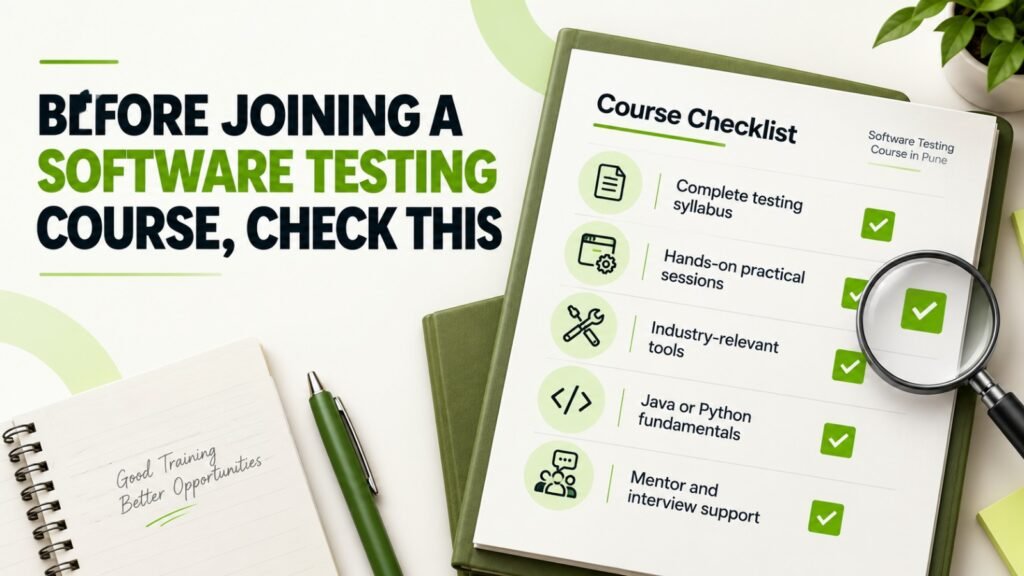
Before signing up for a software testing course in Pune, do not look only at the fee or at how many tools are listed in the advert. Look at what you will actually learn and practise.
Here are the things worth checking:
- Course syllabus: does it cover manual testing, automation testing, API testing and basic database knowledge?
- Practical sessions: will you get hands-on experience writing test cases, finding bugs and working on real projects?
- Tools: does the course cover tools used in the industry, such as Selenium, Jira and Postman?
- Programming: will you pick up the Java or Python basics needed for automation testing?
- Mentor support: can you reach a mentor when you get stuck, and will they help you understand the concept rather than just give you the answer?
- Interview preparation: does the training help with your resume and offer mock interviews?
- Placement support: ask what help is provided and what the eligibility conditions are. Make sure you understand whether a job is guaranteed. Training and placement support are not the same thing as a guaranteed job.
At FirstBit Solutions, the Software Testing Online programme is listed as a beginner-level course. Its published syllabus includes manual testing, Core Java, Selenium, TestNG, API testing, Cucumber, Jira, Playwright, MySQL and project work.
If you are comparing other learning paths as well, you can explore the courses offered by FirstBit Solutions.
The best way to decide is to go through the syllabus, ask about the practical training and discuss your current knowledge with the team before you enrol.
Ready to explore a career in software testing?
If you are considering software testing as your way into IT, start with the fundamentals. Learn how to write test cases, practise finding bugs and build your knowledge of automation tools gradually.
You do not have to work it all out on your own. If you are exploring software testing or another IT career path, contact FirstBit Solutions to discuss your interests, ask about the training options available and understand which learning path may suit your goals.
Frequently asked questions
Is software testing easy for beginners?
The basics are manageable if you learn them step by step. Understanding test cases and identifying bugs takes practice, while automation testing requires additional programming knowledge.
Can I learn software testing in three months?
You can learn the fundamentals in three months if you practise consistently. Becoming comfortable with manual testing, automation, SQL and project work may take longer, depending on your starting point and your learning schedule.
Which programming language is best for automation testing?
Java and Python are both useful choices. Java is commonly used with Selenium and TestNG, while Python is also used in automation projects. Check the tools and requirements of the roles you are targeting before choosing one.
Is manual testing still a good career option?
Yes. Manual testing remains useful for exploratory, usability and other checks that need human judgement. Learning automation and API testing can help you prepare for a wider range of QA roles.
What qualifications are required to become a software tester?
Requirements differ between employers. Many companies prefer graduates, particularly for entry-level IT roles, but the accepted qualifications depend on the job description. Testing knowledge and practical skills matter as well.
What is the difference between a QA tester and a software tester?
The terms are often used interchangeably. Software testing usually refers to checking an application for defects, while quality assurance can cover a broader process of improving and maintaining software quality.