
You’ve applied to about 30 different positions and have updated your resume twice. Why haven’t you got any phone calls yet?
When you ask yourself “Why am I not getting interview calls as a fresher?”, the truth is that the reason varies from application to application. In some cases, your resume is not suitable for the position. In other cases, your projects may show off your skills but in some other cases the position requires something you don’t have. There’s always a different reason and that is a good thing since all these reasons are solvable. This guide will help you understand why there’s no response from recruiters and give nine possible answers.
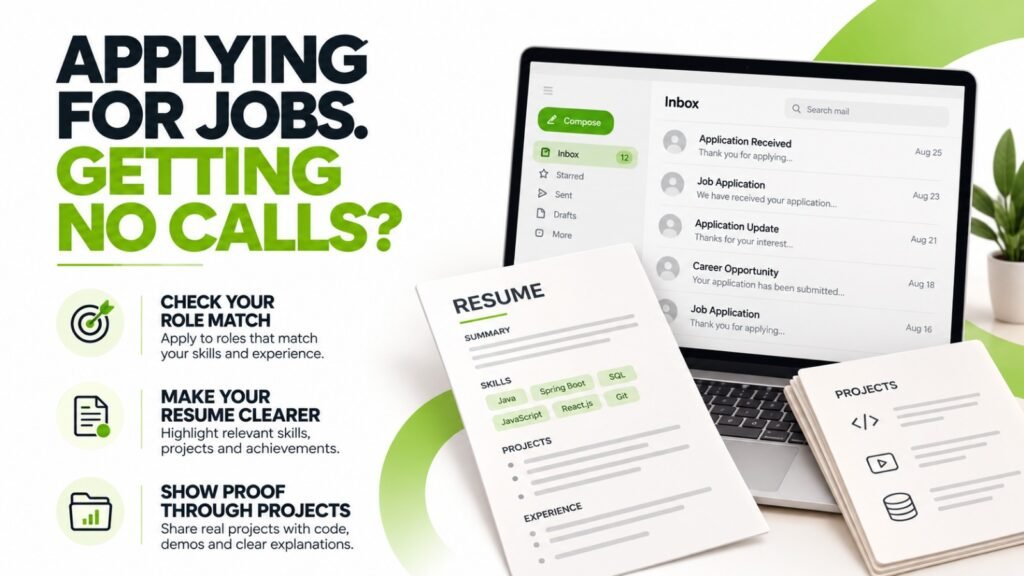
Why am I not getting interview calls as a fresher?
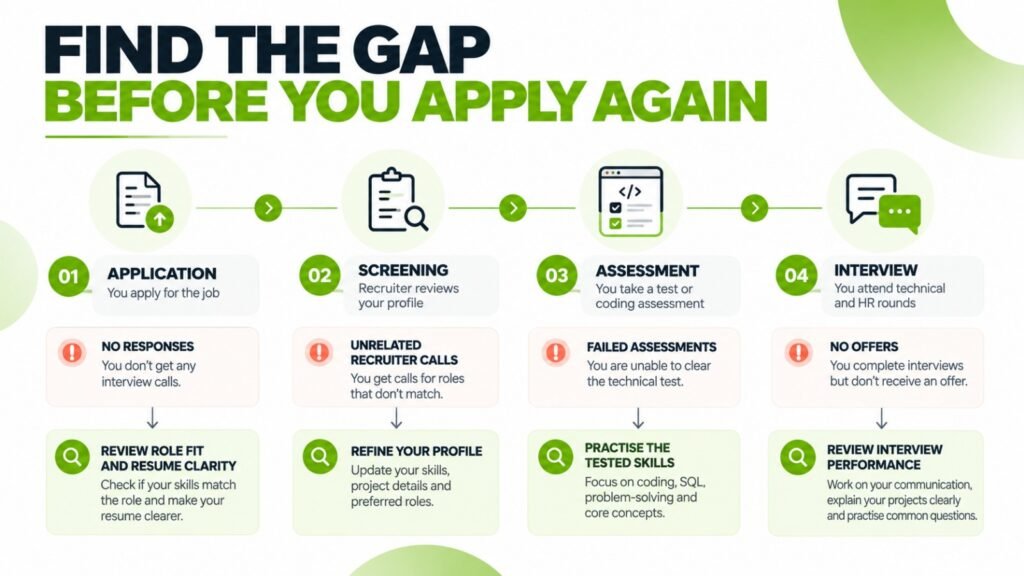
The hiring process usually involves four stages. The company publishes its opening. Candidates apply or recruiters search for them. Then candidates are screened based on what the job requires and those applications that pass screening may be called for an assessment or interview.
Lack of response in stage 2 does not necessarily mean that you lack technical skills. It could mean that you did not notice one of the eligibility criteria or your application was not suitable.
9 reasons you’re not getting interview calls as a fresher
Not all nine will apply to you. Read through them, spot the two or three that sound familiar, and start there.
1. You’re applying for jobs that don’t match your skills
It may feel productive to apply to all postings where “IT” is in the title; however, doing so will spread your efforts too thinly. Imagine an individual trying to learn Java, applying to Java Developer, Data Analyst, Software Tester, and Cloud Engineer postings within one week. Since each of these positions demands a different skill set, the resume will fit none of them well enough.
Choose one primary position. Look at a few job postings for it and see which skills recur in each. Then start looking for entry level titles such as Graduate Engineer Trainee, Associate Software Engineer, Junior Developer. Requirements and titles vary from company to company, so make sure to read each posting carefully before applying to it. For the Java learner in question, it would be more appropriate to apply to entry level Java development postings.
2. Your resume doesn’t match the job description
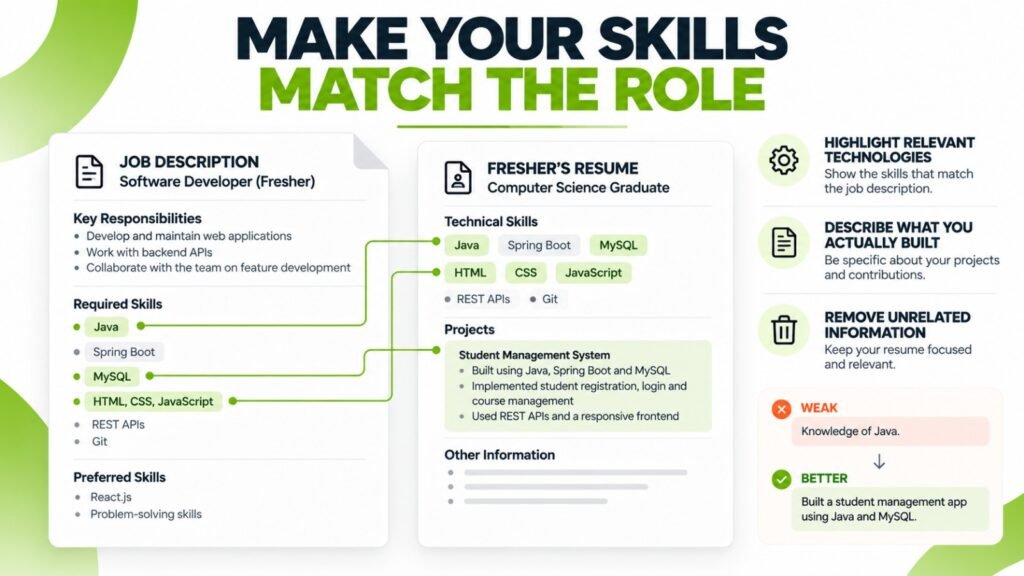
Whoever opens your resume should spot your relevant skills almost immediately. A skills list with Java, Python, SQL, React, AWS and ten other tools doesn’t say much if you’ve only practised the basics of each one.
Keep one master resume with everything in it. Then make a trimmed copy for each role, adjusting the skills, summary, and project descriptions. If the job description uses a term that honestly describes your work, use it. Cut anything that pulls attention away from the role you’re targeting. Here’s what a rewrite looks like:
- Weak: Knowledge of Java and database technologies.
- Better: Built a student management application using Java and MySQL, with features to add, update, and retrieve student records.
Only write about work you’ve actually done. A line you can’t back up in an interview does more harm than good.
3. Your resume is hard to read or missing details
On the other hand, sometimes the content is fine while it is the formatting that creates the issue. Opt for neat headings, simple formatting and readable fonts; use light graphics and no columns. Ensure you have given your accurate phone number and email address because even slight errors here will cost you silent rejections without any calls. Stick to the same dates, education and details of the project; follow file format as requested.
Sometimes, there is the use of applicant tracking systems (ATS) in the hiring process. This refers to the software used by many companies for managing application processes of future employees. Screening of candidates varies greatly depending upon the company. If you have an ATS resume, then life would be easy for you as a fresher; yet, there is no surety of selection.
4. Your projects don’t show what you can actually do
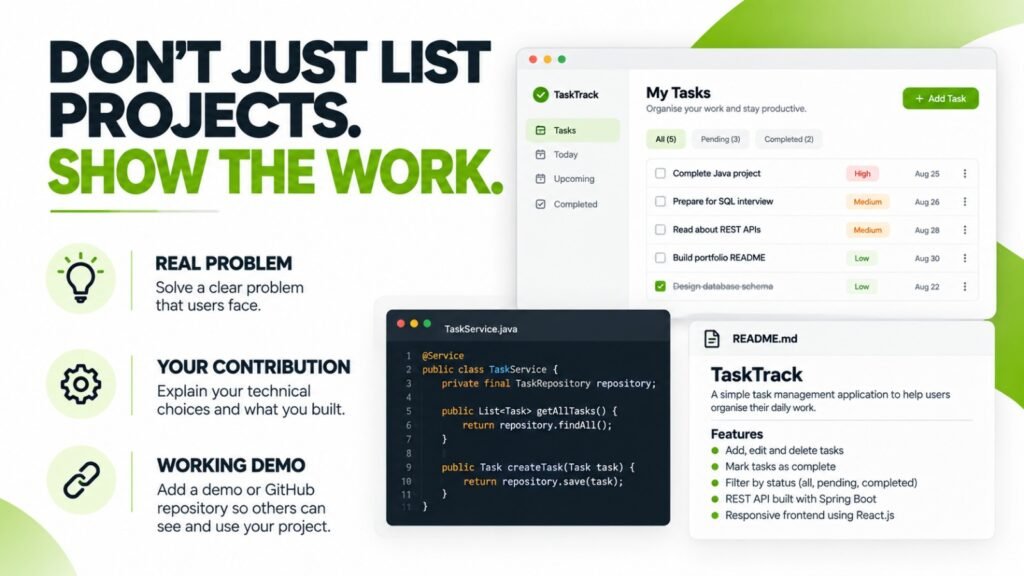
A project title on its own says very little. A tutorial project copied line by line says even less, because plenty of other candidates have built the exact same thing.
Aim for two or three finished, relevant projects instead of a pile of half-done ones. For each, explain the problem it solves, the tech stack, the key features, and what you personally built. Add a GitHub link or a working demo where you can. Then practise explaining why you made certain technical choices, since interviewers love asking about that. For a Java target, that could be an app with database integration. For analytics, it could be a Power BI dashboard that answers a real business question. If you’re unsure which projects to build or how to present them, this guide to building an IT portfolio for freshers in Pune walks you through the process.
5. You’re applying for jobs with eligibility requirements you don’t meet
Even a highly qualified candidate may not be eligible for a certain vacancy. There are many vacancies which require certain parameters like passing out year, educational stream, minimum academic performance, location, and experience level.
Before clicking on the apply button, make sure you have seen the passing out year, read the educational requirements properly, and whether the job posting is for freshers or not. Location and work pattern are other aspects that need attention. Don’t waste much time in applying for the vacancies that demand experience of many years.
6. You’re applying only through job portals
Job portals can help but are not the only option. Look for the careers page of organizations that interest you. Talk to senior students and alumni regarding job offers. Keep a lookout for valid campus and off-campus drives. Send messages to recruiters only when you have a genuine reason to do so. Ask for a referral only when you have a genuine connection or a job in mind. Referral is no sure-shot formula for getting an interview.
It is always important to validate a job vacancy from the official source of the organization. And always keep yourself away from those people who claim jobs in return for money.
7. Your job portal and LinkedIn profiles are incomplete
Recruiters scan the profiles as well. An empty and outdated profile will not attract as much attention as one that is complete. Choose an appropriate title for the profile and mention the skill set you possess, your project experience and your graduation details. Mention a link to your GitHub or portfolio and keep your location details current. Wondering how to write a LinkedIn profile for freshers? A heading like this is always a good choice:
Java Developer Fresher | Core Java, SQL, Spring Boot | GitHub Project Link
Only mention those skills which you can easily explain. If a recruiter asks about Spring Boot, you will have to explain it.
8. You’re still building skills but haven’t practised applying them
Learning from videos and completing courses is one thing while applying the skill independently is something else. If someone is taking Java, then they need to be able to code, manipulate collections, link an application with a database when required, and explain how their project operates.
Match your skills against a few job descriptions to find out what skills you lack most and practice those coding or role-related skills. Don’t start a new course until completing your current project and try to give a presentation of your project orally without notes. It is not necessary for a fresher to have all the skills mentioned in each and every job description. If you’re targeting Java development but aren’t sure which skills to prioritise, this Java Full Stack developer career path can help you understand the skills involved and how they fit together.
9. You’re not tracking applications or following up
When you apply to lots of jobs without keeping a record, patterns stay invisible and you forget where you applied. A simple spreadsheet fixes that. Note the company, role, application date, source, and current status, plus whether the role actually matched your skills and eligibility. Follow up politely when it makes sense, and follow any instructions in the posting. Then review it once a week and adjust.
Here’s an illustrative example, not real candidate data:
| Company | Role | Applied on | Status |
|---|---|---|---|
| Company A | Java Developer Trainee | 12 Oct | No response |
| Company B | Junior Java Developer | 15 Oct | Assessment received |
Look for patterns instead of assuming every unanswered application means the same thing. Maybe the roles you applied to through portals went quiet, while the ones from career pages got replies. That tells you something useful.
How to identify what’s going wrong in your job search
You may recognise yourself in several of the reasons above and still not know which one to tackle first. This table gives you a starting point.
| What you’re experiencing | What to check first |
|---|---|
| No responses to applications | Eligibility, role fit, resume clarity, and application quality |
| Repeated rejection before interviews | Whether mandatory requirements match your profile |
| Recruiters contact you for unrelated roles | Your profile headline, skills, and job preferences |
| You receive assessments but struggle to complete them | The specific technical or aptitude skills being tested |
| You get interviews but no offers | Interview performance, technical explanations, and communication |
These are starting points, not final diagnoses. Nobody outside the hiring team knows the exact reason behind a rejection, so use the table to decide where to look first.
If the table keeps pointing you toward a skills gap, guided practice can speed things up. You can explore FirstBit’s IT courses in Pune to see which programme fits the role you’re aiming for.
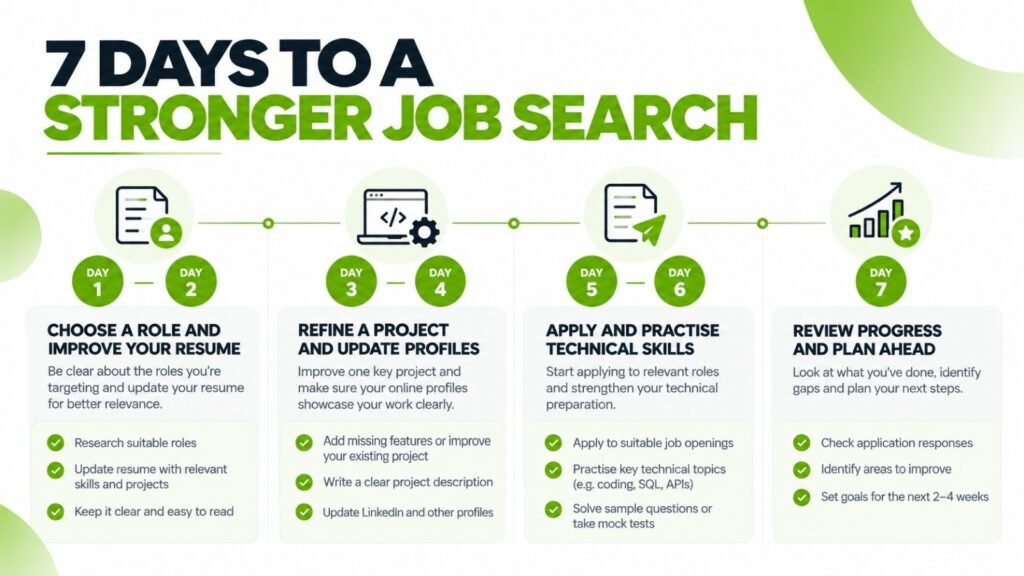
What should you do over the next 7 days?
The goal of this week isn’t to land an interview. It’s to make your next round of applications sharper.
| Day | Action |
|---|---|
| Day 1 | Choose one target role and review five relevant job descriptions. |
| Day 2 | Update your resume to reflect your relevant skills and projects. |
| Day 3 | Review one project and improve its documentation. |
| Day 4 | Update your LinkedIn and job portal profiles. |
| Day 5 | Find and apply for suitable, verified openings. |
| Day 6 | Practise relevant technical questions or role-specific tasks. |
| Day 7 | Review your applications, identify gaps, and plan the following week. |
One week may not be enough to bring in interview calls, but it can make everything you send out afterwards more focused.
Final thoughts: fix your approach before you give up
Not getting interview calls as a fresher is frustrating, but it isn’t proof that you can’t build a career in IT. Start with three checks. Are you applying for roles that suit you? Does your resume clearly show relevant skills and projects? Are you tracking applications so you can see what needs to change? That’s the real answer to how to get interview calls as a fresher: fix the approach, then repeat. If you’ve identified a technical skills gap and want structured guidance, explore FirstBit’s IT training programmes to find a course that fits your career goals. Choose based on the skills you need to build, the projects you want to work on, and the role you’re targeting.
Frequently asked questions
Applying to a lot of jobs doesn’t help much if the applications don’t fit. Common causes include a profile that doesn’t match the role, unmet eligibility criteria, a resume that hides your skills, or heavy competition. Go back through your recent applications before assuming anything.
Lean on what you do have: academic work, completed projects, internships if you’ve done any, and technical skills you can demonstrate. Target suitable entry-level roles and describe your own contribution clearly.
Possible reasons include missing required skills, vague project descriptions, wrong contact details, or an eligibility mismatch. Employers screen differently, so no single change guarantees a shortlist.
Quality and relevance matter more than a fixed number. Two or three well-documented projects are a good starting point, depending on the role and your background.
First check whether you actually have a skills gap. If your resume simply doesn’t show the skills you already have, another course won’t solve the immediate problem.