
If you are a fresher in Pune trying to choose between Java Full Stack and Python Data Science, the confusing part is not finding information. There is too much of it. Search for Java full stack vs Python course Pune, and you will quickly find ten different opinions, five different career paths, and very little clarity about what you would actually learn.
So let’s make the decision simpler.
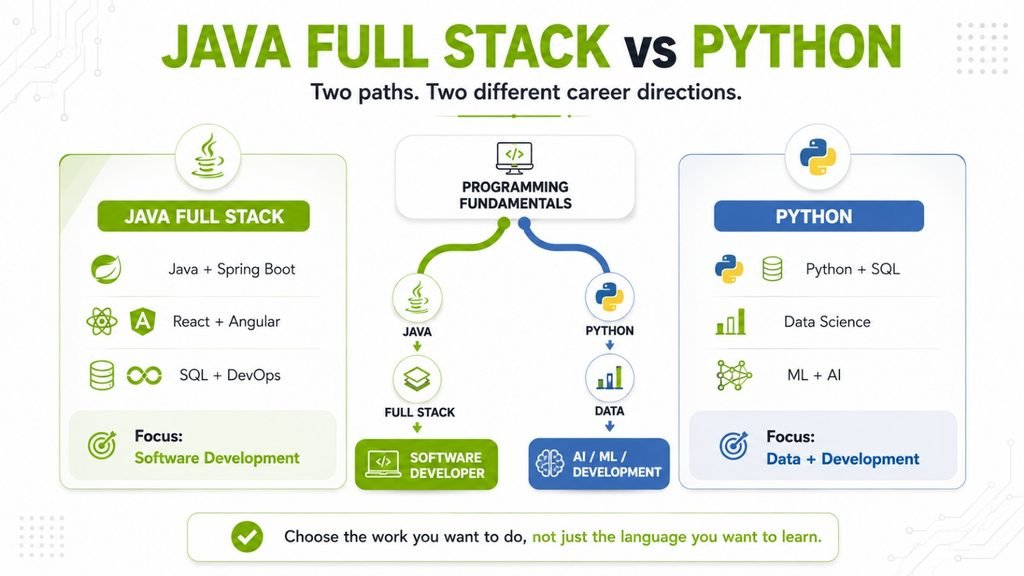
FirstBit Solutions has two very different learning paths here. The Java Full Stack programme is built around software development, starting with programming logic and moving through Java, databases, backend frameworks, frontend technologies and DevOps. The Python programme starts with Python, then opens into data analysis, Data Science, Machine Learning, AI and Python-based web development.
Quick answer: Both programmes are planned as 5-month tracks. Java Full Stack is one focused path, with 18 modules covering C through DevOps, built around becoming a full stack developer. The Python programme starts with Python and web basics, then branches into Data Science, Machine Learning and AI, making it a better fit if you are still deciding between development and data.
The real question, then, is not which language is “better”. It is what kind of work do you want to be good at after those five months?
Java Full Stack Course Syllabus Pune: Module-by-Module Breakdown
If you are comparing courses, do not start with job titles. Start with the syllabus.
A course can call itself “job-ready” and still leave you with a collection of disconnected technologies. The useful question is whether each topic leads naturally to the next one and eventually helps you build something.
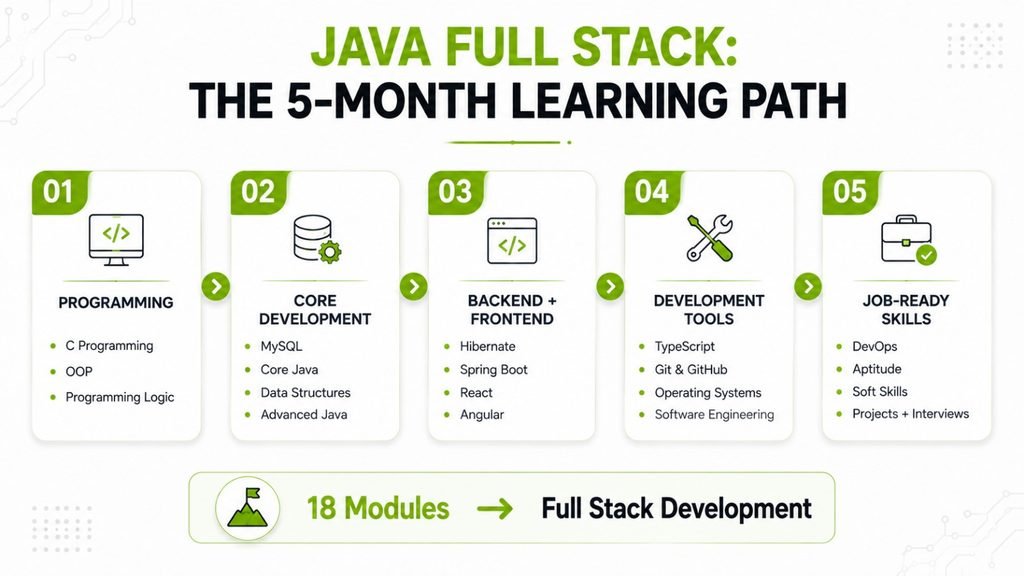
For the Java programme, the progression is quite clear. You start with programming fundamentals, move into databases and web programming, then spend serious time on Java, data structures, backend frameworks, frontend development and deployment. The official Java syllabus lists 18 modules across this path.
That structure matters because a fresher does not just need to know Java syntax. You need to understand how Java connects to a database, how a backend communicates with a frontend, how code is managed in Git, and what happens when an application eventually needs to be deployed.
Java Full Stack syllabus, module by module
1. C Programming
The course begins with programming basics, functions, pointers, arrays, strings, dynamic memory allocation, structures, and macros. A mini project is also part of this stage, giving you somewhere to apply the basics instead of stopping at syntax.
2. OOP
You move into object-oriented programming through classes, objects, abstraction, encapsulation, inheritance, polymorphism, file handling, and templates. This gives you the programming mindset that later makes Core Java much easier to understand.
3. MySQL
Database learning covers normalization, SQL commands, DDL, DML, SELECT statements, GROUP BY, HAVING, joins, subqueries, views, indexes, and PL/SQL concepts such as stored procedures, functions, cursors, and triggers. Transactions and a case study are also included.
If backend development is your target, do not treat this module as a side topic. SQL shows up repeatedly when you start working with real applications and later when you face technical interviews. FirstBit’s own SQL interview guide focuses on JOINs, GROUP BY and HAVING, subqueries, and basic indexing as common areas for full stack interviews.
4. Web Programming
HTML5, CSS3, JavaScript, jQuery, and Bootstrap form the web foundation. You do not need to become a frontend designer, but you do need to understand what happens on the other side of the backend code you are writing.
5. Core Java
This is where Java becomes the centre of the programme. The syllabus covers OOP concepts, interfaces, static and final variables, exception handling, file handling and the Collection Framework.
If you want to keep the official language documentation handy while learning, Oracle’s Java documentation is a useful reference once the basics start getting serious.
6. Data Structures
Stacks, queues, linked lists, trees, graphs, searching and sorting are covered alongside algorithm complexity. This part is especially relevant if your eventual interviews include coding and problem-solving rounds.
7. Advanced Java
The programme moves into application architecture, Servlets, layered application design, full stack application development, multithreading, socket programming, strings and garbage collection. Case studies are included too.
8. Hibernate and Spring Boot
This is where the backend stack starts looking much closer to what you would encounter in a modern Java development environment. Hibernate covers ORM, HQL, associations and collection mapping, while Spring covers Core, dependency injection, JDBC and DAO concepts.
9. TypeScript
You learn TypeScript fundamentals, modules, OOP concepts, classes and objects, type checking, generics, arrow functions, callbacks, maps and sets, debugging, and using libraries through NPM.
10. Credit System
This part focuses on mock interviews, technical quizzes, machine tests and project presentations. That matters because knowing something privately and explaining it under interview pressure are two different skills.
11. ReactJS
React fundamentals, components, props and state, event handling, routing, hooks, CRUD applications, and deployment are included.
12. Angular 17
Angular covers components, bindings, forms, services, dependency injection, pipes, directives, routing, RxJS, inter-component communication, testing and deployment.
13. Git & GitHub
You learn the Git lifecycle, cloning, committing, pushing, updating, branching and stashing, followed by GitHub repositories, branches, commits and pull requests.
14. Soft Skills
Communication, confidence building, public speaking, English grammar, business English, group discussions, resume building, interview preparation, email writing and presentation skills are part of the programme.
15. Aptitude
The syllabus includes percentages, ratios, profit and loss, time and work, probability, permutations and combinations, analytical reasoning, blood relations, coding-decoding, and other common aptitude areas.
16. Operating Systems
You cover operating system types, components, file systems, process and memory management, user management, security, device drivers, VirtualBox, and operating systems in cloud environments.
17. Software Engineering
This module covers SDLC, different SDLC models, Agile and Scrum, requirement analysis, project management, design, UML, coding, testing and DevOps.
18. DevOps
The final module brings in CI/CD, Maven, Git/GitHub automation, Jenkins, Docker and Kubernetes. That gives the programme a deployment and development-workflow layer rather than stopping at writing application code.
Put all of that together, and the Java Full Stack course has a very obvious destination: software development.
See the Java Full Stack Course in Pune
Java Full Stack vs Python Course Pune: What Does the Python Programme Actually Cover?
Python starts differently.
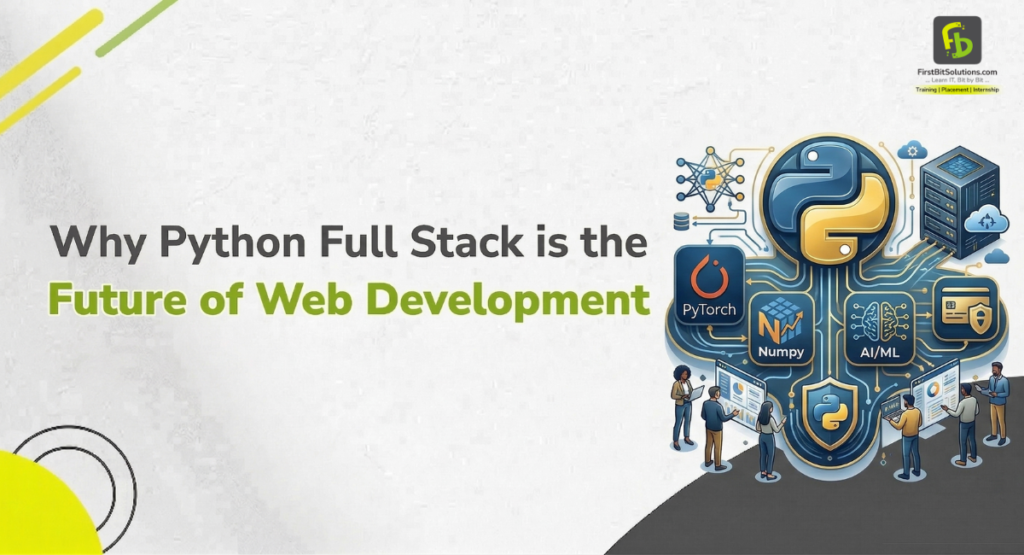
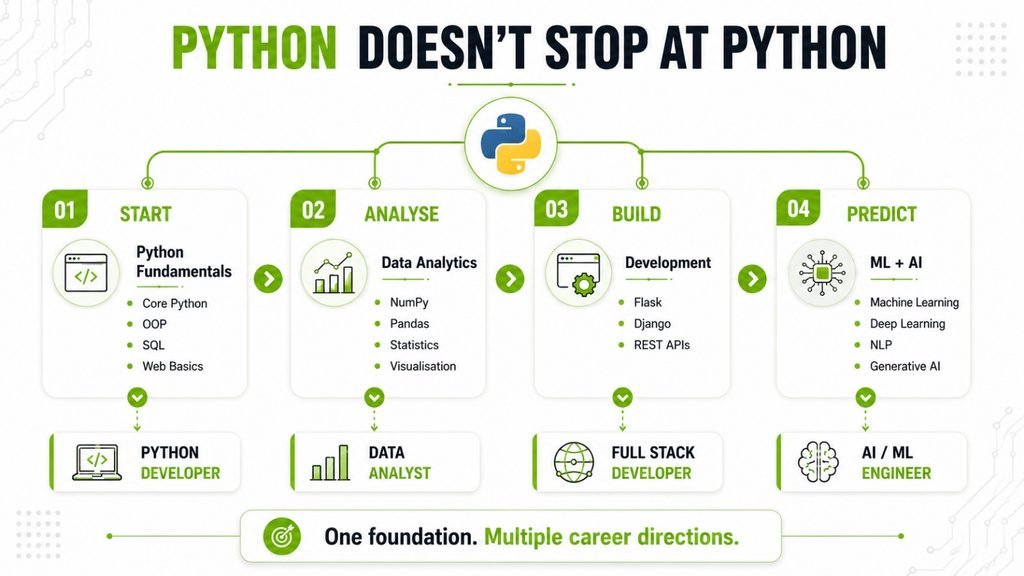
You are still learning programming first, but the destination is wider. The current FirstBit curriculum moves from Core Python and databases into web programming, data analysis, statistics, Machine Learning and AI, while also covering Django and Flask for Python-based development.
That is why calling it simply a “Python course” undersells what you are actually learning.
If you are comparing a Python Data Science course in Pune with a Java Full Stack programme, the biggest difference is what happens after the programming fundamentals.
The attached course material also positions Python as the foundation for Data Analytics, Data Science and AI, with sections covering Core Python, statistics and data analysis. The broader programme then builds on that foundation.
Core Python comes first
The Python foundation covers programming basics, functions and lambda functions, data structures, OOP, comprehensions, generators, decorators, modules, packages, exception handling, file handling, multithreading, regular expressions, Tkinter and database connectivity.
This part deserves more attention than beginners usually give it.
If you skip programming fundamentals because Python looks easier than Java, you eventually run into the same problem. Data Science still requires logic. Machine Learning still requires code. AI projects still require you to understand what your code is doing.
MySQL and web programming
The programme then covers MySQL, including normalization, SQL, joins, subqueries, views, indexes, stored procedures, functions, cursors, triggers and transactions.
Web programming introduces HTML5, CSS3, JavaScript, jQuery and Bootstrap. That gives you enough web context to understand how Python backend applications interact with a user-facing application.
R, data analysis and statistics
This is where the direction starts separating from Java.
The Python programme introduces R, statistics and data analysis. The attached material covers statistical concepts such as population and sample, central tendency, percentiles, dispersion, distributions, hypothesis testing, p-values, correlation and regression.
Data Analysis then moves into tools such as NumPy, Pandas, Matplotlib and Seaborn. You work with arrays, DataFrames, missing data, outliers, merging, aggregation and visualisation.
That changes the type of problem you are learning to solve.
Java asks you to think, “How do I build this application?”
The Python data track increasingly asks, “What does this data tell us, and what can we build or predict from it?”
Flask and Django
The Python route does not completely leave development behind.
Flask covers Python web applications, routing, templates, database connectivity, Ajax, microservices, and a Flask plus MySQL project. Django then goes deeper into application architecture, models, forms, security, state management, and REST API integration.
So yes, Python training can lead towards a full stack developer role. The important detail is that this programme gives you Python-based full stack exposure alongside Data Science and AI, rather than making full stack development the only destination.
Data Science, Machine Learning and AI
The data side keeps expanding.
Data Science covers statistics, visualisation, NoSQL, Big Data and Spark concepts and Power BI dashboards. Machine Learning introduces supervised, semi-supervised and unsupervised learning, regression, classification, SVM, logistic regression and clustering.
The AI and Deep Learning portion then covers ANN, RNN, CNN, OpenCV, TensorFlow, NLP, prompt engineering, Generative AI and a data capstone project.
That is a very different learning journey from the Java programme.
Git, DevOps, OS and Career Preparation
The Python programme also includes Git and version-control fundamentals, operating system concepts, software engineering practices, aptitude preparation and DevOps exposure. These topics sit alongside the technical modules rather than replacing the main Python, Data Science and AI learning path
For official Python references while learning, Python.org’s documentation and learning resources are worth bookmarking.
Same Duration, Different Depth: What 5 Months Actually Buys You in Each Track
This is probably the most useful comparison in the whole decision.
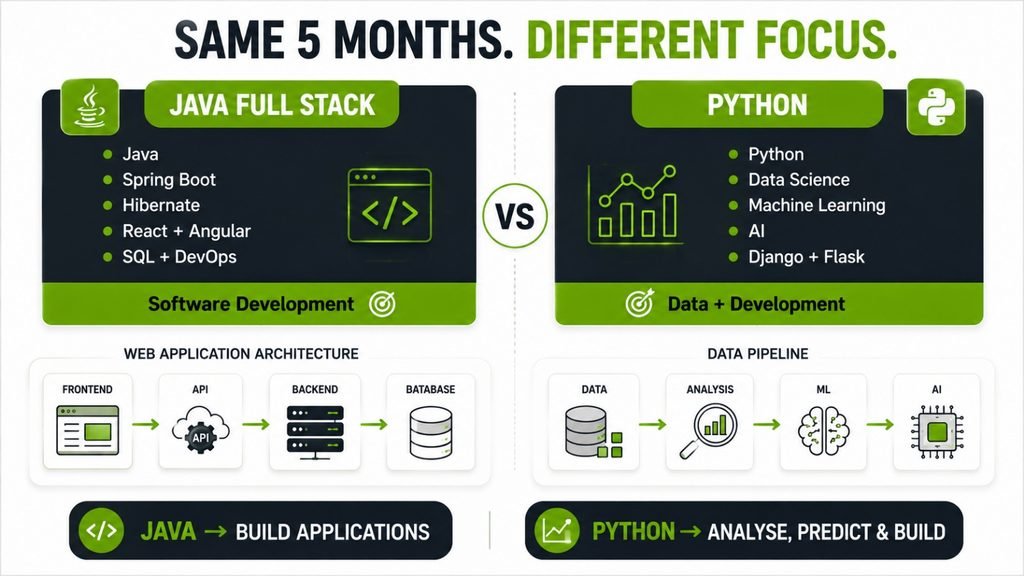
If both programmes take roughly the same five-month learning period, you are not choosing between “short course” and “long course”. You are choosing where those months go.
Java spends that time building depth across software development. You start with programming logic, move through databases and Java, then get into backend frameworks, frontend frameworks, version control and DevOps. The official Java course page describes the programme as a 5-month industry-aligned learning path with 18+ modules.
Python spreads the learning journey across more career directions. You get Core Python, SQL, web development, data analysis, statistics, Data Science, Machine Learning, AI, Django, Flask, DevOps and career preparation.
Think about it like this:
| If you want to spend your learning time on… | Better fit |
| Java backend development and enterprise-style application development | Java Full Stack |
| Frontend plus backend development as one focused career path | Java Full Stack |
| Spring Boot, Hibernate, Angular, React and DevOps | Java Full Stack |
| Python programming with Data Science and AI | Python |
| Data analysis, statistics and visualisation | Python |
| Machine Learning, Deep Learning and Generative AI | Python |
| Python backend development through Django and Flask | Python |
| Keeping multiple technology directions open | Python |
Neither side wins every row.
That is the point.
If you already know you want to become a developer, spending months learning statistics, Machine Learning, and AI may feel like a detour. If you are genuinely curious about data and AI, spending those same months almost entirely inside Java development could leave you wondering whether you chose too narrowly.
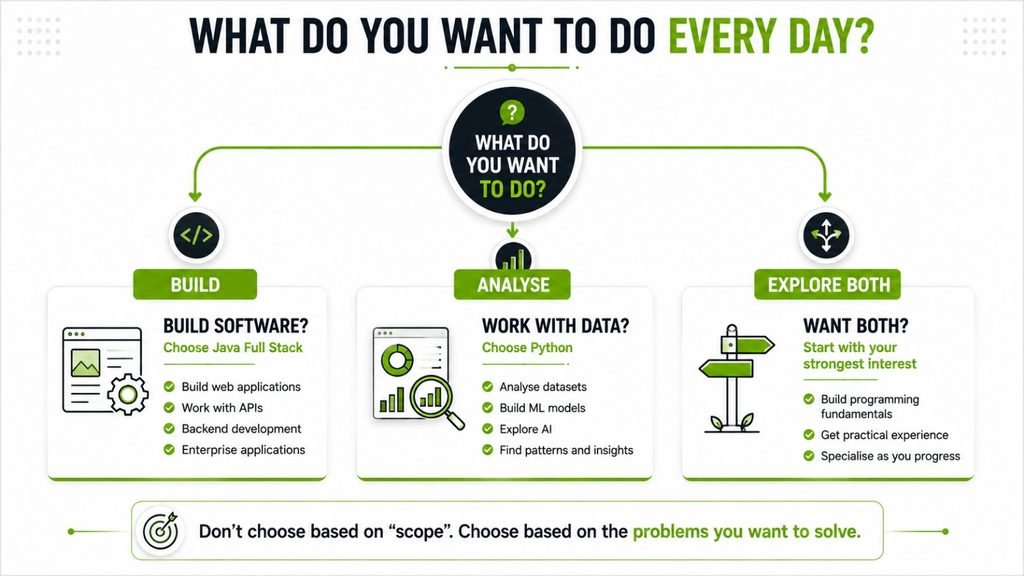
So before choosing the best IT course in Pune, choose the kind of problems you actually want to solve.
This is where the Java vs Python career path in Pune becomes less about the programming language and more about the kind of work you want to do
Still unsure? A short conversation with a FirstBit academic counsellor can help you compare the two tracks against your background, current skills, and career direction before you commit.
Who Should Choose Java Full Stack?
Choose Java Full Stack if the sentence “I want to build software” sounds more exciting to you than “I want to analyse data.”
You might enjoy Java if you can imagine yourself building a login system, an e-commerce backend, an employee management application, an API, or a complete web application. You will spend a lot of time understanding how different parts of that application connect, which is exactly where full stack development gets interesting.
The course is also a sensible choice if you want a structured full stack developer course in Pune rather than a programme that gives you several possible directions and asks you to specialise later. Its syllabus has a clear development sequence from C and OOP to MySQL, Core Java, Advanced Java, Hibernate, Spring Boot, TypeScript, Angular, React, Git and DevOps.
Java may also suit you if you do not mind spending more time on programming fundamentals and backend concepts. Data structures, OOP, exception handling, collections, application architecture, and database work are not always the flashy parts of a course, but they become useful when an interviewer asks you to explain how your application actually works.
You do not need to arrive as a Java expert either. FirstBit’s current Java course says the learning path starts from programming fundamentals and is suitable for beginners, fresh graduates, and career switchers.
The bigger question is whether you are willing to stay with one technical direction long enough to become comfortable with it.
Who Should Choose the Python Track?
Python makes more sense if you like the idea of keeping development, data, and AI open at the same time.
Maybe you are curious about Data Science but have never actually worked with a dataset. Maybe Machine Learning sounds interesting, but you also want to understand backend development. Or perhaps you know you like Python and want to see where that skill can take you before choosing one narrow job title.
That is where the Python programme has an advantage.
You start with programming, then get exposure to SQL, web development, statistics and data analysis before moving into Data Science, Machine Learning and AI. At the same time, Django and Flask give you a route towards Python backend and full stack development.
The trade-off is breadth.
You are touching many areas. That does not mean you will become an expert in all of them in five months. No honest course can promise that. The goal is to build a working foundation, gain practical exposure, and discover which direction deserves deeper study afterward.
Python is also a good fit if you genuinely enjoy working with data. If charts, patterns, business questions, prediction, and experimentation sound interesting rather than boring, you may find the Python path much more engaging than a purely development-focused course.
Shared Foundations: Practical Training, Projects, and Placement Assistance
The difference between the two programmes becomes smaller when you look at how students are expected to learn.
FirstBit currently highlights 80% practical training, live internship exposure, resume building, mock interviews, aptitude preparation, one-to-one doubt solving, and placement assistance across its course ecosystem.
That matters because watching someone build an application is not the same as building one yourself.
A fresher needs practice writing code, making mistakes, debugging those mistakes, and explaining the final project. The Java programme specifically includes coding exercises, assignments, quizzes, project work, mock interviews and machine tests, while the Python programme similarly emphasises practical projects and career preparation.
The career support side also deserves a realistic explanation. Placement assistance can help with resume building, interview preparation, mock interviews, aptitude, and connecting with opportunities, but placement assistance is not the same thing as a guaranteed job. Your technical skills, projects, interview performance, and the requirements of individual employers still matter.
For someone targeting backend development, SQL preparation should not be left until the final week. FirstBit’s SQL interview guide covers JOINs, GROUP BY and HAVING, subqueries and indexing, which are useful areas to practise once your database basics are in place.
Read the SQL interview questions for full-stack developers
Final Takeaway: Which One Should You Join in 2026?
If you are still stuck between the two, make the decision using one simple question: what do you want to build or solve?
If your answer is applications, APIs, backend systems, databases, frontend interfaces and software products, choose Java Full Stack. The syllabus gives you a focused route through programming, Java, Spring Boot, Hibernate, MySQL, Angular, React, Git and DevOps.
If your answer is data, patterns, analysis, prediction, Machine Learning, AI and Python-based development, choose the Python track. You will still get web and backend exposure through Django and Flask, but the programme gives you considerably more room to explore data and AI.
And if you are choosing purely because someone told you one language has “more scope”, pause there. Your first course should give you enough depth to become useful, enough practical work to build a portfolio, and enough exposure to understand what kind of technology work you actually enjoy.
That is the real answer to Java Full Stack vs Python Course Pune. Pick Java if you want a focused development career. Pick Python if you want development plus a serious route into Data Science and AI.
Explore the Java Full Stack course in Pune or explore the Python Data Science and AI course in Pune and speak with a FirstBit counsellor if you want help matching the track to your current background and career goal.
FAQs
Which is better, Java full stack or Python data science, for freshers in Pune?
Neither is automatically better for every fresher. Java Full Stack is the stronger fit if you already want software development, backend engineering or full stack work. Python makes more sense if you want to explore Data Science, AI, data analysis and Python development before deciding on one direction. Your choice should follow the kind of work you want to practise every week, not whichever technology currently sounds more popular.
What does the Java full stack syllabus cover?
The Java Full Stack syllabus covers 18 modules, starting with C programming, OOP, MySQL and web programming before moving into Core Java, Data Structures, Advanced Java, Hibernate and Spring Boot, TypeScript, Angular 17, ReactJS, Git and GitHub, soft skills, aptitude, operating systems, software engineering and DevOps.
Can Python training lead to a full stack developer role?
Yes, Python can lead towards full stack development when the training includes frontend, backend, databases and APIs. FirstBit’s Python programme includes HTML, CSS, JavaScript, Bootstrap, MySQL, Flask, Django and REST API-related learning alongside Python. The programme also gives you Data Science, Machine Learning and AI exposure, so full stack development becomes one possible direction rather than the only one.
Which course has better career flexibility?
Python has broader flexibility within the two programmes because the curriculum crosses Python development, backend development, Data Analytics, Data Science, Machine Learning and AI. Java Full Stack has a narrower direction, but that can actually be an advantage if you already know that software development is what you want. More options are not automatically better. A focused path can make it easier to build depth.
Who can join the Java Full Stack course?
The current FirstBit Java page says the programme is suitable for beginners, final-year students, fresh graduates, career switchers and working professionals. The course starts with programming fundamentals, so prior Java expertise is not presented as a requirement. Students should still be prepared to practise consistently because the later modules move into Java, databases, frameworks, frontend technologies and DevOps.
Do I need prior Python experience for the Python Data Science programme?
No. The programme starts with Core Python fundamentals before progressing into data analysis, Data Science, Machine Learning and AI. FirstBit describes the Python programme as beginner-level, with the foundation built before the advanced areas. If you have never coded before, expect the first stage to require patience. Python may have a beginner-friendly syntax, but programming logic still takes practice.
Can I switch from one track to the other later?
Yes, your career does not have to stay locked to the first language you learn. A Java learner can later add Python for automation, data work or AI. A Python learner can later move deeper into Java and enterprise backend development. The more useful strategy is to build strong programming fundamentals first, then add the second technology when you have a clear reason for doing so. Trying to learn both seriously from day one, however, can make the first few months unnecessarily confusing.