
Search both MEAN stack vs MERN stacks, and you will see something that is quite amusing. Not only do both terms have three common letters, but their course description brochures are quite similar. Job postings sometimes include both these terms in one sentence as if they are the same thing. If you had silently been thinking whether there was any difference between the two or whether they were just terms made up for some marketing purpose, then your question is quite reasonable.
Here is the truth, presented in simple steps, that will help you choose one of the two, whichever one suits you better, whether it’s a MEAN stack course in Pune or a MERN stack course in Pune.
Quick Answer: What’s the Actual Difference?
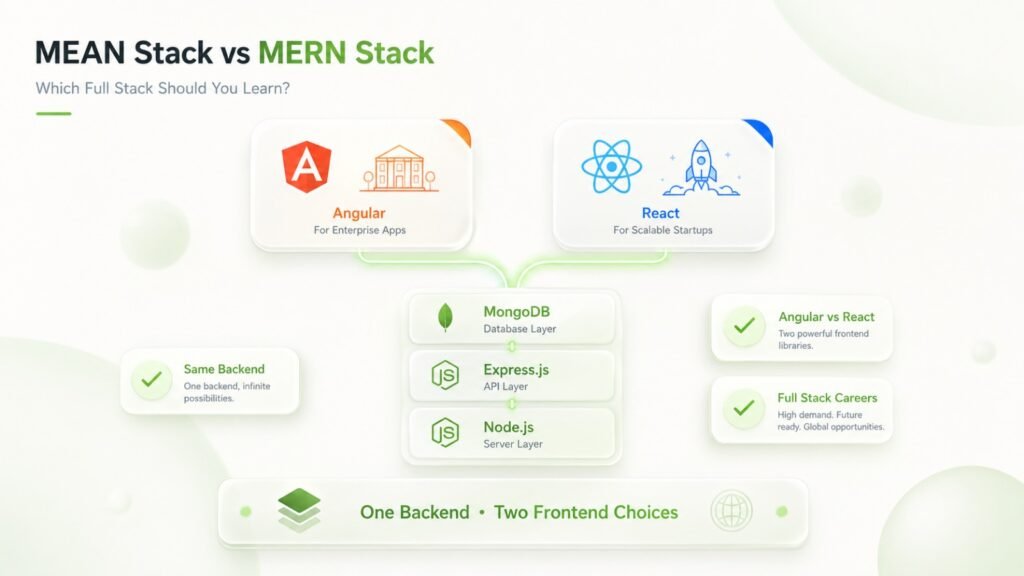
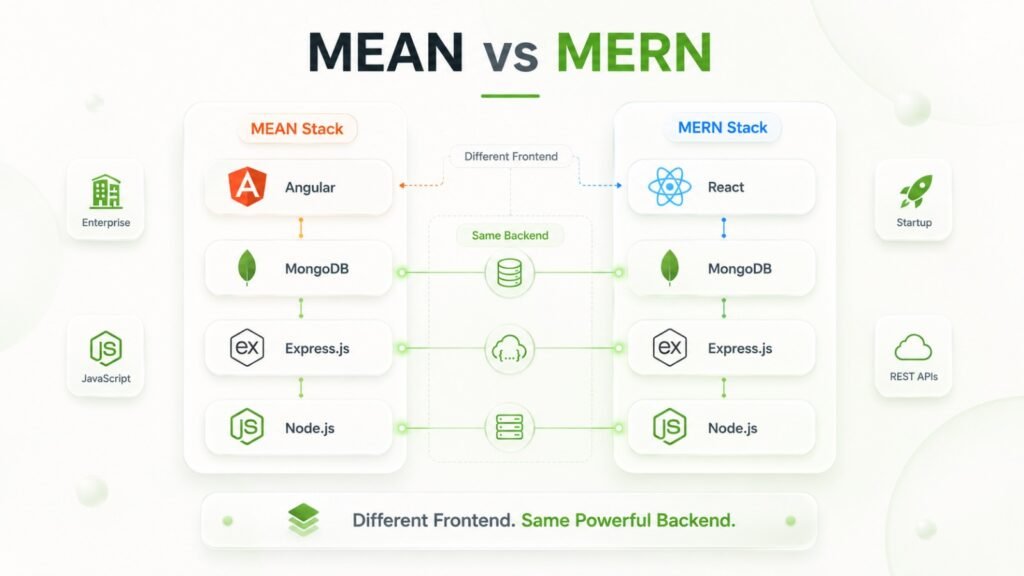
MEAN and MERN share the exact same backend. Both use MongoDB as the database, Express.js as the server framework, and Node.js as the runtime that ties everything together. The only real difference sits on the frontend. MEAN uses Angular. MERN uses React. That’s it. That one swap is the entire decision you’re actually making.
Everything else people argue about online which one is “better,” which one pays more, which one is more modern- mostly comes down to opinions about Angular versus React specifically, dressed up as a bigger debate than it really is.
What MEAN and MERN Actually Share
Before getting into the difference, it helps to understand what’s identical, because this is most of the stack.
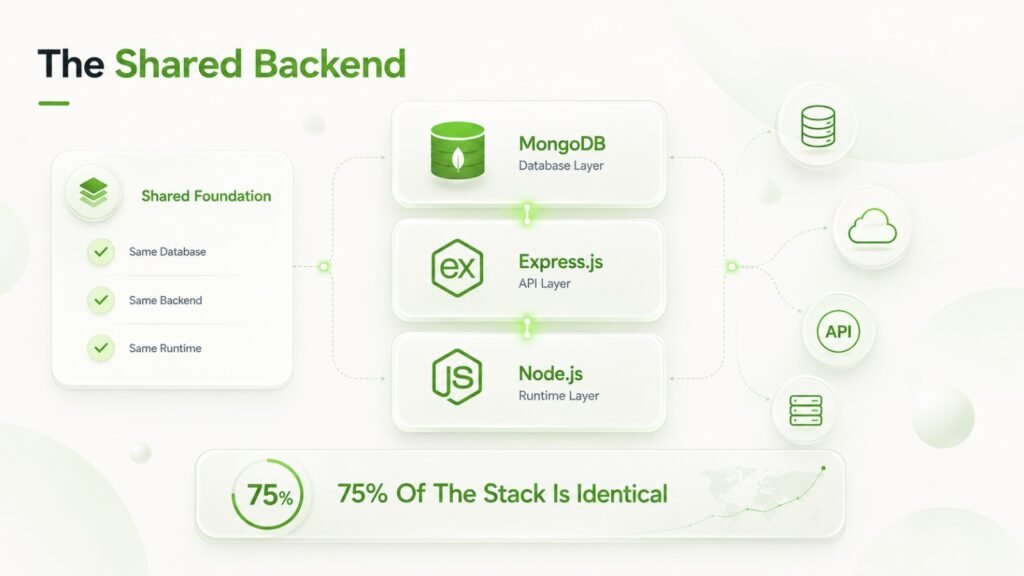
Both use MongoDB as the database. Instead of storing data in rigid rows and columns the way traditional databases do, MongoDB stores information as flexible, JSON-style documents, which tends to feel more natural once you’re already thinking in JavaScript for the rest of the stack.
Both use Express.js to handle the backend. It’s a lightweight framework that runs on Node.js and takes care of things like routing requests, handling APIs, and connecting your application logic to the database, without forcing a heavy, rigid structure on you.
And both run on Node.js, which is what allows JavaScript, a language originally built just for browsers, to also run on the server. This is genuinely the reason these stacks became popular in the first place. One language, frontend and backend, instead of switching mental gears between two completely different languages all day.
So really, three out of four layers are already decided the moment you pick either stack. The actual decision is much smaller than it first appears.
The One Real Difference: Angular vs React
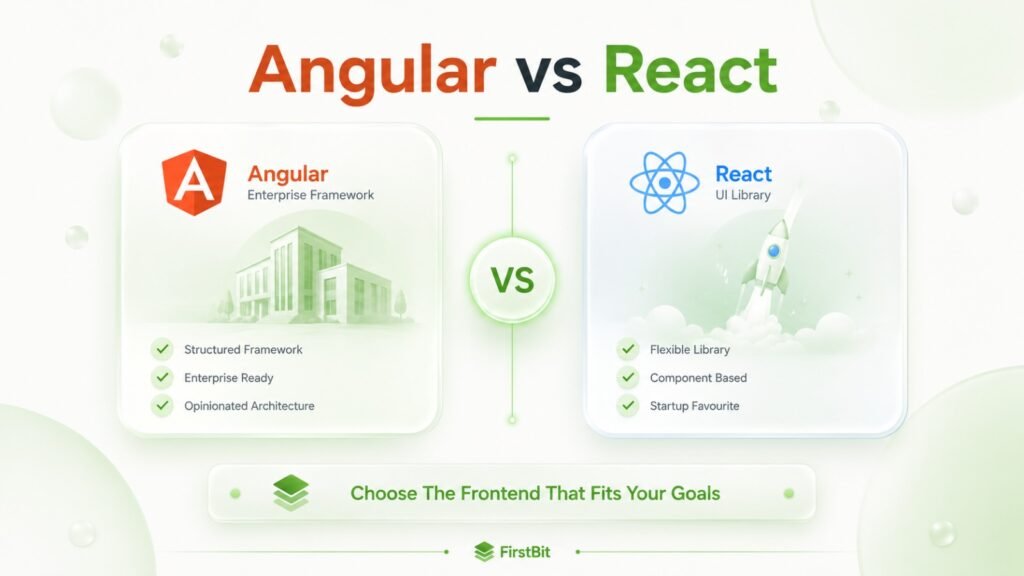
This is where MEAN and MERN actually split. MEAN pairs that shared backend with Angular on the frontend, a full, opinionated framework that comes with its own structure for how an application should be built. MERN pairs the same backend with React, a lighter, more flexible library that gives you more freedom but expects you to make more of your own decisions along the way.
If that distinction sounds familiar, it should. We’ve already covered Angular versus React in detail in our dedicated comparison, including which one tends to show up more in enterprise-style companies versus startups, and how to actually check job postings to decide for yourself. Rather than repeat all of that here, the short version is this: Angular’s structure tends to suit larger, more established companies and teams that value consistency across a codebase, according to Angular’s own documentation, while React’s flexibility, as described in React’s official documentation, tends to suit faster-moving product teams and startups that want to move quickly without a framework dictating every decision.
Whichever way that comparison leans for you personally is, in effect, whichever way MEAN versus MERN leans too.
MEAN vs MERN: Side by Side Comparison
If you’d rather see the whole thing laid out at a glance:
| Layer | MEAN Stack | MERN Stack |
| Database | MongoDB | MongoDB |
| Backend framework | Express.js | Express.js |
| Runtime | Node.js | Node.js |
| Frontend | Angular | React |
| Best fit for | Larger, structured, enterprise-style applications | Faster-moving, flexible, startup-style applications |
| Learning curve | Slightly steeper upfront, thanks to Angular’s structure | Slightly gentler start, thanks to React’s flexibility |
Notice how short that “difference” row really is. Everything above the frontend line is identical. That’s genuinely the whole story, and it’s why so much of the online debate about these two stacks feels more dramatic than the actual technical decision deserves.
Which Stack Gets You a Job Faster?
This is usually the real question underneath all the technical comparison, so let’s answer it directly.
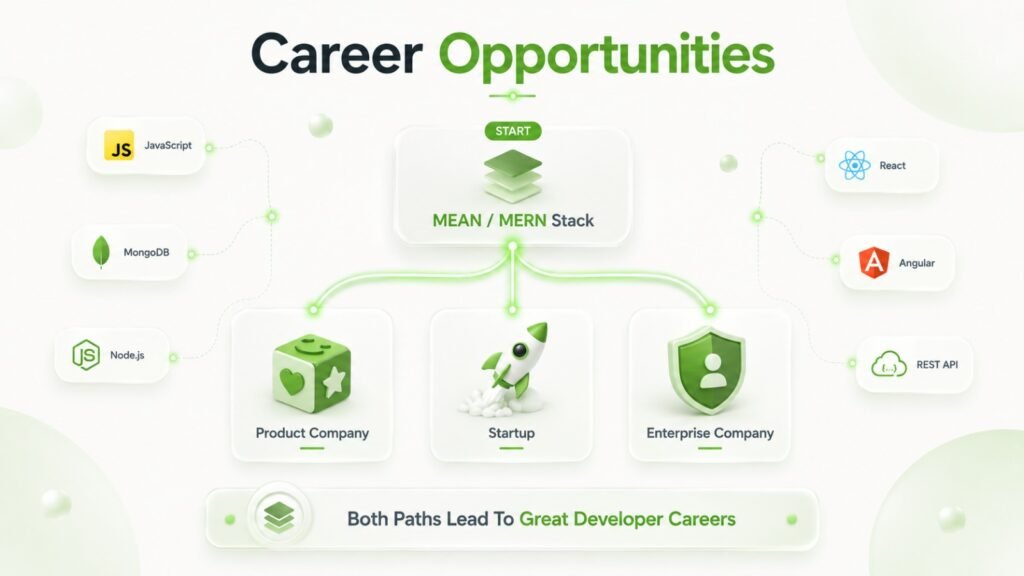
Both stacks are in real, active demand right now. Neither one is a “wrong” or outdated choice, and companies hire for both consistently. The faster path genuinely comes down to matching whichever stack shows up more in job postings for the kind of companies you’d actually want to work at. Full-JavaScript stacks like these are especially attractive to companies that want one team comfortable working across both frontend and backend without constantly switching languages, which is a big part of why MEAN and MERN roles both show up frequently at fast-moving product companies, alongside more traditional software teams that lean toward Angular’s structure.
If you’re genuinely torn, the same trick that works for Angular versus React works here too. Pull up ten or fifteen real job postings for roles you’d actually apply to and see which stack comes up more. That tells you far more about right now than any general online debate, including this one. It’s also worth noticing how often postings for a MERN stack developer specifically call out React experience by name, or how a Java full stack vs MERN stack comparison keeps coming up for candidates trying to decide between two genuinely different career lanes, not just two frontend frameworks.
Still unsure whether MEAN or MERN is the better choice for your career? Join a free demo class at FirstBit and talk to an experienced trainer who can explain both learning paths, show you the technologies in action, and help you choose the stack that matches your career goals before you enrol.
What a First Project Looks Like in Either Stack
Comparing the two technologies will help, but ultimately building a small project in either stack will make the decision crystal clear.
One great project to build in either MEAN or MERN is a basic notes or task app that allows users to create, read, update, and delete items from their database, with all the information stored in MongoDB, unlike a regular HTML page that loses all its information when refreshing the page. Doing this project requires building the common flow of the MEAN and MERN stacks, namely, creating an Express API, tying it to MongoDB, and creating the frontend part: Angular components for MEAN, React components for MERN.
Note that the whole project remains almost the same regardless of your choice, apart from the frontend part. Here is an amazing practical demonstration of how big of a deal it really is.
Common Misconceptions About MEAN and MERN
A few things keep floating around online that are worth clearing up directly.
“They’re basically the same thing.” Mostly true at the backend, genuinely different at the frontend, and that one piece is enough to shape your whole day-to-day experience building applications. Don’t let the shared letters fool you into thinking the choice doesn’t matter at all.
“MERN is newer, so it’s automatically the better choice.” React’s popularity online doesn’t make Angular outdated. Both are actively maintained, both show up in serious production applications, and “newer” isn’t the same as “better” for your specific goals.
“You need to learn both to be employable.” Almost never true for entry-level or mid-level roles. Most postings ask for proficiency in one full stack, not both. Learning the other one later, once you’re confident in your first, is a much smaller lift than starting from scratch.
“Choosing wrong will hurt my career.” Genuinely unlikely. The underlying skills, JavaScript across the stack, working with MongoDB, building REST APIs, building components, transfer heavily between the two. This is a starting point, not a permanent fork in the road.
“A MERN stack vs full stack comparison means MERN isn’t really full stack.” It is. MERN is a specific flavor of full stack development, frontend, backend, and database all covered, just built entirely in JavaScript rather than mixing languages. The confusion usually comes from people comparing MERN with Java or Python full-stack development. While all three are complete full stack development paths, they use different backend technologies and frameworks. If you’re deciding between these career paths rather than just Angular and React, read our guide on Java Full Stack vs Python Full Stack to understand which option best matches your goals.
Do You Need a Computer Science Background to Learn Either Stack?
To put it bluntly, no. MEAN and MERN are regularly introduced to newbies and career changers who have never even seen code before. This is due to the fact that the usage of JavaScript in both stacks means that there are fewer things to learn at once.
Having said that, there are a few good practices to follow. Gaining experience in the basics of JavaScript before using the stack is helpful in many ways.
This is because of the fact that both Angular and React frameworks rely a great deal on JavaScript principles. Patience with all the backend components of MongoDB, Express, and Node.js is equally important as passion for the frontend framework. Many newbies tend to rush into the frontend, excited about it, while their backend knowledge is rather poor.
How FirstBit’s MEAN/MERN Program Approaches This
Our MEAN/MERN Full Stack program covers the shared backend foundation, MongoDB, Express.js, and Node.js, as one solid base, then lets you specialize in the frontend framework that actually fits your goals, the same way our Java Full Stack program handles the Angular versus React decision. You’re not forced to guess blind before you’ve even tried either one.
Classes are live and instructor-led, with hands-on project work at every stage, so you’re building real, working applications rather than watching slides about them. Alongside the technical training, the program includes Placement Assistance once you’re job-ready, along with practical, honest guidance on which frontend path actually fits where you’re trying to go.
Final Thoughts
MEAN and MERN aren’t two completely different worlds; they’re the same solid backend paired with two different, equally valid frontend philosophies. Once you see it that way, the decision stops feeling overwhelming and starts feeling like exactly what it is: a straightforward choice between Angular’s structure and React’s flexibility, layered on top of a shared foundation you can’t really get wrong.
Choosing between MEAN and MERN doesn’t have to be confusing. The right choice depends on your career goals, the type of companies you want to work for, and the frontend technology you’re most comfortable learning. If you’re still unsure, talk to the trainers at FirstBit. They’ll help you understand both learning paths, recommend the one that suits your goals, and explain how the course prepares you with live projects, interview preparation, and Placement Assistance. Contact us today or book a free demo class to start your full stack journey with confidence.