
Yes. That’s the honest answer, and we’re not going to make you read six paragraphs to get there. A Data Science course in Pune is genuinely worth it even if you’ve never written a line of code, even if your degree is in commerce, arts, or something that has nothing to do with computers. What actually decides whether it works for you isn’t your degree. It’s whether you put in the work once you start, and whether the course you pick is actually built to take a non-technical starting point seriously instead of assuming you already know half of it.
Let’s get into why.
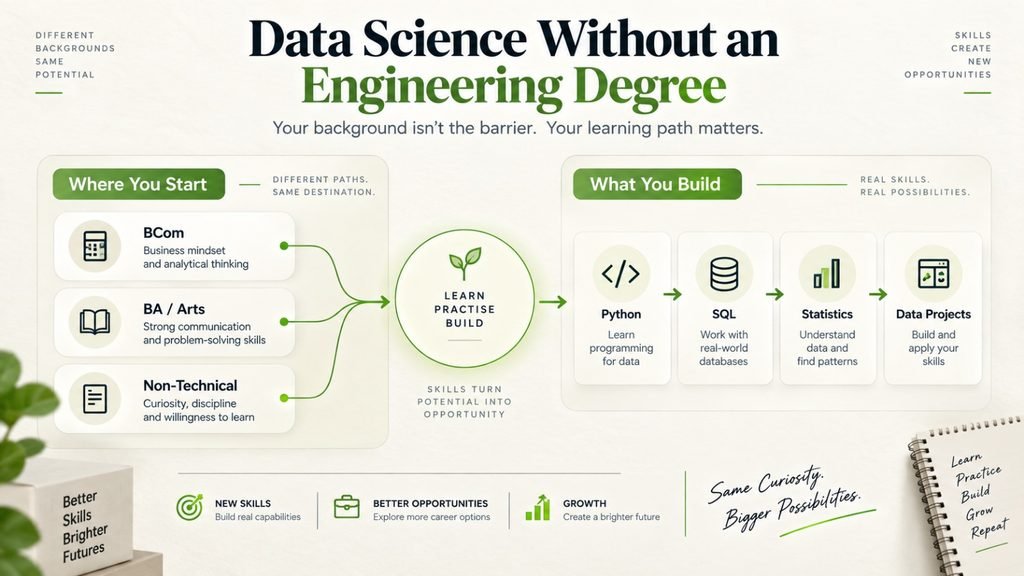
What’s Actually Stopping You Isn’t Your Degree
We hear some version of this question almost every week. “I did BCom, can I really do this?” “I’m from arts; everyone else in these classes will already know coding, right?” “I’m not a math person; isn’t data science basically all math?”
Here’s the thing nobody tells you plainly enough. The fear isn’t really about your degree. It’s about not knowing what you don’t know yet, which is a completely different problem, and one that has nothing to do with which subject you studied in college.
Most people who hesitate here are picturing data science as something closer to software engineering, heavy code, complex algorithms, years of computer science theory behind it. That’s not really what the entry-level work looks like. A lot of it is working with data in Excel and Power BI, writing SQL queries that read almost like plain English once you know the syntax, and using Python for tasks that are far more repetitive and logical than they are mathematically hard. If you’re worried specifically about the math side of it, we’ve actually written a separate guide on how much math you genuinely need for data analytics, worth a look if that’s the exact thing keeping you up at night.
What Python Actually Looks Like in Week One
Let’s take the fear out of this specifically, because “Python” is the word that scares people the most before they’ve even seen it.
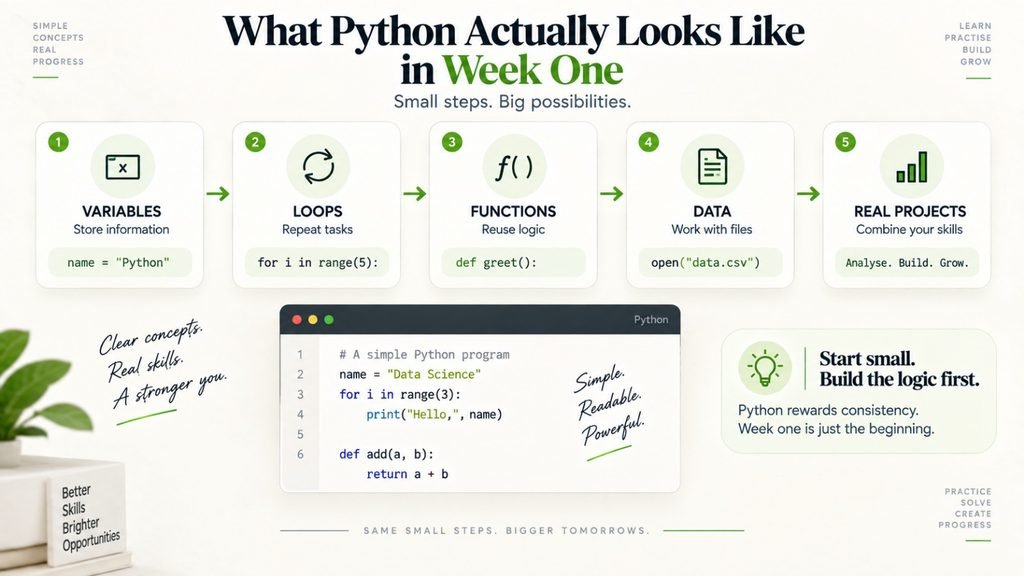
Python for data science beginners in Pune doesn’t start like what you’re probably imagining. Nobody hands you a blank screen and asks you to build something complex on day one. It starts with basics that read almost like instructions, telling the computer to do one small thing at a time: storing a number, reading a file, printing a result. Most people who’ve never coded before are genuinely surprised by how much Python reads like plain English compared to what they expected.
The first few weeks are usually just variables, loops, and simple functions, the building blocks everything else sits on top of. By the time you’re actually working with real datasets, you’ve already quietly built the foundation without it feeling like a separate, harder phase. If week one still feels intimidating on paper, that’s normal. It rarely feels that way once you’re actually in the room.
Engineering Background vs Non-Engineering Background: What Actually Differs
It’s worth being specific about what an engineering background genuinely gives someone a head start on, and what it doesn’t, instead of leaving it vague.
| Engineering Background | Non-Engineering Background | |
| Prior coding exposure | Often some; varies a lot by branch | Usually none, and that’s fine |
| Catching up needed on | Less on logic, sometimes still new to Python specifically | Basic programming logic and syntax, covered early in the course |
| What you bring in already | Comfort with technical thinking | Domain context, communication, business understanding |
| Time to feel comfortable with code | Faster in the first few weeks | A bit slower at first, evens out by mid-course |
The honest takeaway here is that the gap is real, but it’s a head start measured in weeks, not a permanent advantage. A non-technical background doesn’t mean starting from a worse position; it means starting from a different one.
Do Non-Engineering Candidates Genuinely Succeed in Data Science Roles?
We could just tell you yes and move on, but that’s not really proof of anything, so here’s something with actual weight behind it.
India’s own government research on the country’s AI and data science job landscape found something worth sitting with. Non-engineering background candidates are entering and succeeding in data science and AI roles with the right training, and there’s a strong, growing interest among people from outside the field who want to move in. This isn’t a training institute’s marketing claim. It’s a government-backed study looking at the actual state of the industry.
That matters because a lot of what circulates online about “40% of data professionals come from non-technical backgrounds” or similar numbers doesn’t actually trace back to anywhere real. We checked. It shows up across dozens of blogs with no source behind it at all, just repeated until it sounds true. We’d rather point you to something we can actually stand behind.
What Employers Are Actually Screening For
If companies still cared mainly about your degree, this would be a very different conversation. Increasingly, they don’t, at least not the way they used to.
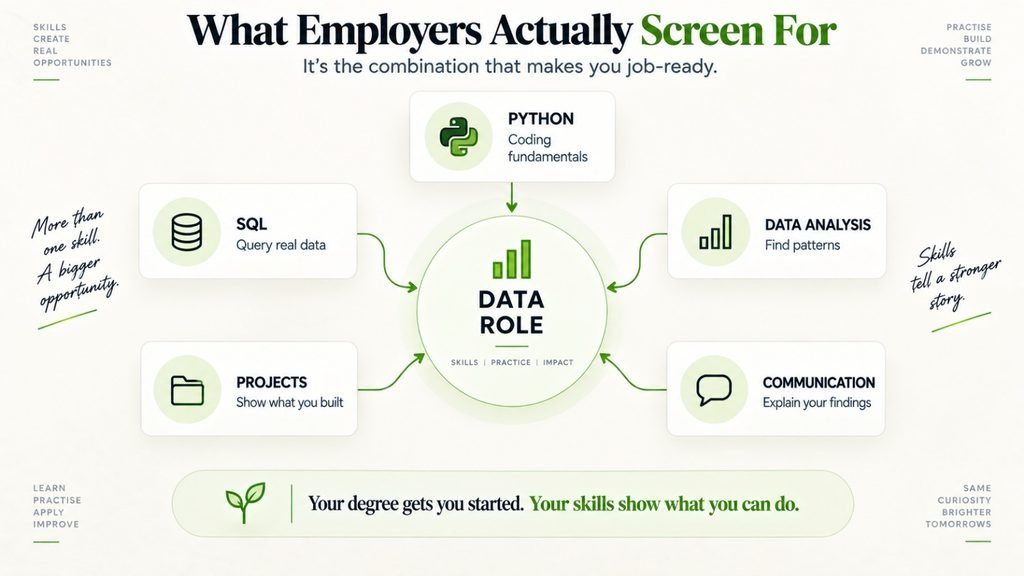
Recent hiring research out of India shows a real, ongoing shift toward skills-first evaluation, where what you can actually demonstrate matters more than the specific degree printed on your resume. It’s not a complete flip yet; plenty of companies still weigh academic background to some extent. But the direction is clear, and it’s moving in favor of exactly the kind of career switcher reading this article.
Not sure whether this kind of course genuinely starts from zero, or whether you’d feel lost in week one surrounded by people who already code? Sitting in on a free demo class is the fastest way to actually check that before committing to anything.
What a BCom, BA, or Non-Technical Background Actually Gives You
Here’s a reframe worth sitting with for a second. Your background isn’t a gap you’re trying to hide. It’s something a lot of purely technical candidates genuinely don’t have.
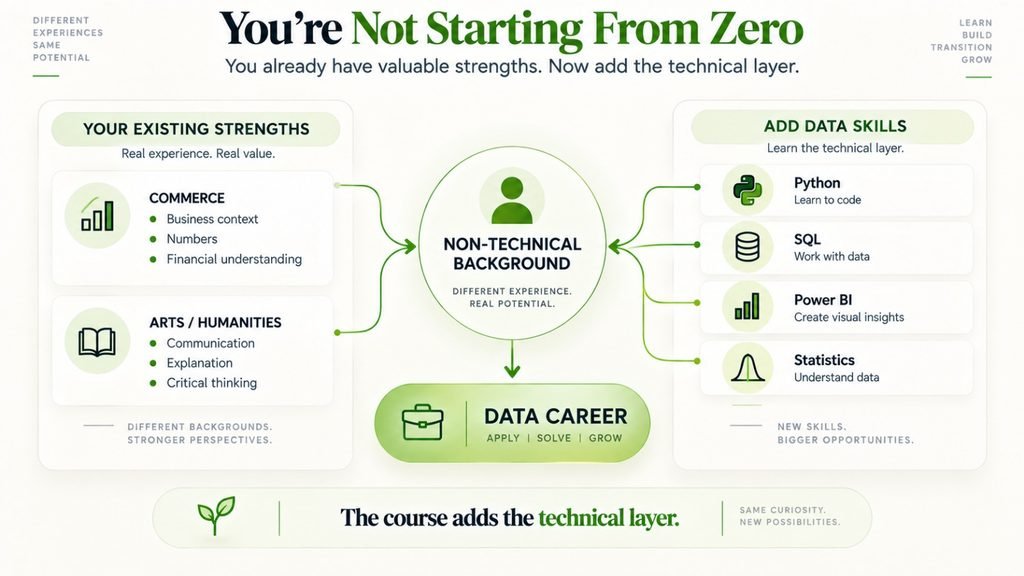
Someone who studied commerce already understands how a business actually runs, what a balance sheet means, and why a company cares about certain numbers more than others. That context is worth a lot in a data role, because raw numbers on their own don’t tell anyone anything; someone still has to understand what those numbers mean for the business. Someone from arts or humanities often brings something else companies quietly struggle to find in technical hires: the ability to actually explain a finding to a room full of non-technical people without losing them halfway through.
Neither of these things gets taught in a data science course. You already have them. The course teaches you the technical layer to put that existing strength to use.
What You’ll Actually Need to Build to Prove You’re Ready
We’re not going to pretend the course itself is the whole story, because it isn’t.
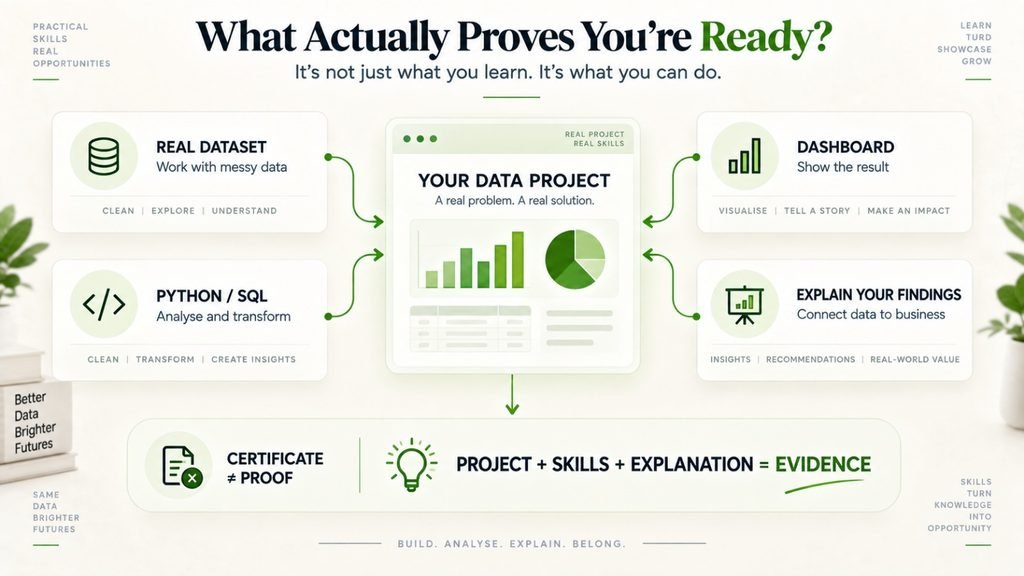
Two people can finish the exact same program. One walks away with two or three real, working projects they built themselves and can talk through in detail. The other has a certificate and not much else. When it comes to actually getting hired, that difference matters more than almost anything else on the resume. If you’re not sure what a strong first project even looks like, we’ve laid out a full guide on building an IT portfolio as a fresher in Pune that applies just as much here; project quality is project quality, whether you’re coming from a technical background or not.
What to Actually Look for in Data Science Training in Pune
Not every program billed as Data Science Training in Pune is built for someone starting from zero. Some genuinely are, structured, sequential, assuming no prior coding. Others quietly assume a baseline you don’t have yet and move fast past exactly the fundamentals you’d need slowed down. Before committing, it’s worth checking three things specifically: whether the program actually starts with real programming basics instead of skimming them, whether there’s live instruction you can ask questions in rather than pre-recorded content alone, and whether project work is built in throughout rather than tacked on at the very end.
None of this is really about finding the “best” institute in some abstract sense. It’s about finding training that’s honest about starting from zero, because that’s exactly where you are, and that’s fine.
If You’re Ready to Look at the Full Picture
Once the “should I even try this” question is actually settled, and hopefully it is by now, the next questions get a lot more concrete. What does the course actually cover, week by week? How long does it realistically take? Which direction inside data, analytics, data science, or Python development, fits you best once you’re a few months in?
We’ve written that part out separately, since it deserves its own space rather than being squeezed into this piece. Our full breakdown of the Data Science course syllabus and the career paths it opens up covers exactly that. And if what’s actually pulling at you is a bigger question than just this one course, whether switching into IT from a completely different field makes sense at all, our piece on switching to IT without a CS degree is probably the better next read.
Where This Leaves You
Your degree was never really the qualifying factor here. What actually decides this is whether you’re willing to start from the fundamentals and put in the work to build something real by the end of it. If you’re ready to see what that actually looks like in practice, rather than take our word for it, book a free demo class and judge it for yourself.
You can also see what the Python course with Data Science and AI in Pune covers before you decide.