Getting an IT job as a fresher is not only about having a degree, a certificate, or a list of programming languages on your resume.
Suppose two candidates apply for the same junior developer role. Both have a B.E. or B. Tech degree, both have completed a few certifications, and both know basic Python or Java. One candidate can also open GitHub, show a working application, explain why they chose a particular database, and walk through a problem they solved. That candidate has something the other resume does not: proof of work.
That is where an IT portfolio for freshers in Pune becomes useful. It gives recruiters something concrete to evaluate instead of asking them to take every skill on your resume at face value. Glassdoor’s current Pune data puts fresher software engineer base pay in the ₹3 lakh to ₹5 lakh per year range, with an average of about ₹4 lakh, although actual pay varies by company, skills, experience, and the quality of your portfolio
The ideal portfolio doesn’t require 15 projects or a costly personal website. For most freshers, 3-5 well-documented and pertinent projects are way more effective to begin with.
How can one prepare an IT portfolio for freshers in Pune?
- Begin with 3-5 solid projects, rather than gathering unfinished tutorial projects.
- Select projects that fit the IT position you aspire to: Python, Java, React, SQL, or full stack development.
- Post your code on GitHub and describe the problem, technology stack used, functionality, and your contribution to it.
- Add screenshots or live demos wherever possible to make it easy for others to understand the project without having to go through thousands of lines of code.
What Is an IT Portfolio for Freshers and Why Does It Matter?
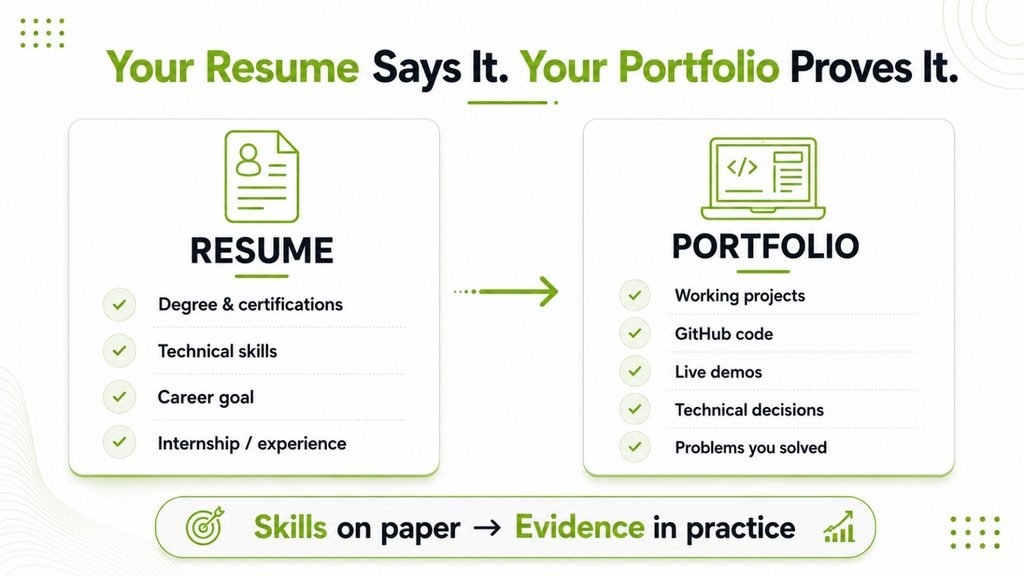
Your resume tells a recruiter what you say you can do. Your portfolio gives them something they can actually inspect.
For example, writing “Python, SQL and web development” under technical skills takes up one line on a resume. Building an employee management application with Python and SQL, documenting the database structure, uploading the code to GitHub, and explaining how authentication works gives those same skills context.
It is important because fresher resumes turn out to be very much alike. Hundreds of applicants can have identical degrees, certificates, and technologies. A good project allows the interviewer to ask a question that will actually help to understand you better; for example, about your choice between PostgreSQL and any other databases, or your handling of invalid data provided by the user.
Your portfolio is therefore not another version of your resume. Think of it as the evidence behind your resume, which makes the quality of what you build much more important than the number of things you list.
What Should an IT Portfolio for Freshers Include?
A portfolio can be simple. What matters is whether someone can understand your skills within a few minutes without hunting through broken links or half-finished repositories.
Start with a short introduction that says what role you are targeting. A candidate applying for a Python developer role should not make the visitor guess whether they are interested in development, testing, data analytics, or something else.
Your projects should then do most of the talking. A useful project entry normally explains the problem, the technology stack, the main features, your contribution, and where someone can see the code or application.
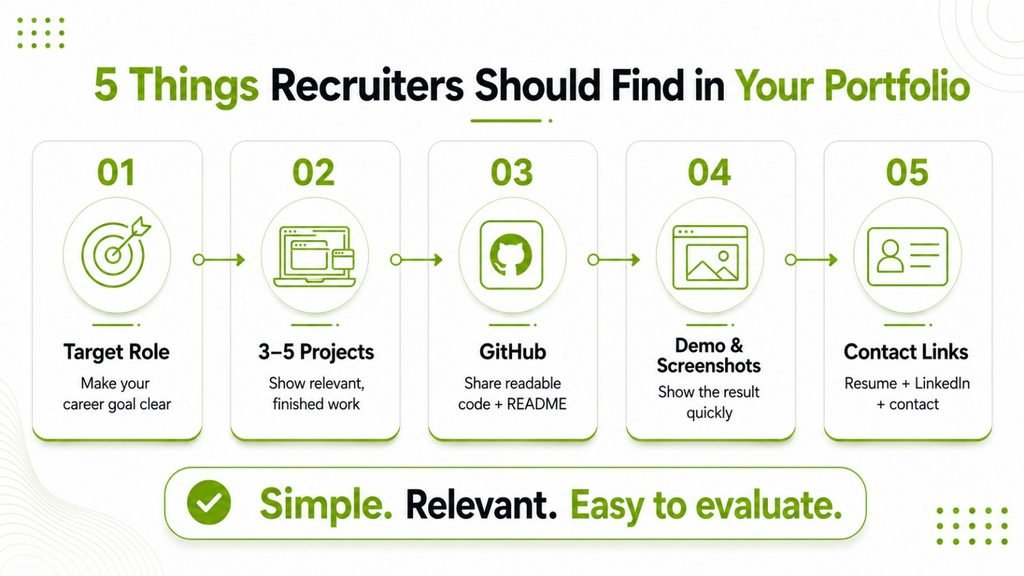
For a fresher, the portfolio should normally contain:
- Three to five relevant projects that demonstrate different aspects of the role you are targeting, rather than five versions of the same basic tutorial application.
- A GitHub repository for development projects, with readable code, useful commit history where possible, and a README that explains how the application works.
- Screenshots or a working demo when the project has a user interface, because recruiters should not have to install every project just to understand it.
- A short explanation of your contribution for college or group projects, especially when several students worked on the same application.
- Links to your resume and LinkedIn profile, along with a simple way for a recruiter to contact you.
GitHub also has a practical role beyond simply storing code. The 2025 Stack Overflow Developer Survey reports that GitHub was the most desired tool in its code documentation and collaboration category, while GitHub also ranked among the most admired community platforms.
That does not mean uploading code to GitHub will get you a job. It means a properly maintained GitHub presence is a sensible part of a developer’s professional footprint, especially when the repositories actually show what you know.
How to Build an IT Portfolio for Freshers Step by Step
The easiest mistake is to start by designing a portfolio website.
Do not.
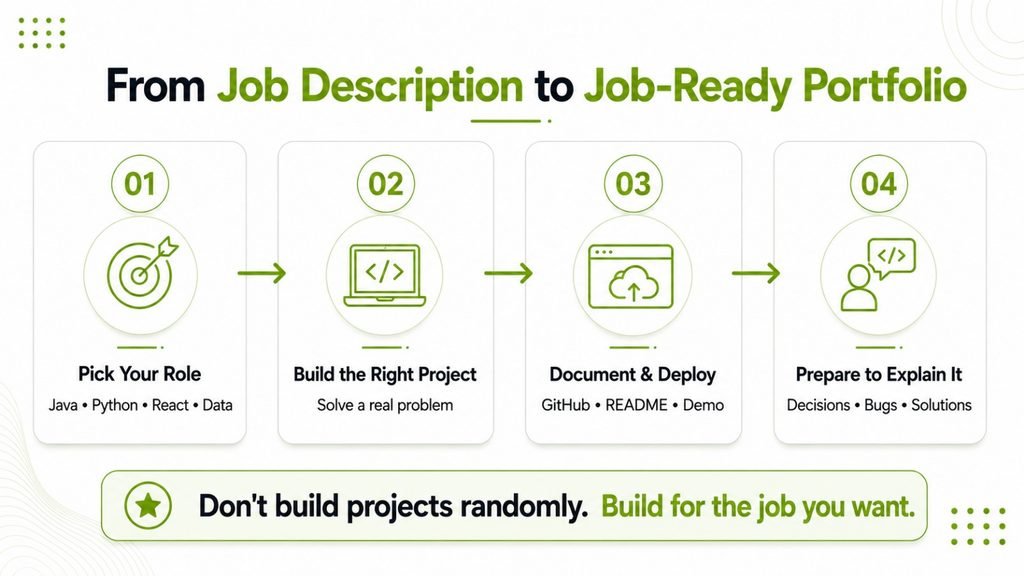
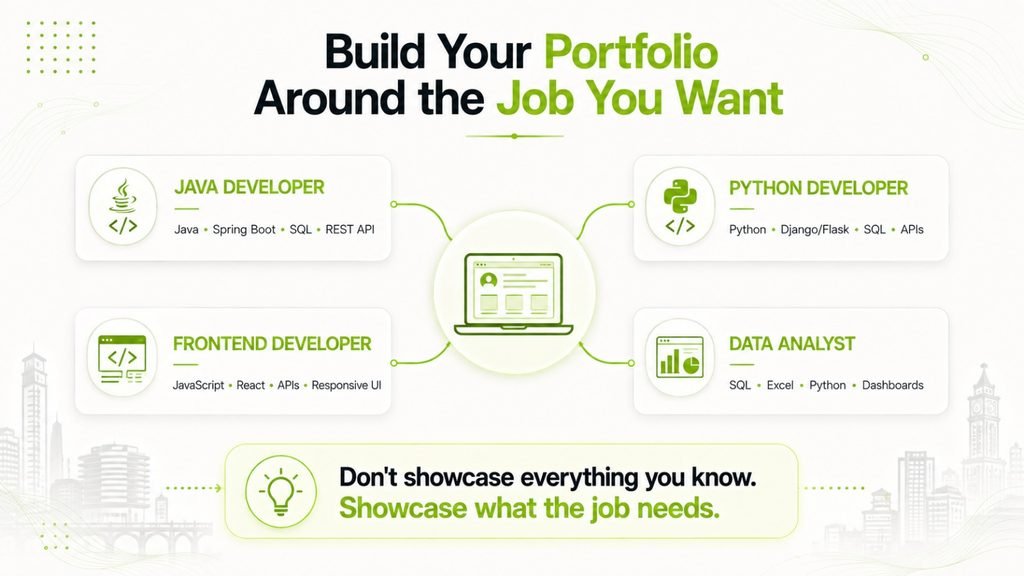
Start with the job you want. Once you know the role, it becomes much easier to decide which projects deserve your time and which technologies are worth demonstrating.
1. Choose the IT role before choosing the project:
Look at 10 to 20 entry-level job descriptions for the role you are targeting. You will quickly notice recurring technologies and responsibilities.
A Java developer portfolio might demonstrate Java, Spring Boot, REST APIs, and SQL. A Python developer could show Python with Django or Flask and database integration. A frontend candidate might focus on JavaScript, React, responsive interfaces, and API integration.
The point is not to copy every technology mentioned in a job description. Pick a realistic stack you understand well enough to build with, then create projects that demonstrate those skills.
2. Build projects around problems, not technologies:
“Python project” is not a useful project description.
“Expense tracking application that lets users record transactions, categorise spending and view monthly summaries” is much stronger because it tells the reader what you actually built.
A project becomes more valuable when it forces you to solve several problems. You might need authentication, database design, validation, API handling, error management and a usable interface. Those are the kinds of details that create better interview conversations than a basic calculator ever will.
3. Build, document and deploy the project:
Once the project works, resist the temptation to immediately start another one.
Clean the code. Add a README. Explain the setup process. Include screenshots. Deploy the application if the technology and project allow it. Then write down the two or three technical problems that took the most effort to solve.
That last part is easy to underestimate. During an interview, you may be asked, “What was the most difficult part of this project?” If you have already thought through the answer, you can explain the problem and your reasoning instead of trying to remember everything five minutes before the interview.
4. Show what you personally built:
College projects create a common problem. A candidate lists a large application on the resume, but when the interviewer asks about the backend, the candidate has no idea how it works because another team member handled it.
If it was a group project, say so. Then explain your own contribution clearly.
In fact, honesty will improve the project because an interviewer will be able to ask appropriate questions. To say that the code belongs to someone who cannot explain it will ruin the interview quickly.
What Projects Should Freshers Put on Their Resume?
The best projects for resume building are not necessarily the most complicated ones. They are projects that give you enough technical depth to demonstrate how you think and what you can build.
A simple employee management system can be useful if it includes authentication, CRUD operations, database integration, validation, and a clean interface. An e-commerce application can demonstrate product management, user accounts, cart functionality, orders, and API integration.
Other useful directions include:
- Job portals can demonstrate authentication, search and filtering, database relationships, role-based access and form handling within one application.
- Inventory management systems can show database design, stock updates, reporting logic and business rules that resemble problems used in real organisations.
- Expense trackers can demonstrate data entry, categorisation, calculations, authentication and dashboard-style visualisation without requiring an enormous codebase.
- REST API projects can show backend development, endpoints, validation, error handling and database interaction when you are targeting a backend role.
- Data analytics dashboards can demonstrate SQL, Python, data cleaning and visualisation when your target is data analytics rather than software development.
The project should also match the role. A candidate applying for a data analyst position does not gain much by spending three months building a visually impressive React application if the job mainly requires SQL, Excel, Python, and reporting.
That is why projects for a resume should be selected based on the job you want next, not simply based on whatever tutorial happens to be popular this month.
If you’re targeting Java development, this guide to 5 Java Spring Boot projects you can build to strengthen your resume gives you a more specific starting point
What Makes a Fresher’s Portfolio Look Professional?
Professional does not mean flashy.
A portfolio with nice presentation, functioning links, and well-documented projects is much better than an overloaded website with fancy animations that takes 10 seconds to load. In most cases, recruiters have a very simple question in mind: “Can this person really do the job?”
Provide the answer to their question as soon as possible.
Each project should have its title and explanation line, which introduces it briefly before you get into technicalities. Then comes the technology stack, the list of features, screenshots, GitHub repository, and a link to a live version if any.
README for each of your repositories deserves the same level of attention too. When someone enters the repository, they should see clearly why it exists, how to use it, what tools were employed, and what could be done better in the next version.
GitHub profile follows the same logic. Dozens of experiments are less trustworthy than a few finished repositories with nice documentation.
Portfolio should provide answers, not raise new questions.
How Many Projects Should a Fresher Have in Their IT Portfolio?
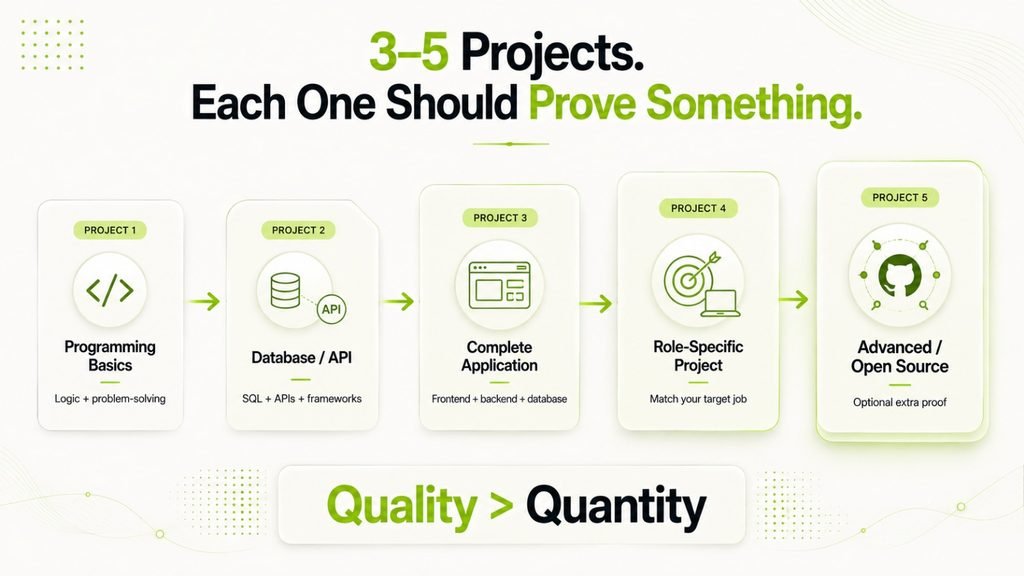
Three to five projects should be a realistic goal for most freshers, although there is no magic number used as a recruiting criterion.
What is important is what those projects prove together. One project can prove basics, another can prove some API or Database knowledge, and an end-to-end application will bring all the skills together.
A useful progression looks like this:
| Project | What it should demonstrate |
| Project 1 | Programming fundamentals and basic problem-solving |
| Project 2 | Database, API, or framework skills relevant to your target role |
| Project 3 | A complete application that combines several technologies |
| Project 4 | A role-specific project that closely matches the jobs you want |
| Project 5 | An optional advanced or open-source contribution |
You do not need to finish all five before applying. If you have three good projects and can explain every important part of them, start applying while continuing to improve the portfolio.
That approach is usually better than spending another six months trying to create the “perfect” portfolio before sending your first application.
GitHub vs Portfolio Website: What Does a Fresher Actually Need?
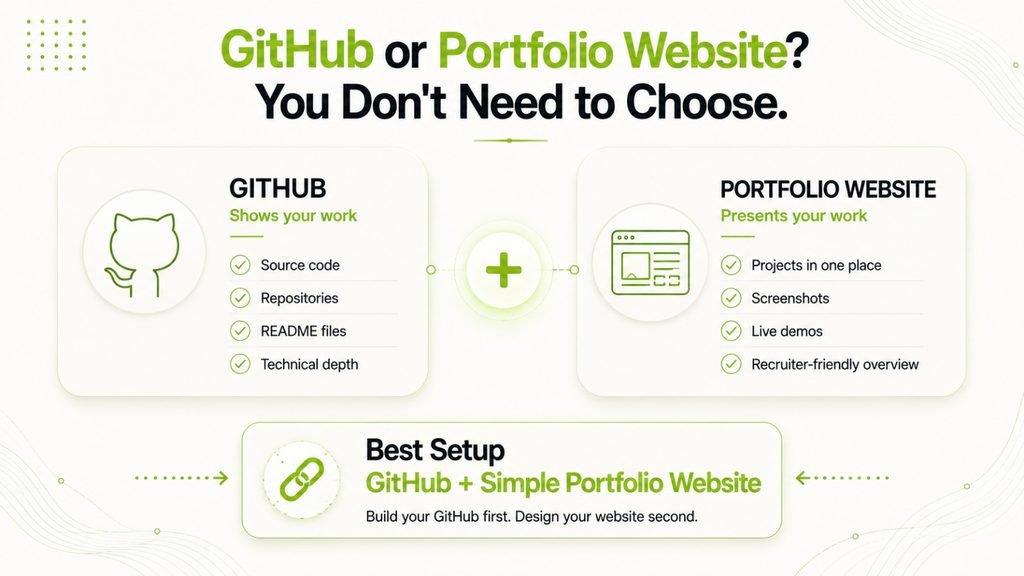
These two things serve different purposes.
GitHub shows the actual development work. A portfolio website packages that work into an easier-to-read presentation. If you have limited time, GitHub and good project documentation should come before spending weeks designing a personal website
| Feature | GitHub | Portfolio website |
| Source code | Excellent for showing repositories and development work | Usually links back to GitHub |
| Project documentation | Strong when README files are maintained properly | Easy to summarise visually |
| Personal branding | Limited | Stronger |
| Live project presentation | Can link to demos | Easy to organise in one place |
| Recruiter overview | Depends on repository quality | Easier to control |
| Priority for a fresher | High for developer | Useful, but optional |
The 2025 Stack Overflow Developer Survey lists GitHub as the most desired tool in its code documentation and collaboration category. It also notes that GitHub remains among the most admired community platforms used by developers.
So if you have two weekends available, spend the first making your repositories genuinely useful and the second building a simple portfolio website if you still need one. A beautiful website cannot rescue weak projects.
How to Make Your IT Portfolio Stand Out to Recruiters in Pune
Pune offers a refreshing combination of job positions involving technology in sectors like Hinjewadi, Kharadi, Baner, Wakad, and Pimpri Chinchwad. This does not imply that all companies in these regions have the same hiring criteria; hence, the sensible thing is to base yourself on the position you actually want.
Let’s say your dream position is Junior Java Developer. Analyze some Junior Java developer positions and find out what are the skills come up again and again: things like Java, Spring Boot, SQL, and REST API’s. You can highlight them through your portfolio without mentioning them in your skills section.
This approach applies equally well to Python, data analytics, and frontend development. The candidate seeking a career in Python may design a backend application, while one seeking jobs in data may choose to create a project from scratch involving raw data, clean up using Python or SQL, and end up with an interesting dashboard.
Job search locally requires a different way of presenting the portfolio. For example, if you are planning to apply for job positions in Hinjewadi, Kharadi, or Pimpri Chinchwad, ensure that your resume, LinkedIn profile, and portfolio convey your job target instead of forcing the recruiter to figure out where you fit.
What If You Have No Projects to Put in Your Portfolio?
This is probably the most common problem among freshers who have completed courses but still do not feel ready to apply.
Maybe you know Python syntax but have never built an application. Maybe your only project is the same student management system that appears in hundreds of GitHub repositories. Or perhaps your college project was a group assignment, and you cannot explain most of the code.
If Java is where you’re starting, this guide on why beginners struggle with Java in the first 30 days can help you avoid some of the common mistakes before jumping into a larger project.
None of these situations means you need to start over.
Pick one small project and finish it properly. Then take what you learned and build something larger. The second project should introduce a new problem, and the third should bring several skills together into a more complete application.
Structured training can also make this process less confusing when you are not sure what to build or how to progress. FirstBit Solutions currently lists its Python Full Stack Data Science with AI programme as a minimum five-month course for beginners, with project assistance and lab assistance included in the course details. It also lists placement assistance, rather than a placement guarantee.
Need Help Turning Skills Into Real Projects?
If you know the basics but still don’t have strong projects to show on your resume, structured training can help you move from learning concepts to building practical work. Explore FirstBit Solutions’ IT courses in Pune to see which programme fits your target role, or contact the team to discuss your learning path and project goals.
How to Turn Your Portfolio Into an Interview Advantage
A portfolio becomes important in the course of an interview if you can justify your choices.
You can be asked by an interviewer about why you chose a particular database. Why did your API crash when it got bad data? How was the authentication system implemented? What was the most difficult bug to fix? What changes would you make if there were ten times more users?
You should not have a perfect answer for all the questions. But you must know your project well enough to explain its design, strengths, and weaknesses without going through the README file.
This is also why copied projects are risky. You can copy a tutorial in an afternoon, but you cannot reliably answer questions about code you never understood.
Before putting a project on your resume, try explaining it aloud in two minutes. Then explain the hardest technical problem in another two minutes. If you can do that clearly, the project is probably ready to become part of your interview story.
FirstBit Solutions’ placement support includes resume building, mock interviews, aptitude preparation, and interview preparation. For a fresher who already has projects but struggles to present them, that kind of preparation can address a different problem from technical training itself.
IT Portfolio Checklist for Freshers in Pune
Before sending your portfolio to recruiters, open it as if you were seeing it for the first time.
Can you understand the candidate’s target role in 10 seconds? Can you reach the GitHub repository without clicking through five pages? Can you see what each project does without downloading the code?
A practical final check should include:
- The job you are targeting is evident; therefore, the recruiters will be able to know immediately whether your CV indicates an interest in development, testing, data, or some other technology job.
- There are three to five projects relevant to the position, with each project being completed and ready for discussion, and at least one of the projects being beyond the simple coding exercises.
- Each development project has an available GitHub account with a README file describing the objective, technology used, and installation instructions.
- Screenshots and/or a demo link are provided where appropriate in order to give the recruiter a quick view of the resulting application.
- Your participation in the project is well-explained, especially if it was developed together with your peers.
- Your resume, LinkedIn profile, and portfolio are consistent in telling the same story for the same target job and have a similar technical skillset.
- Tutorial projects with broken links, incomplete projects, and projects with copy-pasted code are not included since less quantity with better quality is a good idea.
The final test is simple: could you sit in an interview tomorrow and explain every project without opening the code?
If the answer is yes, you have moved beyond simply listing skills. You have started building evidence that those skills are usable.
Should I include college projects in my IT portfolio?
Yes, provided the projects are relevant, and you can explain your own contribution. Clean up the documentation, explain the technologies used, describe what you personally developed, and be honest about which parts were completed by other members of the team.
A strong IT portfolio for freshers in Pune is not about looking impressive on the internet. It is about making your technical skills easier for a recruiter to believe because you have something concrete to show, explain, and defend.
If you can build three to five relevant projects, document them properly and talk through the decisions behind your work, your portfolio can become one of the strongest parts of your fresher job application.
If you still need structured training and hands-on project support, explore FirstBit Solutions’ IT courses in Pune or contact the team to discuss which programme best matches the role you want to pursue.