
A career switch to IT without a CS degree is genuinely possible in 2026, and it happens every day in Pune. Companies are increasingly looking at what you can actually build, not just which degree sits on your resume. But it takes a real plan, not a two-week YouTube binge and a prayer. Here is what that plan actually looks like, without the sugarcoating.
The Conversation You’re Probably Having With Yourself
Let’s just say it out loud, because we hear this from students almost every week.
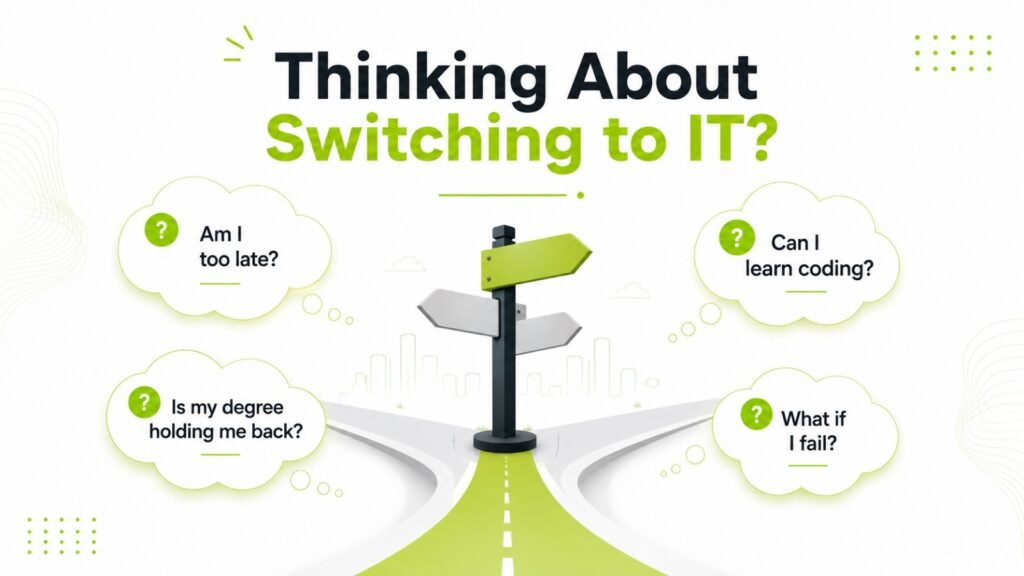
You studied BCom, or BA, or maybe mechanical or civil engineering. Somewhere along the way, you started noticing that your engineering or CS friends were pulling in salaries that felt like a different universe. And now you’re sitting with a mix of feelings that don’t have a name. Is my degree a waste? Am I too old to start from zero? What if I try coding and I’m just… bad at it? What will family say if this doesn’t work out?
We’re not going to pretend these worries are silly. They’re real, and honestly, they’re the same worries every switcher has had before you. The difference isn’t always talent. More often, it’s having an honest roadmap and sticking with it. It’s whether they had an honest roadmap instead of vague motivation.
That’s what this is.
And if it helps even a little, you’re not as alone in this as it feels. Every batch we train has students who came from commerce colleges, arts backgrounds, and engineering branches that have nothing to do with computers. The ones who make the switch successfully aren’t the ones who were “naturally good at coding” from day one. They’re the ones who stopped waiting to feel ready and started following a plan instead.
Is Your Degree Actually Wasted?
Short answer: no. Your degree shaped how you think, and that matters more than people give it credit for.
If you’re from a BCom or commerce background, you already understand numbers, logic, and how businesses actually run. That’s a massive head start for data analytics or business analyst roles, where the real skill isn’t just writing code; it’s understanding what the numbers mean for a company. Tools like Python for data analytics build directly on top of what you already know from accounting and statistics.
If you’re from BA or humanities, your writing and communication skills are genuinely rare in tech teams. Most developers are decent coders but average communicators. Someone who can explain a technical problem clearly to a client or a manager is valuable in ways a fresh CS graduate often isn’t yet.
If you’re from mechanical or civil engineering, you’ve already been trained to think in systems and solve structured problems. That’s basically what programming logic is, just with code instead of load calculations. A lot of our strongest full stack students come from exactly this background.
Your degree isn’t wasted. It’s just not the whole story anymore. It’s the foundation you build the new skill on top of.
Do Companies Really Hire Without a CS Degree in 2026?
This is the part where most blogs throw around big scary numbers to sound impressive. We’d rather give you the honest picture.
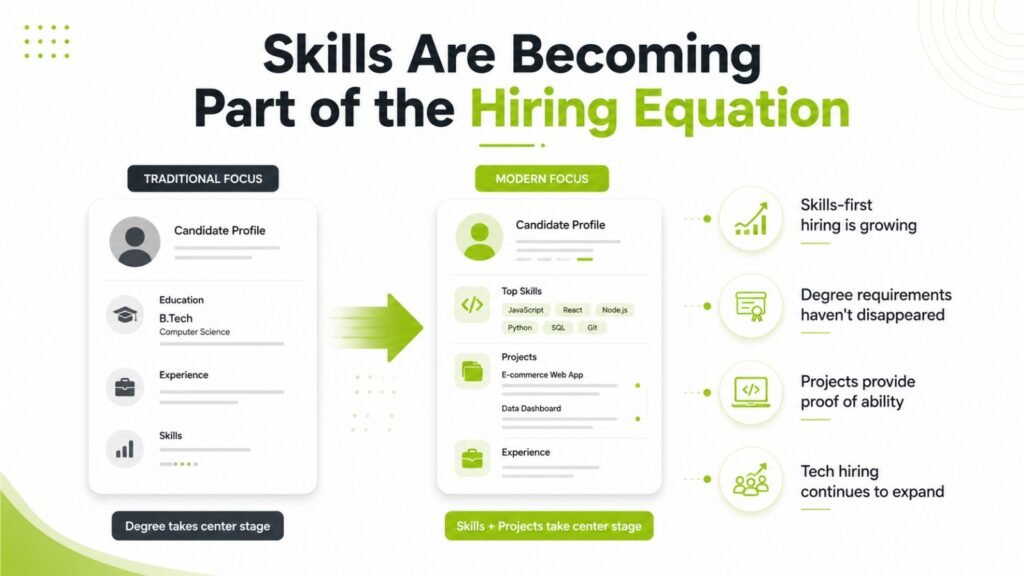
According to HirePro’s State of College Hiring in India 2026 report, only 21 percent of Indian corporates have fully moved to skills-first hiring so far. Another 51 percent still let CGPA and academic background influence their decisions, and the remaining 42 percent are somewhere in between, actively shifting toward skills but not fully there yet.
So no, the degree requirement hasn’t vanished overnight like some articles want you to believe. But here’s the part that matters for you: that shifting 42 percent is a huge, real, growing door. Companies are actively building processes to evaluate people on what they can do, not just what’s printed on a certificate. That door is open right now, and it’s getting wider every year.
And there’s genuinely more room to walk through it than you might think. Nasscom’s Annual Strategic Review 2026 projects around 135,000 net new tech jobs being added in FY26 alone, pushing the sector’s total headcount close to 5.95 million people. That’s not hype from a training institute; that’s the industry’s own numbers.
Put simply, the opportunity is real, but it rewards people who show up with proof of skill, not just a resume line about “wanting to switch.”
The Realistic Timeline for an IT Career Switch (No, It’s Not Six Weeks)
We’re going to be straight with you here, because you deserve better than a course that promises a job in 30 days.
Phase 1, roughly 6 to 8 weeks: fundamentals. This is where you actually learn how to think in code, pick one language, and get comfortable with the basics before jumping into anything fancy. If you’re worried about surviving this stage, you’re not alone; plenty of beginners hit a wall here. We’ve actually written about exactly why beginners quit learning Java in the first 30 days, and honestly, knowing why it happens is half the battle in not letting it happen to you.
Phase 2, roughly 8 to 10 weeks: real projects. This is where things start feeling real. You’re not just following tutorials anymore; you’re building things you can actually show someone. A small e-commerce page, a data dashboard, a simple app, whatever fits the direction you’re heading in. This is also the stage where your portfolio starts doing the talking for you instead of your degree.
Phase 3, roughly 4 to 6 weeks: interview readiness. Mock interviews, resume rebuilding around your projects instead of your degree, and getting comfortable explaining your work out loud. This stage is where a lot of self-taught switchers fall short, not because they lack skill, but because nobody prepared them to talk about it confidently.
Here’s the same breakdown in one glance, since it’s easier to come back to this way.
| Phase | Duration | What You’re Doing | What You’ll Have By The End |
| Fundamentals | 6 to 8 weeks | Learning how to think in code, picking one language, building basics | Comfort with core logic, no more blank-screen panic |
| Real Projects | 8 to 10 weeks | Building things you can actually show, not just tutorials | A small portfolio of 2 to 3 working projects |
| Interview Readiness | 4 to 6 weeks | Mock interviews, resume rebuild, learning to explain your work | The confidence and language to talk about your switch |
All in, you’re looking at 4 to 6 months of focused effort, not weeks. Anyone promising you a job in a month either doesn’t understand the market or isn’t being honest with you.
A quick word on cost too, since nobody likes to talk about it directly. A solid structured program in Pune usually costs a fraction of what a second degree would, and unlike a degree, you start showing employable proof of work within the first couple of months, not years later. It’s a real investment, but it’s not the multi-year, multi-lakh commitment that going back for another formal degree would be.
Common Mistakes We See Non-CS Switchers Make
We’ve watched enough students go through this to notice a pattern in what trips people up, and it’s rarely the coding itself.
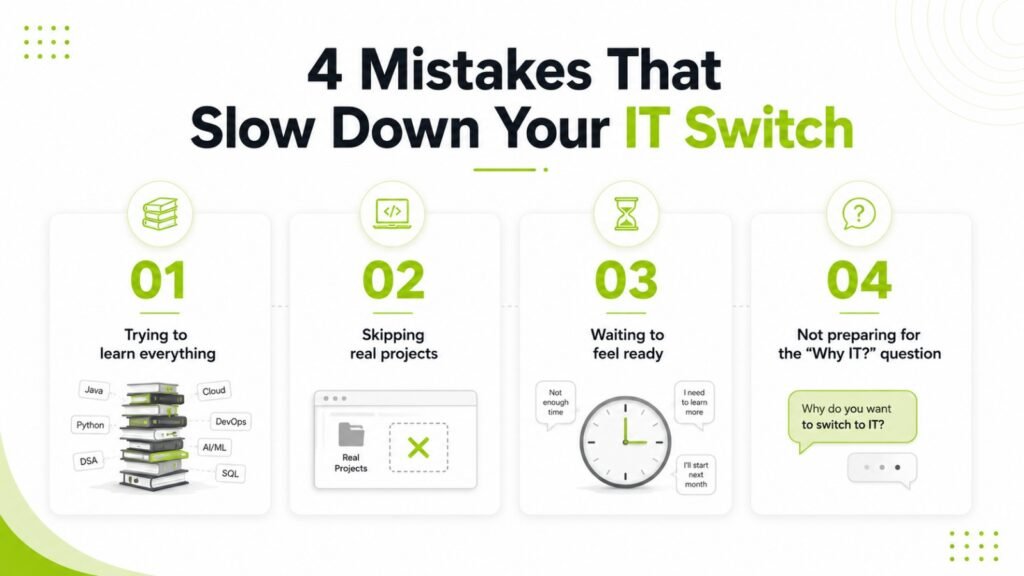
Trying to learn everything at once. Jumping between five different languages and ten different YouTube channels because every video says something different. Pick one path, one language, one structured plan, and stick with it long enough to actually see progress.
Skipping projects and only doing tutorials. Watching someone else code isn’t the same as building something yourself. Employers don’t hire based on how many courses you finished; they hire based on what you can show them.
Waiting to feel “ready” before applying. Nobody feels fully ready. The students who get placed are usually the ones who started applying while still slightly unsure of themselves, not the ones who waited for perfect confidence that never actually arrives.
Not preparing to explain the switch itself. Interviewers will ask why you’re switching. Have a real, honest answer ready, not a rehearsed one. “I realised I enjoy building and solving problems more than my previous field” lands a lot better than sounding defensive about your background.
Which Path Actually Fits Your Background?
Not every switcher should go straight for full stack development. Here’s a simple way to think about it.
If numbers and logic come naturally to you and you enjoyed anything statistics or Excel related, data analytics is probably your fastest, least painful route in. Our post on data analyst vs data scientist breaks down which of those two suits you better based on how deep you want to go with math.
If you like building things end to end and enjoy seeing a visible result, like a website or an app, full stack development is a strong fit. If you’re not even sure what that means day to day, our guide on what Python full stack development really involves is a good place to start before committing.
A quick side-by-side, in case you’re the type who likes to compare before deciding:
| Your Background | Suggested Path | Why It Fits |
| BCom, commerce, finance | Data Analytics | You already think in numbers, patterns, and business logic |
| BA, humanities | Full Stack (with a communication edge) | Strong writing and client-facing skills are rare in dev teams |
| Mechanical, civil, other engineering | Full Stack Development | Systems thinking transfers directly into programming logic |
| Anyone comfortable with Excel already | Data Analytics | Power BI and SQL build naturally on what you already use |
There’s no wrong choice here, just a better fit or a worse one for how your brain already works.
Either way, becoming a full-stack developer without a computer science degree is doable through the same route: structured learning plus real projects. The degree was never really the qualifying factor; the working code is.
What Pune Specifically Offers Switchers Like You
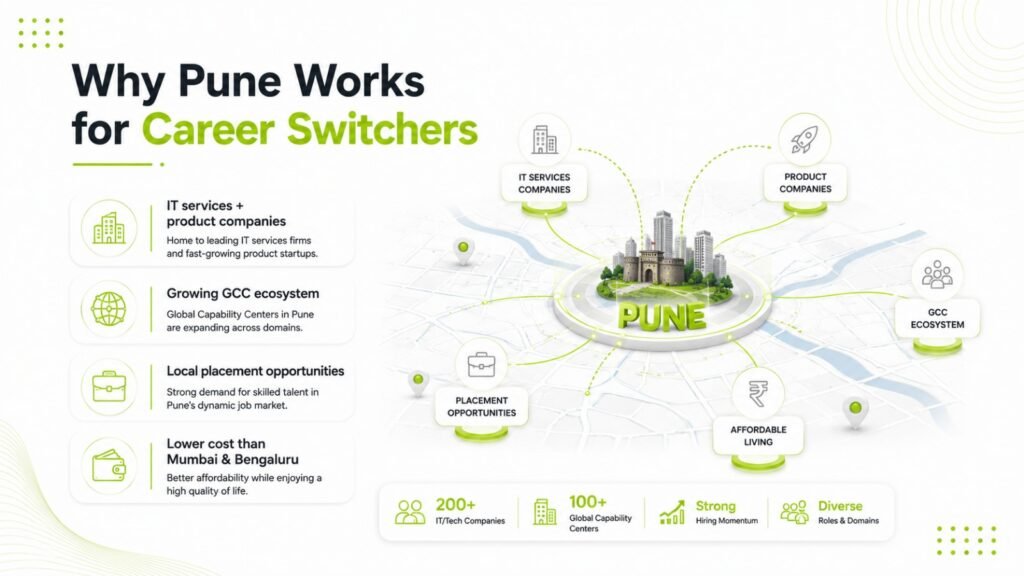
Pune isn’t just a convenient city to be in for this; it’s actually one of the better ones. The city has a strong mix of IT services companies, product startups, and Global Capability Centres, the kind of setups run by companies like KPIT, Persistent Systems, and several banking and engineering GCCs, that hire in large numbers and are genuinely open to candidates with strong project work over a specific degree background.
Cost of living here is also friendlier than Mumbai or Bangalore, which matters when you’re investing months into reskilling without a steady paycheck. And because the hiring ecosystem here spans everything from traditional IT services to newer product companies, there’s more than one type of door open depending on which path you choose.
There’s also a practical, everyday reason Pune works well for this switch specifically. A large chunk of the hiring here happens through referrals, alumni networks, and local placement drives, not just cold applications on a job portal. Being physically based here, building your network here, and training here all quietly stack the odds in your favour in a way that applying remotely from another city never quite matches.
If you’re weighing whether this switch makes sense specifically from here, it genuinely does. This isn’t a “move to Bangalore” story. It can happen right where you are.
Not sure which path actually fits your background and your timeline? Book a free demo class with us, and we’ll walk through it together before you commit to anything.
What Can You Actually Expect to Earn?
This is the question everyone has, and almost nobody asks out loud, so let’s just answer it directly instead of dancing around it.
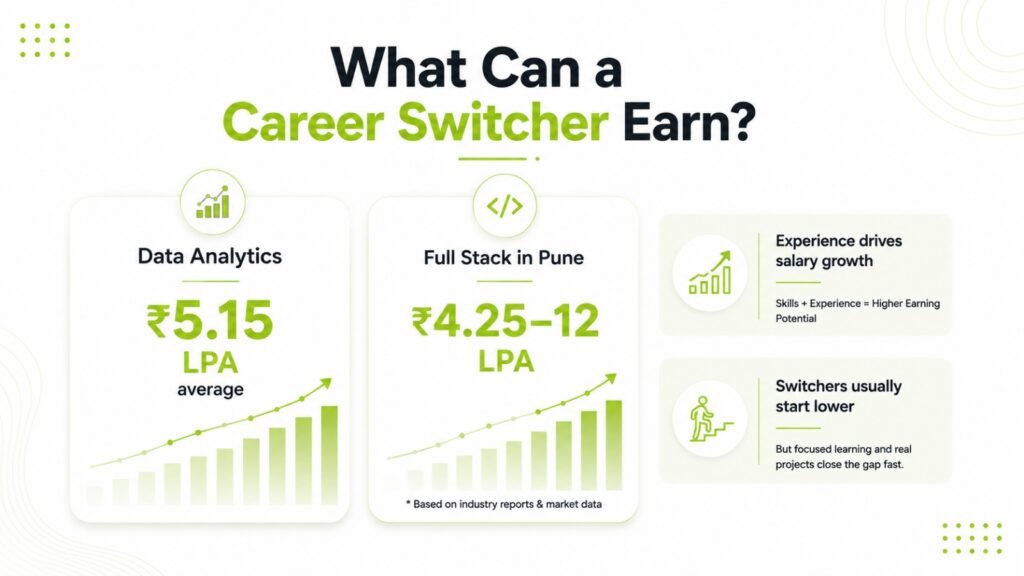
For data analytics, entry-level roles in India average around ₹5,15,010 per year (Source: Indeed India, Data Analyst salaries). It’s not a huge number on day one, but it moves fast once you have a year or two of real project work behind you, since the jump from entry-level to two years of experience in analytics tends to be steep.
For full stack development in Pune specifically, salaries typically fall between ₹4,25,000 on the lower end and ₹12,00,000 for more experienced hires, with the average sitting around ₹7,35,000 per year (Source: Glassdoor, Full Stack Developer salaries in Pune). As a switcher starting out, you’d be landing toward the lower to middle part of that range initially, and moving up as your project experience builds.
Neither number is going to make you rich in month one. But both are real, livable starting points in Pune specifically, and both grow meaningfully once you have actual work experience on your resume instead of just a course completion certificate.
Final Thoughts on Making the Career Switch to IT
A career switch to IT without a CS degree isn’t a shortcut, and it isn’t a myth either; it’s just a different road that takes real effort and an honest plan. Your BCom, your BA, your engineering degree, none of it was wasted. It’s the base you’re building on, not the thing holding you back.
If you’re ready to stop thinking about it and actually start, explore our courses and find the path that fits where you’re starting from.
If you are weighing which IT role to aim for, it is also worth reading why software testing is a high demand career. And if Python is where you want to start, see the Python course with Data Science and AI in Pune.