If you are searching for the best data analytics institute in Pune, you have probably already seen enough “Top 10” lists.
The problem is that most of them do not help you decide.
They give you a list of names, maybe a rating, course duration, and a few words about placement support. Then you are left trying to figure out what actually matters when you compare one institute with another.
We have seen students make this decision based on the wrong things. A flashy certificate, a long list of tools, or a placement claim can look impressive until you ask what happens inside the classroom.
So instead of giving you another ranking, we want to show you how to choose a data analytics institute in Pune properly.
Quick Answer: How do you find the best data analytics institute in Pune?
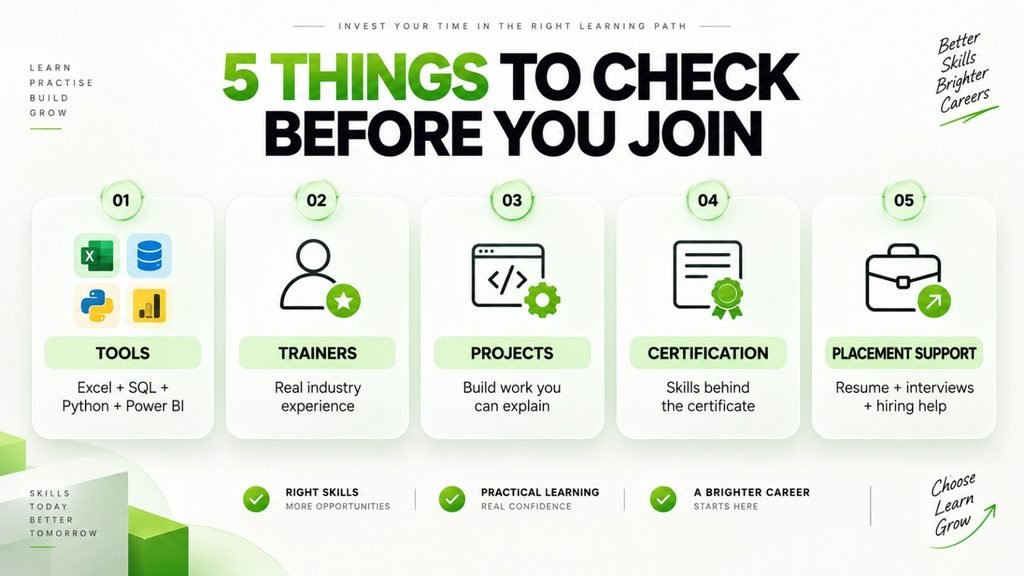
- Check the tools taught: Python, SQL, and Power BI matter more than an Excel-only syllabus
- Check who’s teaching: real industry background beats a vague “expert faculty” claim
- Check real project count: a genuine live project differs from a templated class exercise everyone submits
- Check whether certificates are backed by demonstrated skill, not just attendance
- Check what placement support actually includes: mock interviews and resume work, not vague promises
Why “Top 10” Lists Don’t Actually Help You Decide
There is nothing wrong with making a list of institutes.
The problem starts when the list becomes the decision.
Two institutes can both appear in a “Top 10 Data Analytics Institutes in Pune” article while offering very different learning experiences. One might spend weeks teaching SQL and building dashboards. Another might mention SQL, Python, Power BI, Tableau, and ten other tools in the syllabus but barely give students time to practise any of them.
Both can still look impressive on a webpage.
This is why we would not tell a student to simply pick the institute sitting at number one on a Google result or ranking article.
Start with the course itself.
Ask what you will learn, who will teach it, what you will build, how you will be assessed, and what support you will receive when you start applying for jobs.
That takes a little more effort than reading a list. It also gives you a much better chance of choosing something that fits your situation.
What to Look for in a Data Analytics Course in Pune: Tools and Skills
This is probably the first thing we would check when comparing a data analytics course in Pune.
Look at the actual syllabus.
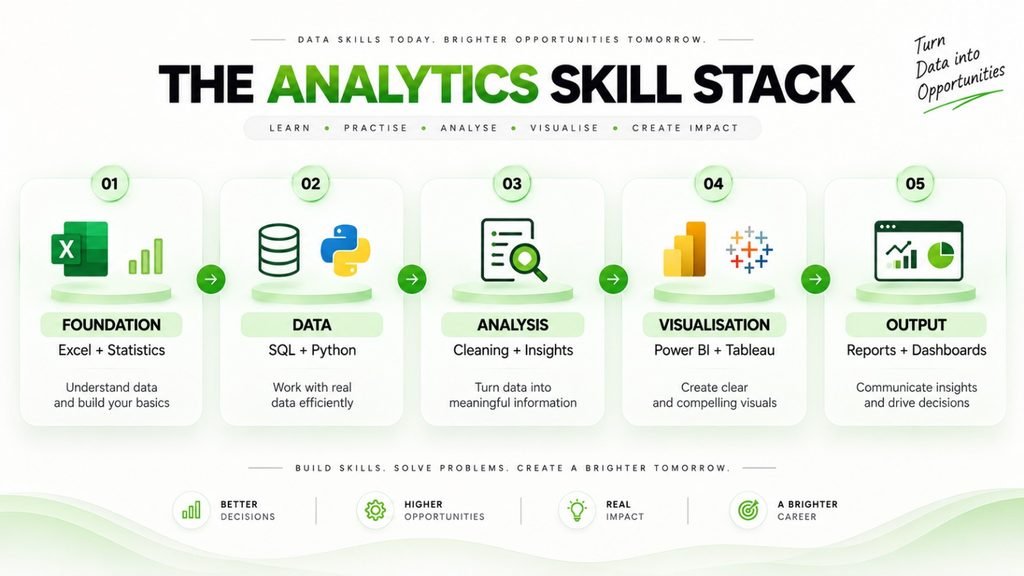
For a serious beginner-level analytics path in 2026, you should expect to see tools such as Excel, SQL, Python, Power BI, and Tableau, along with data cleaning, reporting, visualisation, and statistics.
The important part is not how many tool names appear on the page.
It is how deeply you will use them.
For example, seeing “Python” in a syllabus does not tell you much. Will you only learn basic syntax? Will you work with datasets? Will you use libraries for data manipulation? Will you solve an actual business problem with it?
The same applies to Power BI. Learning how to create one attractive dashboard is very different from learning how to clean data, choose useful KPIs, structure a report, and explain what the numbers mean.
This matters because the tools are connected to the work you are preparing to do. Indeed’s current India salary data puts the average Data Analyst base salary at ₹6,35,622 per year, with entry-level Data Analysts averaging ₹5,15,010 based on its reported salary data. The numbers vary by company, location and experience, of course, but they give you a useful reason to look beyond the certificate and ask what practical skills you are developing.
See Indeed’s current entry-level data analyst salary figures in India
So if an institute describes itself as offering a Python, SQL, Power BI course in Pune, open the syllabus and check what you will actually do with each tool.
A good question to ask is:
“Can I show you something I will build using this tool by the end of the course?”
If the answer is clear, that tells you much more than a long technology list.
How to Choose a Data Analytics Institute Based on Trainer Experience
“Expert faculty” sounds good. It tells you almost nothing.
When you are choosing a data analyst training program in Pune, ask who will be sitting in front of you every week.
What is the trainer’s industry background? Have they worked on real software, data, or business projects? Can they explain why a particular SQL query is useful rather than simply showing you the syntax?
This matters especially when you are a beginner.
At some point, your code will throw an error that the textbook example never mentioned. Your dashboard will show a number that does not make sense. Your SQL query will return duplicate rows, and you will have no idea why.
That is when trainer experience becomes useful.
A good trainer can connect the classroom concept to the kind of problem you might face at work.
So don’t hesitate to ask for trainer names and professional backgrounds before joining. You are not being difficult. You are checking what you are paying for.
How Many Live Projects Should a Data Analytics Course Include
“Hands-on training” appears on almost every technology course page now.
We would go one step further.
Ask: What will I actually build?
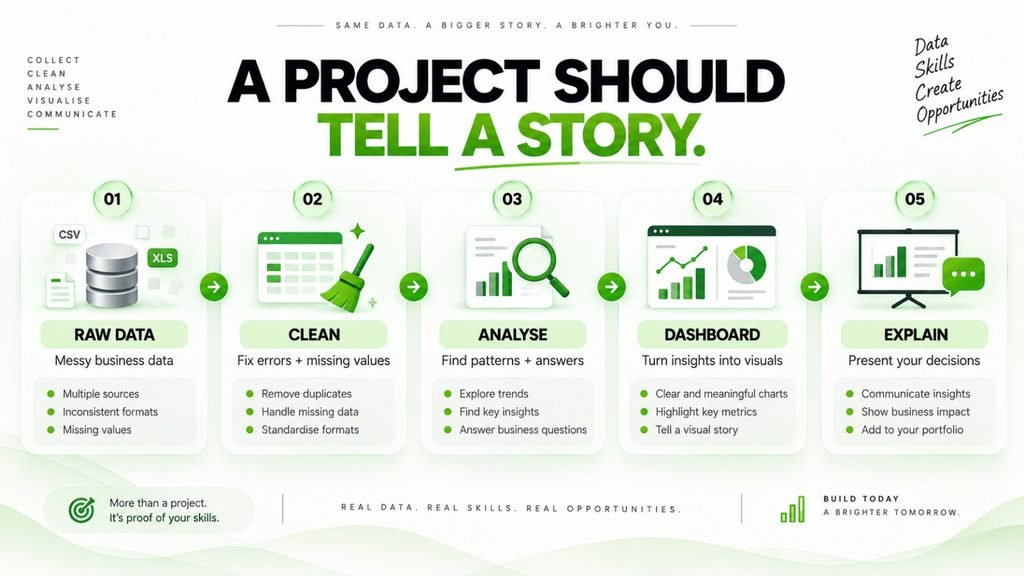
A genuine project should give you a problem to solve, data to work with, decisions to make, and something you can explain afterwards.
For example, imagine you are given sales data from several regions. You clean the dataset, use SQL to answer business questions, analyse trends and create a Power BI dashboard. Then someone asks why you selected particular KPIs.
That is useful project experience.
Compare that with a classroom exercise where every student follows the same instructions, uses the same dataset, and submits an identical dashboard at the end.
Both may be described as “practical.”
They are not the same thing.
The project also needs to be useful after the class ends. Can you put it in your portfolio? Can you discuss the problem and your approach during an interview? Can you explain what you personally did?
We have gone deeper into this in our guide on what a real portfolio should include, because a project becomes much more valuable when you know how to present the work properly.
If you are comparing institutes, ask for examples of previous student projects. Not just screenshots of dashboards. Ask what the student had to solve.
That one conversation can tell you a lot.
Is a Data Analytics Certification Worth It Without Practical Skills?
A certificate feels reassuring.
You finish the course, receive the document, and finally have something official to put on your resume.
But ask yourself what the certificate proves.
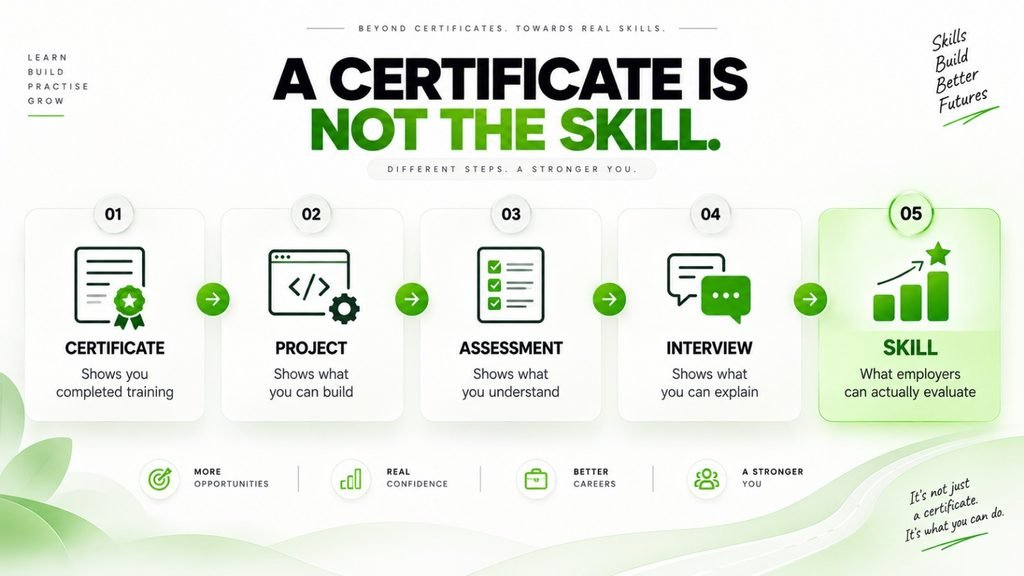
Usually, it proves that you completed a particular training program.
It does not automatically prove that you can write a SQL query, clean a messy dataset, or explain a Power BI dashboard to an interviewer.
This is why the question “Is a data analytics certification worth it?” needs a slightly more careful answer.
Yes, a relevant certificate can help show that you have completed structured training. But its value becomes much stronger when you can back it up with projects, practical work, and the ability to demonstrate what you learned.
HirePro’s 2026 State of College Hiring report shows that skills-first hiring is growing in India, although the shift is not complete. The report says 21% of corporates have fully adopted skills-first hiring, while 51% still allow CGPA to influence hiring decisions. That is a useful reminder that credentials still matter in some hiring situations, but demonstrated skills are becoming increasingly important too.
If you are trying to understand where certificates fit into an IT career, our guide on why a certificate alone isn’t the full picture goes deeper into the difference between formal qualifications, practical skills, and employer requirements.
When comparing institutes, ask what sits behind the certificate.
Projects? Assessments? Practical assignments? Interview preparation?
Those answers are more useful than the certificate design itself.
What Should a Data Analytics Curriculum Cover? Math, Statistics and More
You do not need advanced mathematics to become an entry-level data analyst.
You do need to understand the basics.
That means a good curriculum should not treat statistics as one chapter that gets rushed through because there are more exciting tools to cover.
You should understand concepts such as averages, percentages, ratios, probability, standard deviation, and correlation, and more importantly, know when those concepts matter while analysing data.
For example, if two groups have different averages, you should be able to understand what that difference means. If a dataset has unusual values, you should know that they may affect your analysis. If two variables move together, you should understand that correlation does not automatically mean one caused the other.
That is the level of foundation a beginner needs.
You do not need to spend months doing calculus before opening Excel or Python.
If math is the part making you hesitate, our guide explains how much math a data analytics course should actually cover and which concepts are useful for practical analytics work.
The same depth test should be applied to every part of the syllabus.
“Statistics” is not enough. “Python” is not enough. “Power BI” is not enough.
Find out what sits underneath those labels.
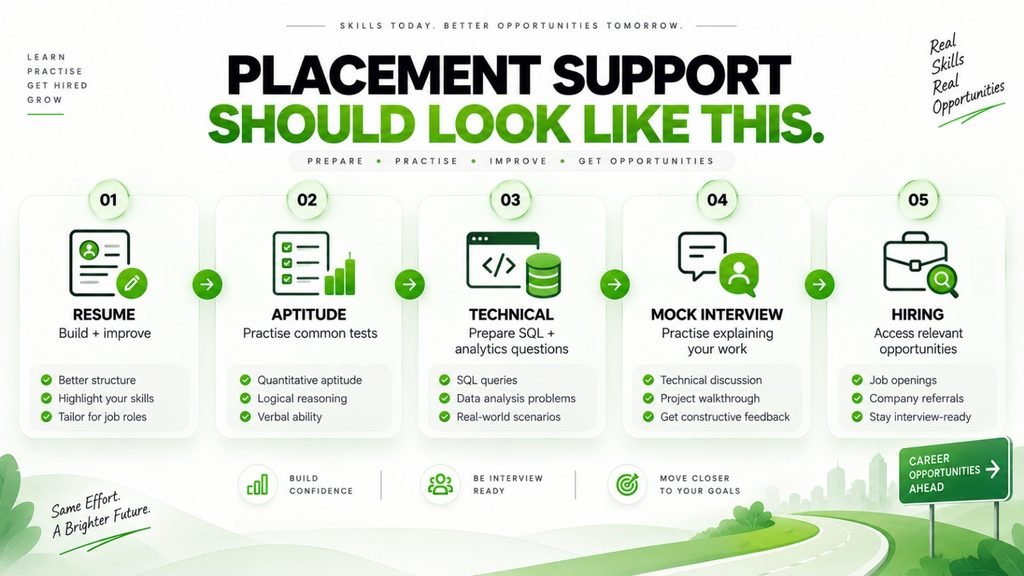
How to Evaluate Placement Assistance at a Data Analytics Institute
This is where we would tell you to slow down.
A brochure saying “placement assistance” can mean very different things depending on the institute.
Ask what that support includes.
Does the institute help you build or improve your resume?
Are there mock interviews?
Do trainers help you prepare for technical questions?
Do students get access to relevant hiring drives?
Is there aptitude preparation?
Does someone help you understand how to present your projects?
These are concrete forms of placement support.
A placement guarantee is a completely different claim, and you should be cautious about any institute making promises that sound too easy.
You still have to learn the skills, complete the projects, attend interviews, and improve based on feedback. No training institute can control what an employer decides after an interview.
For a student, useful placement assistance should make that process less confusing and help you become better prepared for it.
If you want to see how a program measures up against everything covered so far, tools, trainers, projects, and placement support, a free demo class is the fastest way to check it firsthand rather than take a brochure’s word for it.
Putting It Together: A Quick Checklist Before You Enrol
By now, you should have a much better way to compare a shortlist of the best data analytics institutes in Pune.
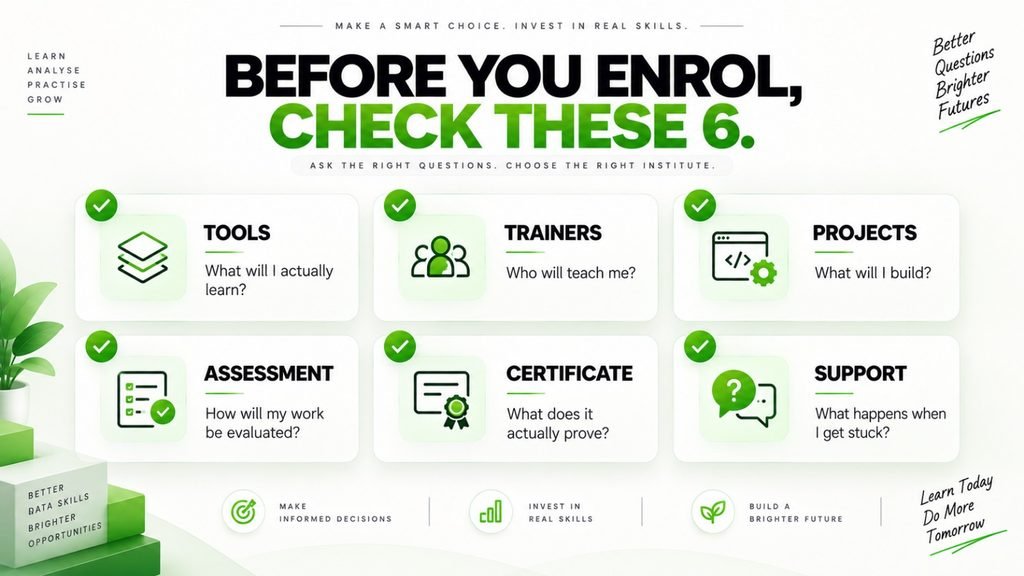
Before paying the fee, ask these questions:
1. What tools will I learn?
Look for meaningful coverage of Excel, SQL, Python, Power BI, and Tableau, depending on the career path and course structure.
2. How much practical work is included?
Ask how many projects you will complete and whether you can use them in your portfolio.
3. Who will teach me?
Check the trainers’ actual industry experience rather than relying only on titles such as “expert” or “mentor.”
4. How is my work evaluated?
Ask whether you will receive feedback on projects and assignments or simply complete exercises and move to the next topic.
5. What does the certificate represent?
Find out whether it comes after practical training and assessment or simply course attendance.
6. What does placement support include?
Ask about resume building, mock interviews, aptitude preparation, and access to hiring opportunities.
7. What happens when I get stuck?
This is an underrated question.
If you are struggling with SQL for three days, who helps you? If your Power BI dashboard is wrong, can you get feedback? If you cannot explain your project in an interview, does anyone help you fix that?
Those answers tell you what learning at the institute will feel like.
If you want one real program to test against this checklist, you can also look at FirstBit’s Python and Data Science program and compare its curriculum, practical work, trainer support, and career assistance with the criteria above.
Don’t pick it because we told you to.
Open the page. Check the details. Ask questions. Then decide whether it holds up for you.
Final Thoughts
Choosing the best data analytics institute in Pune becomes much easier once you stop treating the institute’s ranking as the main decision.
Look underneath the brochure.
Check the tools. Check the trainers. Ask about the projects. Understand what the certificate represents. Find out what placement assistance really includes.
Then compare the answers.
You might find that an institute ranked highly on a generic “Top 10” page is not the right fit for you. You might find that another program makes much more sense once you look closely at what happens inside the classroom.
That is the point of this checklist.
The right institute is the one that holds up against these questions, not the one at the top of a list. If you’d like to walk through FirstBit’s Python and Data Science program against everything covered here, book a free demo class and judge it for yourself.