At some point in every Java Full Stack learner’s journey, the backend starts feeling manageable. You’ve got a decent handle on Core Java, Spring Boot makes sense now, and SQL doesn’t scare you anymore. Then someone says “okay, now pick a frontend framework,” and you go looking for help online, and instead you fall into an Angular vs React debate that’s been running for about a decade with no end in sight.
Here’s the thing, though. Most of those debates are opinion, nostalgia, or straight-up fandom. What you actually need isn’t someone’s personal favorite. You need to know which one gets you hired, specifically as a Java Full Stack developer, specifically if you’re job hunting around Pune. That’s a much narrower, much more answerable question, and that’s what this post is actually about.
Quick Answer: Which Should You Pick?
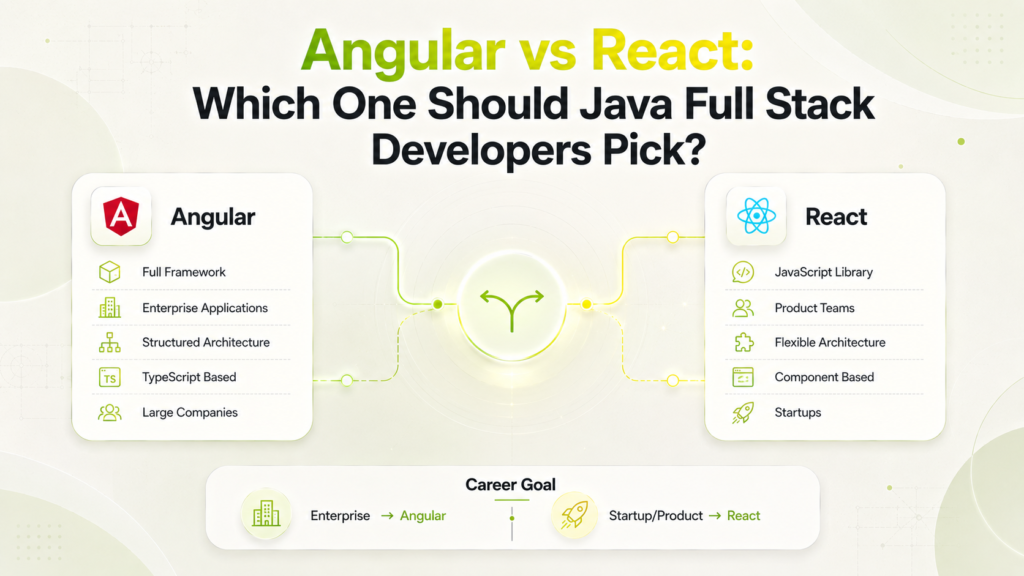
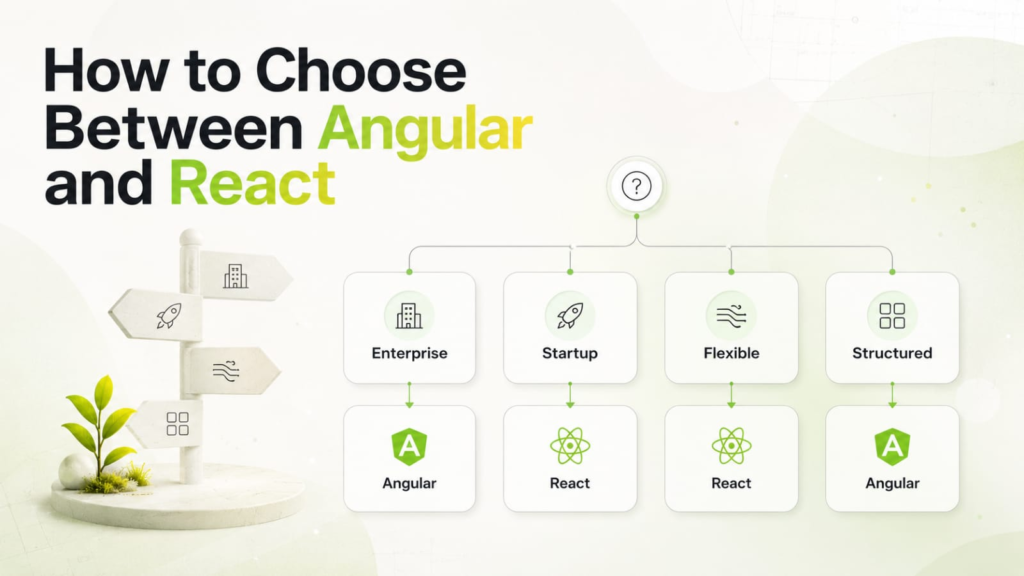
If you’re short on time, here’s the direct version. If you’re aiming for larger, established companies or enterprise-style product teams, which make up a good chunk of Pune’s IT parks, Angular shows up more often in job requirements. If you’re more drawn to startups or smaller product companies, React tends to come up more. Neither choice locks you out of the other path permanently, and both are genuinely solid, employable skills. The rest of this post explains why, and helps you figure out which fits you better right now.
What Angular Actually Involves
Angular differs a little from both React and Vue since this is not a simple JavaScript library, but a full-fledged framework that already has its own understanding of how applications must be constructed. This may look restrictive, but in the case of big applications, this is one of the most valuable qualities of Angular.
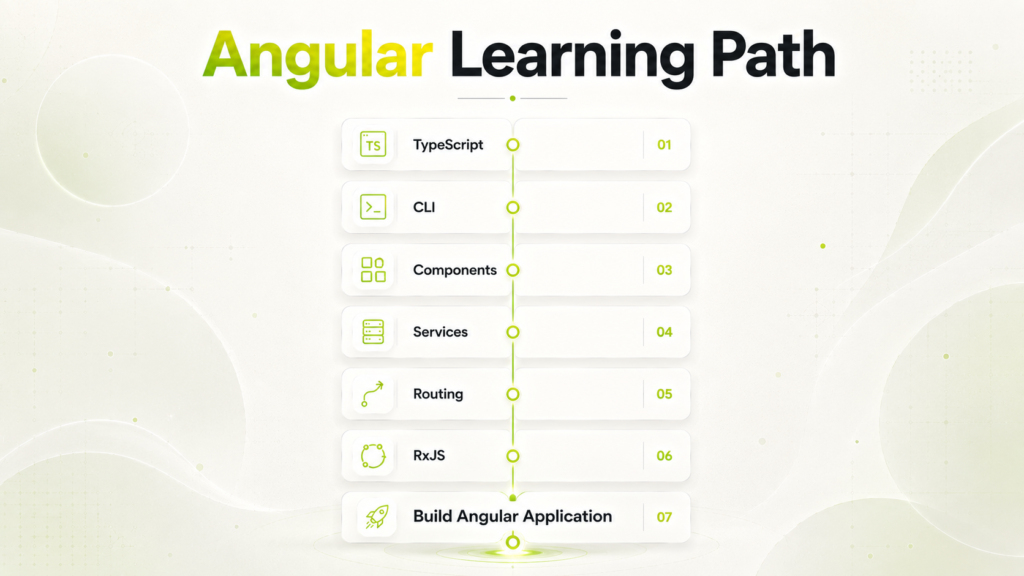
When you study Angular in the FirstBit course, you will not immediately start working on applications. You will first become familiar with TypeScript since Angular relies on it. You will learn the basics, such as data types, classes, interfaces, and generics, for some time before proceeding. Even though this may seem boring at first, it will definitely be useful when you start working with Angular.
Next, you will use Angular CLI to build applications and do other routine tasks. Finally, you will get down to work and start working on components, binding data with UI elements, working with forms, and making parts of the application work together. As well, you will have to become acquainted with services and dependency injection, but this is not as scary as it seems.
Another important concept would be routing, since in most practical implementations, there are several pages. Also, you are going to deal with RxJS and Observables, which are used to work with API calls and other async tasks. This part of the material seems confusing to many newcomers at the beginning; however, once you develop several apps, it will become clear.
Of course, there is no need to pretend that Angular is an easy framework to start learning. It requires an understanding of more principles at the very beginning compared to React. However, the reward is that after you become accustomed to its architecture, developing and maintaining complex apps might become easier and more structured.
What React Actually Involves
React does things differently. As a library, and not an entire framework, React is excellent at working with views (the part of the app that is displayed), but lets you make all other architectural choices, such as routing or managing state in large applications, on your own or collectively with your team.
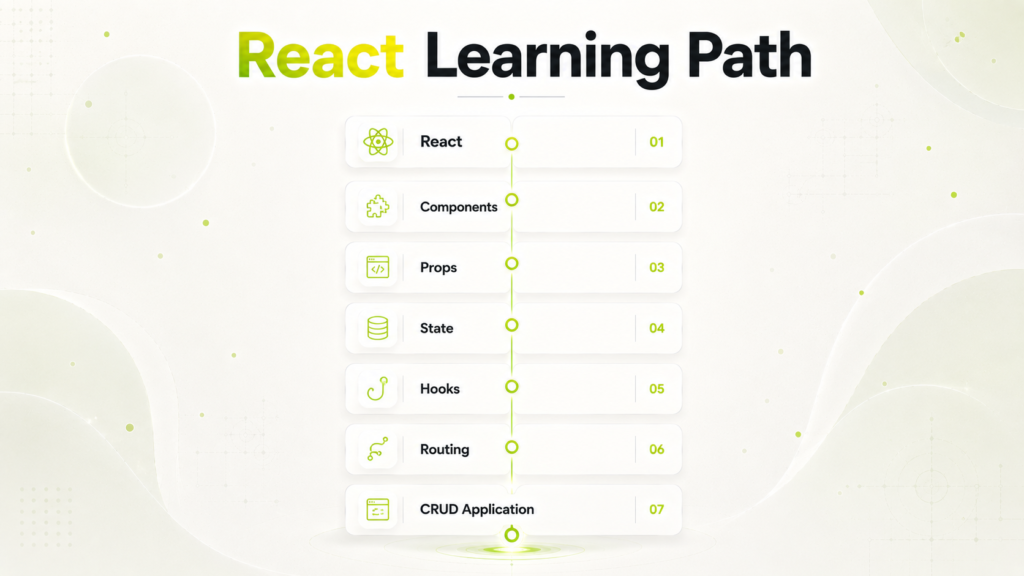
In the React path of the curriculum, you first learn about basic concepts, React itself, and reasons why teams choose it. Then you learn about components, props, and state, how to handle events, and how to navigate through your application (routing). Finally, you will dive into Hooks the modern way of implementing logic in function components and develop and deploy a complete CRUD application, i.e., an app capable of creating, reading, updating, and deleting data from your database.
The learning curve in React seems to be a little softer in the beginning. You can achieve something visible on your screen quite quickly. The downside is that when your application grows, you (and your team) have to make more and more architectural decisions by yourself because React doesn’t give you any documentation like Angular.
Angular vs React: Side by Side
If you want the whole comparison in one glance, here it is.
| Factor | Angular | React |
| Type | Full framework | Library (needs extra tools for full app structure) |
| Learning curve | Steeper at first, more built-in structure | Gentler start, more flexibility as you grow |
| Language | Built around TypeScript | Works with JavaScript or TypeScript |
| Common in | Enterprise applications, larger product companies | Startups, product-first companies |
| What you’ll learn at FirstBit | Angular 17, CLI, RxJS, forms, routing | React fundamentals, hooks, building a CRUD app |
Worth being honest here: which framework shows up more in Pune specifically does shift depending on the company and the year, and we’d rather not throw out a fake percentage just to sound authoritative. What we can tell you is that both frameworks appear regularly enough in local full-stack postings that learning either one, properly, gets you in the conversation for real roles.
Which One Should You Learn First as a Java Full Stack Developer?
This is truly what lies behind all the comparisons, so let’s talk about it practically.
If you’ve got a vague sense that you want to work at a bigger company with a history, or you simply love the framework where you’ve got guidelines, the structure provided by Angular will likely be a better fit for your day-to-day work. While it requires a steeper learning curve initially, the payoffs are huge once you’re working on a larger project within a bigger codebase.
If you prefer smaller product teams with quick iterations, or you need quick results to build your confidence and knowledge, then React will be much easier and quicker for you to start with. Even though you’ll learn your “structure” along the way with experience, you’ll have something practical built faster.
And if you genuinely have no strong pull either way, and a lot of people don’t at this stage, the simplest tiebreaker is to actually go look at ten or fifteen Java Full Stack job postings for companies you’d realistically apply to, and see which framework shows up more. That’s a more useful signal than any blog post’s opinion, including this one.
A quick way to do this in fifteen minutes: Search “Java Full Stack Developer” on a job portal restricted to Pune, and make a tally for the first fifteen posts which appear to be legitimately relevant to your experience level, with just two columns, one for Angular and another for React. It’s no scientific measure, but it takes away the uncertainty from an otherwise abstract choice and gives you what is actually in demand today rather than something that was in demand two years back when most arguments were written.
One more point worth stating explicitly: This is definitely not going to be a point of no return. Once you get a good hold of one of the modern frameworks for the frontend, learning the other becomes just a fraction of the work done earlier to learn the first one.
Mistakes People Make When Choosing a Frontend Framework
We see the same few decision mistakes come up again and again, and most of them are easy to avoid once you know what to look for.
The first is choosing based on what’s trending on social media rather than what’s actually being hired for locally. Framework popularity online and framework demand in Pune’s job market are related, but they’re not the same thing, and chasing whatever’s loudest on a tech forum this week isn’t a great long-term strategy.
The second is spending weeks agonizing over the decision instead of just picking one and starting. Both frameworks are good choices. The learner who commits to either one and actually builds three solid projects will be miles ahead of the learner who’s still comparing pros and cons a month later.
The third is picking a framework and then never really finishing it, jumping to the other one halfway through because it “seemed easier,” and ending up with a shallow understanding of both instead of a solid grasp of one. If you switch, switch on purpose, not out of frustration with a temporarily confusing concept. Every framework has a phase where it feels confusing before it clicks.
And the last one, which is more of a mindset thing: treating the frontend framework choice as the most important decision in your whole full-stack journey. It isn’t. Your Core Java, your understanding of REST APIs, your comfort with SQL, those fundamentals matter more to your long-term career than which frontend framework sits on top of them.
Building Your First Project: Ideas for Each Framework
Once you have chosen a path, the quickest way to feel comfortable about what you are doing is to create a working piece of software, not to go through more tutorials.
The Angular approach should start with creating a task management application with user authentication because it will force you to use components, forms, services, and routing. The more ambitious choice for your very first Angular application is creating an inventory or expense tracker based on data from the Spring Boot back-end application that you’ve already created.
The React path starts with building a to-do list that keeps data locally, but if you are feeling ambitious enough, building a small e-commerce website with product listings that retrieve data from an API will get you familiar with hooks, conditional rendering, and asynchronous data usage. If you have already built a Spring Boot back-end application, connecting your to-do list or e-commerce application to that back end is the next logical step.
Either way, the goal isn’t a polished, production-ready app. It’s something you built yourself, understand completely, and can talk through confidently in an interview. If you want more structured project ideas to pull from on the backend side, we’ve put together a full list here: 5 Java Spring Boot Projects You Must Build.
Common Myths About Angular vs React
A few things keep floating around online that just aren’t true anymore, if they ever were.
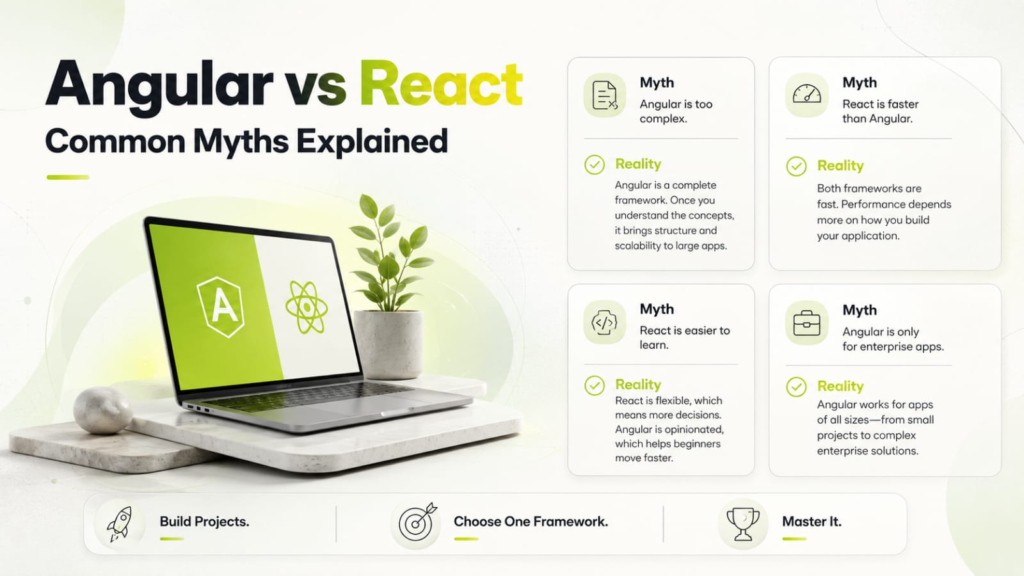
“Angular is dying.” Not really. It’s very much in use in enterprise software development, and there have been actual improvements made with Angular 17. It’s just not what people are talking about on Twitter, which does not make something irrelevant.
“React is for beginners or small projects only.” Not quite. There are some of the biggest and busiest web applications built using React out there, and it scales well enough; developers just have to be more careful about structuring their projects because React does not do that by itself.
“You have to know both in order to get hired.” Rarely applies to junior or even mid-level positions. Very few job listings require knowledge of both; usually, one is expected. Knowing both might help you out later in your career, but it is not necessary to start.
“Whichever one you pick first locks you in forever.” We already covered this above, but it’s worth repeating because it stops a lot of people from even starting. It doesn’t lock you in. It’s a starting point, not a life sentence.
How FirstBit’s Java Full Stack Program Handles This Choice
Given that this is a genuinely common point of confusion, our Java Full Stack curriculum includes both tracks, Angular 17 and ReactJS, so you’re not forced to guess blindly before you’ve even seen either one in action. Trainers also help students think through the decision based on where they’re aiming to work and what’s currently showing up in the local job market, rather than just handing over a generic recommendation.
Alongside the technical side, the program includes live, instructor-led classes, hands-on projects in whichever framework you choose, and Placement Assistance once you’re job-ready. The goal is that by the time you’re interviewing, this decision feels settled and confident, not like something you’re still second-guessing.
Still not sure which path fits you? Book a free demo class and talk it through directly with a trainer before committing to either framework. No pressure, just clarity.
Final Thoughts
At the end of the day, this decision matters less than it feels like it does right now. Both Angular and React are real, employable skills, and the frameworks themselves are less important to your career than how deeply you actually learn whichever one you pick. Rushing past the fundamentals to “just get through” a framework is a bigger risk than picking the “wrong” one.
What actually helps is having someone who’s seen this decision play out for hundreds of students before you, someone who can look at your goals and the current job market and give you a straight answer instead of an internet debate. That’s exactly what structured guidance is for.
Our Java Full Stack program includes both Angular 17 and ReactJS as part of the same curriculum, with live projects in whichever framework you choose and Placement Assistance once you’re ready to start applying. See the full Java Full Stack course details to check how it lines up with your goals.