If you’re reading this because you’re seriously thinking about quitting right now, take a breath first. Seriously. That’s a completely normal place to be, not a sign you’re bad at this, and definitely not proof you weren’t cut out for coding. Most people who eventually become genuinely good developers hit this exact wall somewhere in their first month. You’re not the exception here. You’re the rule.
So why do beginners quit learning Java so often, and is it normal to quit learning to code more than once before it sticks? Yes, on both counts, and this post gets into why, the specific mistakes that make it worse, some Java learning tips for beginners that actually hold up, and a straightforward way to stick with it instead of becoming one more dropout statistic.
Quick Answer: Why Do Most Beginners Quit Learning Java?
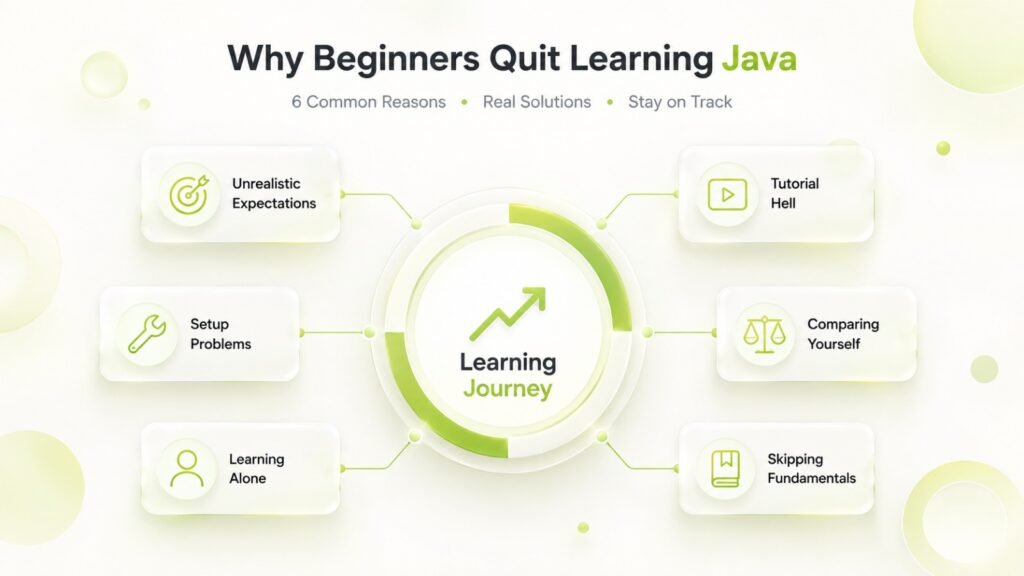
Most beginners quit for a handful of specific, avoidable reasons. Expecting to be job-ready in a few weeks. Watching hours of tutorials without writing much code themselves. Getting stuck on installation and setup before they’ve even written a real program. Comparing their pace to unrealistic success stories online. Learning entirely alone with nobody to ask when they get stuck. None of that comes down to intelligence, or “not being cut out for coding.” They’re fixable habits, and once you can name them, they get a lot easier to dodge.
Common Mistakes Beginners Make Learning Java
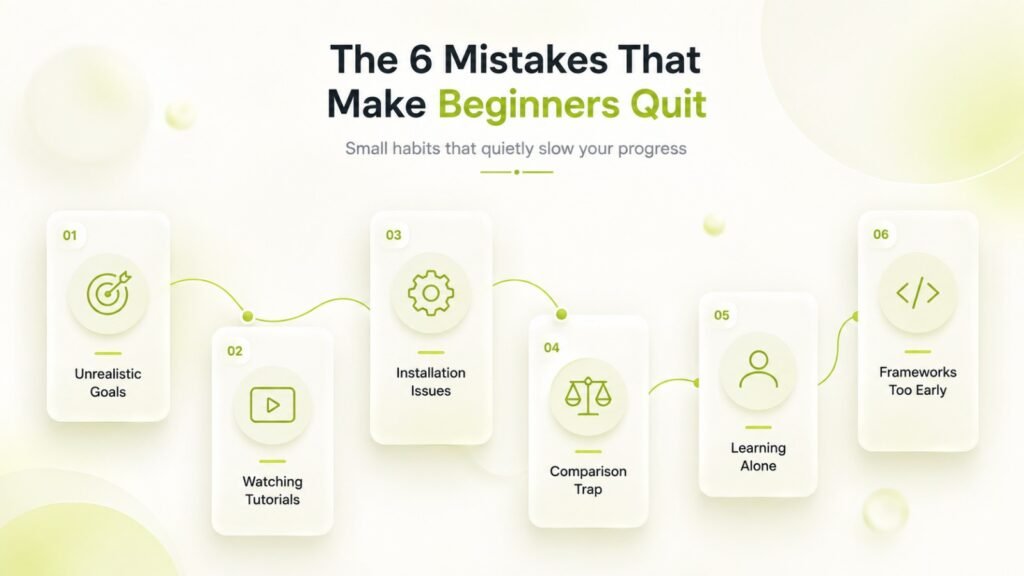
Let’s go through each one properly, because knowing the pattern by name is honestly half the battle. This isn’t about why Java is hard for beginners in some large abstract sense. It’s about small, everyday habits quietly derailing progress without anyone noticing until week three.
1. Expecting to Be Job Ready in a Few Weeks
Course ads and social media love implying you can go from zero to hired in a month or two. That happens sometimes, sure, but there’s almost always unseen context behind it, a related background, way more hours than advertised, or just good timing in the job market. When your own progress doesn’t match that fantasy pace in the first 30 days, it feels like failure. It isn’t. It’s just a marketing timeline colliding with a real one.
2. Too Much Watching, Not Enough Typing
Classic tutorial hell. You watch a two-hour video, follow along, nod along, feel like you get it, then try to write something similar from scratch the next day and freeze completely. Watching feels productive because you’re consuming information. But the actual skill only builds when your own fingers are doing the typing, not someone else’s on screen.
3. Getting Stuck on Setup Before Writing a Single Line
Nobody warns beginners about this one enough, and it’s honestly one of the sneakiest quitters. Installing the JDK, wrestling with an IDE, staring down a confusing error before you’ve even written “Hello World,” it’s genuinely discouraging, and it hits right when your motivation is at its peak. Losing your first few sessions to setup instead of actual learning is deflating, even though it has nothing to do with whether you can code.
4. Comparing Your Pace to Curated Success Stories Online
“I learned to code in three months and got hired” posts are real, sure, but they almost never show the full picture. Prior experience, hours nobody mentions, an unusually good hiring window at the time. Measuring your own week two against someone else’s highlight reel is a losing game, every single time.
5. Learning Completely Alone With No One to Ask
When you’re learning solo, one confusing error message or one concept that just won’t click can stall you for days. That stuck feeling, with nowhere to turn, is exactly where a lot of people quietly give up, not because the material was too hard, but because there was no path through it alone.
6. Jumping Into Frameworks Before Fundamentals Are Solid
This one’s very Java-specific. Spring Boot feels exciting because it feels like “real” development, so plenty of beginners rush toward it before Core Java and object-oriented programming actually feel comfortable. Frameworks click a lot faster once the fundamentals are second nature. Skip ahead too early, and you’re just confused on two fronts instead of one.
The Science of Why This Feels So Hard (And Why That’s Normal)
Here’s something genuinely reassuring, and it’s backed by real research, not motivational fluff. Skill development doesn’t come from raw hours logged; it comes from focused, structured effort paired with feedback, what researchers actually call deliberate practice. That’s exactly why passively watching tutorials can eat up real time and still feel unproductive. You’re putting in hours, just not the kind that build the skill. This comes from decades of research on deliberate practice, and it explains a lot about why “I watched so many videos and still can’t code anything” is such a common complaint.
There’s a second piece worth knowing too. Stanford’s research on growth mindset has consistently found that people who treat early struggle as a normal part of learning, rather than proof they’re not cut out for it, are the ones who actually stick around long enough to get good. In plain terms, that frustration you’re feeling right now isn’t a warning sign. It’s what learning something genuinely new is supposed to feel like. For basically everyone. Not just you.
If learning on your own has started to feel overwhelming, you don’t have to figure everything out alone. A structured learning environment, regular feedback, and experienced mentors can make those frustrating early weeks much easier to navigate.
Book a free demo class to see how our instructors guide beginners through Core Java step by step before moving on to advanced topics.
The 30-Day Reality Check: What “Normal” Actually Looks Like
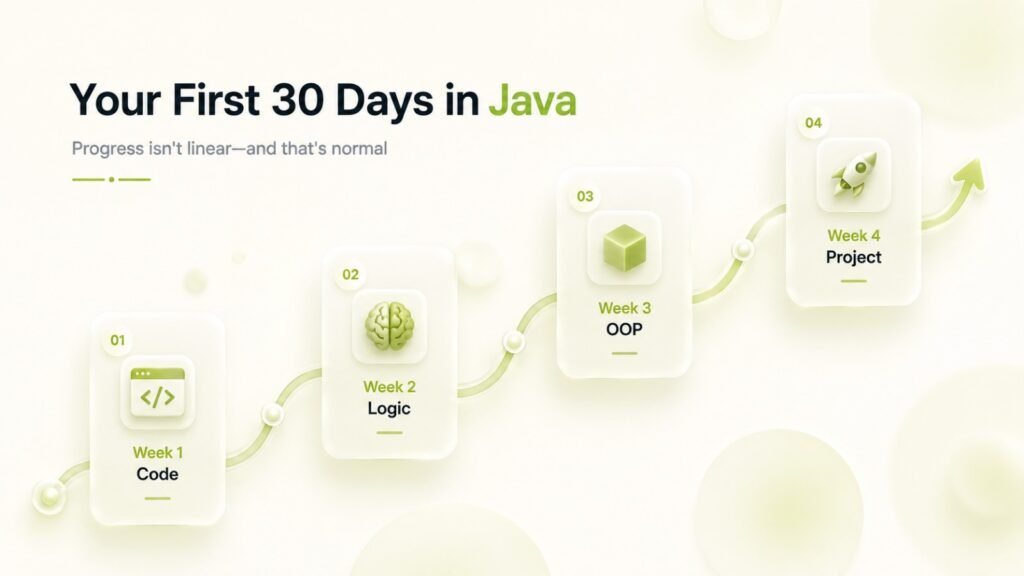
This is how it really happens, not how people try to present themselves on social media. Sometimes you’ll be sitting, coding for an hour, and feeling that nothing went right. This happens to all people; it does not mean that you are failing in anything. Learning object-oriented programming specifically can take much more time than people think it will. Such terms as encapsulation and polymorphism might still be unclear until you use them several times in practice, not only read the definition for the fifth time.
In the first 30 days of the learning process, there won’t be a clear progress line. It’ll be like two steps forward and one step back, then one day of being totally confused, and finally some breakthrough which will make everything you did before make sense. If this is what is happening to you, it doesn’t mean you are doing something wrong.
Signs You’re Making Progress (Even If It Doesn’t Feel Like It)
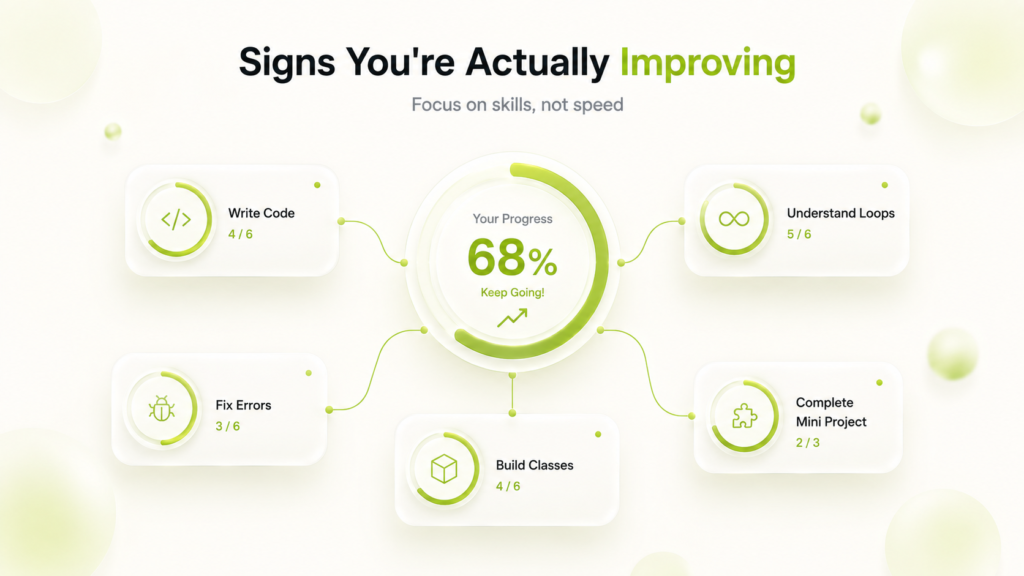
| If you can… | You’re making good progress |
| Write a simple Java program without copying every line | ✅ |
| Explain what variables, loops, and methods do | ✅ |
| Fix basic syntax errors on your own | ✅ |
| Create a class and an object | ✅ |
| Build a small calculator or number guessing game | ✅ |
If you can do most of these after your first month, you’re progressing well, even if you don’t feel “ready.” Learning Java is about building a strong foundation, not racing through topics.
How Long Does It Take to Learn Java? A Realistic Week-by-Week Look
This question comes up constantly, and most answers online are either wildly optimistic or annoyingly vague. Here’s a more honest breakdown for Java for complete beginners, based on consistent, daily practice rather than sporadic weekend bursts.
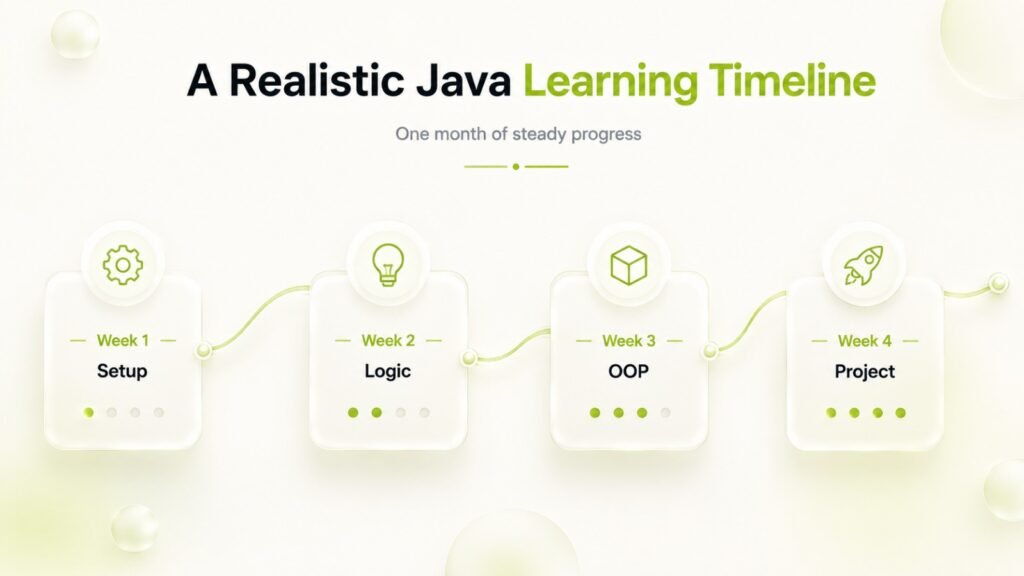
| Week | What You’ll Learn | What You’ll Be Able to Do |
| Week 1 | Java setup, syntax, variables, data types, operators | Write and run simple Java programs like “Hello World” and basic calculations. |
| Week 2 | Loops, conditionals, methods, arrays | Solve beginner coding problems and build small console applications. |
| Week 3 | Classes, objects, constructors, encapsulation | Understand object-oriented programming and create simple Java classes. |
| Week 4 | Inheritance, polymorphism, exception handling | Build a small Java project independently using the concepts you’ve learned. |
This timeline assumes you’re practising consistently for around 1 to 2 hours a day. If you’re balancing college, work, or other commitments, your progress may be slower, and that’s completely normal.
None of this is a race. If you want to learn Java without giving up, it has far less to do with speed and far more to do with simply not stopping during the foggy weeks, since that’s exactly when most people quit, right before things were about to click.
If you’re unsure whether you’re progressing the right way, join a free demo session and see how our instructors help beginners stay on track with practical coding exercises and live guidance.
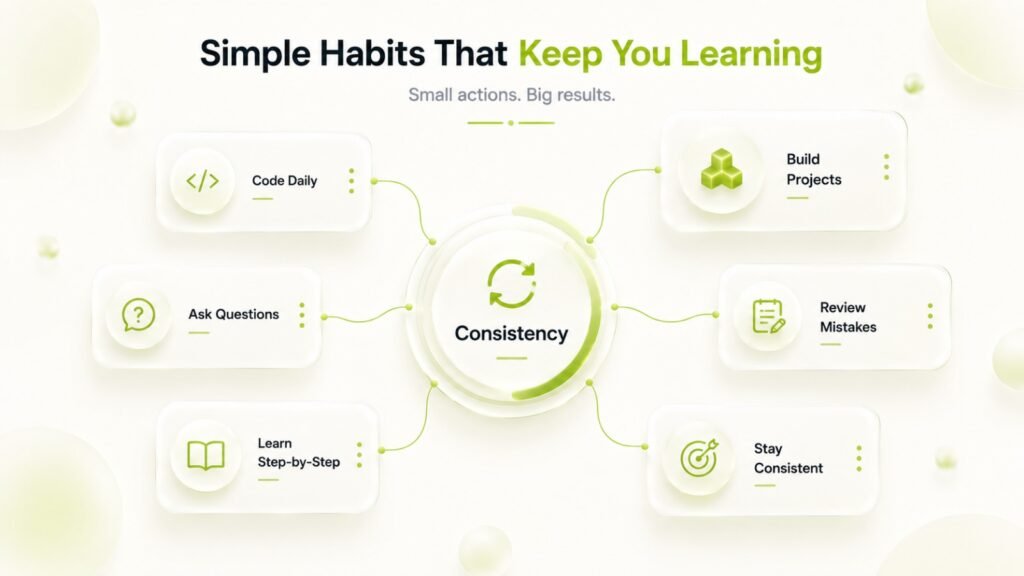
How to Not Give Up Learning Java: A Quick Checklist
If you only take one section from this whole post, make it this one.
- Set a realistic timeline based on skills gained, not days elapsed
- Write code every single day, even just ten minutes, instead of watching more tutorials
- Get help with setup and environment issues early instead of troubleshooting alone for hours
- Track your own progress against your own starting point, not someone else’s highlight reel
- Find any consistent source of support, a mentor, a study group, a structured course, anything that isn’t total isolation
- Follow a realistic, staged learning order instead of jumping straight to frameworks
That last point matters more than people expect. If you want to see what a sensible, step-by-step order actually looks like instead of guessing your way through it, we’ve laid one out in full here: a realistic, staged learning order.
What to Actually Do in Your First Session
If you haven’t started yet, or you’re restarting after quitting once already, here’s a better way to spend that first session than most beginners default to.
Skip the two-hour “Java for beginners” mega-tutorial. Just get your setup working first: JDK installed, an IDE open, one working “Hello World” on screen. That alone is a real win, genuinely; plenty of people quit before they even get this far. Then, instead of reaching for more content, go change something in that program yourself. Print a different message. Add a second line. Break it on purpose and actually read the error message instead of flinching away from it. Error messages look intimidating at first, but they’re really just the compiler telling you exactly what went wrong, which is a lot more useful than silence would be.
That one session get it running, then poke at it yourself, teaches you more about how Java actually behaves than an hour of passive watching ever would. Small shift. But it’s the exact shift that separates people who stick with this from people who quietly drift away in week one.
If You’ve Already Quit Once, Here’s What to Do Differently This Time
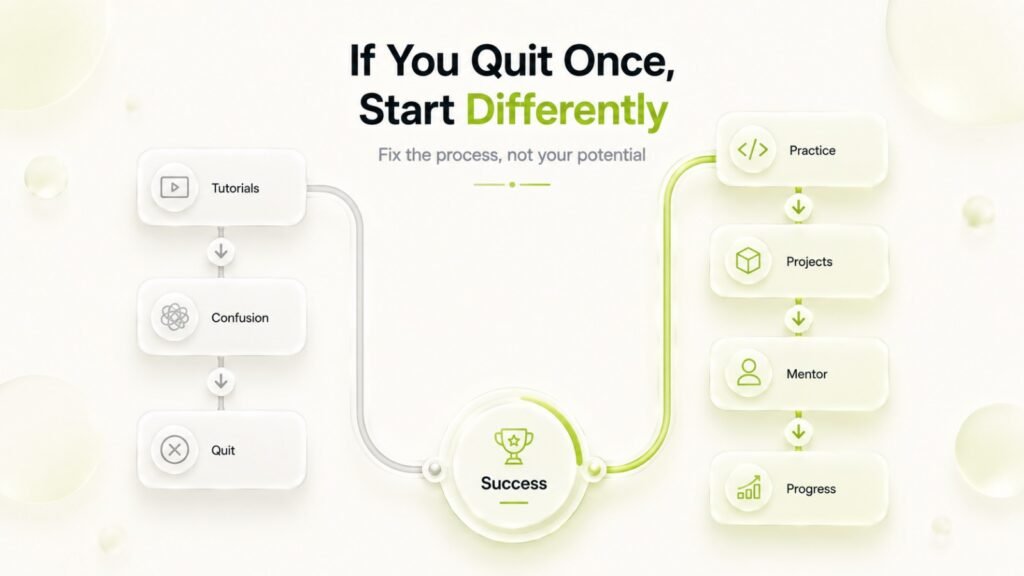
A lot of people reading this aren’t starting for the first time. They’re considering a restart after quitting once, maybe a few times. If that’s you, here’s the good news: you’re not actually starting from zero. You’re starting with real, hard-won information about what didn’t work last time, which is more than most first-timers walk in with.
Before diving back in, take a few minutes and honestly name which mistake actually got you last time. Tutorial hell, watching without typing? Total isolation, no one to ask when you got stuck? Jumping toward frameworks before Core Java felt solid? Naming it matters, because “just try harder” rarely fixes a structural problem. If isolation got you last time, more willpower alone won’t fix that, but finding a mentor or a structured course will. If tutorial hell got you, a different set of tutorials won’t fix it either. Actually typing code will.
Restarting with the same approach that already failed once is usually how people end up quitting a second time. Restarting with a targeted fix aimed at your actual failure point is what breaks the cycle.
How FirstBit Helps Beginners Actually Stick With It
Every mistake covered above gets easier to dodge with the right structure around you. Our live, instructor-led classes mean you’re never stuck alone on a confusing error for three days straight; there’s always someone to actually ask. The curriculum is paced deliberately, so nobody’s tempted to rush into Spring Boot before Core Java actually feels solid, and there’s real accountability built in, the kind that’s genuinely hard to manufacture when you’re learning entirely by yourself at 11 pm.
If you’re not even sure this career direction is right for you yet, it helps to first understand what the role actually looks like once you get there, rather than just grinding through the hard early weeks without knowing what you’re actually working toward.
And if you’ve been searching for Java classes for beginners in Pune, or a Java course for beginners in Pune that actually accounts for how discouraging the first month can genuinely be, that structure and support is exactly the gap it’s meant to close. Not just more content to watch. A real path through it.
Final Thoughts
Quitting Java in the first 30 days usually isn’t about ability at all. It’s unrealistic timelines, too much passive watching, early setup frustration, unfair comparisons, and trying to push through completely alone. Every single one of those is fixable. None of them mean you’re not cut out for this.
Learning Java isn’t about finding the perfect tutorial. It’s about building the right habits, practising consistently, and getting help when you’re stuck.
If you’re looking for a course that combines live instruction, hands-on projects, and mentor support, explore our Java Full Stack Course and see how we help beginners build real programming skills with confidence.
If you are still deciding whether to commit, it is worth reading whether learning Java is still relevant.