Someone in your batch probably sent you an article last week saying AI is going to replace data analysts. And honestly, maybe you half-believed it.
Here is the version nobody is packaging neatly: yes, AI is changing this field. Fast. But the direction it is changing in is not what the scary headlines suggest. NASSCOM flagged a shortfall of over 2 lakh data analytics professionals in India this year. That is not a field on its way out. That is a field where demand is growing faster than people are entering it and Gen AI is making that gap wider, because now even mid-size companies that never had a dedicated analyst before are hiring one.
So no, data analysts are not getting replaced. But something is changing, and if you ignore it, that is when it becomes a problem.
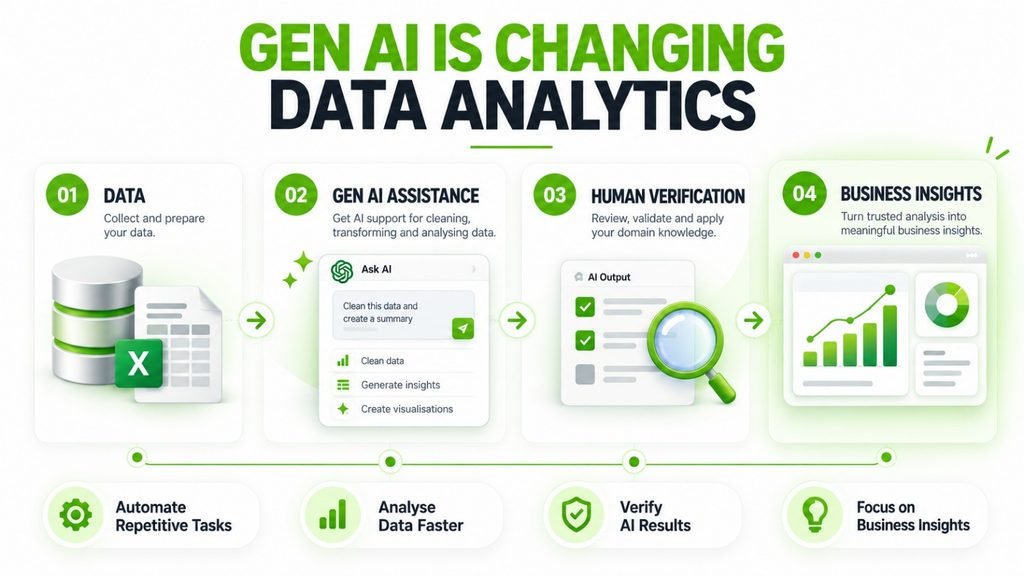
The short version:
Gen AI is removing the repetitive, syntax-heavy parts of analyst work: writing the same SQL queries, cleaning datasets, formatting the same report every week. What it is not removing: the judgment, the context, the “something looks off here before I even run the query” instinct that comes from actually understanding a business.
Analysts with SQL, Python, Power BI, and Gen AI tool experience earn 25 to 35% more than those without, based on 2026 salary data across Glassdoor, Naukri, and AmbitionBox. Gen AI fluency is now one of the five core skills employers screen for in data analyst job descriptions.
The risk is real, just not to the career. It is to the specific analyst who treats 2026 like it is still 2021.
The part that actually changed
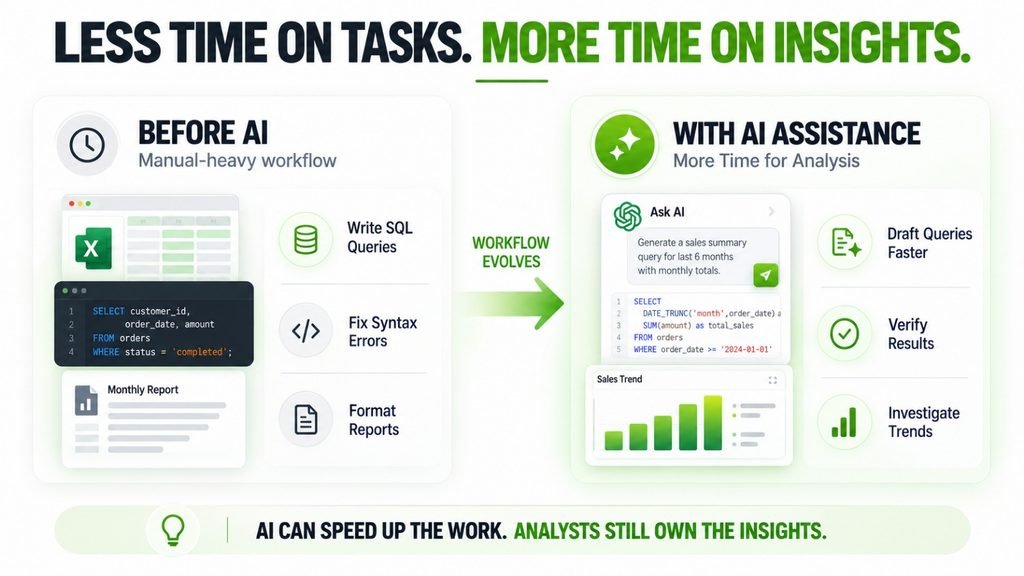
Picture a Monday morning. Your manager needs the weekly sales summary before 11 am broken down by region, product, and channel. SQL query, cleaned data, Power BI refresh, the whole thing. Two years ago that was 90 minutes, and at least half of it was just fighting syntax errors and formatting issues.
An analyst who knows how to use ChatGPT today describes what she needs in plain English, has the SQL in eight minutes, verifies it, runs it, and spends the remaining time actually looking at what the numbers say. Not just pulling them. And that is where she notices something: one region is down, but not because of lower orders. It is a shipping delay nobody flagged. That insight the one that actually matters only exists because she had time to look.
Gen AI did not do that part. It just got the boring part out of the way first.
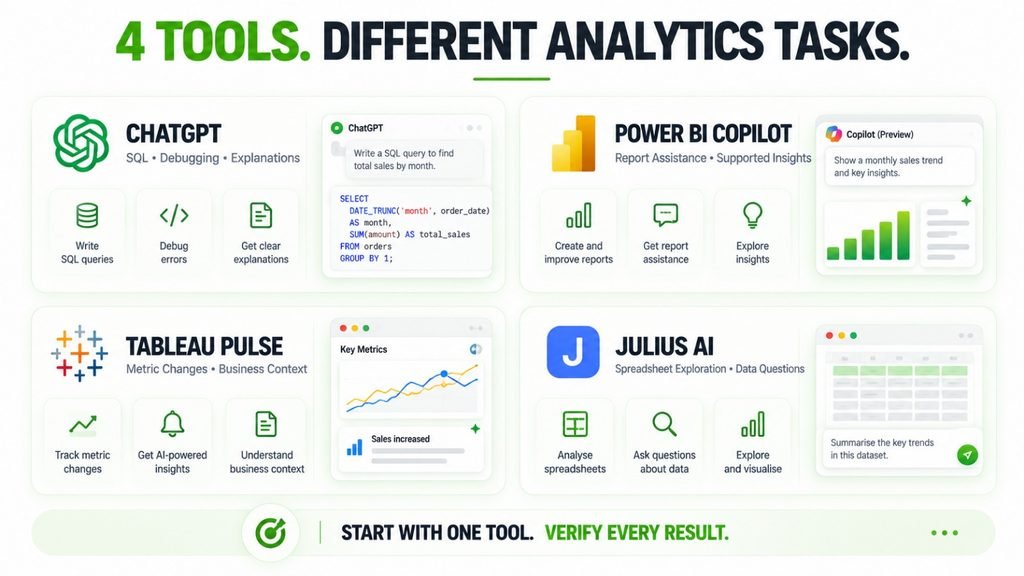
According to Simplilearn’s 2026 guide on AI tools for data analysts, the tools being adopted fastest right now are ChatGPT for SQL and trend identification, Power BI Copilot for dashboard insights, Tableau Pulse for metric explanations, and Julius AI for spreadsheet work. They are all doing the same basic thing from different angles: handling repetitive, syntax-heavy tasks so the analyst’s attention can go somewhere more useful.
Will AI actually replace data analysts in India? Honest answer
No.. Here is why the math makes that clear.
Gen AI is making it easier for companies to use data. Businesses that could not hire an analyst before are now doing so because AI tools have made it easier to work with data. That is not a force reducing the need for analysts. It is the opposite.
Here is the catch. The standards are getting higher at the same time. An analyst who only knows Excel and basic SQL, who has never used a Gen AI tool, is competing for jobs. That market exists. It is just getting smaller each quarter as more companies change how they work.
Know SQL, Python, Power BI, and real Gen AI experience? Different situation. Different interview. Different salary discussion. The risk of being replaced is aimed at one type of analyst. The analyst who is still working the same way they did three years ago. Not in data analytics as a career.
The Gen AI tools every data analyst should know
Most “Gen AI tools for data analysts” articles give you a list of 25 things and somehow leave you knowing less than when you started. So here is the version that is actually useful for someone working in India’s market right now.
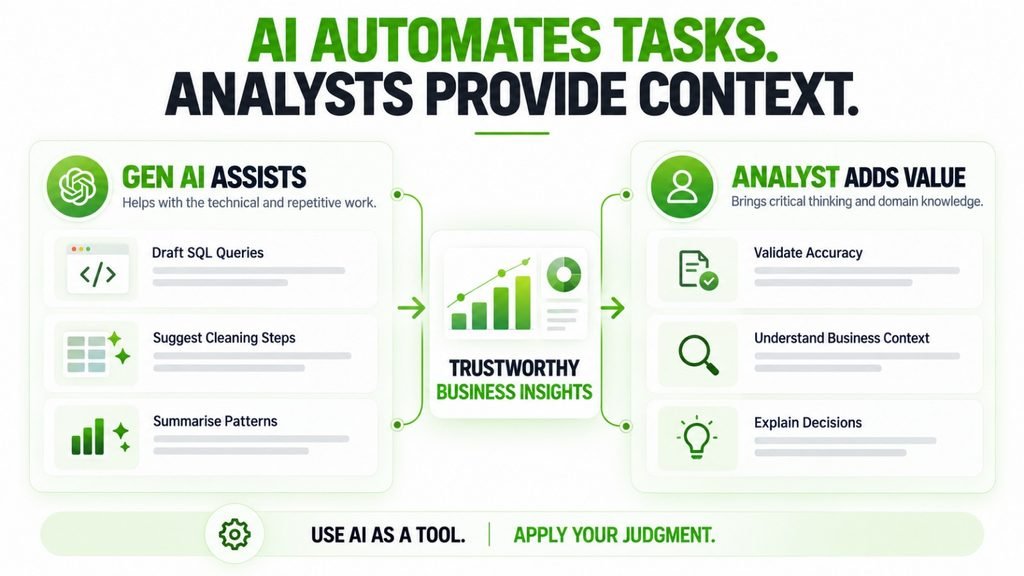
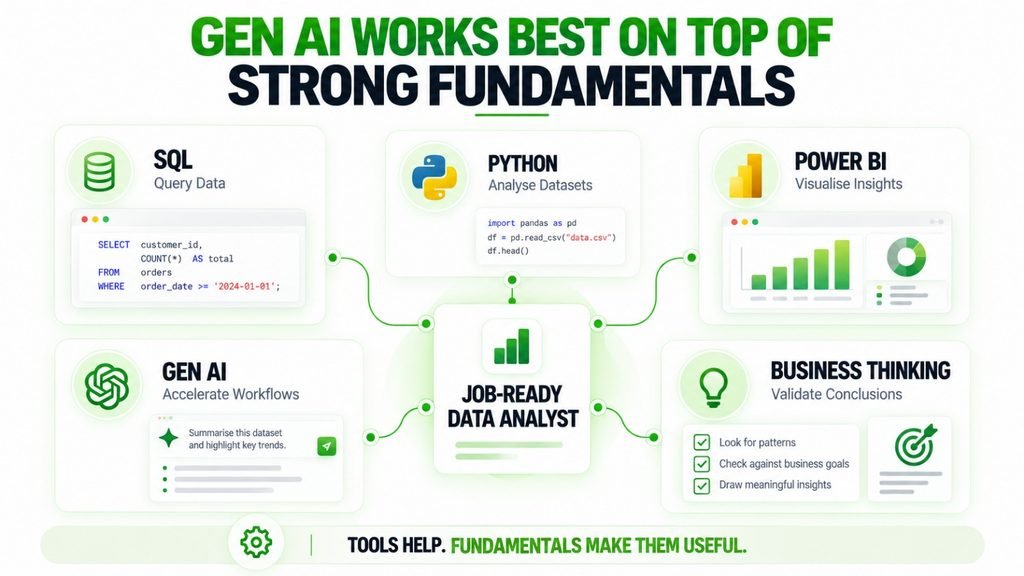
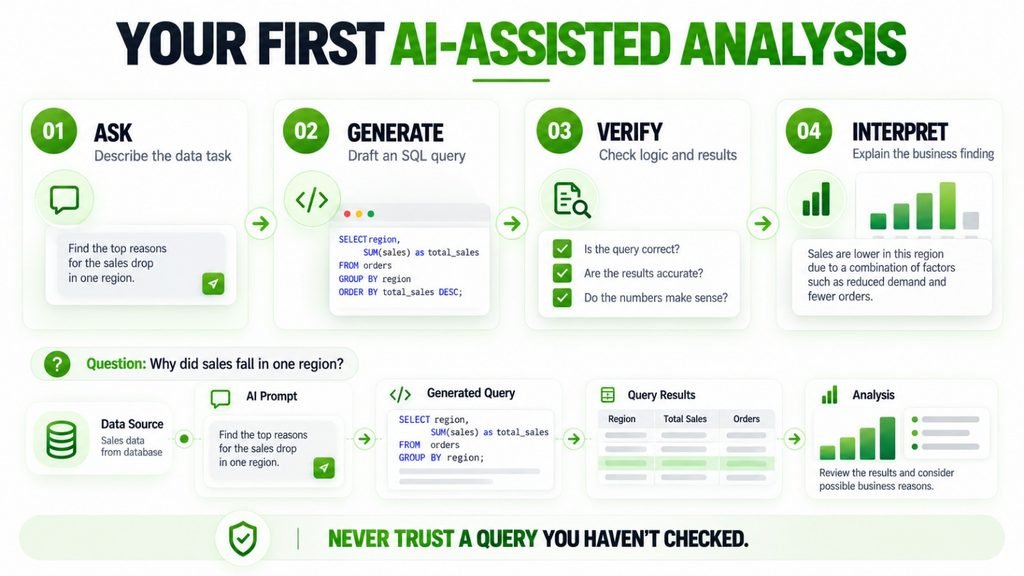
1. ChatGPT is where most people should start, and for good reason. You describe what you need; it writes the SQL, you verify it and run it. You use it to debug a formula that is misbehaving. You use it to draft the narrative section of a report you write every month. One thing that matters here: always verify the SQL before you run it. ChatGPT generates queries that look right and are sometimes subtly wrong: a wrong join, missing filter, results that are almost correct but not quite. If you understand SQL, you catch this immediately. If you do not, you are building a process on a shaky foundation. Learn SQL properly first, then use ChatGPT to move faster on top of it.
2. Power BI Copilot is the one that changes everyday work most immediately for anyone already in Power BI. Ask it a question in plain English about your data, get a visual or a written insight back. For analysts at BFSI companies and IT services firms in Pune, where Power BI is practically standard, this is the most practically useful Gen AI tool right now.
3. Prompt engineering sounds complicated and is not. It just means knowing how to ask the right question. Give the AI context: what the dataset contains, what you are trying to find, what format you need the output in. Analysts who pick up this habit consistently get better results than those who type something vague and get something generic back. It is less a skill and more a habit. One that takes about two weeks of regular use to build.
What job postings are actually saying?
According to Masai School’s data analytics with AI career guide, Gen AI fluency is now one of the five core skills employers explicitly screen for in data analyst job descriptions this year. Analysts with AI skills are spending less time on repetitive syntax work and more time on the interpretation and communication that requires a human.
In practice, this shows up as phrases like “familiarity with AI-assisted analytics tools” and “experience using LLMs for reporting workflows” appearing in fresher-level job listings at companies in Pune’s Hinjewadi and Kharadi areas, not just senior roles.
The salary gap is not subtle. Analysts with SQL, Power BI, Python, and Gen AI experience earn 25 to 35% more than single-tool profiles at the same experience level, based on 2026 data from Glassdoor, Naukri, and AmbitionBox. These vary by company and location, but the trend is consistent across all sources. To understand salary ranges by experience level, our data analyst salary guide for Pune explains what to expect and which factors affect pay.
What this means for someone starting a data analytics course
A data analytics course built in 2022 teaches you how analysts worked in 2022. That is not what employers are hiring for in 2026.
Gen AI should not be a bonus session tagged on at the end of a curriculum. It should be integrated into how you learn to work with data because that is how it actually works in a real job. FirstBit’s data analytics course in Pune includes ChatGPT for data cleaning and auto-insights, prompt engineering for analysis, and AI-assisted data visualisation as part of the core programme. Not extra. Built in. You are using these tools on real datasets alongside SQL, Python, Power BI, and Tableau throughout the course.
By the time you are in an interview, you are not saying “I know what ChatGPT is.” You are saying, “Here is a project where I used it to clean a messy dataset, here is the error I caught in the output, and here is what that taught me about not trusting the tool blindly.” That is a completely different candidate.
If you are still deciding between data analytics and Python full stack development, the Python full stack vs data analyst comparison covers both side by side with honest salary data and guidance on which path suits which kind of person.
Want to see the curriculum in a live session before deciding anything? Book a free demo at FirstBit. One class will give you more clarity than five more articles on this.
How to start using Gen AI as a data analyst right now
You do not need to learn five different AI tools before you can start using Gen AI in data analysis. Pick one tool and try it on a task you already understand.
For example, suppose you regularly write an SQL query to prepare a weekly sales report. Ask ChatGPT to write a query that retrieves sales for a particular date range. Read through the query, check whether it uses the correct tables and conditions, and run it against your dataset. If the result looks different from what you expected, investigate why rather than simply accepting the answer.
Once you are comfortable with that, try asking ChatGPT to explain an unfamiliar SQL function, help you understand an error, or suggest ways to handle missing values in a dataset.
If you already use Power BI, explore Copilot if it is available in your setup. Try using it to help with a report or explore your data, then compare its suggestions with the actual numbers.
The habit worth building is simple: use AI to help you work, but understand and verify what it produces. You will get much more out of these tools when you know enough about data analysis to judge their answers.
The question is not just whether you should learn Gen AI. It is how you plan to use it alongside the skills that make a good data analyst.
If you are choosing a course, look beyond the list of tools. Find out whether you will get to work with real datasets, practise solving problems, and learn how to check the results AI produces.
At FirstBit, the data analytics course in Pune covers SQL, Python, Power BI, Tableau, and Gen AI-related skills as part of the learning programme.
Book a free demo to explore the curriculum, understand how the training works, and decide whether it fits your career goals.