
If you’re considering a data analytics course in Pune, the salary question probably comes before everything else: will I actually earn enough to make the course worth it?
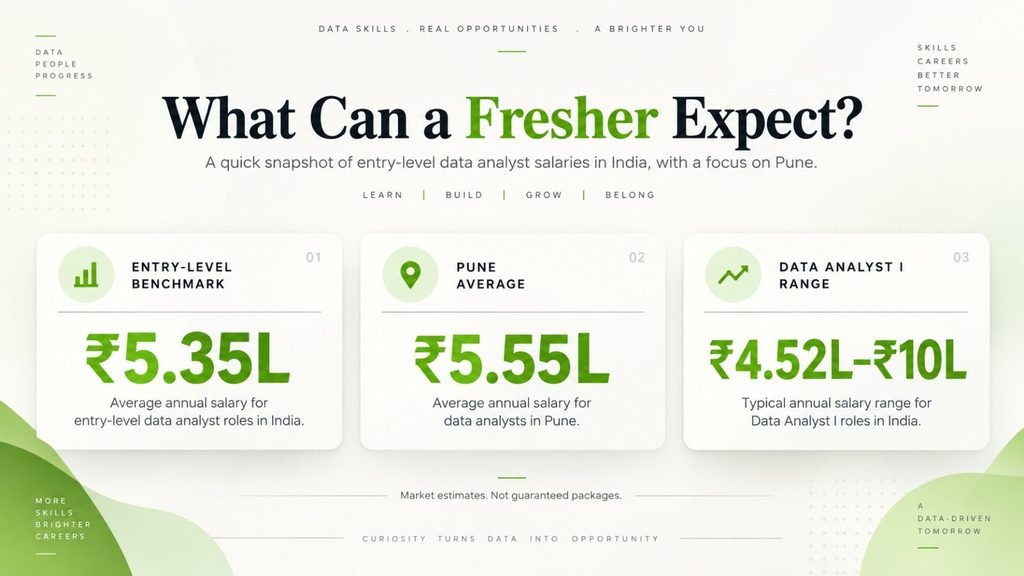
The current Indeed estimate for an entry-level Data Analyst in Pune is ₹5,35,680 per year. Indeed’s broader Data Analyst page currently reports an average base salary of ₹5,55,097 per year in Pune, based on 65 reported salaries.
That gives you a useful starting point, but don’t treat ₹5.35 lakh as a promised fresher package. Salary changes quite a bit depending on the company, your technical depth, the kind of projects you can discuss, and how well you perform in the interview.
Quick answer: What’s the realistic salary after a data analytics course in Pune?
- Indeed currently estimates ₹5,35,680 per year for an entry-level Data Analyst in Pune.
- Glassdoor’s current Pune page for Data Analyst I shows a total-pay range of ₹4.52 lakh to ₹10 lakh per year, with a median of ₹6.89 lakh.
- These figures are market estimates, not guaranteed starting packages. Your SQL, Python, Power BI, project work, interview performance, and employer type can all affect the offer.
- The salary a data analytics course student in Pune receives can therefore be quite different from the headline average.
What Is the Salary After a Data Analytics Course in Pune?
The current starting benchmark sits right around ₹5.35 lakh per year, but there’s a great detail you shouldn’t ignore: Indeed’s entry-level page explicitly notes that its estimate relies on a fairly small data pool and includes a weirdly outdated timestamp. So, treat that ₹5.35 lakh as a helpful direction, not a promise that every single fresher will get it.
To put that in perspective, Indeed’s main Data Analyst page for Pune lists ₹5,55,097 per year based on 65 salaries logged up to August 31, 2026. It also maps out a much wider spread from ₹2,79,929 all the way up to ₹11,00,753 per year depending on how much experience you bring and who hires you.
That gap matters a lot.
When someone casually tells you, “Data Analysts in Pune make ₹5.5 lakh,” you still have no idea if they’re talking about a fresh graduate, someone with three years under their belt, or a specialist working on niche systems.
If you’re just stepping into the field for the first time, stick to the entry-level numbers as your baseline.
Data Analyst Salary in Pune: What Is the Realistic Range?
There simply isn’t a single salary figure that every fresher can bank on. Glassdoor’s current Data Analyst page for Pune spans a total pay range from ₹4.52 lakh to ₹10 lakh per year, centered around a median total pay of ₹6.89 lakh.
Why is that gap so wide? Because the title “Data Analyst” covers totally different jobs depending on where you land.
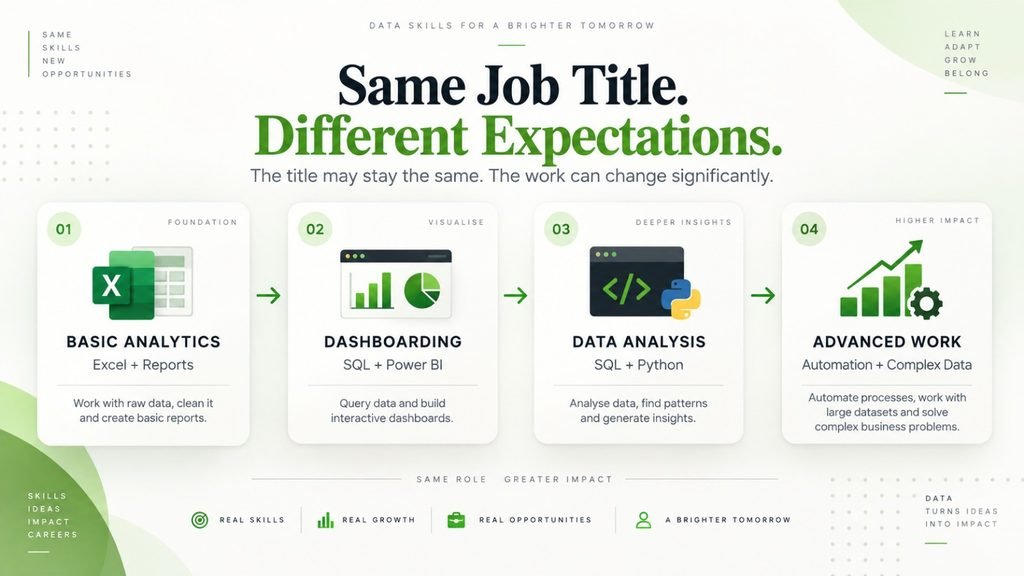
One team might just need someone to clean up basic Excel sheets and refresh a couple of simple Power BI dashboards. Another team might expect you to write heavy SQL queries, handle massive datasets, write Python scripts for automation, and explain business findings directly to managers.
It’s the exact same job title on paper. But in practice? Completely different expectations.
There’s another reason to take salary sites with a pinch of salt: they lump together all kinds of companies, experience levels, duties, and pay structures. Glassdoor itself displays widely varying pay ranges across major Pune employers like TCS, Accenture, Cognizant, Capgemini, and Infosys.
So when you’re looking into fresher salaries in Pune, don’t hunt for one magical number. Focus on the actual level of work you’re prepared to do.
What Skills Can Increase Your Data Analyst Salary in Pune?
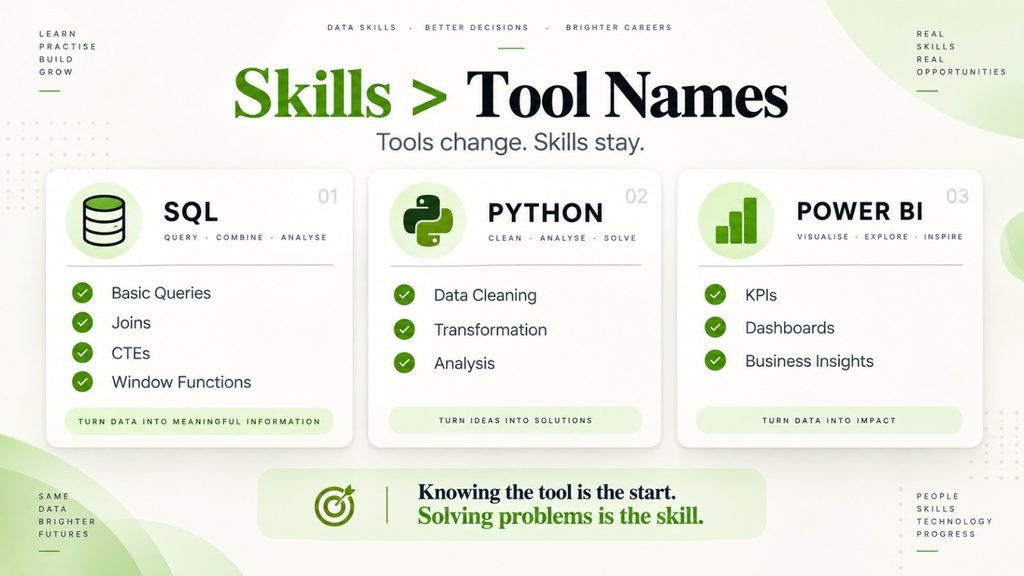
The absolute biggest differentiator is how deep your skills actually go.
Knowing that SQL is on a syllabus is miles away from sitting in front of an interviewer and writing queries to solve a live data problem.
For instance, a complete beginner might know basic SELECT statements, WHERE clauses, and standard joins. But a stronger candidate can confidently talk through real-world scenarios handling multi-table joins, aggregations, subqueries, CTEs, window functions, and data cleaning while explaining exactly why their query returns the right answer.
Python works the exact same way.
You don’t need to turn into a full-scale software developer to be a Data Analyst. But if your Python knowledge ends at printing “Hello World” or running basic loops, you’ll run into a wall the moment an interviewer asks you to clean, transform, or analyze a messy real-world dataset.
Then comes Power BI.
A dashboard loaded with five colorful charts doesn’t automatically mean you built a great analytics project. What interviewers actually care about is whether you can explain the story behind those numbers: which KPI actually matters, what changed, why it changed, and what business action should happen next.
A little domain knowledge goes a long way, too. An analyst who grasps the underlying business problem will almost always beat out someone who just memorized tool mechanics.
That’s why it pays to measure your salary potential by the depth of your problem-solving skills, rather than counting the software names listed on your resume.
If Python is the next skill you want to add to your analytics toolkit, explore FirstBit’s Python and Data Science program and see whether it fits your goals.
Why Data Analyst Salaries Differ Even After the Same Course
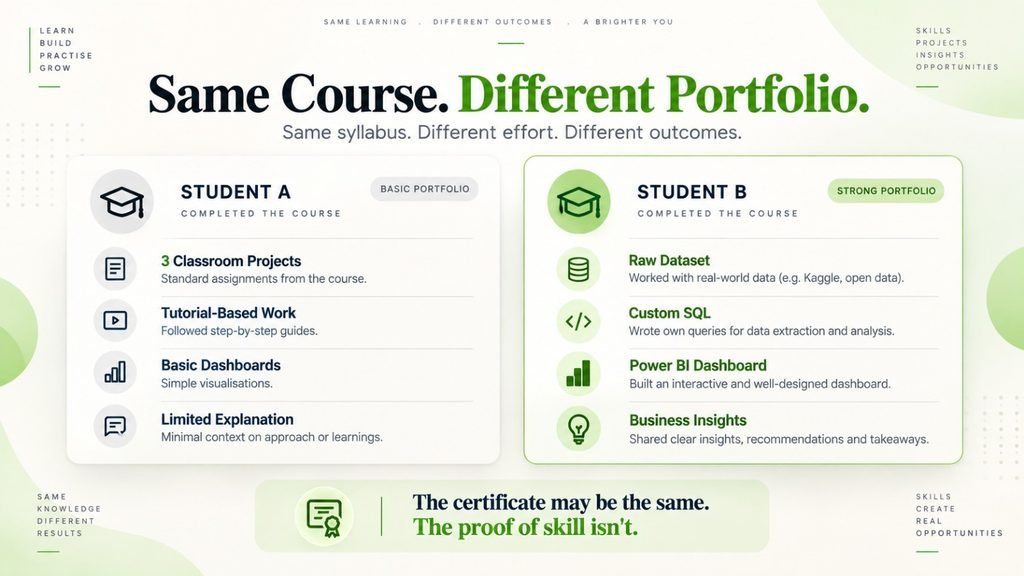
Two students can take the exact same data analytics course, finish on the same day, and walk into job interviews with night-and-day profiles.
The first student might have three standard classroom projects that just mirror whatever the instructor did on screen.
The second student picked up a raw sales dataset, cleaned out all the broken records, wrote custom SQL queries, built a targeted Power BI dashboard, spotted a real commercial pattern, and wrote up a short summary on what the business should do about it.
Both of them have a course certificate.
But the second person actually proved they can do the work.
This is precisely why your portfolio carries so much weight. When an interviewer asks, “Walk me through a project you built,” you need something far more compelling than a generic exercise copied straight out of a course module.
A solid project gives you something real to talk about: the business challenge, the messy data, the calls you had to make, the bugs you ran into, and what you actually learned along the way.
If you’re at this stage right now, the next step is to start building a portfolio that actually gets you hired, with projects that give you something concrete to discuss in interviews.
Data Analyst Salary in Pune by Company Type: Product, Service, or Startup
Company type definitely plays a role in what you get offered, but be cautious if anyone promises you a guaranteed “product company markup.”
There’s no universal percentage rule that applies to every single analytics role out there.
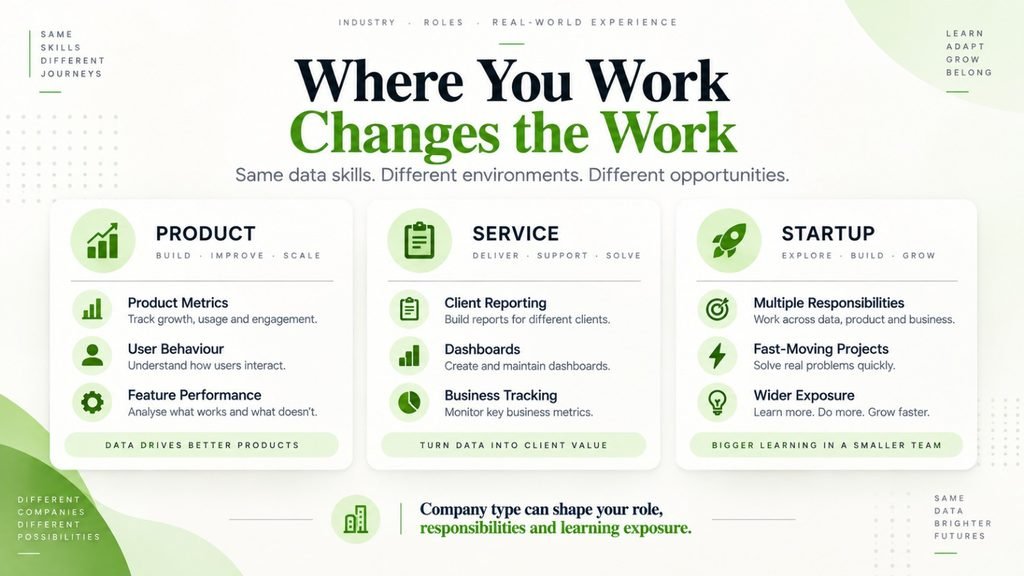
Pune has a huge mix of IT service giants, product-driven companies, early-stage startups, financial firms, and specialized analytics hubs. The current job market reflects this variety, listing everything from classic Data Analyst setups to specialized Data Product Analyst roles.
The day-to-day scope of the role matters just as much as the sign on the door.
An analytics position at a product company usually centers around user testing, product usage metrics, feature performance, and collaborating closely with dev teams. A service-based role, on the other hand, often focuses on client reporting, custom dashboard requests, and routine business performance tracking.
If you join a startup, you’ll likely wear a lot of hats because the team is lean and moves fast.
So while company structure influences your paycheck, as a fresher, your main focus should be on what you’ll actually learn on the job. A smart choice for your first role can expose you to far deeper SQL, Python, business strategy, or client-facing skills, and those are the exact things that will boost your pay when you make your next career move.
How Fast Does a Data Analyst Salary Grow in Pune?
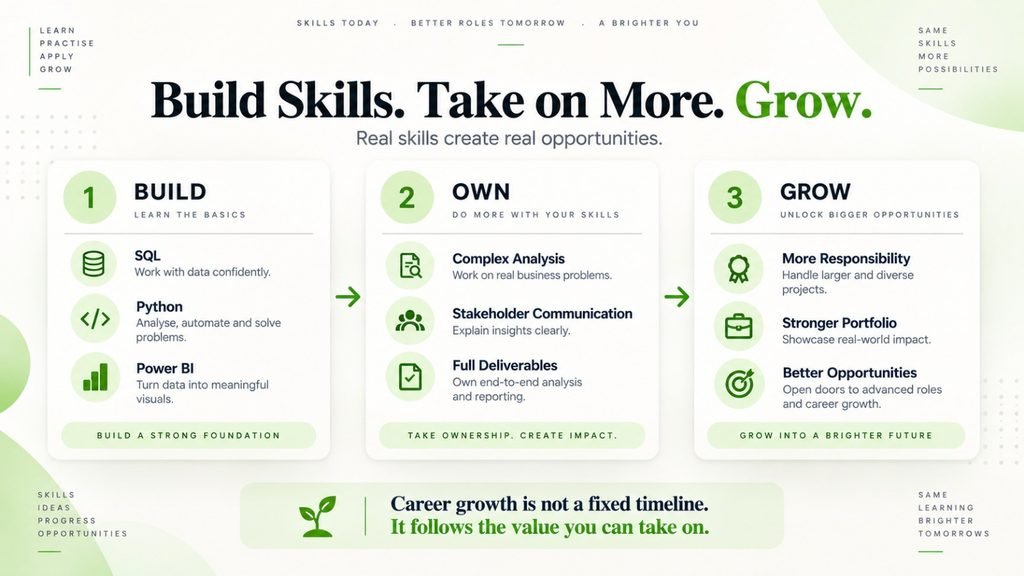
There’s no golden rule or fixed calendar that says you get a specific raise after 12 or 18 months.
Your financial growth is directly tied to how much ownership you can handle.
If your daily work stays stuck on tweaking repetitive reports, your skill development will stall out. But if you start tackling trickier data problems, communicating directly with key stakeholders, streamlining processes, and taking charge of entire deliverables, you build a rock-solid case for your next review or job change.
The same principle applies when you switch jobs down the line.
Avoid building your career timeline around vague promises like “you’ll hit X LPA in Y years.” Salary data varies way too much for anyone to make that kind of guarantee responsibly.
Instead, focus entirely on the variables you actually control:
- Can you tackle intermediate and advanced SQL problems on your own?
- Can you use Python to manipulate and analyze messy datasets?
- Can you design a Power BI dashboard that drives real business decisions?
- Can you clean up unstructured, messy data without needing hand-holding?
- Can you explain your analytical findings clearly to non-technical people?
- Do you have portfolio projects that prove you can do all of the above?
Those practical benchmarks are far better indicators of whether your market value is actually going up.
How to Choose a Data Analytics Course for Better Career ROI
The course you pick matters because your learning environment directly impacts how prepared you’ll feel when you step into job interviews.
A paper certificate by itself won’t prove to a manager that you can write clean SQL, manipulate Python dataframes, or extract insights from raw data.
Before you invest money in any program, take a hard look at what you’ll actually be doing day-to-day. Look closely at the project work. Ask how much time is spent on hands-on coding versus passive listening. Find out if you’ll be forced to solve real problems independently or if you’ll just be following along with a trainer’s pre-written scripts.
And please don’t enroll somewhere just because a recruiter showed you a flashy placement statistic.
Ask what a typical student is actually capable of building by the end of the program.
If you’re currently comparing different options, reading through this guide on what to check before choosing a data analytics institute will give you a clear framework to evaluate training quality before spending a rupee.
And if you want to see what genuine skill-building feels like before making a commitment, sitting in on a free demo class is the quickest way to experience it firsthand.
Final Takeaway
If you’re trying to figure out what kind of salary you can target after finishing a data analytics course in Pune, use current market data as your starting guide, but don’t treat an average number as your guaranteed offer letter.
Indeed currently lists entry-level Data Analyst pay in Pune at ₹5,35,680 per year, alongside a broader Pune average of ₹5,55,097. Glassdoor’s Data Analyst I page reveals a much wider salary band, which is a great reminder that a job title alone never dictates your paycheck.
The real question to ask yourself is: what will you actually be able to do by the time you start applying?
If you can write efficient SQL, clean and analyze data using Python, build dashboard views that answer business questions, talk through your portfolio clearly, and grasp the commercial context behind the numbers, you put yourself in a much stronger position.
The market numbers give you a benchmark, but the practical skills you build are what actually land the offer. If you want to see what that practical training looks like in action, book a free demo class and see it for yourself.