The average salary of a Java Full Stack Developer in Pune is currently around ₹5 LPA in Glassdoor’s live Pune data, with base pay shown at ₹4 LPA to ₹7 LPA and average additional pay of about ₹50,000 a year. The number is useful, but it does not tell the whole story. A fresher joining a large IT services company and a developer with five years of Spring Boot and cloud experience can both have the same job title and very different salaries.
So, if you are searching for the average salary of a Java full stack developer in Pune, the more useful question is: where would you fall in that range? That depends on experience, company type, the kind of work you can actually handle, and how well you perform in interviews.
Java Full Stack Developer salary in Pune 2026, quick answer
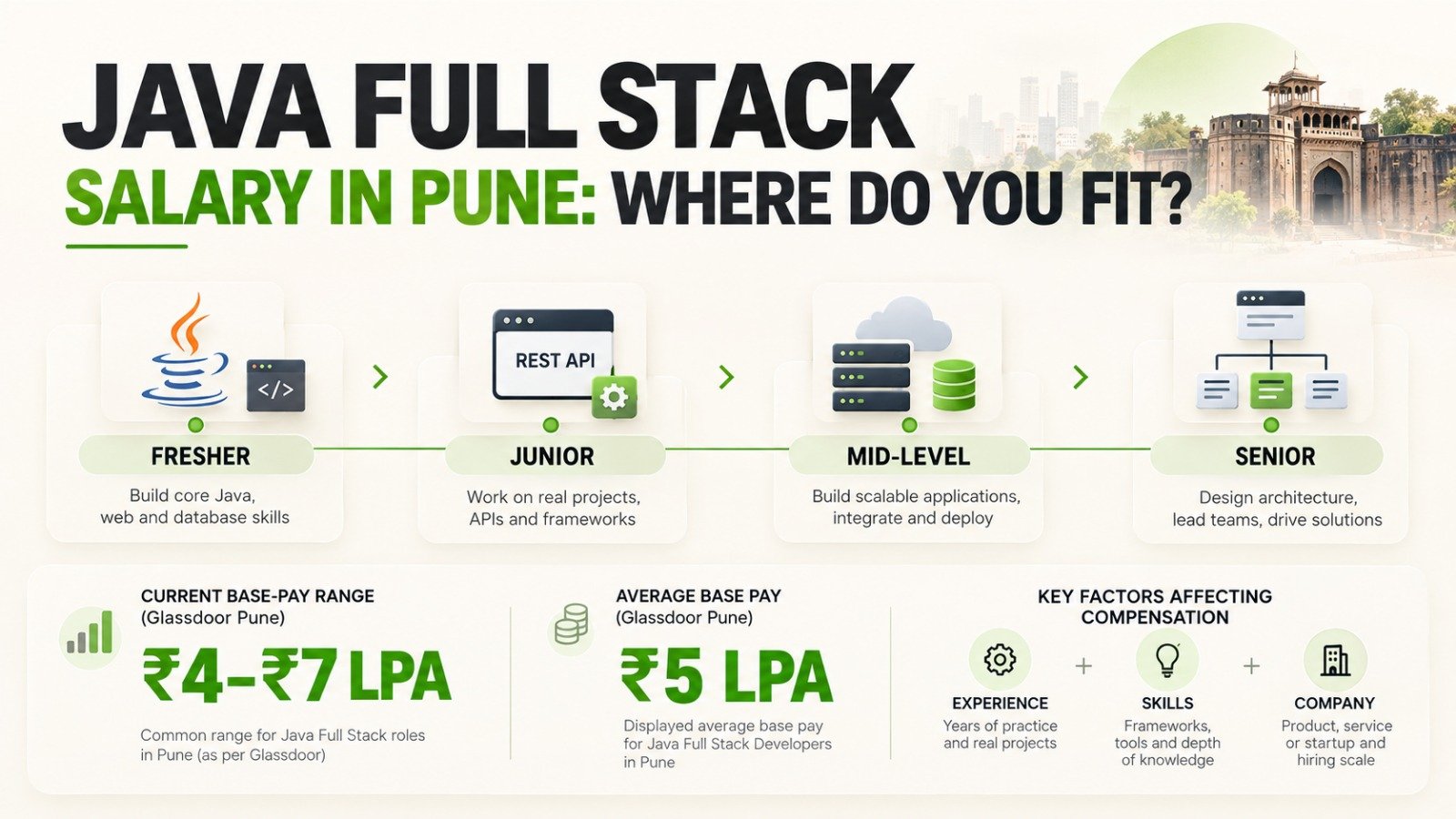
Current Glassdoor Pune data: ₹4 LPA to ₹7 LPA base pay, with ₹5 LPA shown as the average base pay and around ₹50,000 average additional pay.
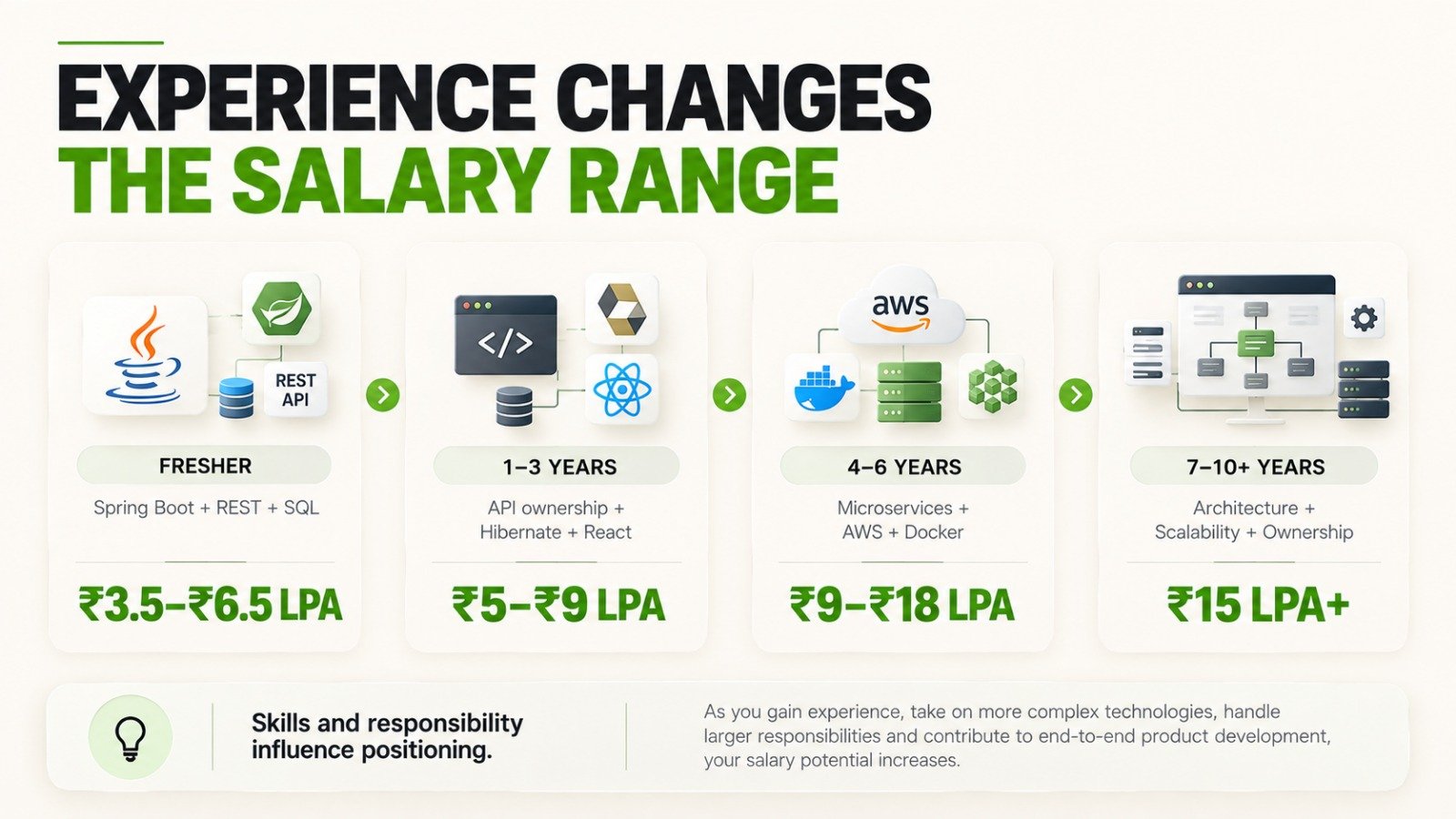
Fresher: roughly ₹3.5 LPA to ₹6.5 LPA, depending heavily on the company and practical skills.
1 to 3 years: roughly ₹5 LPA to ₹9 LPA in many service and mid-market roles.
4 to 6 years: roughly ₹9 LPA to ₹18 LPA, with wider variation at product companies and GCCs.
Senior: ₹15 LPA and above is possible, but senior salary data varies considerably by company and responsibility.
Skills that can change the range: Spring Boot, React, REST APIs, Microservices, AWS, Docker, Git, and security.
These are market ranges, not guaranteed salaries. Your company, skills, location, interview performance, and previous package all affect the final offer.
What “average” actually means here, and why it can mislead you
The Glassdoor number is useful because it gives you a real market reference rather than a salary figure copied from a generic career blog. But an average still compresses people with very different experience levels into one number. The current Glassdoor page for Pune shows ₹4 LPA to ₹7 LPA in base pay, ₹5 LPA average base pay, and around ₹50,000 in average additional pay.
That is why someone searching for a Java full stack fresher salary in Pune should not look at ₹5 LPA and assume that is what every fresher gets. A fresher, a developer with two years of experience and a senior engineer may all appear under related job titles while doing very different work. Company type matters too, which is why the next useful step is to look at experience and employer separately.
Java Full Stack Developer salary in Pune by experience level
Your experience level usually tells you more about your expected salary than the job title alone. A developer who can independently build and deploy a Spring Boot application is in a different position from someone who has only completed Java tutorials, even if both are technically applying for “Java Developer” roles.
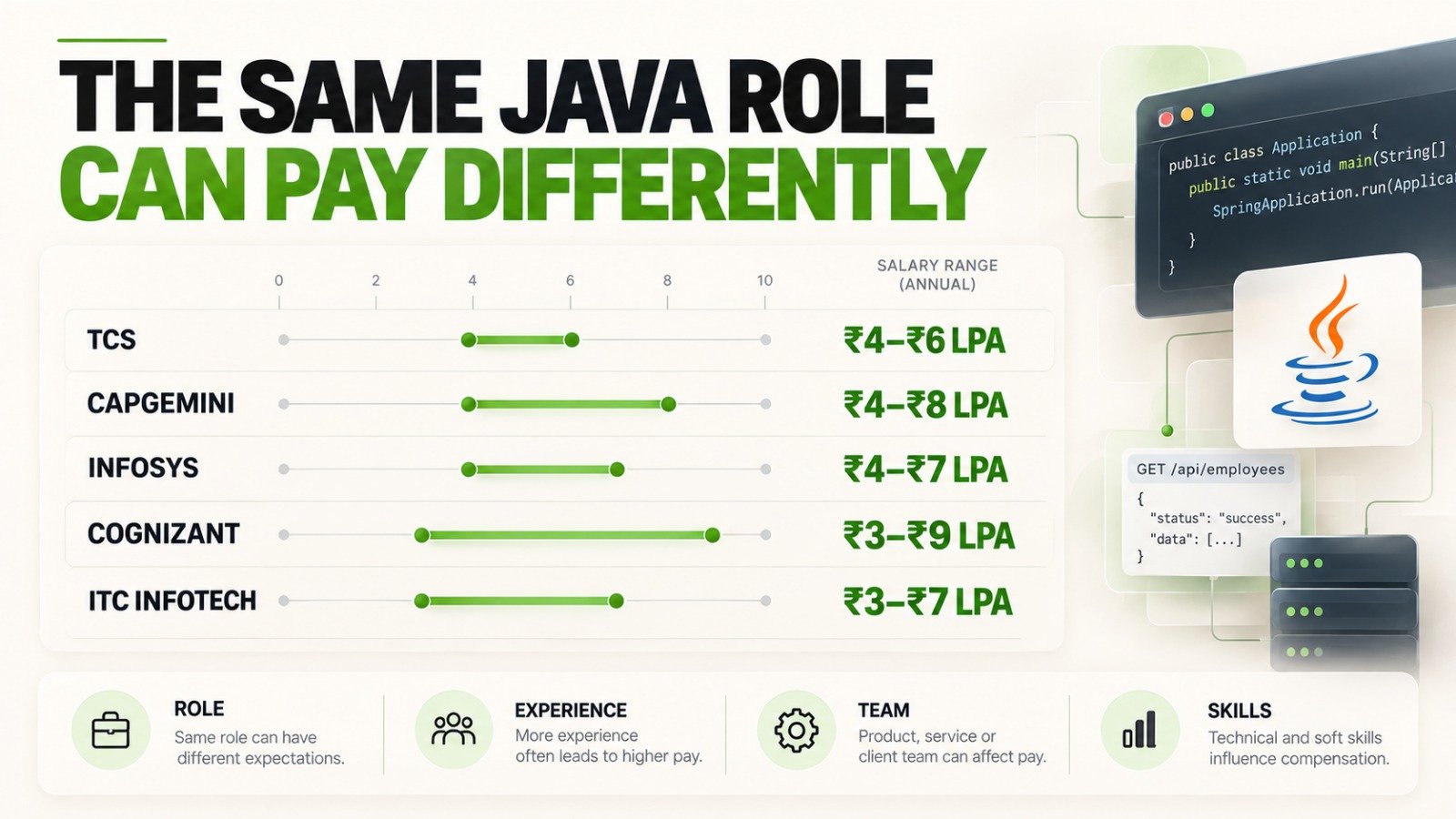
Current Glassdoor data shows Pune base pay for Java Full Stack Developers at ₹4 LPA to ₹7 LPA, with ₹5 LPA as the displayed average base pay. The same page also lists company-level salary ranges such as TCS at ₹4 LPA to ₹6 LPA, Infosys at ₹4 LPA to ₹7 LPA, and Cognizant at ₹3 LPA to ₹9 LPA
Experience | Indicative Pune range | What usually helps you reach the higher end |
Fresher, 0 to 1 year | ₹3.5 to ₹6.5 LP | Spring Boot, REST APIs, SQL, Git, and real projects |
Junior, 1 to 3 years | ₹5 to ₹9 LPA | API ownership, Hibernate/JPA, React and first switch |
Mid-level, 4 to 6 years | ₹9 to ₹18 LPA | Microservices, AWS, Docker and system design |
Senior, 7 to 10 years | ₹15 to ₹25+ LPA | Architecture, scalability, mentoring and ownership |
Lead / Architect, 10+ years | ₹22 LPA and above | Architecture decisions, technical leadership and domain depth |
These are practical market bands rather than fixed salary rules. Salary aggregators use different samples and methodologies, and actual offers vary by company, role, experience, current package, and interview performance.
The fresher salary reality, what nobody tells you upfront
A fresher who knows Core Java definitions but struggles to build a REST API is not in the same position as someone who can explain their Spring Boot project, connect it to MySQL, write APIs, and push the code to GitHub.
That difference can show up during the technical interview very quickly. The interviewer may ask you to explain your database design, why you used a particular API structure, how authentication works or what happens when something goes wrong. A certificate cannot answer those questions for you.
For a Java full stack developer salary in India for freshers, current 2026 salary data from AlgoVentra puts the broader fresher range at ₹4 LPA to ₹7 LPA, with Pune listed at ₹4.5 LPA to ₹6.5 LPA. The same source says large service companies commonly sit around ₹3.5 LPA to ₹5 LPA, while product companies can have higher fresher ranges.
So instead of asking, “What salary will I get after this course?”, a better question is, “What can I actually build by the time I start applying?”
The mid-career jump, when salaries can accelerate
The jump becomes more noticeable when you stop being the person who simply receives development tasks and start owning features from beginning to end.
Imagine you are given a requirement for a payment or order-management feature. At a junior level, you might implement the assigned API. At a more experienced level, you may be expected to think about database design, service boundaries, authentication, error handling, deployment, performance, and how the feature fits into the rest of the system.
That is where skills such as Microservices, AWS, Docker, and system design start becoming useful. They are not magic salary buttons, but they help you qualify for roles with greater technical responsibility.
Company-wise Java Full Stack salary in Pune: who pays what
The company you join can change the salary range considerably, even for similar Java Full Stack titles. Current Glassdoor Pune data lists the following total-pay ranges and median figures for several large employers.
Company | Java Full Stack salary range in Pune | Median |
TCS | ₹4 LPA to ₹6 LPA | ₹5 LPA |
Capgemini | ₹4 LPA to ₹8 LPA | ₹5 LPA |
Infosys | ₹4 LPA to ₹7 LPA | ₹6 LPA |
Cognizant | ₹3 LPA to ₹9 LPA | ₹4 LPA |
ITC Infotech | ₹3 LPA to ₹7 LPA | ₹6 LPA |
These figures should be read as company-level market data, not promises for a particular candidate. Even within the same company, the role, experience, technology stack, and hiring requirements can change the offer.
IT services vs product companies: the real salary gap
Company type is another major variable. AlgoVentra’s 2026 India salary analysis reports that product companies typically pay 30% to 50% more than service companies, while its Pune estimate puts fresher Java Full Stack salaries around ₹4.5 LPA to ₹6.5 LPA and mid-level salaries around ₹11 LPA to ₹18 LPA.
That does not mean every product company will pay more than every service company. A better way to understand it is that product companies often hire for deeper technical ownership, while large service companies have broader hiring volumes and structured salary bands.
Pune also has a mix of IT services, product companies, and GCCs, so the Java Full Stack developer salary company-wise can look very different across the city.
Why the same role pays differently at the same company
Two people with the same number of years on their resumes can still receive different offers. One may have worked mostly on maintenance tickets, while another has designed APIs, handled production issues, and worked with cloud deployment.
The timing of the offer matters too. So do the candidate’s previous salary, interview performance, and the exact skills required by the team hiring them.
This is why a job switch can sometimes create a bigger salary movement than waiting for normal annual increments, but there is no fixed 40% or 60% increase that every developer should expect. Treat those numbers as examples from market discussions, not a rule.
Skills that push Java developer salaries higher in Pune
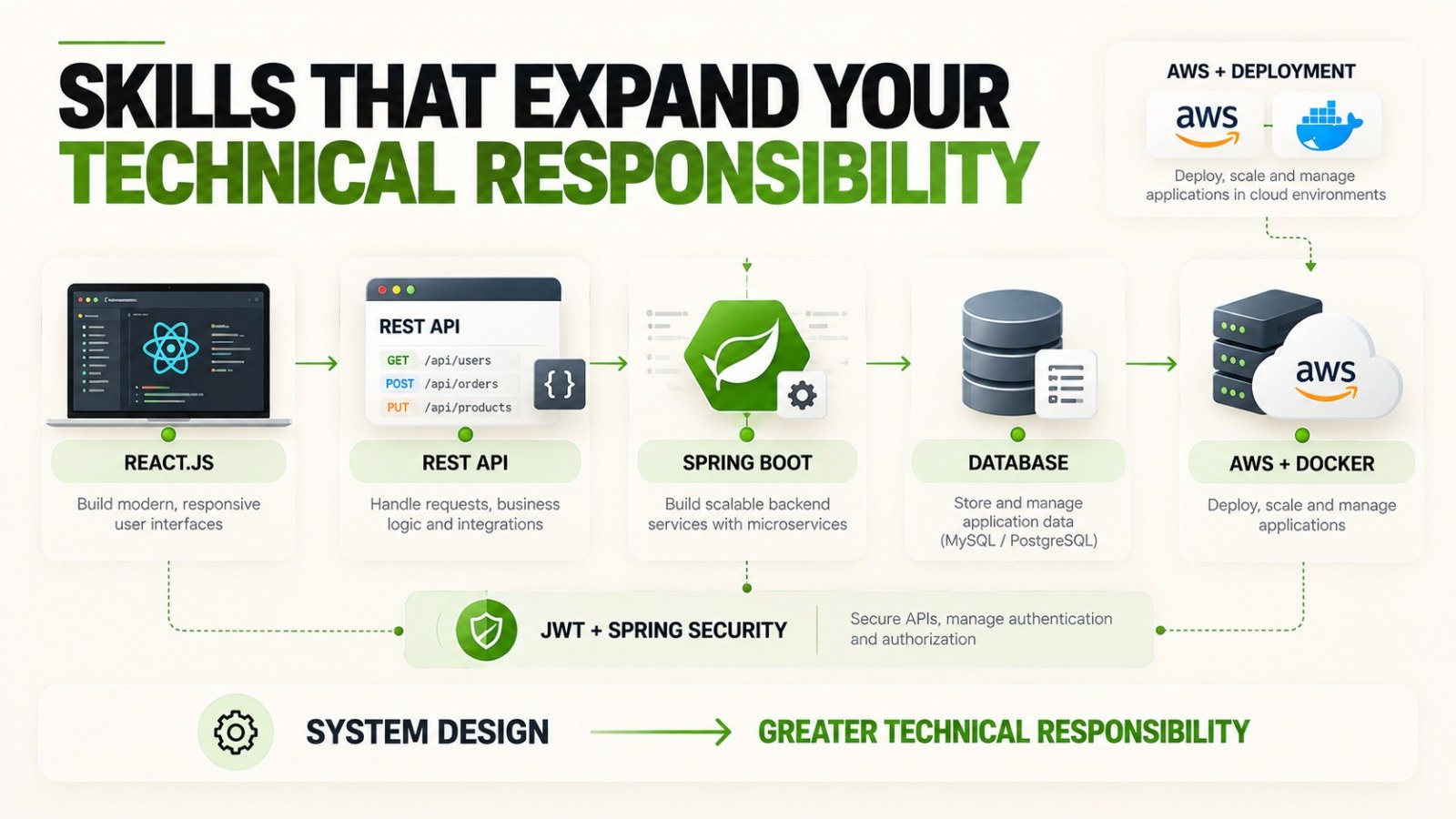
The skills that matter most are usually the ones that let you take responsibility for a larger part of the application. Spring Boot, Microservices, frontend development, cloud deployment, and security are useful because they move you beyond basic Java coding.
Spring Boot and Microservices: Why employers ask for them
Spring Boot is used to build Java backend applications and REST APIs without having to manually configure every part of the application. Microservices take that a step further by splitting a larger application into smaller services that can communicate with each other.
You do not need to learn Microservices on day one. First, get comfortable with Core Java, SQL, REST APIs, and Spring Boot. Once those pieces make sense, concepts such as service discovery, API gateways, and distributed systems become much easier to understand.
Current Pune Java job listings on Glassdoor also show Spring Boot, React, REST APIs, microservices, and cloud skills appearing in Java Full Stack roles.
React.js on the frontend, the full stack part
A Java backend developer can build the server side of an application. A Java Full Stack Developer is expected to understand what happens on the frontend too.
React lets you build the user interface that communicates with your Spring Boot APIs. For example, your backend might return customer orders as JSON, while React displays those orders in a dashboard that a user can filter and update.
That ability to understand both sides of the application is useful when a company is hiring specifically for a full-stack role. It is also why current Pune job listings frequently pair Java and Spring Boot with React or Angular.
AWS and cloud deployment
Knowing AWS only from a certification book is not the same as deploying an application.
A beginner should understand what an EC2 instance does, how an application is deployed, how files can be stored in S3, and why environment variables should be used instead of hardcoding credentials. You do not need to become a cloud engineer to benefit from this knowledge, but being able to explain how your Java application reaches production makes your profile more practical.
JWT security and Spring Security
Authentication is another area where theory becomes very obvious during interviews.
JWT can be used to identify authenticated users between requests, while Spring Security provides the framework for implementing authentication and authorisation. A fresher does not need to know every security concept, but being able to build a login system with role-based access and explain what happens behind the scenes is much more useful than simply writing “JWT” on a resume.
A practical project should include these concepts rather than treating them as keywords.
Skill | Where it helps |
Spring Boot + Microservices | Backend and enterprise application roles |
React.js | Full-stack development role |
AWS + deployment | Cloud-enabled development teams |
JWT + Spring Security | Applications requiring authentication |
System design | Mid-level and senior engineering interviews |
If you want a structured route for learning these technologies, see the FirstBit Java Full Stack course. The current programme covers Core Java, Spring Boot, Hibernate, MySQL, REST APIs, React or Angular, Git, Docker, and other supporting technologies.
You can also use these 5 Java Spring Boot projects as a practical project checklist while building your portfolio.
Java Full Stack vs MERN Stack salary in Pune: which pays more?
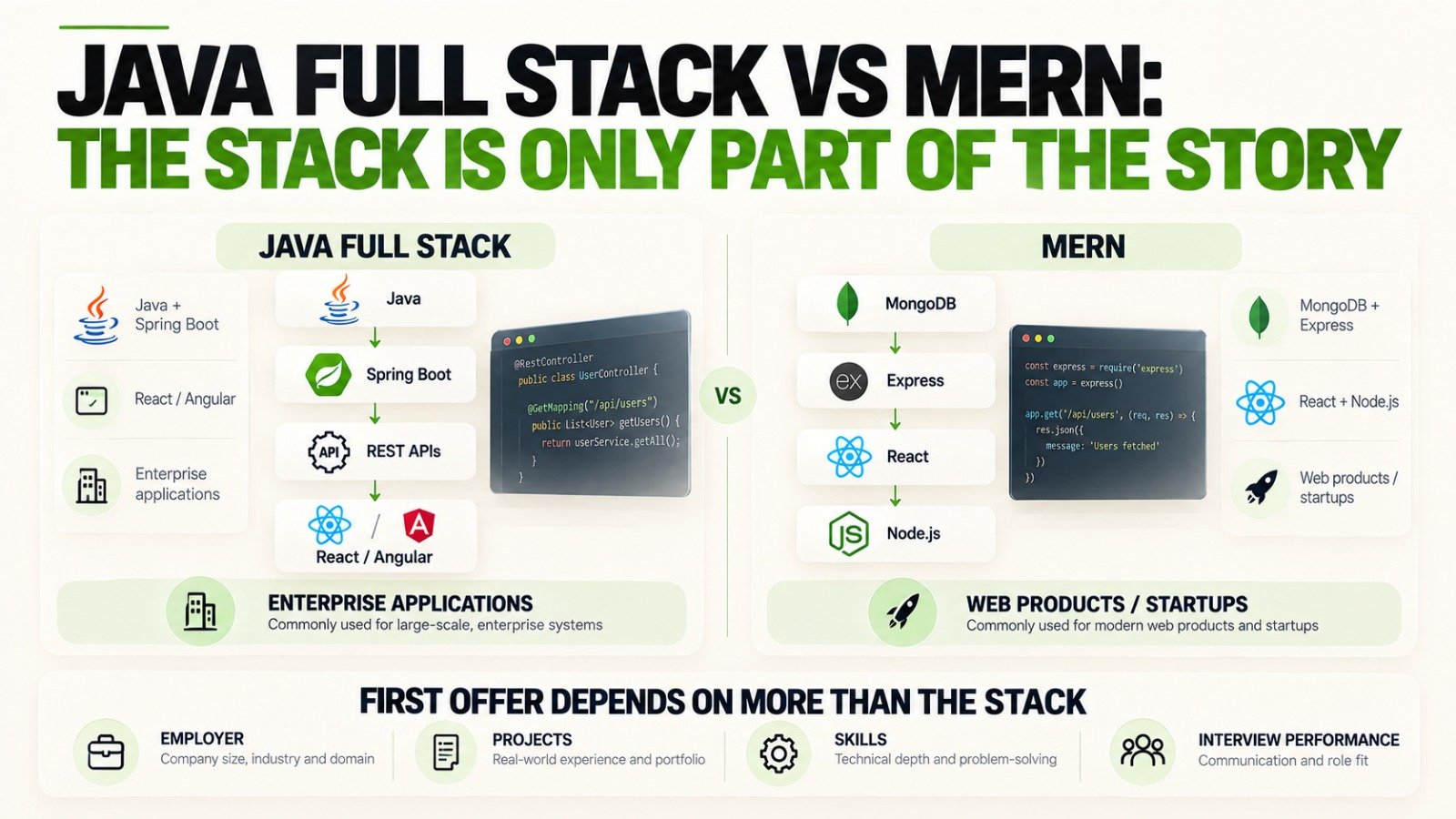
There is no reliable single salary winner across every experience level, because Java Full Stack and MERN roles cover different companies, job requirements, and candidate profiles. Current 2026 salary data from AlgoVentra places Java Full Stack fresher salaries around ₹4 LPA to ₹7 LPA in India, while its separate career comparison lists MERN at ₹3.5 LPA to ₹6 LPA.
For a fresher, the difference can therefore be fairly small. Your first offer is likely to depend more on the employer, technical assessment, projects, and the skills listed in the specific job description than on the stack name alone.
At mid and senior levels, Java is widely used in enterprise software, financial services and large organisations, while MERN is common across web products and startups. That means the type of company you want to work for matters as much as the salary figures you see online.
If you are choosing between Java and Python rather than Java and MERN, FirstBit’s Java vs Python career guide explains the difference in terms of the type of work each path focuses on.
City comparison: how Pune compares to Bangalore and Mumbai for Java developers
City-level salary comparisons are useful only when you remember that different sources use different samples. AlgoVentra’s 2026 data lists Pune at ₹4.5 LPA to ₹6.5 LPA for freshers and ₹11 LPA to ₹18 LPA for mid-level developers, compared with ₹5 LPA to ₹8 LPA and ₹14 LPA to ₹22 LPA respectively for Bangalore. Mumbai is listed at ₹4.5 LPA to ₹6.5 LPA for freshers and ₹12 LPA to ₹19 LPA for mid-level roles.
City | Fresher | Mid-level |
Bangalore | ₹5 to ₹8 LPA | ₹14 to ₹22 LPA |
Pune | ₹4.5 to ₹6.5 LP | ₹11 to ₹18 LPA |
Mumbai | ₹4.5 to ₹6.5 LP | ₹12 to ₹19 LPA |
Hyderabad | ₹4.5 to ₹7 LPA | ₹12 to ₹20 LPA |
These are broad market estimates, not a guarantee that a developer in one city will earn more than someone with the same experience elsewhere. Company type, remote work, role level and technical stack can change the comparison significantly.
How does the Java Full Stack course at FirstBit prepare students for higher-paying roles?
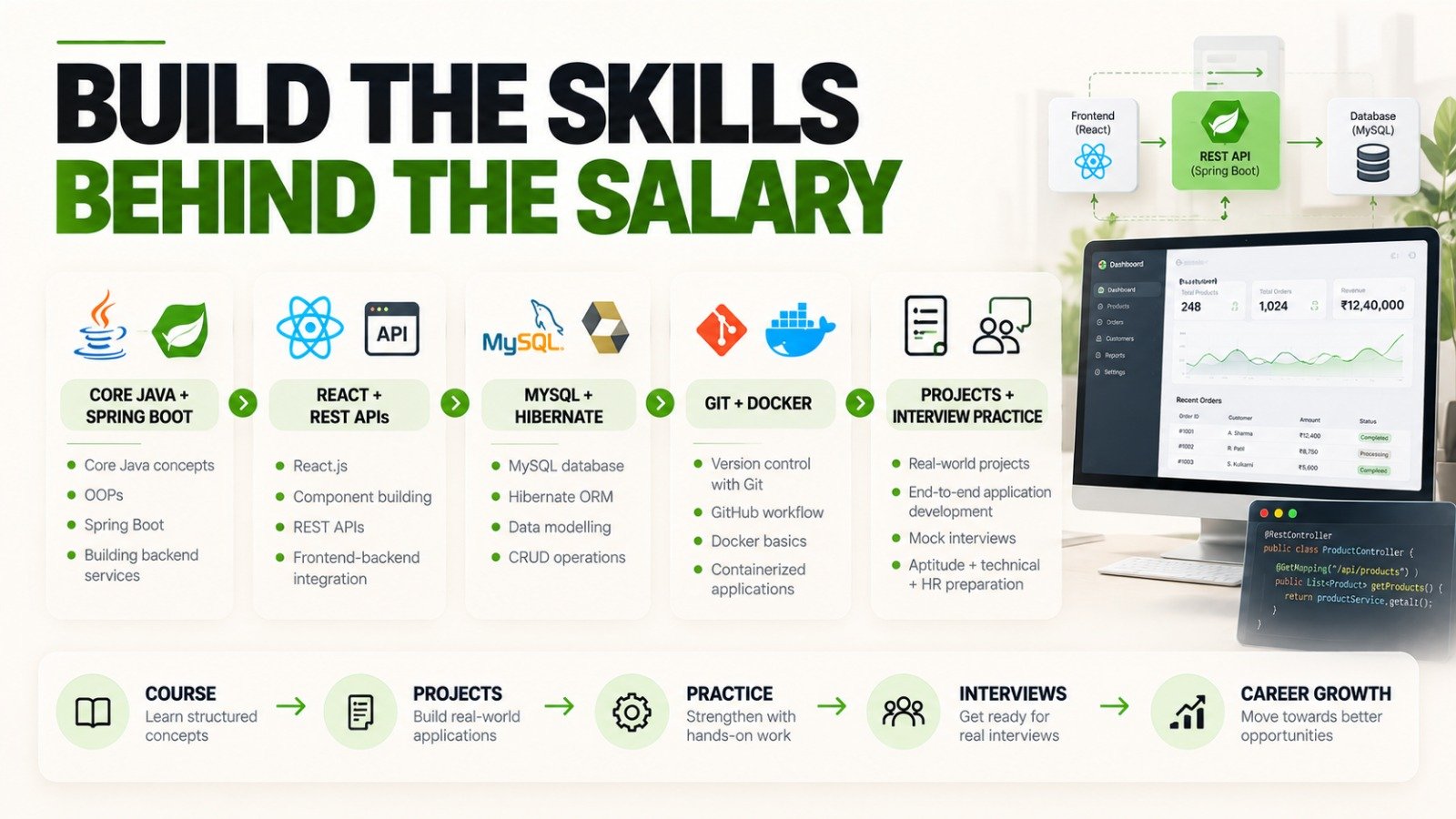
FirstBit’s current Java Full Stack programme covers Core Java, MySQL, Spring Boot, Hibernate, REST APIs, React or Angular, Git, Docker and other development tools. The course also includes practical projects, coding exercises, mock interviews, resume preparation and career support. Those elements can help build the technical and interview skills needed for applications, but completing a course does not guarantee a particular salary or job offer.
The Java Full Stack developer salary in Pune can range widely, and the number you see on a salary page is only the starting point for understanding the market. For a fresher, the difference between knowing Java in theory and being able to build, explain, and debug a real Spring Boot application can matter a lot. As experience grows, Microservices, cloud, security, system design and ownership become more relevant to the roles you can target.
If you are starting from zero, focus less on trying to predict your exact future package and more on building the skills that let you qualify for the next role. FirstBit’s Java Full Stack course is one structured route for learning that stack, while your own projects, practice and interview preparation will still determine how well you can use those skills in the job market.