If you’re starting Python because you want a job, the answer you probably want is a number.
How long does it take to learn Python for a job?
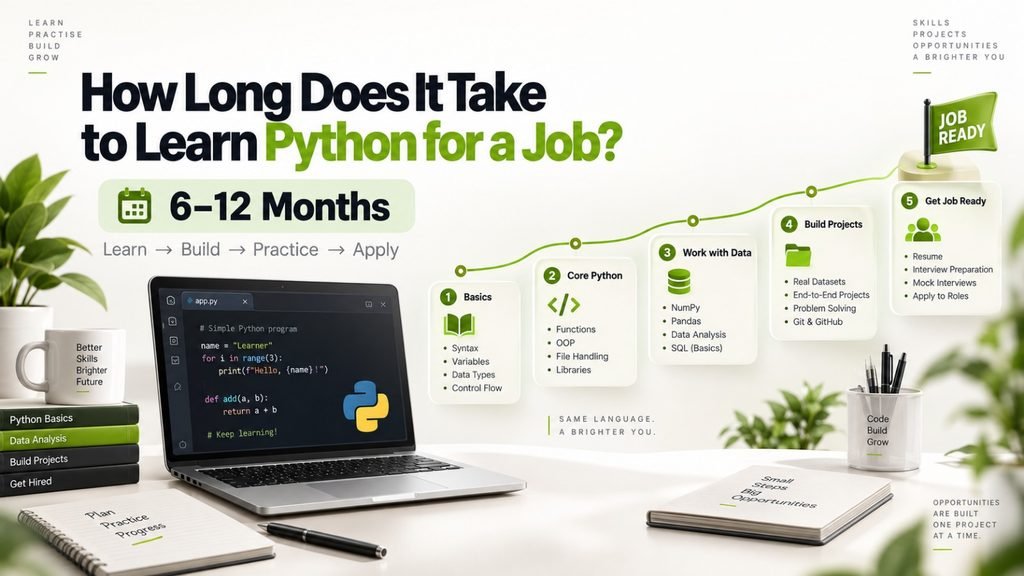
For people just starting out, a more realistic time frame is about 6 to 12 months to become fully job-ready, with consistent practice and the skills needed for a specific role. Learning basic Python takes about 2 to 6 months; however, knowing variables, loops, functions, and data structures is very different from being able to use them in practical tasks and during a technical interview.
It makes a difference.
You might come across online courses or video tutorials saying that you will learn how to code in Python and find a job within three months. It is indeed possible to master the foundations within such a period of time if you have previous programming knowledge or you are able to learn full-time. For people who start from scratch, learning basic Python skills, tools, building projects, getting ready for interviews, and even applying for positions might take more time.
According to Real Python, it is going to take around 2 to 6 months to master the basics and 6 to 12 months to become ready to work.
So if you’re planning your career around Python, 6 to 12 months is a much more useful planning window than a three-month promise.
How Long Will It Take to Learn Python to Get a Job?
The time needed to learn the basics of Python is 2-6 months, and to be ready for the job market, it may take 6-12 months.
It depends on your goals.
A programmer who learns Python for simple automation purposes does not require the same level of knowledge as the one who prepares for the position of a Python developer. The skills needed by a programmer who wants to become a data analyst differ from those of someone who wants to become a backend developer or even enter Data Science/AI.
Previous experience counts.
If you have had some experience with languages like Java, C++, JavaScript or any other programming language, then the concepts of loops, functions, conditions, debugging, and object-oriented programming will not be so new for you, and the majority of the time you will spend learning syntax and the ecosystem, not programming.
In case you start from scratch, it’s different.
But here is the good news: you do not have to know everything about Python until you can apply for a job.
Learning Python Basics and Becoming Job-Ready Are Two Different Milestones
This is where a lot of confusion around the Python learning timeline comes from.
Imagine you’ve spent three months learning Python.
You understand variables. You can write loops. You know lists and dictionaries. You’ve written functions. You have solved a few beginner coding problems.
That’s progress.
But if an interviewer asks you to explain a project you built, work with a database, use an API, debug an error, or solve a practical coding problem, knowing the syntax alone may not be enough.
Dice’s career guidance makes a similar distinction. It describes roughly 2 to 3 months for beginner-level Python and simple projects, followed by another 3 to 6 months for developing stronger skills with libraries, frameworks, more complex projects, and problem-solving.
That’s why we should separate learning Python from learning Python for a job.
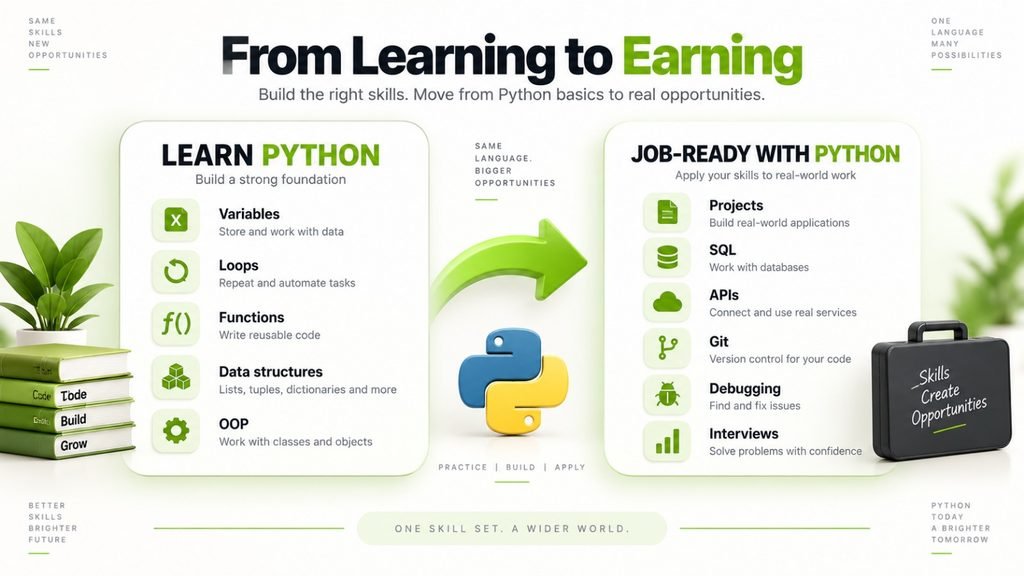
Learning Python basics usually means you can:
- Understand variables, data types, operators, conditions, and loops
- Write and use functions
- Work with lists, tuples, dictionaries, and sets
- Understand basic object-oriented programming
- Read and modify simple Python programs
- Handle basic errors and exceptions
- Write small scripts and programs
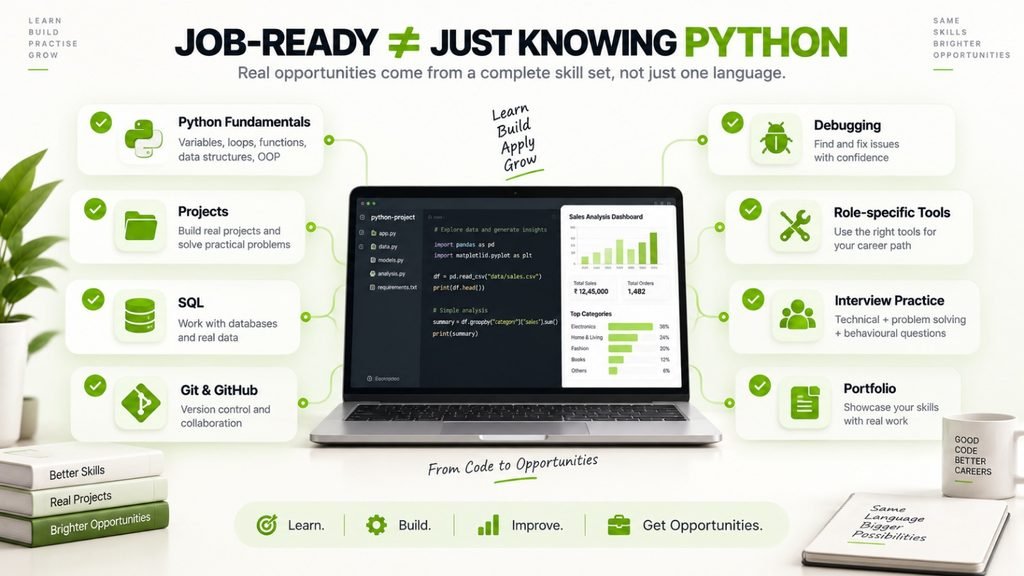
Being job-ready usually means you can do more:
- Build and explain practical projects
- Work with databases and SQL where the role requires it
- Use libraries or frameworks relevant to your target role
- Work with Git and GitHub
- Debug problems instead of simply copying solutions
- Understand APIs and how applications communicate where relevant
- Explain your code during an interview
- Solve basic coding and logical problems
- Present your projects clearly on your resume and GitHub
Dice also recommends focusing on projects that demonstrate practical Python skills and tailoring your learning to the role you actually want.
That’s a much better definition of job readiness than simply finishing a Python playlist.
How Long Does It Take to Learn Python for Different Career Paths?
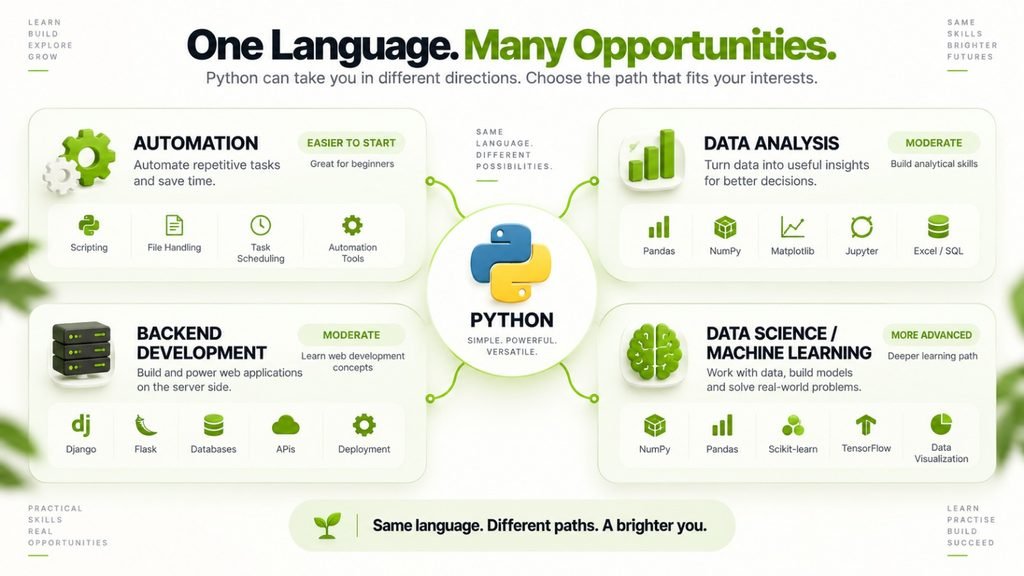
There isn’t one Python timeline that works for everyone because Python is used for very different types of work.
Real Python’s learning guide points out that your target, previous experience, available time, motivation, mentorship, and learning resources can all affect how quickly you progress.
Here is what that looks like in practice.
Python for Automation
If your goal is automation, scripting, or small productivity tools, you may reach a useful level sooner than someone preparing for full-stack development.
Once you understand Python fundamentals, you can start working with files, folders, APIs, web scraping tools, automation libraries, and scripts that solve repetitive problems.
You still need practice, but the scope is narrower.
Python for Data Analysis
Data analysis usually requires Python plus tools such as NumPy, Pandas, and visualization libraries, along with SQL and an understanding of basic statistics.
Real Python places data analysis at roughly 2 to 6 months beyond the basics, depending on the learner and the depth required.
So someone starting from zero should think about the full journey rather than assuming that learning Python syntax alone makes them ready for a Data Analyst role.
Python for Web or Backend Development
This path generally takes longer because Python is only one part of the stack.
You may need to learn:
- Python
- SQL and databases
- Django or Flask
- REST APIs
- HTML, CSS, and some JavaScript
- Git and GitHub
- Authentication and application structure
- Testing and deployment basics
You don’t need to master every technology before building your first project. In fact, learning everything first is a good way to never start the project.
The better approach is to learn each technology when you reach the point where you need it.
Python for Data Science and Machine Learning
This is where the timeline can become considerably longer.
Beyond Python, you may need statistics, NumPy, Pandas, data visualization, machine learning concepts, model evaluation, and libraries such as scikit-learn. More advanced roles can also require deep learning, NLP, computer vision, or other specialized knowledge.
Dice notes that advanced specialization in areas such as Data Science and AI can take one to two years of focused study.
That doesn’t mean you need two years before you can do anything useful. It means there’s a significant difference between becoming employable at an entry level and developing deep expertise in a specialized field.
What Actually Speeds Up Python Learning and What Slows It Down?
The number of hours you study matters, but how you spend those hours matters just as much.
You can watch Python tutorials for four hours a day and still struggle to write a program yourself.
Another learner might spend two hours coding, debugging, and building a small project and make much stronger progress.
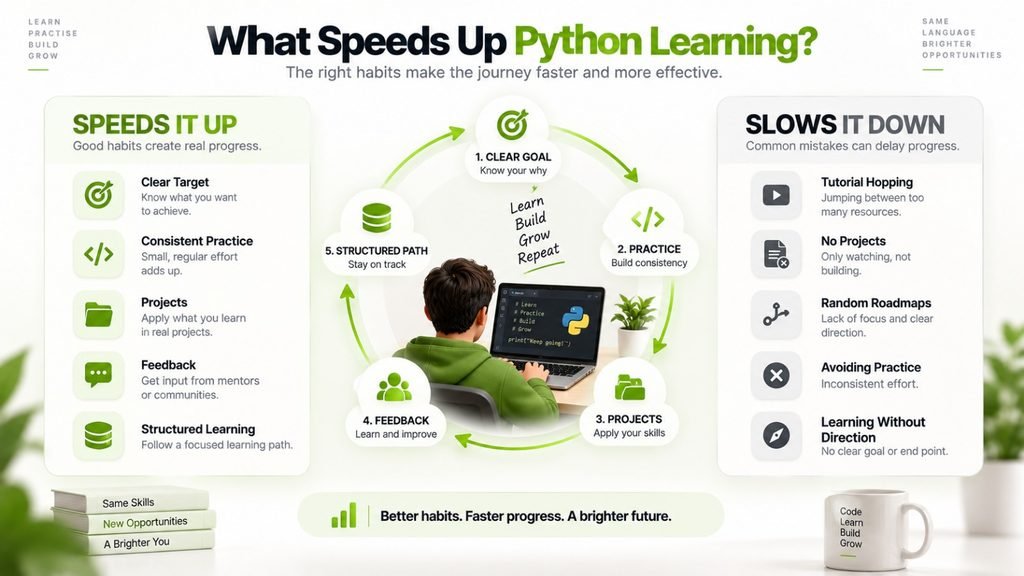
Real Python highlights consistent practice, hands-on coding, feedback, mentorship, and the quality of learning resources as important factors affecting learning speed. It also warns against tutorial-hopping and consuming content without actually writing code.
What usually speeds things up?
A clear target.
Learning “Python” is vague. Learning “Python for backend development” gives you a much clearer path.
Regular practice.
Two focused hours most days will usually help more than studying for eight hours once every two weeks.
Building projects early.
Projects force you to remember what you’ve learned and expose the gaps you don’t notice while watching tutorials.
Getting feedback.
When you’re stuck on the same error for three hours, having someone explain what you’re missing can save a lot of time.
Following a structured sequence.
You don’t need to spend two weeks deciding whether to learn Flask before Django or Pandas before NumPy. A good learning path removes many of these small decisions.
What usually slows beginners down?
The biggest problem we see is often not difficulty with Python itself. It’s the learning process.
You start with one YouTube playlist. Then another instructor explains the same topic differently. Then someone recommends a bootcamp. Then you find a new roadmap on Reddit. A week later, you’ve watched 30 videos but haven’t completed one project.
That is exactly the kind of scattered learning pattern that can stretch a six-month journey into a year or more.
If you’ve experienced that before, it is worth understanding why so many self-taught learners quit before finishing.
The answer isn’t that self-learning doesn’t work. It absolutely can.
The problem is that self-learning requires you to manage the curriculum, schedule, practice, projects, doubts, and progress yourself.
Self-Taught vs a Structured Course: Does It Change How Long Python Takes?
A structured course does not magically turn a 12-month learning journey into a three-month one.
What it can do is remove some of the uncertainty around what to learn, when to learn it, and what to do when you get stuck.
That’s an important difference.
If you’re learning alone, you might spend weeks wondering whether you should learn Django, Flask, React, SQL, or machine learning next.
A structured program gives you a sequence.
For example, FirstBit’s current Python program starts with Core Python and programming fundamentals before moving into SQL, data analysis, Flask, Django, Data Science, Machine Learning, AI, Git, and other supporting technologies. The program is listed as 5 to 6 months, with online and offline options in Pune.
That course duration should not be confused with a guarantee that everyone becomes job-ready in exactly five or six months.
Your actual job-readiness still depends on how consistently you practice, how well you understand the concepts, the quality of your projects, interview preparation, and the type of role you’re targeting.
The advantage of structure is that your learning time has somewhere to go.
You can still learn Python for free. The real question is whether you are able to create and follow your own structured path without spending too much time figuring out what comes next.
Python Course in Pune: How Can a Structured Path Fit Into This Timeline?
If you’re in Pune and you know you learn better with a teacher, regular practice, and a fixed curriculum, a structured Python course can make the 6 to 12-month journey easier to organize.
For example, FirstBit’s Python Classes in Pune currently list a 5- to 6-month program covering Python, Data Science, AI, Machine Learning, Django, Flask, SQL, Git, and practical projects. The program is offered online and offline.
The course also includes practical training, projects, live internship exposure, 1:1 doubt-solving, lecture recordings, resume support, mock interviews, aptitude preparation, and placement assistance.
That combination is useful because the learning doesn’t stop at Python syntax.
You move from Core Python into databases, backend frameworks, data analysis, and other technologies depending on the path. The curriculum includes practical work with tools such as NumPy, Pandas, Django, Flask, MySQL, Git, Docker, scikit-learn, TensorFlow, and others.
There is another useful point here.
A course lasting 5 to 6 months does not mean you should expect a job automatically at the end of month six.
The course can give you the structure and preparation. You still have to practice, complete projects, understand what you’re building, prepare for interviews, and apply for suitable roles.
If you want to see what that learning environment actually looks like before making a commitment, you can explore FirstBit’s structured Python program.
You can also attend a free demo class and judge the teaching style, curriculum, and learning format for yourself before deciding.
What Does Being Job-Ready With Python Actually Require?
This is the part beginners often underestimate.
Knowing Python is one thing. Being able to use Python to solve a problem is another.
Suppose you are applying for a Python developer role.
You may be asked about Python fundamentals, object-oriented programming, SQL, databases, APIs, frameworks, debugging, Git, and the projects you’ve worked on.
Now imagine you’re applying for a Data Analyst role.
The expectations change. Python may be combined with Pandas, NumPy, visualization, SQL, Excel, statistics, and business problem-solving.
That’s why we recommend deciding on your target role before trying to learn every Python technology you can find.
Your portfolio matters here too.
A recruiter can read “Python, SQL, Django, Pandas” on a resume in ten seconds. A working project gives them something concrete to discuss.
You could build a web application, an API, a data analysis project, an automation script, or another project that matches the type of job you’re targeting.
The project doesn’t need to be revolutionary.
It needs to be something you understand well enough to explain:
Why did you build it?
How does it work?
What problem does it solve?
What went wrong while building it?
How did you fix it?
Those answers are much more valuable in an interview than saying you’ve completed 100 hours of video lessons.
If you’re a fresher, spend some of your learning time on building the portfolio that actually proves you’re job-ready.
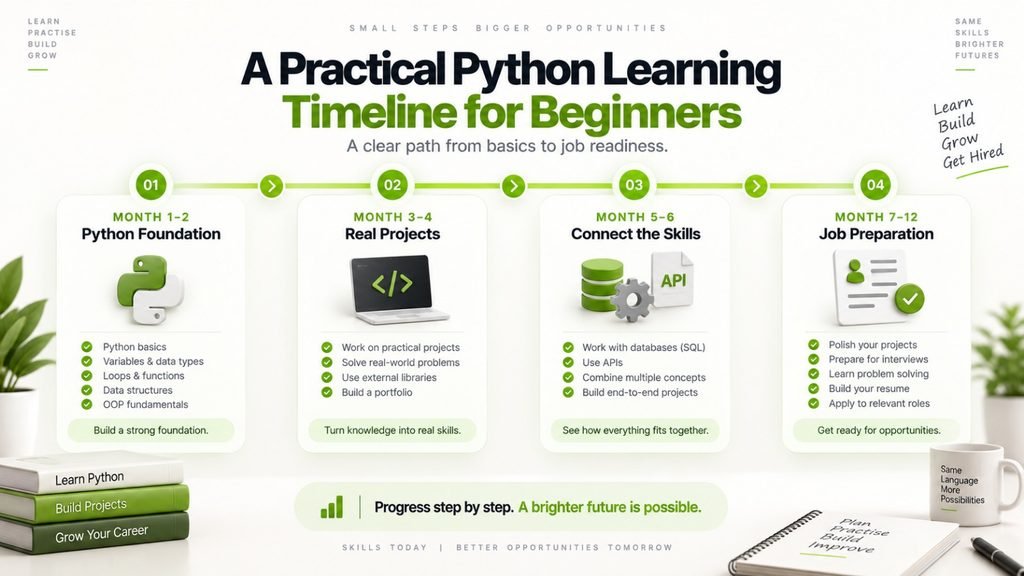
A Practical Python Learning Timeline for Beginners
If you’re starting from zero and can maintain a consistent routine, your journey might look something like this.
Months 1 to 2: Build the Python foundation
Start with programming logic and Core Python.
Focus on variables, data types, operators, conditions, loops, functions, data structures, modules, exception handling, and basic object-oriented programming.
Don’t worry about memorizing every Python feature.
Your goal is to become comfortable writing small programs without needing to copy every line from a tutorial.
Months 3 to 4: Start building real things
This is where your learning should become more practical.
Depending on your target role, you might move into SQL, Pandas and NumPy, Flask or Django, APIs, data visualization, or other relevant tools.
Start building projects while you’re learning these technologies.
Don’t wait until you feel “ready.”
You will probably feel unready when you build your first project. That’s normal.
Months 5 to 6: Connect the pieces
By this stage, you should be doing less isolated practice and more complete work. Build projects that combine multiple skills. For a backend learner, that could mean Python + Django/Flask + SQL + REST APIs.
For a data-focused learner, it could mean Python + Pandas + SQL + visualization + a meaningful dataset.
Start using Git and GitHub properly. Improve your projects. Write documentation. Practice explaining your code.
Months 7 to 12: Job preparation and deeper practice
If you’re starting from zero, this is where the difference between “I know Python” and “I’m ready to apply” becomes much clearer.
Continue building and improving projects. Practice interview questions.
Work on coding problems. Review Python fundamentals. Learn to explain your decisions.
Start applying for roles that match your actual skill level instead of waiting until you feel like an expert. You will continue learning after you get your first job. That’s normal in technology. The goal isn’t to know everything before your first opportunity. The goal is to have enough practical ability to contribute, learn, and grow once you get there.
Is 3 Months Enough to Learn Python and Get Hired?
Three months can be enough to learn the Python fundamentals, but it is a tight timeline for a complete beginner aiming to become genuinely job-ready.
If you already know another programming language, have strong programming fundamentals, or can study intensively every day, three months can take you much further.
For someone starting completely from scratch, however, three months is better viewed as a foundation period.
You may be able to write programs and complete beginner projects by then. But you will still need time to build role-specific skills, create stronger projects, prepare for interviews, and develop the confidence to solve problems without following a tutorial line by line.
So if someone asks, “Can I learn Python in three months?”
The answer can be yes.
If the question is, “Can every complete beginner become job-ready in three months?”
That’s a much harder promise to make.
How Many Hours a Day Should You Study Python?
There is no magic number of hours that guarantees a job.
For most learners, 2 to 4 focused hours a day is a practical target if their schedule allows it. What matters more is whether those hours include actual coding and problem-solving rather than only watching lessons.
Even one focused hour every day can create meaningful progress when you maintain it consistently.
Your study time could look like:
- 45 minutes learning a new concept
- 60 minutes writing code and solving exercises
- 45 minutes working on a project
- 30 minutes reviewing errors or revising older concepts
You don’t have to follow that exact schedule.
The important part is that your keyboard gets more time than your YouTube history.
Real Python similarly emphasizes time investment and consistent practice as two essential parts of learning Python.
Does Prior Coding Experience Change How Long Python Takes?
Yes.
If you’ve already learned Java, C++, JavaScript, or another programming language, Python will usually feel different from learning programming for the first time.
You already understand ideas such as variables, loops, conditions, functions, debugging, and perhaps object-oriented programming.
That means you’re mainly learning how Python expresses those ideas and how its ecosystem works.
A complete beginner has two things to learn at once:
How programming works.
How Python implements programming.
Someone with previous coding experience may only need to focus heavily on the second part.
Your educational background can matter too, but it doesn’t decide whether you can learn Python.
A learner from commerce, arts, engineering, science, or another background can learn programming. The main difference is usually the amount of time needed to become comfortable with programming logic.
So, How Long Should You Actually Plan for Python?
If you’re starting from scratch, plan for 6 to 12 months to become genuinely job-ready with Python.
Use the first few months to build your programming foundation. Then move into the tools your target role requires. Build projects instead of collecting tutorials. Practice explaining your work. Prepare for interviews. Keep improving even after you start applying.
Could you do it faster? Possibly.
Could it take longer? Also, yes.
Your background, available time, target role, consistency, and learning environment all change the timeline.
The important thing is not to choose the shortest number because it sounds good.
Choose a timeline you can actually follow.
If you want a structured way to spend those months, explore FirstBit’s Python training in Pune, look at the curriculum, attend a free demo, and decide whether the learning format works for you.
Six months of focused learning is valuable. Twelve months of scattered learning can feel like starting over every few weeks. The difference is often the path you follow, not just the number of hours you put in.