Take five minutes scrolling through Instagram and LinkedIn and you will find three different people recommending three different career paths. One says become an AI Engineer. Another insists on Data Science. The third is certain you should be a Machine Learning Engineer.
For a fresher trying to pick a direction, that is simply confusing.
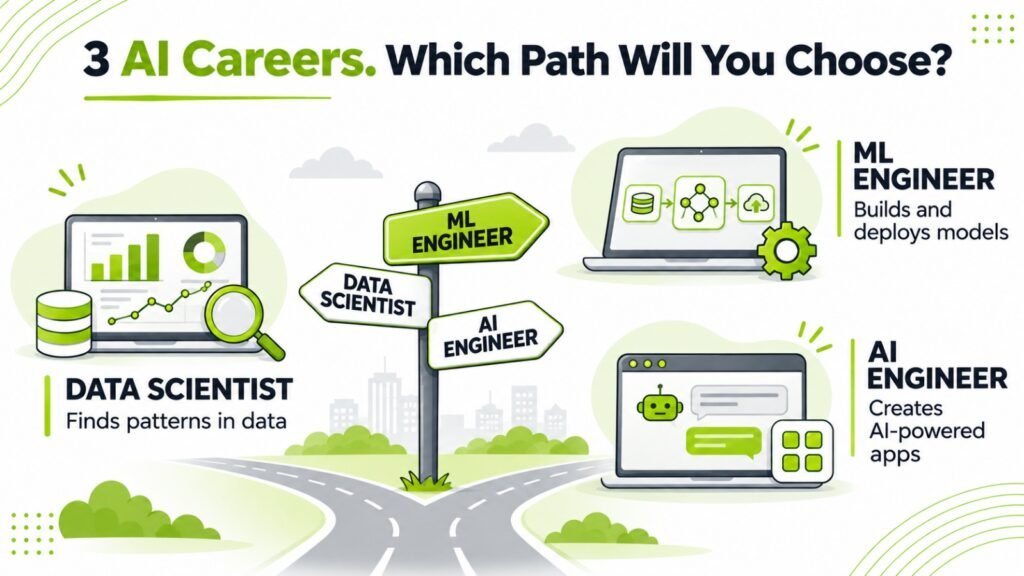
AI Engineer vs Data Scientist vs ML Engineer in India is not a contest between three competing options. They are three different jobs, each with its own skills and its own entry barrier.
The short answer is that a fresher can get into any of them, but not with equal ease. Data Analyst and AI Operations roles are the most accessible. Junior Data Scientist and entry-level AI or ML Engineer roles are reachable with strong basics and real projects in your portfolio. Production-focused ML Engineer roles are hard to reach without software engineering experience.
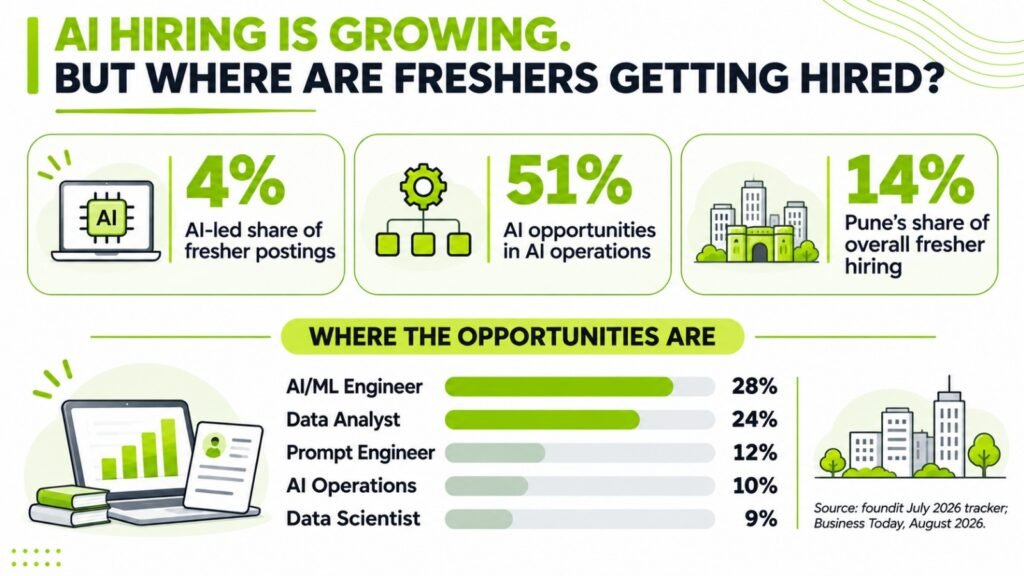
Here is the evidence. According to foundit’s July 2026 hiring tracker, AI-led jobs made up about 4% of fresher listings, and more than half of those sat in AI operations rather than model development itself.
That is one month from one tracker, not the whole Indian job market. But it is better than guesswork.
What does fresher AI hiring actually look like in India?
“AI” appears in almost every job posting now. Landing an actual job in the field is a different matter.
Hiring in AI is growing. foundit’s July 2026 report put AI-led roles at around 4% of fresher recruitment, up from roughly 1%, even though overall fresher hiring fell about 10% year on year.
This is how those AI-led fresher openings were split, as reported by Masai School:
| Job role | Share |
|---|---|
| AI/ML Engineer | 28% |
| Data Analyst | 24% |
| Prompt Engineer | 12% |
| AI Operations | 10% |
| Data Scientist | 9% |
| GenAI Developer | 7% |
| AI QA and Testing | 5% |
These are shares of AI-led fresher postings, not of all fresher jobs. The categories listed account for 95% of the reported mix.
Notice anything?
Data Scientist roles account for only 9% of that mix. AI/ML Engineer and Data Analyst are far more common.
There is a second point worth making. In an August 2026 report by Business Today, 51% of AI-led fresher opportunities fell under AI operations, which includes data analysis, prompt engineering and testing.
One more thing. Employers increasingly want freshers who have already done something hands-on. Nearly six in ten fresher postings now prefer or require prior internship experience.
If you are weighing up a course that includes one, here is what to check before you enrol on an IT course with an internship.
AI Engineer vs Data Scientist vs ML Engineer: what is the difference?
These roles make a lot more sense once you look at what each person actually does all day.
Take an e-commerce business that wants to keep more of its customers.
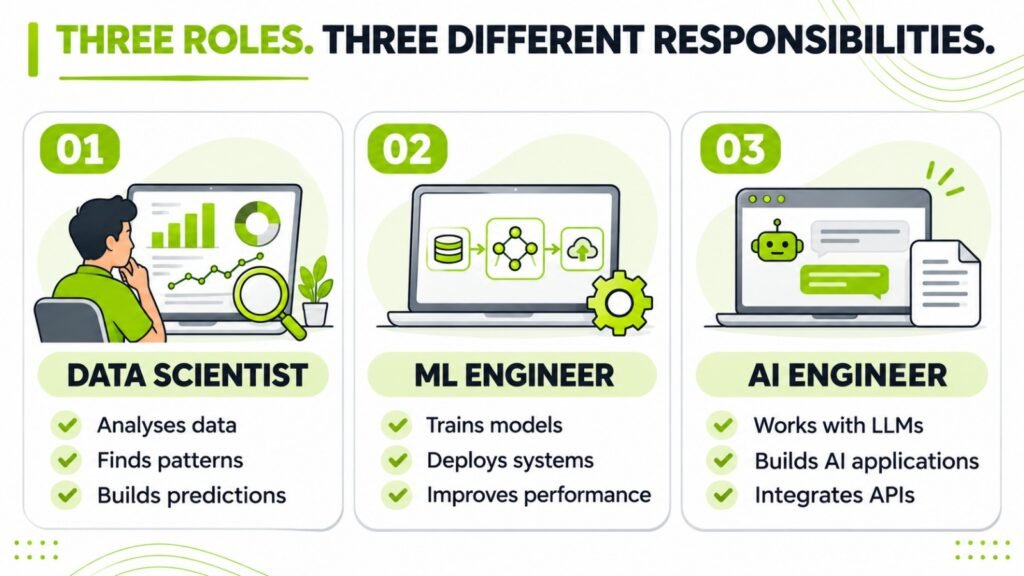
- The Data Scientist studies customer behaviour and predicts which customers are likely to go quiet.
- The ML Engineer builds and deploys the machine learning system that makes those predictions run reliably.
- The AI Engineer builds an AI-powered feature, perhaps a shopping assistant that understands customer questions and suggests products.
Same business, same goal, three different jobs.
Data Scientist: understand the data and find patterns
A Data Scientist uses data to answer business questions and make predictions.
Typical questions include why people cancel a subscription, which products will sell well next month, and what is really driving a change in sales.
Skills you will need:
- Python, Pandas and NumPy
- SQL and database queries
- Statistics and probability
- Machine learning fundamentals
- Power BI, Tableau or another visualisation tool
- Scikit-learn
Interview focus: SQL queries, statistics, Python, analytical thinking and practical problem solving.
This role leans on statistical reasoning more than the other two.
ML Engineer: make machine learning work in real applications
Building a model in a notebook is one thing. Making it run reliably inside a live application is another.
That is where an ML Engineer comes in. They train models, improve their performance, deploy them and maintain the systems around them.
Skills you will need:
- Strong Python programming
- Machine learning frameworks such as Scikit-learn and PyTorch
- Model training and evaluation
- Flask or FastAPI
- Docker and cloud fundamentals
- MLOps tools such as MLflow
Interview focus: coding, machine learning concepts, model evaluation, deployment and software engineering fundamentals.
This role needs a stronger engineering foundation, especially when the job involves production deployment.
AI Engineer: build applications using existing AI models
An AI Engineer does not usually build an AI model from scratch. Most application-focused AI engineers take existing large language models and build products around them.
Think of a customer support chatbot that can read a company’s own documents and answer questions from them. That is the kind of thing an AI Engineer builds.
Skills you will need:
- Python and API integration
- Large Language Models (LLMs)
- Prompt engineering and evaluation
- Retrieval-Augmented Generation (RAG)
- Vector databases
- Frameworks such as LangChain
- FastAPI and basic backend development
Interview focus: Python, API integration, LLM applications, prompt evaluation and basic system design.
For a deeper comparison of the skills and responsibilities, see FACE Prep’s guide to AI Engineer vs Data Scientist vs ML Engineer.
Quick comparison
| Factor | Data Scientist | ML Engineer | AI Engineer |
|---|---|---|---|
| Main focus | Data and predictions | Model deployment | AI applications |
| Main tools | Python, SQL, Pandas | Python, PyTorch, Docker | Python, LLM APIs, RAG |
| Maths requirement | High | Moderate | Generally lower |
| Engineering requirement | Moderate | High | Moderate to high |
| Typical output | Insights and models | Deployed ML systems | AI-powered applications |
A simple question to ask yourself: would you rather spend an afternoon analysing data, deploying a model, or building an AI-powered application?
Your answer tells you more about fit than any job title will.
What does an ML Engineer fresher job in India actually look like?
This is where a lot of people go wrong.
They see ML Engineer vacancies, notice the salary looks good, and assume a machine learning course will make them eligible.
That is not always how it works.
Some AI Engineer and ML Engineer listings ask for three or more years of experience. Others expect production systems, cloud and model deployment.
A few things to look for when you read a job description:
| Job description mentions | What it probably means |
|---|---|
| Python, SQL, ML basics | Junior data or ML role |
| 3+ years experience | Not a fresher opening |
| Model deployment, Docker, pipelines | ML engineering |
| LLM, RAG, vector database | AI application engineering |
| Internship or contract | Possible entry point |
Do not rule out a role just because the title sounds advanced.
A listing asking for Python, SQL and machine learning basics may suit you far better than one called AI Engineer that quietly expects several years of experience.
Which role can a fresher actually get?
Let us be practical. Based on the hiring mix and the skills each job demands, the routes look like this.
Easiest way in: Data Analyst and AI Operations
These roles get you into tech and data without asking you to build ML systems on day one. If you have SQL, Excel, Python and a dashboard tool, a Pune based Data Analytics course is a sensible starting point. Still deciding between the analyst and scientist routes? Here is the difference between a Data Analyst and a Data Scientist. A lot of AI operations work sits close to analytics, so it is also worth understanding what Gen AI actually means for a data analyst.
Reachable with a good portfolio: Junior Data Scientist and AI/ML Engineer
These become realistic once you can show you understand the whole process, from preparing data through to modelling and evaluation. Application-focused AI Engineer roles open up in the same way, once you have an AI project you can walk someone through.
Harder at the start: production-focused ML Engineer
Where a role expects deployment pipelines, cloud infrastructure and monitoring, it is difficult to qualify straight out of a training programme. An internship or a junior engineer role often comes first.
What about AI and ML jobs for freshers in Pune?
Pune is worth a closer look. In the August 2026 Business Today report, Pune accounted for 14% of fresher hiring, the same share as Bengaluru and Mumbai.
That 14% is not AI hiring alone. It is the city’s share of general fresher hiring across industries.
So students in Pune should look beyond the AI Engineer title. Python Developer, Data Analyst, Junior ML Engineer, AI Operations and internships are all worth watching.
What salary can a fresher expect?
Now for the number most people check before anything else.
Articles online quote ₹12 LPA, ₹18 LPA and ₹25 LPA for AI professionals. Those salaries do exist. They are not the fresher benchmark.
According to foundit’s July 2026 tracker, fresher salaries across all roles were distributed like this:
| Salary range | Share of fresher roles |
|---|---|
| ₹3 to 5 LPA | 41% |
| ₹5 to 8 LPA | 23% |
| ₹8 to 12 LPA | 9% |
| Above ₹12 LPA | 3% |
Only about 12% of fresher roles sat at ₹8 LPA or above.
AI, Data Science, Cybersecurity, Semiconductor and Product Engineering are the fields behind most of those better-paid roles.
For a closer look at starting pay in one of those fields, see what you can realistically earn after a data analytics course in Pune.
Remember that these figures cover all fresher jobs, not only AI and machine learning ones. Your skills, your projects, the company, the location and how you interview will matter more than the label on your CV.
How to become an AI Engineer after Python
Already comfortable with the basics of Python? Good. Resist the urge to jump straight into advanced AI frameworks.
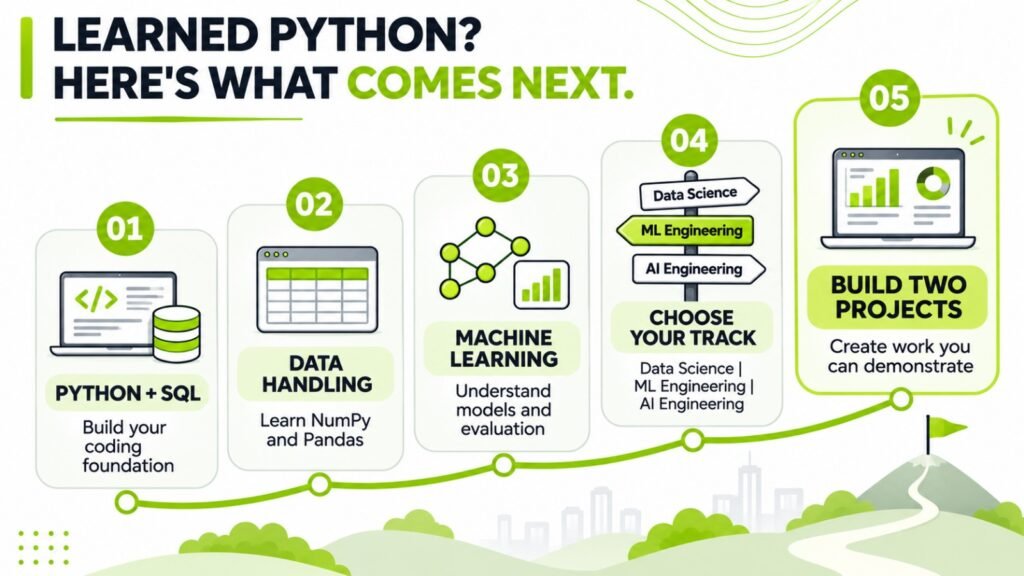
Build the foundation first. Here is a sensible order.
Step 1: get solid with Python and SQL
Functions, loops, data structures, file handling and object-oriented programming in Python. Queries and joins in SQL, practised until they are second nature.
Step 2: learn to handle data
NumPy and Pandas, and enough practice on real datasets to be comfortable with messy ones.
Step 3: learn statistics and machine learning
Regression, classification, clustering and model evaluation. Understand why data is split into training and test sets, and how to judge whether a model is any good.
Step 4: choose your track
- Data Science: statistics, SQL, predictive modelling and visualisation.
- ML Engineering: deploying models, building APIs, Docker and MLOps.
- AI Engineering: LLM APIs, RAG, vector databases and prompt evaluation.
Step 5: build two complete projects
Not just a notebook with model code in it. Build something you can explain from start to finish.
Three project ideas:
- Data Science: customer churn prediction using SQL and Python, with a dashboard that explains the result.
- ML Engineering: train a model, then serve it with FastAPI and Docker.
- AI Engineering: a document question answering app built with RAG, with a check on how accurate its answers are.
Put your dataset, evaluation metrics, outcome and error analysis on your CV. Where you can, find an internship and do some of this work on real problems.
If you are not sure how to present that work, this guide to building an IT portfolio for freshers in Pune walks through it.
Where does FirstBit’s Python with Data Science and AI course fit?
When you are starting out, teaching yourself everything can get confusing. Even with Python basics in hand, it is hard to know whether Pandas, machine learning, Django or Generative AI should come next.
A structured course can take that decision off your plate.
FirstBit Solutions runs a Python with Data Science and AI course in Pune, available online and in the classroom. It is described as a five to six month programme covering:
| Core curriculum | Additional exposure |
|---|---|
| Core Python and OOP | Prompt Engineering |
| MySQL and SQL | Generative AI |
| NumPy and Pandas | Deep Learning |
| Statistics and visualisation | NLP and Computer Vision |
| Regression, KNN, Decision Trees, Random Forest and SVM | TensorFlow |
| Flask, Django and REST APIs | Git, Docker and Kubernetes |
The course outline also includes 80% practical training, one to one doubt clearing, an integrated internship, CV guidance, aptitude preparation, mock interviews and placement assistance.
Who is it for?
It can work as a starting point if you are aiming at Python programming, Data Analytics, junior Data Science or machine learning for beginners. If your goal is specifically LLM-focused AI engineering, plan on building an extra RAG project of your own alongside it.
There is a fuller breakdown of the modules, duration and career outcomes in our guide to the Python Data Science course in Pune.
You can look through the Python Classes in Pune with Data Science and AI syllabus for the full detail.
Final thoughts: choose the work, not the job title
Do not become an AI engineer just because everyone is talking about AI. Do not pick Data Science only because it looks promising from the outside.
Start with Python, get comfortable with data, learn machine learning, and build something yourself.
Two projects you can discuss confidently in an interview will always beat a CV listing tools you have only skimmed.
And if your applications are going out but nothing is coming back, these nine things are worth checking first.
Want to try the work before you pay for it?
FirstBit Solutions offers 15 days of free online demo sessions for students interested in its Python with Data Science and AI course.
Book your free demo class or explore the Python with Data Science and AI course in Pune.
You can talk to the team about the syllabus, the practical projects and the learning options before you decide.
Frequently asked questions
Yes. Freshers can apply for junior AI and ML positions, internships and entry-level data roles. That said, AI-led opportunities made up around 4% of fresher postings in foundit’s July 2026 tracker, so relevant projects and practical experience carry a lot of weight.
A Data Scientist analyses data and builds predictive models. An ML Engineer trains, deploys and maintains machine learning systems. An AI Engineer typically builds applications using existing AI models and LLM APIs.
Generally, yes. Data Analyst roles tend to have a more accessible entry bar, built around SQL, Excel, Python and visualisation. Data Scientist roles usually expect stronger statistics and machine learning knowledge.
Start with SQL, data handling and machine learning basics. Then move on to LLM APIs, prompt engineering, RAG, vector databases and backend development. Build at least one working AI application you can demo.
Not always. Some employers weigh practical skills and projects alongside formal qualifications. In foundit’s July 2026 fresher tracker, 15% of postings did not specify a formal qualification. That figure covers all fresher roles, not only AI positions.