A lot of Java freshers have the same problem: their resume says “Spring Boot, MySQL, React, REST API”, but their project section looks almost identical to everyone else’s.
A Student Management System. An Employee Management System. Maybe a Library Management System. All three may technically work, but if the project came directly from a tutorial, an interviewer can usually tell within a few questions. The real value of a project is not the number of technologies you have mentioned. It is whether you can explain what you built, why you built it that way, and what went wrong while building it.
That is what these Java Spring Boot projects to get hired are designed around. They move from clean backend fundamentals to authentication, security, and finally Microservices, so you can build projects that give an interviewer something meaningful to ask about.
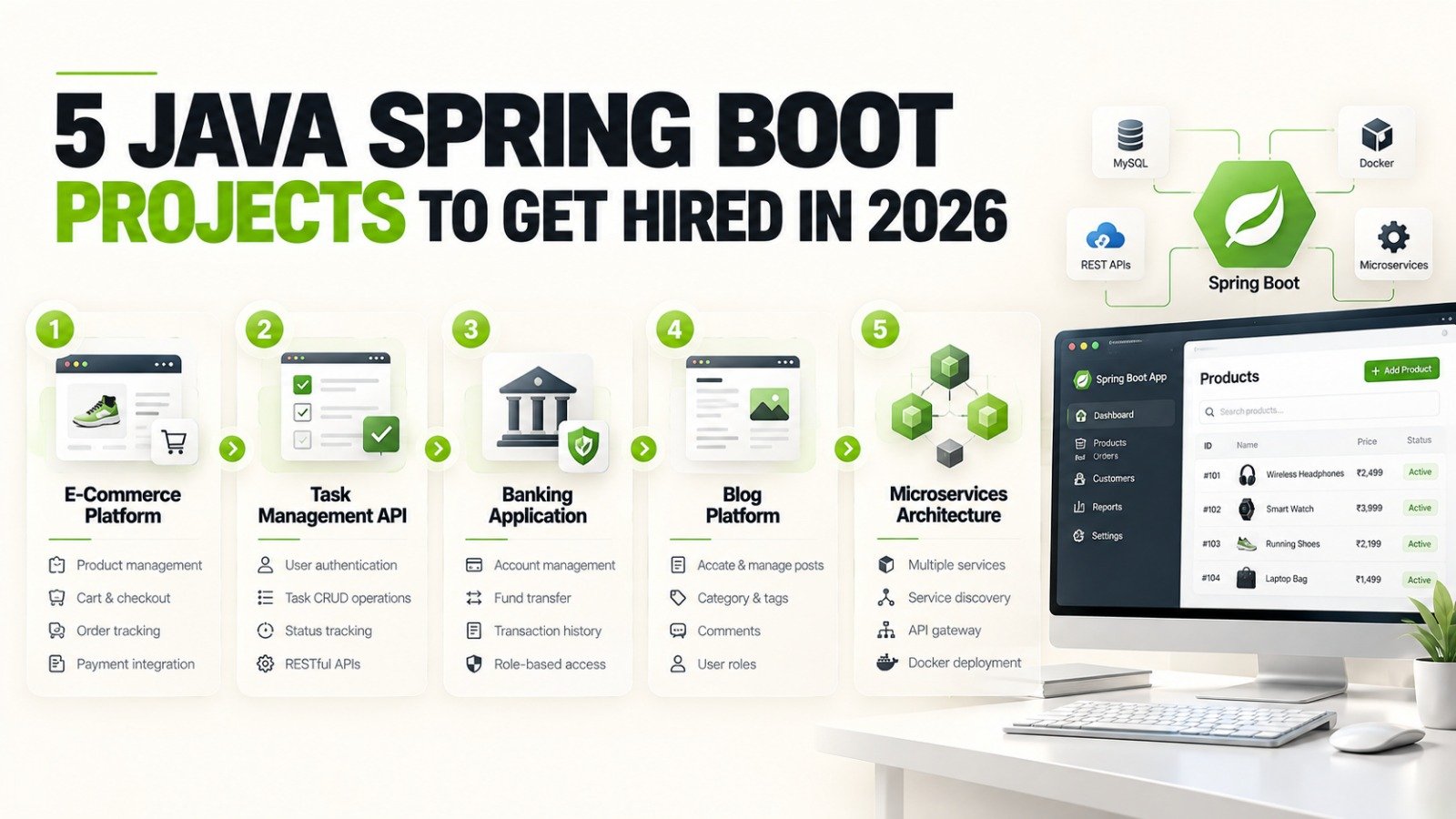
5 Spring Boot projects worth building as a Java fresher in 2026
- E-Commerce Platform: Spring Boot, JWT, React and MySQL
- Task Management REST API: Spring Boot, JPA, validation and exception handling
- Banking Application: Spring Security, JWT, roles and transaction handling
- Blog Platform: OAuth2, JWT, and role-based access control
- Microservices Application: Spring Cloud, Eureka and API Gateway
For every project, aim for a clean GitHub repository, a proper README, working APIs, and at least a few technical decisions you can explain without opening the code.
Why the project you build matters more than the course you took
Your course tells a recruiter what you studied. Your project gives them some evidence of what you can actually do.
That distinction matters especially for a fresher because you do not have two or three years of professional experience to point to. A project can show that you know how to connect Spring Boot to a database, design APIs, implement authentication, handle errors, and make different parts of an application work together. AlgoVentra’s 2026 Java Full Stack portfolio guide also puts real-world relevance, authentication, multiple database relationships, a working frontend, deployment, and a clean GitHub repository among the features that make a project more useful in an interview.
A good project should also show the practical Java Full Stack Developer skills that companies expect beyond just knowing Java syntax.
There is another test that is easy to miss. Can you explain the project without reading from your README?
Suppose an interviewer asks why you used JWT, why you chose MySQL, or what happens when two users try to buy the last product. If you can explain the reasoning, the project becomes evidence of understanding. If you only know which annotations to type, the project becomes a tutorial you happened to copy.
So do not build five projects just to fill five lines on your resume. Two or three projects that you genuinely understand are more useful.
How to think about project tiers before you start building
A useful way to plan Spring Boot projects for freshers in India is to think in levels. Beginner projects establish that you understand Spring Boot, REST, JPA, and basic database work. Intermediate projects add things such as authentication, validation, caching, or more complicated business rules. Advanced projects introduce distributed systems and Microservices.
Scaler’s current Spring Boot project guide follows a similar progression, moving from beginner REST and JPA projects to intermediate security and production concerns, then to Microservices projects. It also recommends choosing projects based on your experience rather than trying to build every advanced project immediately.
For a fresher, the sensible route is simple: build one solid backend project first, then one more complete application with authentication and a frontend. Only after that should you worry about Microservices.
That order saves you from a common mistake: learning Eureka and API Gateway before you are comfortable writing a normal REST API.
Project 1: E-Commerce Platform, the one recruiters already understand
An e-commerce application is a strong Spring Boot React project portfolio because almost everyone understands what the application is supposed to do. More importantly, it gives you enough moving parts to demonstrate several skills in one project.
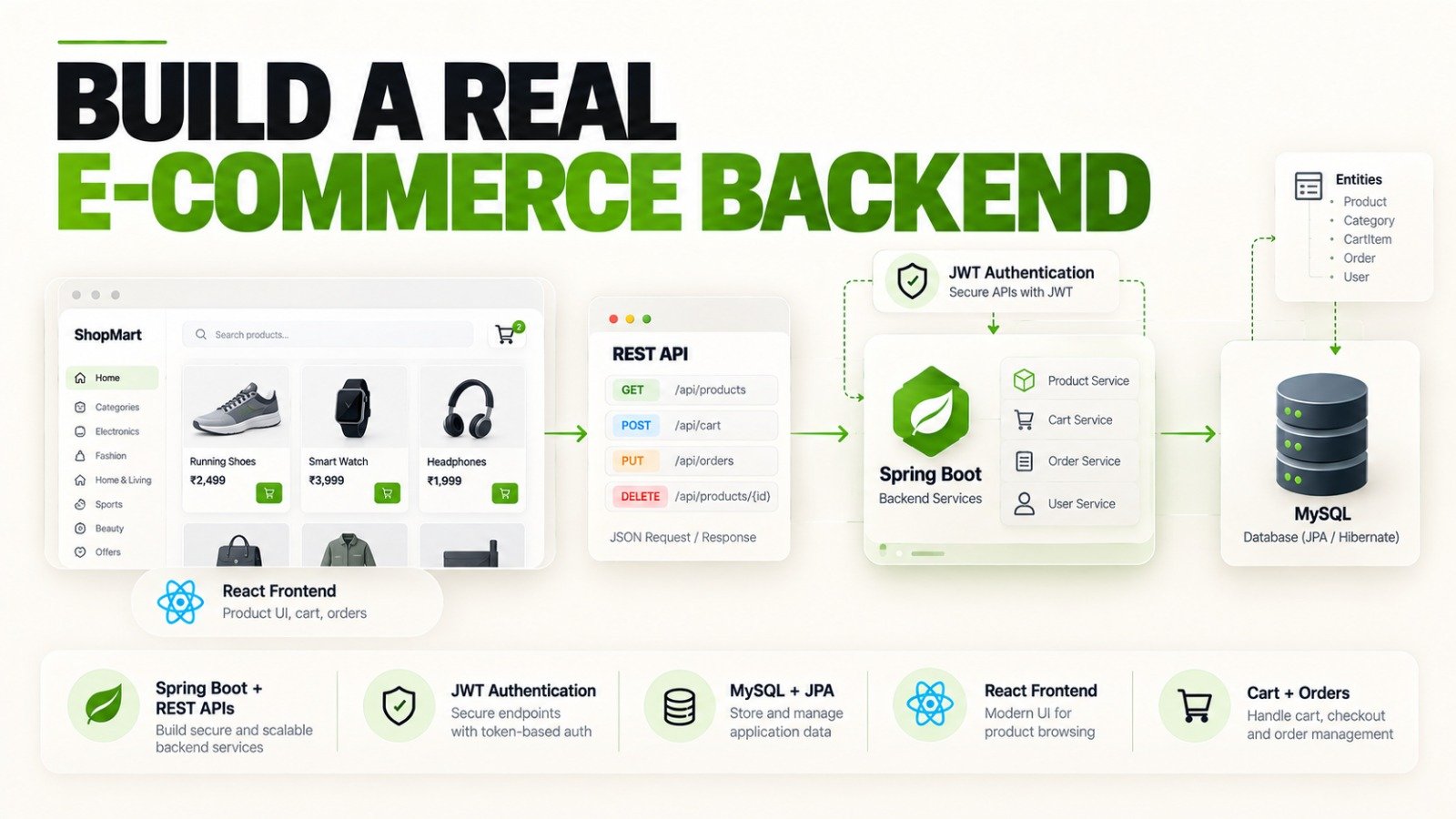
What you are building: A full-stack shopping application with registration and login, product browsing, search and filtering, a shopping cart, order placement, and an admin panel for managing products and orders.
Suggested stack: Spring Boot 3.x, Spring Security, JWT, Spring Data JPA, Hibernate, MySQL, React, Maven, and Git. You can add Docker and AWS deployment once the application itself is working.
The interesting part is not creating a /products endpoint. It is everything around it. A real project has users, products, categories, orders, order items, and cart items, with relationships between those tables. You also have to decide what a normal user can access and what only an admin can change.
f you are deciding between React and Angular for the frontend, this guide on React vs Angular for Java Full Stack jobs in Pune can help you choose.
AlgoVentra’s 2026 portfolio guide identifies e-commerce as a widely recognised Java Full Stack portfolio project because it combines product catalogues, accounts, carts, orders, authentication and a frontend in one application.
Expect questions such as:
- How did you implement USER and ADMIN access?
- How does JWT authentication work in your application?
- What happens if a product goes out of stock while it is in someone’s cart?
- Why did you choose MySQL?
- Walk me through what happens when a user places an order.
Those questions are exactly why this makes one of the better Java full-stack project ideas for 2026. There is enough depth for the interviewer to move beyond “What is Spring Boot?”
For your resume, avoid writing only “Developed an e-commerce website using Java and Spring Boot.” Explain what you actually built.
A stronger version would be:
Built a full-stack e-commerce application with product management, cart, and order workflows using Spring Boot, JWT authentication, MySQL, and React. Implemented separate USER and ADMIN access and developed REST APIs for product, cart, and order operations.
Only mention deployment, API counts, or specific features if you actually built them.
Project 2: Task Management REST API, the foundation that shows clean architecture
A Task Management API is a good Spring Boot REST API project for beginners because the business idea is simple enough to understand while the backend can still demonstrate proper development practices.
What you are building: Users can create tasks, assign them, change status, set priorities and deadlines, and filter tasks based on different conditions.
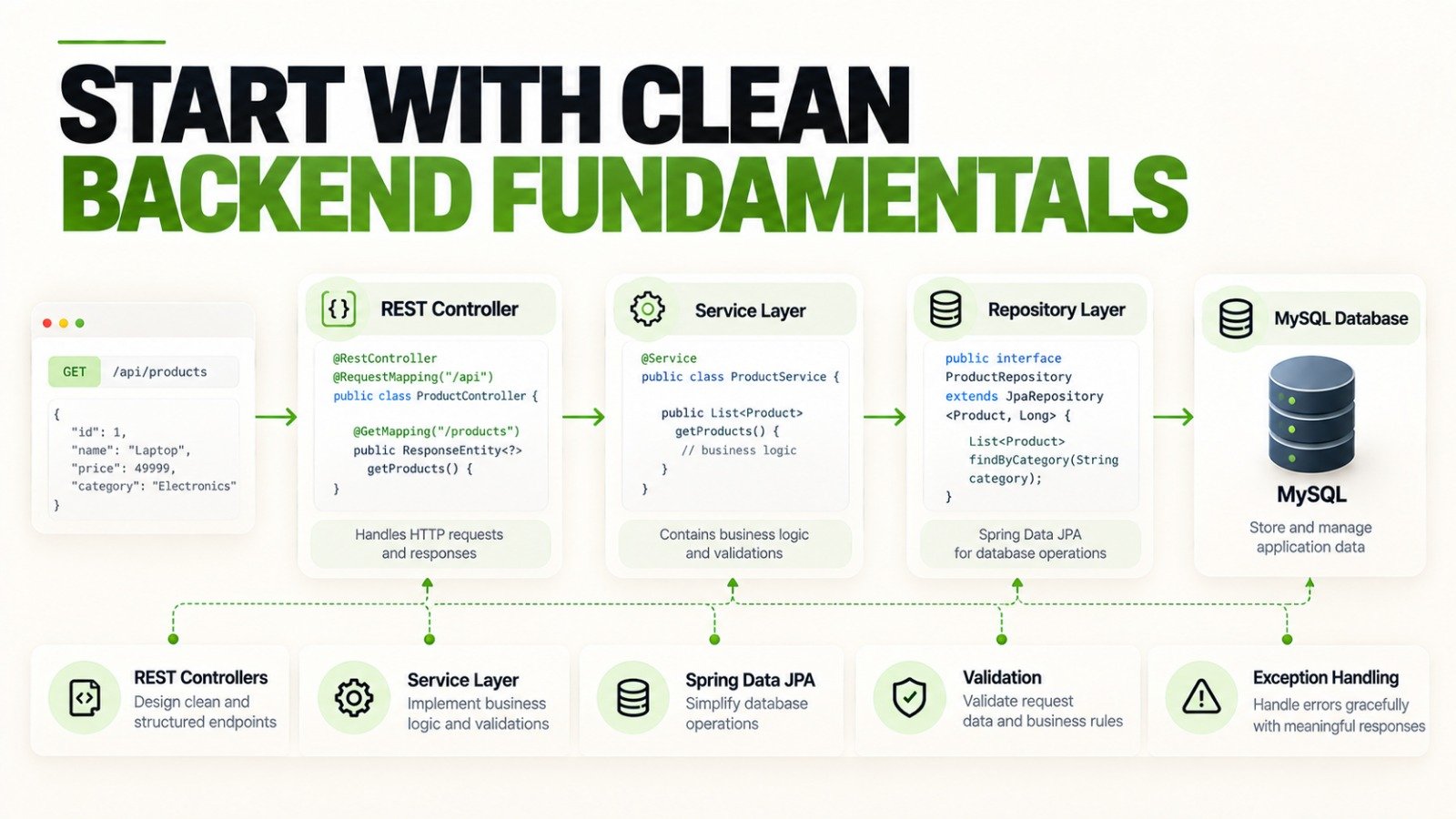
The project does not need an elaborate frontend. In fact, keeping the focus on the backend can be useful here. Build REST endpoints using Spring Boot, store data with Spring Data JPA, use MySQL or H2, validate incoming requests, and create consistent error responses.
For example, if someone creates a task without a title, your API should not simply crash or return a confusing server error. Bean Validation can catch the invalid input, while a global exception handler can return a useful response to the client.
This is where a basic CRUD project starts becoming something more meaningful.
You can structure the application into controllers, services, and repositories rather than putting all your business logic inside the controller. Add Swagger or OpenAPI documentation so someone can understand and test your endpoints without reading your source code.
Scaler’s current beginner project guidance specifically includes dependency injection, REST controllers, Spring Data JPA, validation, and global exception handling in its Task Management API example.
An interviewer may ask, “Why did you create a service layer?” or “What happens when invalid data reaches your API?” Those are much better conversations than simply being asked to demonstrate a CRUD operation.
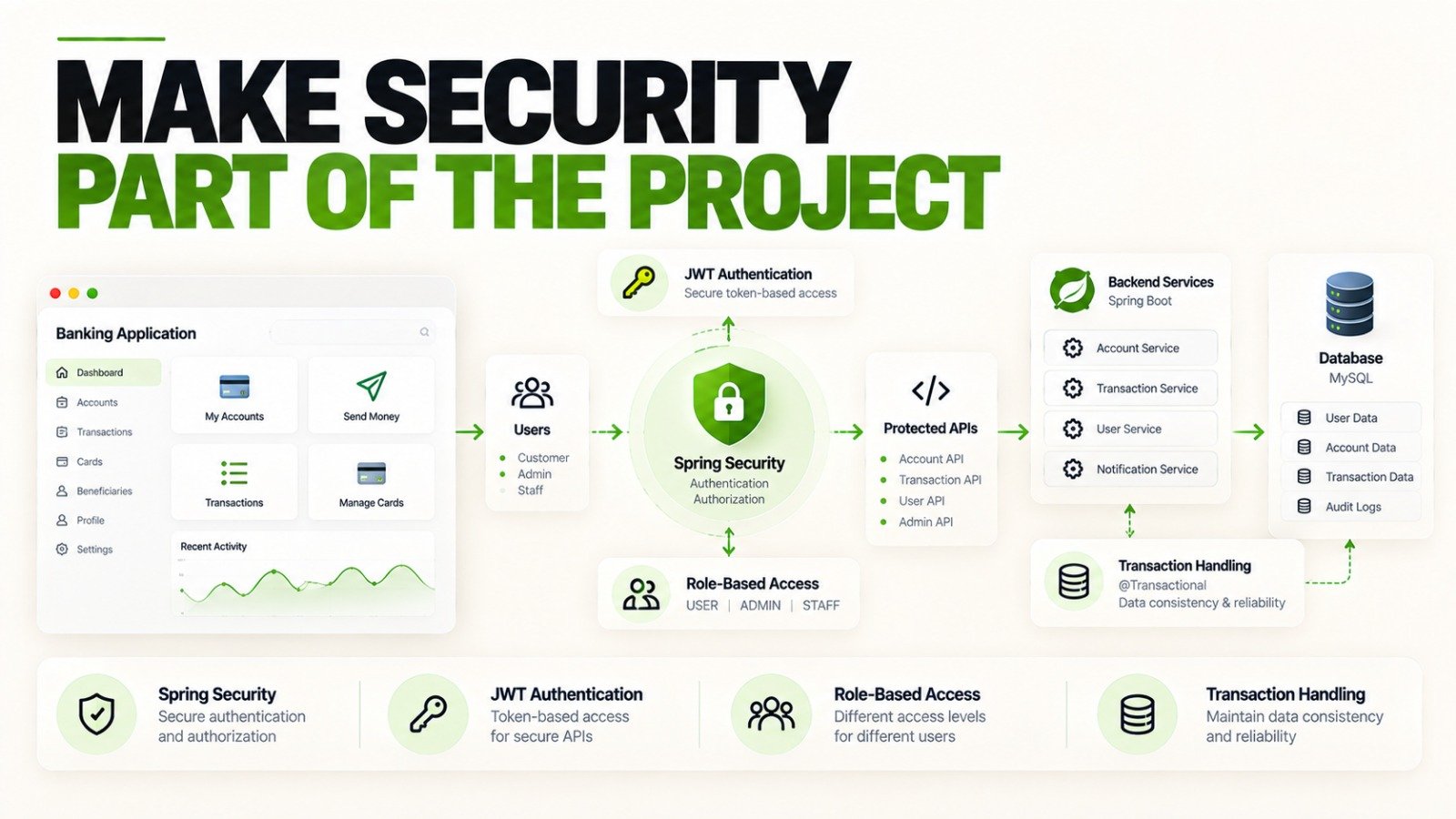
Project 3: Banking or Finance Application with Spring Security and JWT
A banking project is useful if you want to demonstrate that you understand authentication and authorisation, not just database operations.
What you are building: A simple banking application where customers can register, log in, view their balance, transfer money, and check transaction history. An administrator can have separate permissions, such as viewing accounts or freezing an account.
Suggested stack: Spring Boot, Spring Security, JWT, Spring Data JPA, MySQL, Postman, and role-based access control.
The important part is security. A customer should be able to access their own account information, but they should not be able to change another customer’s details simply by changing an ID in the request.
That gives you real questions to solve. How do you identify the logged-in user? Where is the JWT checked? What happens when the token expires? How do you restrict an admin endpoint? What should happen when authentication fails?
You should be able to draw the basic JWT flow before putting this project on your resume: the user sends credentials, the server validates them and issues a token, the client sends that token with later requests, and the application validates it before allowing protected operations.
Do not build security by blindly copying a configuration from a video. Spring Security has enough moving parts that an interviewer can quickly find out whether you understand what your code is doing.
For a Spring Boot JWT authentication project, the security flow itself should be something you can explain comfortably.
Building these projects alone is absolutely possible, but there is a difference between following a tutorial and getting unstuck when your application stops behaving as expected. Database errors, authentication bugs, dependency conflicts, and deployment problems are often where beginners spend most of their time.
FirstBit’s Java Full Stack course is designed around structured learning, practical work, and interview preparation. If you are comparing training options in Pune, you can look at the Java Full Stack course and use a demo session to understand how the project work is handled before making a decision.
Project 4: Blog Platform with OAuth2 and Role-Based Access Control
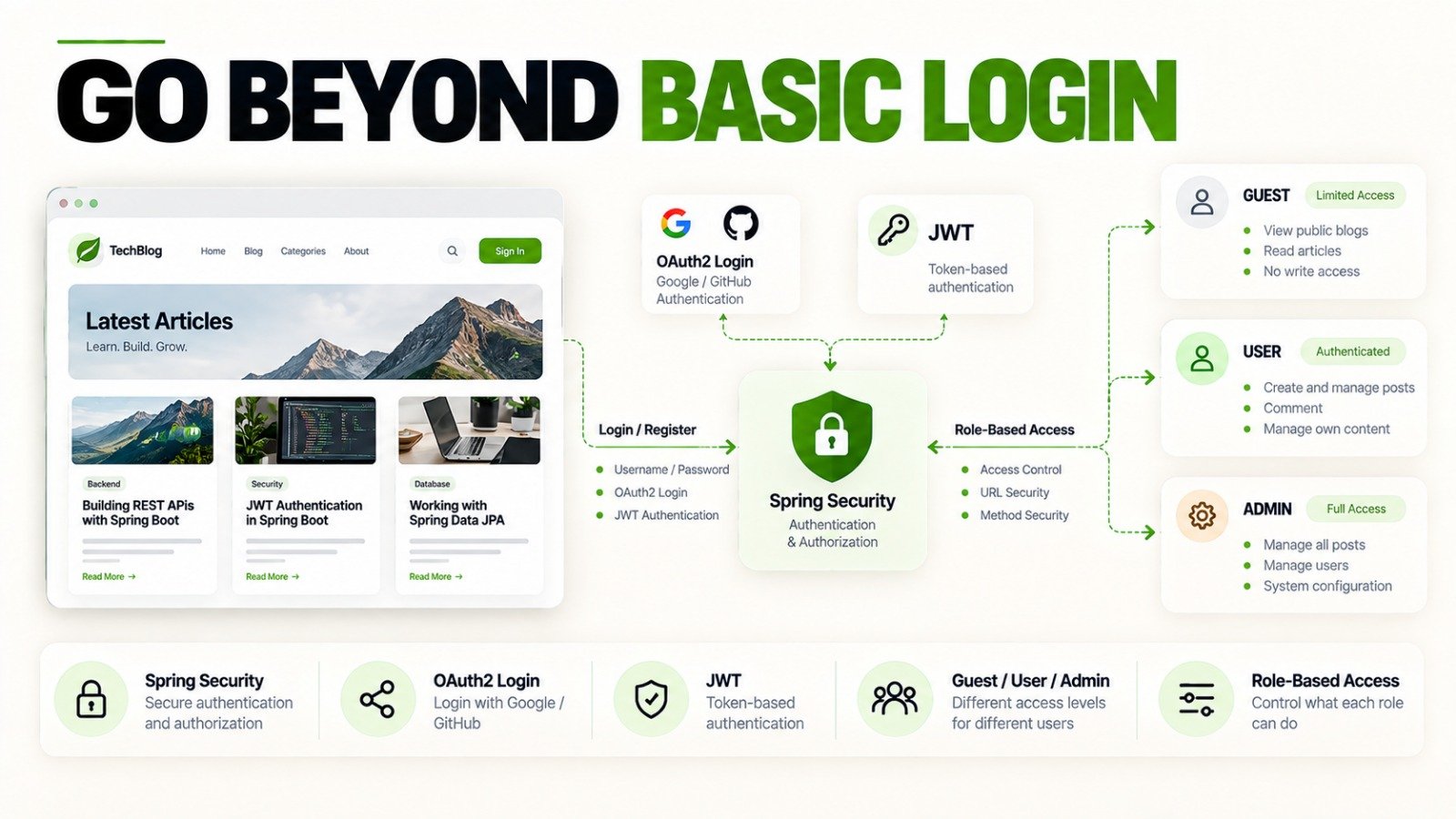
A blog platform becomes much more interesting once you move beyond “users can create posts.”
Build an application where visitors can read published posts, registered users can create and manage their own content, and administrators can moderate posts, manage categories, and restrict users.
Add email registration and Google OAuth2 login. Then introduce different roles such as GUEST, USER, and ADMIN.
Suggested stack: Spring Boot, Spring Security, OAuth2, JWT, Spring Data JPA, and MySQL.
This is a good Spring Boot project for a Java fresher resume in India because it gives you a chance to discuss authentication and authorisation from several angles. OAuth2 lets users sign in through an external identity provider, while your application still needs to decide what that user is allowed to do.
For example, signing in with Google should not automatically make someone an administrator. Your application needs its own user and role model, along with rules that protect admin-only operations.
You can also discuss questions such as:
“Why did you use OAuth2?”
“How do you handle a first-time Google login?”
“How does your application stop a normal user from calling an admin endpoint?”
Scaler’s current intermediate project guidance includes a blogging platform using JWT, OAuth2, and role-based access control, and specifically focuses on understanding the Spring Security filter chain rather than copying security configuration without understanding it.
This is the kind of project where a smaller feature set with proper security is more valuable than a huge application full of unfinished features.
Project 5: Microservices Architecture with Spring Cloud, the advanced differentiator
Microservices should not be your first Spring Boot project. They become useful once you already understand how to build a normal application and want to demonstrate system design concepts.
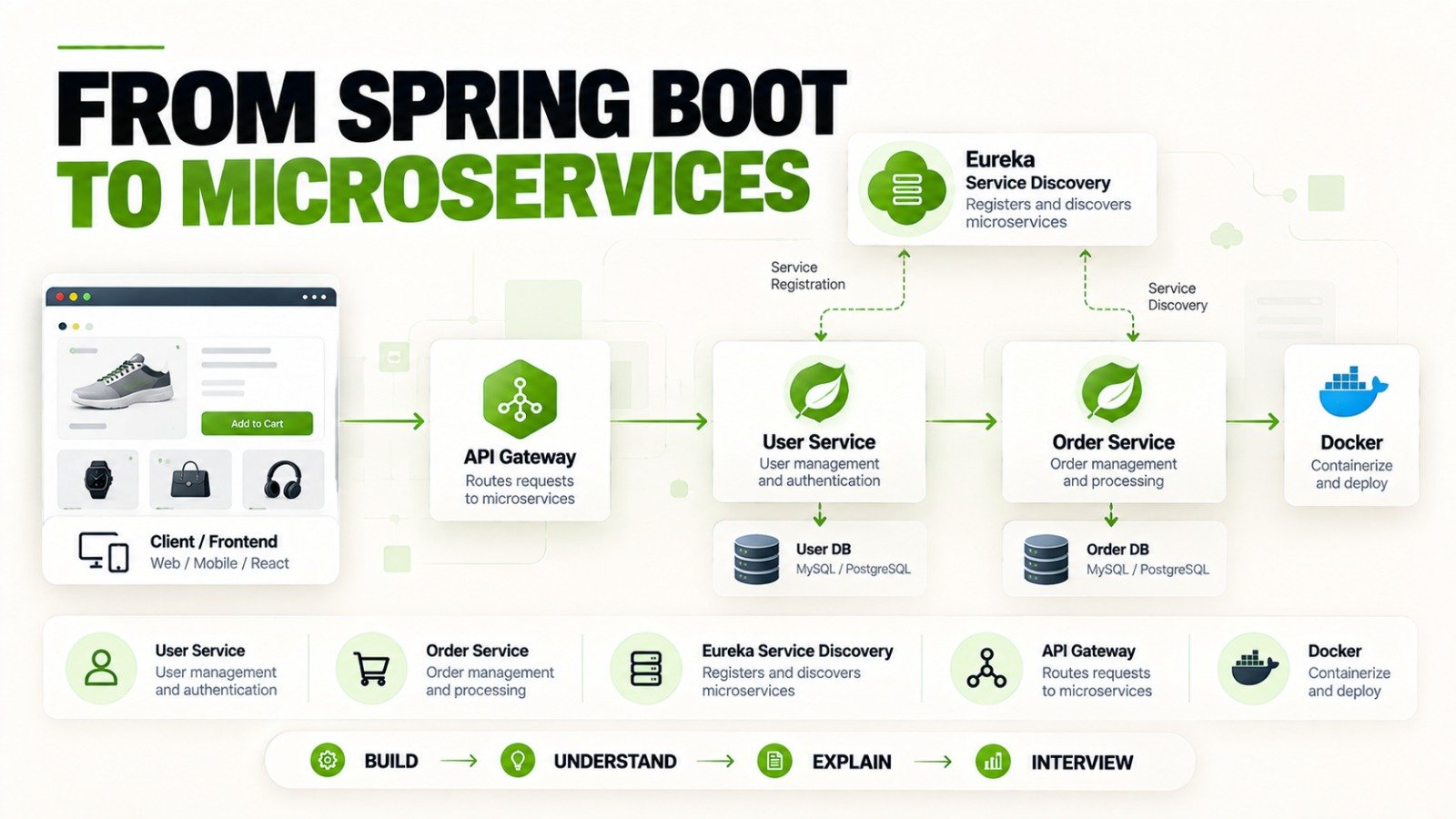
What you are building: Start with two services, such as User Service and Order Service. Give each service its own responsibility and database, then allow them to communicate through APIs. Add service discovery using Eureka and an API Gateway to provide a single entry point.
Suggested stack: Spring Boot, Spring Cloud Netflix Eureka, Spring Cloud Gateway, WebClient or OpenFeign, MySQL, and Docker.
The important word here is separate. Putting two controllers into different packages and calling it Microservices does not make an application distributed. The services should be independently structured and communicate over the network.
That creates new problems, which is exactly why this project is more advanced. What happens if the Order Service is unavailable? How does one service find another? Where should authentication be checked? What happens when a network request times out?
Scaler makes the same distinction in its current guide, pointing out that genuine Microservices involve independently deployable services, network communication and separate data ownership. It also cautions that freshers do not need Microservices for their first job and that a poorly built Microservices project can be weaker than a well-built monolith.
So build this project only after your fundamentals are comfortable. If you can explain Eureka, API Gateway routing, service-to-service communication, and failure handling without memorising definitions, the project has done its job.
How to present these projects on your resume and GitHub
Building a project is only half the work. You also need to make it easy for someone else to understand what you built.
Every serious project should have a clean GitHub repository with a README explaining the problem, features, technology stack, setup instructions, and important design decisions. Add screenshots, an architecture diagram, or API documentation where useful. If the application is deployed, include the live URL.
AlgoVentra’s 2026 portfolio guide recommends showing the project problem, technical implementation, and specific features rather than filling the resume with a generic technology list. Its e-commerce example also uses concrete details such as REST APIs, authentication, database relationships and deployment.
Your resume bullet should follow a simple pattern:
Built + what you built + how you built it + what it actually does.
Instead of:
“Created a Spring Boot project using Java and MySQL.”
Write:
“Built a task management REST API using Spring Boot and Spring Data JPA, with request validation, layered architecture and global exception handling.”
The second version gives an interviewer somewhere to go.
For a fresher, two or three strong projects are enough. You do not need ten repositories. Scaler’s current project guide makes the same broader point: depth matters more than building several versions of the same CRUD application.
Once your portfolio is ready, the next challenge is explaining it clearly during an interview. Your project should not become a script you memorised. You should be able to explain the problem, architecture, one difficult technical issue, and what you would improve next.
The projects matter, but your understanding matters more
The best Java Spring Boot projects to get hired are not necessarily the biggest ones. A fresher who can build a clean REST API, explain JWT authentication, design a sensible database, and debug their own code has something useful to talk about in an interview.
Start with the Task Management API if your backend fundamentals are still developing. Move to e-commerce or finance when you are ready to combine Spring Boot with security, databases, and a frontend. Leave Microservices until you understand why you need separate services in the first place.
If you want to learn the stack through structured training and project work, you can explore FirstBit’s Java Full Stack course before deciding. The goal should not be to collect projects for your resume. It should be to build two or three applications that, when an interviewer asks, “Why did you build it this way?”, you actually know the answer.