
You have two tabs open. One is a Coursera page for the Google Data Analytics Certificate. It looks sensible, and it is far cheaper than most institutes. The other is a classroom course, with a syllabus PDF and a counsellor who keeps calling. Both promise a route into data analytics. All you really want to know is which one gets you interviews.
The short answer is that neither certificate gets you interviews on its own. What gets you interviews is a combination of the right skills, which means SQL, a BI tool, Python and Excel, projects you can talk through step by step, and interview answers you have actually practised out loud.
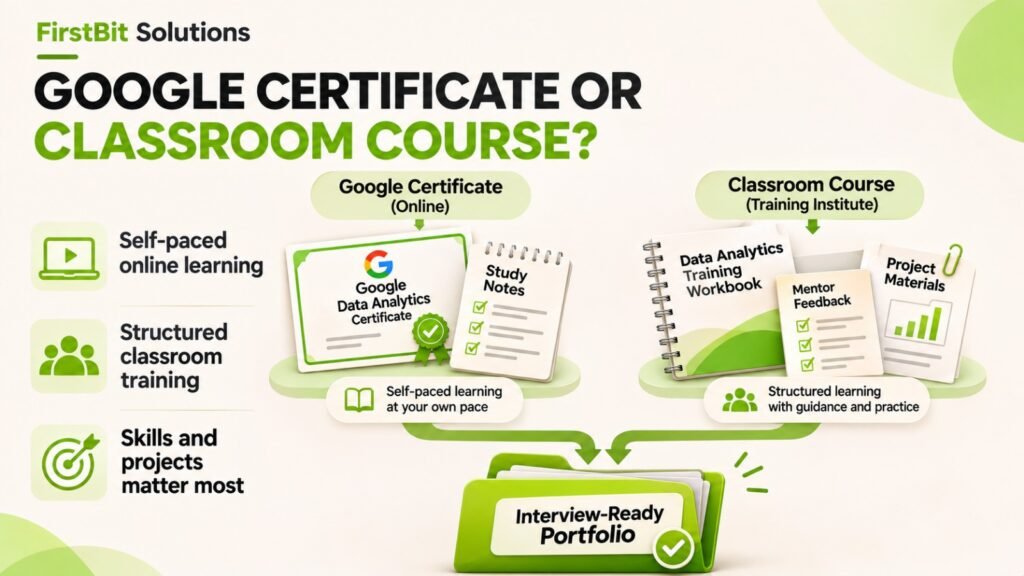
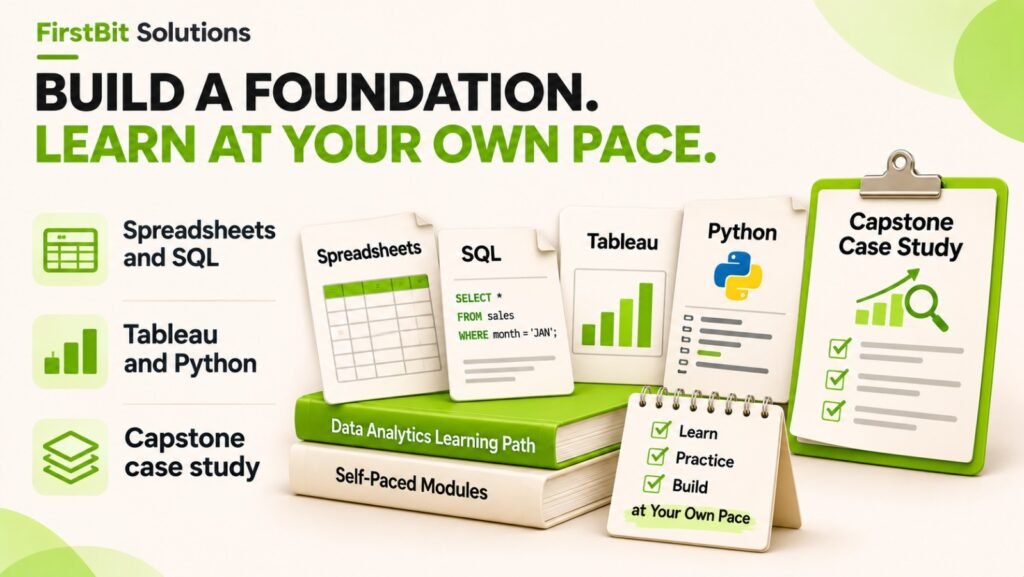
The Google certificate is a low-cost, self-paced foundation. It covers spreadsheets, SQL, Tableau and Python. A classroom course adds Power BI and Advanced Excel, plus mentored projects and interview practice. It costs more and it runs to a fixed timetable.
Disciplined and on a budget? Start with Google, then add Power BI and a project of your own. Need structure and interview practice in Pune? A classroom course fits better.
What the Google certificate gives you
Credit where it is due. This is a well-built beginner course, and you do not need a degree or any experience to enrol. According to Google, high school maths is enough.
There are eight courses and around 240 hours of work in total, so the programme runs about three months at 20 hours a week, or six months at 10 hours a week. The tools are spreadsheets, meaning Google Sheets and Excel, along with SQL, presentations, Tableau, Python and Kaggle. It also covers using AI to clean and structure data and to suggest visualisations, and it finishes with a capstone case study you can show an employer.
One thing to check for yourself. Older reviews say this programme teaches R. Google’s current FAQ says Python, and the seventh course is an introduction to data analysis with Python. Open the syllabus on Coursera before you enrol.
Cost needs the same care. Google states $49 a month in the US and Canada after a seven-day free trial, and says prices elsewhere may be lower, so open the Coursera page for your rupee price on the day you read this. We would skip any blog that quotes a fixed rupee figure, since the ones we found disagree with each other by a wide margin. And because it is a monthly subscription, how fast you finish decides what you pay.
What you will not find is machine learning, which sits in Google’s separate Advanced Data Analytics Certificate. That is fine for a first analyst job. It is just worth knowing where the edges are, and you can read the full course list on Google’s certificate page.
What a classroom course adds, and what it does not
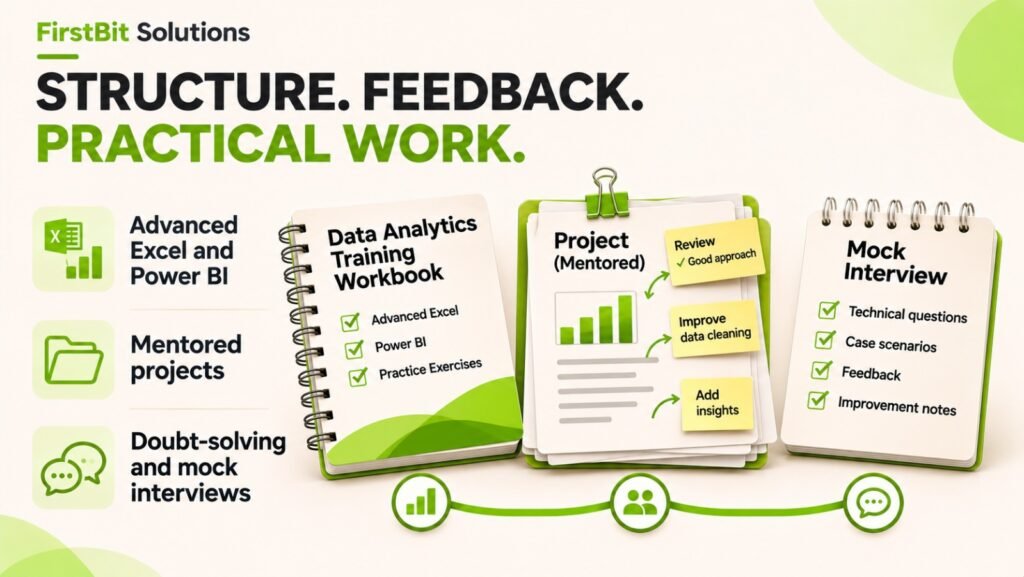
Structure gives you three things a self-paced course cannot: a trainer, a timetable, and someone to ask when you get stuck. The Data Analytics course at FirstBit in Pune runs over five to six months, online or in the classroom on Fergusson College Road, and the institute describes it as 80 per cent practical.
The syllabus covers Advanced Excel, SQL using MySQL, Python with NumPy and Pandas, Matplotlib, Seaborn, Power BI, Tableau, statistics and machine learning fundamentals. A Gen AI module covers using ChatGPT for data cleaning, and where AI falls short in analytics.
The practical work includes projects such as a sales dashboard, customer analysis, marketing analytics, a business dashboard and ecommerce. The exact projects vary by batch. The programme also includes an integrated internship, doubt clearing, recorded sessions, resume help, aptitude tests and mock interviews.
There are a few things to weigh before you join a classroom course, here or anywhere else.
First, the certificate you receive at the end is a FirstBit course completion certificate, not a university or partner certificate. Second, it costs more than a Coursera subscription. Third, the full 675-plus hour syllabus includes web UI, Flask, Django and Git. Those are useful skills, but they are not what every data analyst role asks for.
And the same caveat applies on both sides. A certificate helps your application get read. Your projects, and how you explain your work in an interview, are what prove you can do the job.
Google certificate vs FirstBit classroom course, side by side
| What to compare | Google certificate | FirstBit Data Analytics |
|---|---|---|
| Format | Self-paced, online | Live online or classroom in Pune |
| Duration | Around 240 hours | 5 to 6 months, 675+ hours |
| Spreadsheets | Google Sheets or Excel | Advanced Excel, pivot tables, Power Query |
| SQL | Yes | Yes, using MySQL |
| Python | Yes | Yes, with NumPy and Pandas |
| BI tools | Tableau | Power BI and Tableau |
| AI learning | AI for data tasks | ChatGPT, prompt engineering and AI limitations |
| Projects | Capstone case study | Practical projects and an integrated internship |
| Doubt support | Quizzes and discussion prompts | One-to-one doubt solving and recordings |
| Interview preparation | Career support, with US-specific eligibility | Resume guidance, mock interviews and aptitude practice |
| Certificate | Google Career Certificate via Coursera | FirstBit course completion certificate |
| Cost | Monthly subscription | Confirm the total fee with the institute |
The real difference is in how you learn. Google gives you convenience and a low price. A classroom course gives you a trainer, Advanced Excel and Power BI, project work that someone reviews, and somewhere to take your doubts.
Neither one promises you an interview. So the next question is what companies are actually asking for.
So which one actually gets you interviews?
Honestly, no certificate guarantees an interview. And there is no study comparing interview success for Google certificate holders against classroom course students in Pune, so nobody can give you that number.
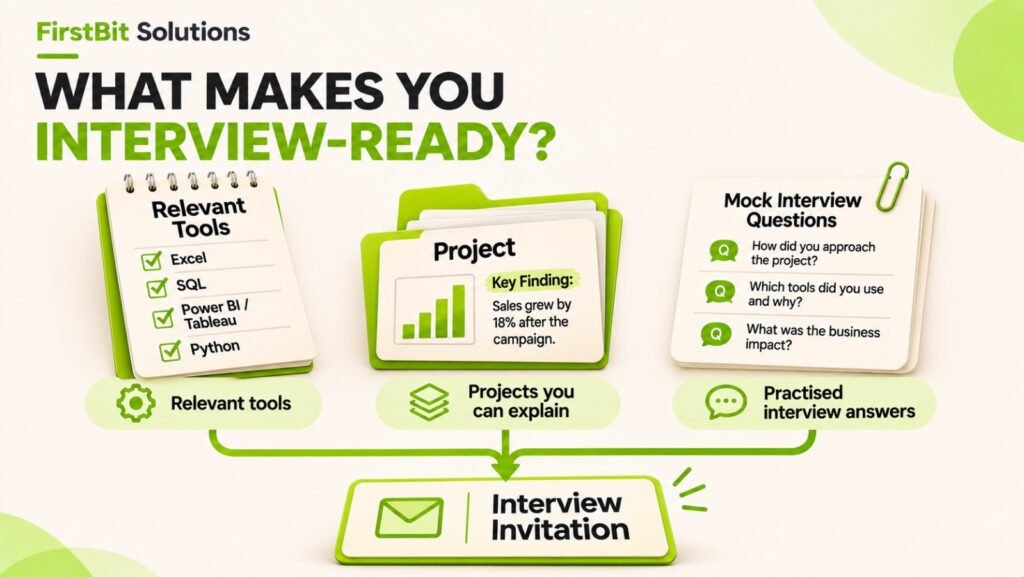
What you can do is measure your own readiness against three things: the tools companies ask for, the projects you have finished, and how you perform in the room.
1. Does your resume match what the jobs ask for?
An analysis published in May 2026, covering 2,585 data analyst listings on a single job board, found SQL in 72 per cent of them, Python in 53 per cent, Power BI in 40 per cent, Tableau in 40 per cent and Excel in 35 per cent.
Those figures are not specific to Pune, but they show you the shape of what employers want. You can read the full data analyst skills analysis.
Notice that Power BI and Tableau appear equally often. Being fluent in one and able to find your way around the other gives you more options. Google teaches Tableau and not Power BI. You can learn Power BI on its own, or take a course that covers both.
Better still, check it yourself. Open 20 current entry-level data analyst openings on Naukri and LinkedIn, and count how many times each tool appears. That tally is more useful than any national average.
2. Do you have projects you can explain?
Google’s capstone gives you one case study to work through. That is a reasonable start, but do not let it be your only portfolio piece.
Build something of your own on a dataset you find interesting, and be ready to say which metrics you chose, how you cleaned the data, and what you concluded.
On a classroom course, someone reviews your work and points out what you missed. That matters most when you are still learning to read an unfamiliar dataset.
Either way, here is the test. Can you explain your project, end to end, without looking at your notes? If not, spend more time understanding it before you put it on your resume.
3. Have you practised for the interview?
Learning SQL and Python is one thing. Writing a query while someone watches, or walking a stranger through your dashboard, is another thing entirely.
Google does offer career services, including CareerCircle, coaching, interview preparation and resume help. But that support and its employer network are built around US graduates, so if you are applying from Pune it is worth finding out what you would actually get.
A classroom programme can build resume sessions, aptitude practice and mock interviews into the course itself. FirstBit also offers placement assistance, which helps with preparation and applications. It is assistance, not a guaranteed job, and you should read it that way.
If you want to compare the two properly, book a free demo and put it side by side with Google’s first course.
Already finished the Google certificate but still no interview calls?
You are in a better position than it feels, because the fix is often small. Take your last ten applications and test them against three gaps. Does your resume show Power BI or Advanced Excel? Is the capstone still your only project? Have you ever answered interview questions out loud and had someone tell you how it landed?
Most people find that one or two of those apply. The first two you can close on your own in a couple of weeks with free resources. The third is the hard one, because nobody will tell you that your answer rambled and never reached the part the interviewer was waiting for. That is what a mentor is for, and it is why a mock interview can be worth paying for.
Online or classroom in Pune: who should pick which
Think about the last self-paced course you started. Did you finish it? That one answer tells you more than any comparison table, because 240 hours on your own means a lot of evenings where nobody is checking.
Pick Google if you can protect around 10 hours a week for months, money is tight, and you want a cheap way to find out whether you even enjoy this kind of work. Plan to add Power BI and one project of your own as you go.
Pick a classroom course if you do better with deadlines and a person to ask, you want Excel, SQL, Python and Power BI taught together, or you are switching from a non-IT degree and the interview is the part that worries you. The FirstBit course starts from fundamentals and assumes no prior coding. If maths is what is holding you back, we wrote about how much maths data analytics actually needs.
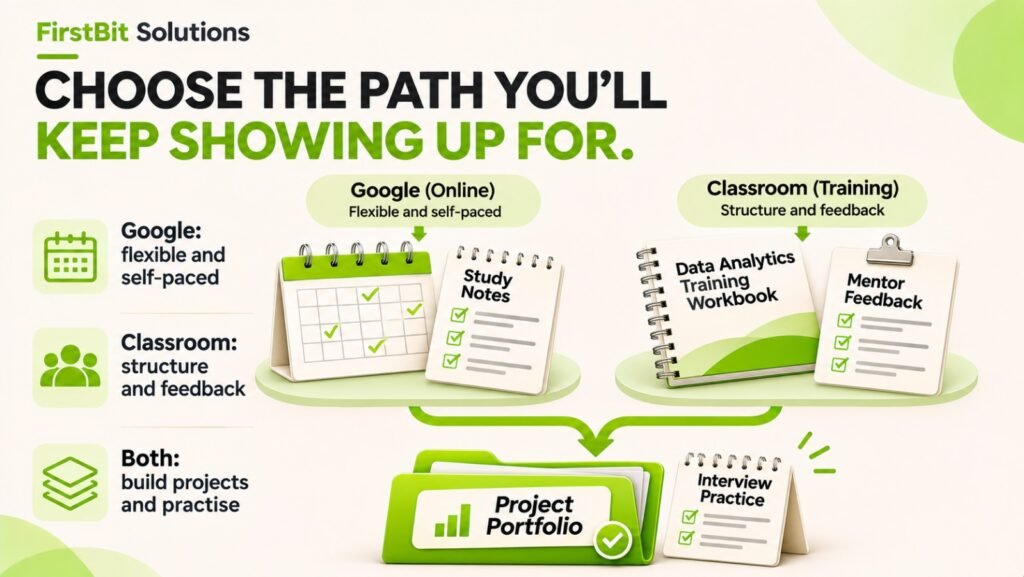
Do both, in order, if you are unsure. Start Google’s first courses as a low-cost test, then sit in on a demo class and see which way of learning you would keep turning up for.
A weekend test before you spend anything
- Tally the tools. Count what 20 current Pune data analyst listings ask for, as described above.
- Try Google’s first course. Check whether the free trial on the Coursera page applies where you are.
- Attend a demo class. Watch what happens when a student gets stuck: who answers, how fast, and how well.
- Ask any institute, us included, five questions. What will I build? Who reviews my project? What exactly does placement assistance include? What is the total fee, in writing? Can I attend before I pay?
If you are comparing several institutes, our guide on how to choose a data analytics institute in Pune goes further.
The honest bottom line
The Google Data Analytics Certificate versus classroom course question has a boring answer, which is also the true one. Do not pay for either until you have tried both. Google’s own page mentions a seven-day free trial for its US and Canada subscription, so check whether one applies on your Coursera page. FirstBit offers 15 days of free online demo sessions. Put the first week of each side by side and notice which one you would keep showing up for.
Whichever you choose, aim to finish with three things: a tally of tools from real Pune listings, two or three projects you can explain without notes, and a few mock interviews behind you. Those are what get interviews. The certificate just gets you started.
If you want to see our side of it, here is the data analytics course in Pune, or book a free demo and bring your questions.
Frequently asked questions
Yes, it is a useful starting point for beginners who want to learn spreadsheets, SQL, Tableau and Python at a relatively low cost. However, you will need additional projects and possibly Power BI training to cover more job requirements.
Google’s current syllabus includes Python in course seven, Introduction to Data Analysis Using Python. Older reviews may mention R, so check the latest course details before enrolling.
No. The programme covers spreadsheets, SQL, Tableau, Python and other data analysis skills. You will need to learn Power BI separately.
The programme takes approximately 240 hours across eight courses. Google estimates three months at 20 hours per week or six months at 10 hours per week.
Google lists $49 per month in the US and Canada after a seven-day free trial. Other countries may have lower pricing. Check Coursera for the current Indian subscription price before enrolling.
It depends on your learning style, budget and need for guidance. Google suits self-driven learners, while a classroom course may be more suitable if you need regular doubt-solving, project feedback and interview preparation.
Yes. Its five-to-six-month programme covers Advanced Excel, SQL using MySQL, Python with NumPy and Pandas, Power BI, Tableau, statistics, machine learning basics and Gen AI. It also includes an integrated internship, mock interviews and placement assistance.