Getting your first job in data analytics can be hard work. You may be comfortable with Excel, you may have just started with SQL, you may even have finished a project in Power BI, and still have no idea who to send a CV to or what recruiters are actually looking for.
The good news is that entry-level roles in this field do not ask for a decade of experience. There are opportunities out there. Knowing how and where to look makes most of the difference.
Pune has openings across IT services, analytics, banking, consulting and other sectors that rely on data for decision making. This guide covers data analyst jobs in Pune for freshers: the companies and industries worth applying to, and the skills they ask for.
What does the data analyst job market in Pune look like for freshers?
Data analytics is no longer confined to the tech industry. Companies across sectors collect customer data, sales data, operations data and financial data. They need people who can organise it, find patterns in it and draw out something useful.
Pune has IT firms, financial institutions, manufacturing companies, consultancies and startups, and each of them offers a different kind of opportunity.
For instance:
- IT and technology: teams use data to monitor the performance of products, customers and business processes.
- Banking and financial services: roles involve transactional data, customer data, financial data and risk data.
- E-commerce and retail: companies analyse sales, customer preferences, product performance and buying patterns.
- Manufacturing: data is used to monitor production, inventory, quality and operational performance.
- Healthcare: organisations use data for reporting, resource planning and analysis of operations.
It is also worth looking beyond the Data Analyst title itself. Several other roles carry much the same responsibilities.
Entry-level job titles freshers should search for
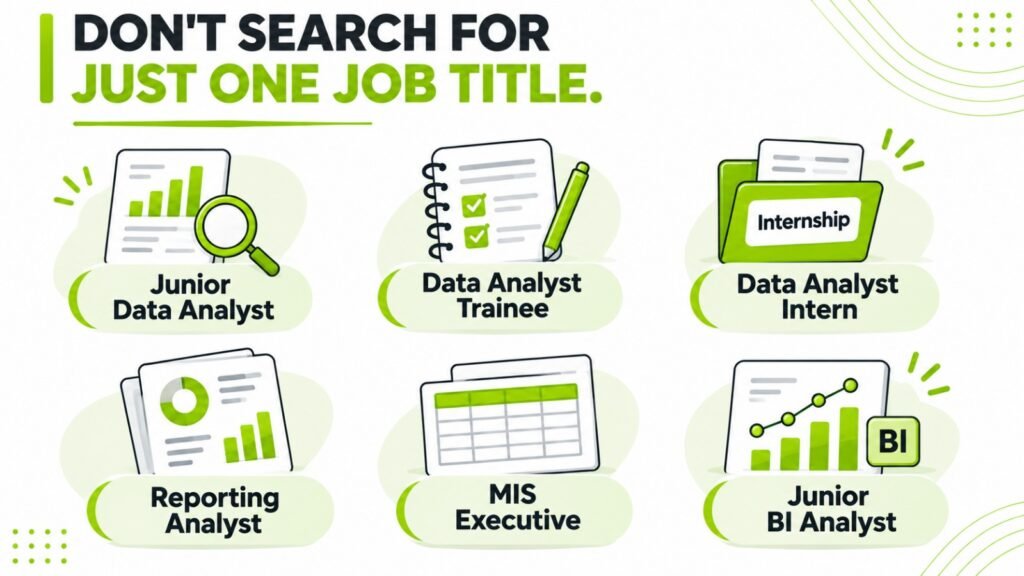
| Job title | Typical responsibilities |
|---|---|
| Junior Data Analyst | Analysing datasets and preparing reports |
| Data Analyst Trainee | Learning and assisting with analysis tasks |
| Data Analyst Intern | Supporting data cleaning and reporting |
| Reporting Analyst | Preparing regular business reports |
| MIS Executive | Managing spreadsheets and operational reports |
| Junior BI Analyst | Working with dashboards and business intelligence |
These roles are not identical. An MIS Executive usually does more Excel-based work, while a Junior BI Analyst spends more time on dashboards. Both can be a sensible starting point for a fresher.
Companies hiring data analysts in Pune: where should freshers look?
A common mistake is to search only for companies advertising a Data Analyst role. Plenty of firms have people doing analyst work inside their finance, operations, marketing or technology teams.
It helps not to limit the search to one type of employer. The categories below are all worth covering.
Analytics and consulting companies
Companies that specialise in analytics, research and business intelligence work with large volumes of data. Their projects can cover customer behaviour, market research, business performance and predictive analysis.
Some organisations worth researching include:
- SG Analytics: works in data analytics, research and consulting.
- Fractal Analytics: focuses on enterprise analytics and artificial intelligence.
- Tredence: works on data analytics and AI driven business solutions.
- Teradata: provides enterprise data and analytics solutions.
Check each company’s official careers page for Pune based openings, and confirm whether a particular position accepts fresh graduates.
IT services and technology companies
Large IT services firms often have people working on reporting, business intelligence, data management and analytics projects.
Freshers can look at firms such as:
- Tata Consultancy Services (TCS)
- Infosys
- Wipro
- Cognizant
- Capgemini
Not every opening at these firms will be called Data Analyst. Some will sit under business intelligence, reporting, operations analytics or data management.
Banking, finance and other industries
Banks, financial services companies, manufacturers and e-commerce firms also rely on data in their day to day decisions.
A financial services team might need someone who can analyse transaction trends. A manufacturing firm might need performance reports on its production process.
What matters is identifying the kind of work involved, rather than going by the job title alone.
One practical tip: build a list of at least 15 to 20 organisations you could apply to, visit their careers pages regularly and save the job descriptions you find.
What skills do Pune companies look for in fresher data analysts?
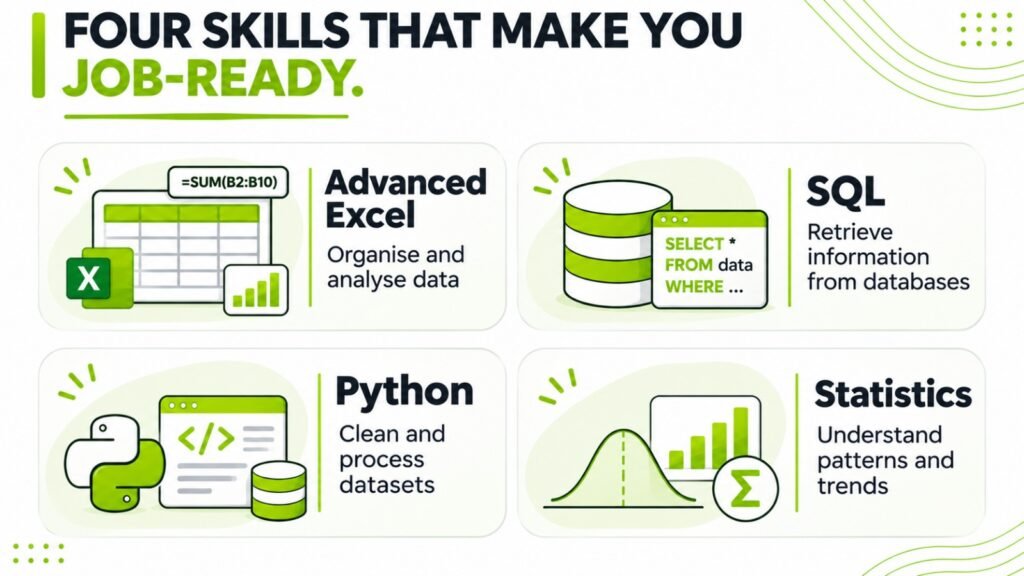
A degree makes a candidate eligible. What employers want to know is whether that candidate can actually handle data. Excel, SQL, data cleaning, reporting, visualisation and analysis are the technical skills that keep appearing in recent Pune job postings.
Here is what those skills mean in practice.
Advanced Excel
Excel is often the first tool used for organising and analysing business information.
Freshers should understand:
- Formulas and functions such as IF and SUMIFS.
- VLOOKUP, XLOOKUP and related lookup functions.
- PivotTables and PivotCharts.
- Sorting, filtering and data cleaning.
- Basic reporting and visualisation.
For example, a sales team may hand over thousands of transaction records. An analyst can use Excel to calculate monthly revenue, compare product performance and spot sales trends.
SQL
Businesses store large amounts of information in databases. SQL is how an analyst retrieves and works with it.
A fresher should practise:
- SELECT and WHERE statements.
- ORDER BY and GROUP BY.
- Aggregate functions such as SUM, COUNT and AVG.
- INNER JOIN and LEFT JOIN.
- Subqueries and basic data filtering.
Knowing SQL means you can do more than work with whatever already sits in a spreadsheet. If you are new to it, start with this practical guide to SQL for data analysts, including the essential queries and real examples.
Python
Python is useful for larger datasets and for automating repetitive analysis.
Beginners can start with:
- Python fundamentals.
- Pandas for data manipulation.
- NumPy for numerical operations.
- Data cleaning and exploratory data analysis.
Advanced programming is not expected in every entry-level role. How deep you need to go depends on the job description.
Statistics and analytical thinking
Tools alone do not make a good analyst. A strong candidate understands basic statistics such as mean, median, percentages and probability.
More importantly, they can read the data, notice what looks odd and ask the right questions about it.
What do recruiters screen for during data analyst hiring?
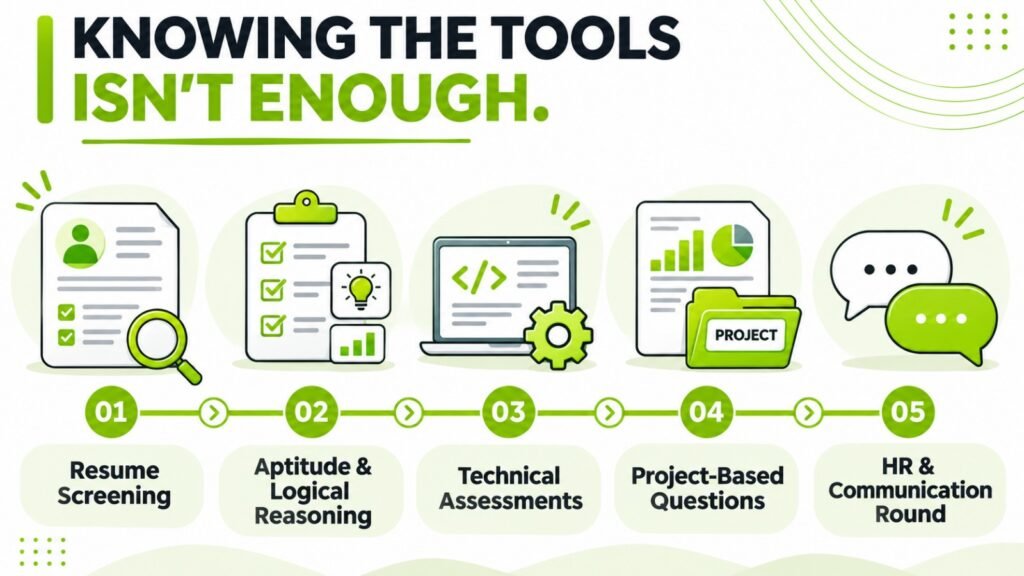
Knowing a tool is one thing. Showing that you can use it to solve a problem is another. Hiring processes differ between organisations, but freshers can expect some or all of the stages below.
Resume screening
Recruiters usually look for the right educational background, technical knowledge, internships and projects.
A CV that only lists Excel, SQL and Python says very little about what the candidate can do.
Compare these two:
Basic: Knowledge of Excel, SQL and Power BI.
More useful: Built a sales dashboard in Power BI to track monthly sales figures, product performance and regional sales trends.
The second gives a recruiter a much clearer picture.
Aptitude and logical reasoning
Some employers run an aptitude test before the technical interview.
Topics usually include:
- Numerical aptitude.
- Logical reasoning.
- Percentages and simple calculations.
- Interpreting data.
- Problem solving.
Steady practice is what prepares candidates for these tests.
Technical assessments
This is where candidates show what they can do with analytics tools.
A task might be to:
- Clean up a spreadsheet full of duplicates.
- Write an SQL query to find total sales.
- Create a PivotTable to compare monthly performance.
- Analyse a dataset using Python.
- Build a simple dashboard in Power BI.
The point is to see whether the candidate can apply the theory.
Project-based interview questions
Recruiters often ask about the projects listed on a CV.
Typical questions include:
- What was the objective of the project?
- Where did the data come from?
- How were missing values handled?
- Why was that particular chart chosen?
- What patterns did you find?
- What would you do differently next time?
Candidates need to know their own projects properly, rather than repeating answers from a tutorial.
HR and communication round
This round covers educational background, career preferences, communication and willingness to learn. Nobody expects a fresher to know everything. Being able to explain your work clearly counts for a lot.
What projects should freshers build before applying?
Without work experience, your own projects are the proof that you can apply what you have learned. Rather than several unrelated pieces of work, build a few that show different parts of the analysis process.
Four beginner friendly ideas:
| Project | Tools | What it demonstrates |
|---|---|---|
| Sales performance dashboard | Excel, Power BI | Revenue trends and KPIs |
| Customer analysis | SQL, Python | Customer behaviour and segmentation |
| Employee attrition analysis | Excel, Power BI | HR data and business insights |
| E-commerce data analysis | SQL, Python | Product and sales patterns |
For each project, be ready to explain four things:
- Problem: what question was the analysis trying to answer?
- Data: where did the data come from?
- Process: what processing, calculations or queries were involved?
- Findings: what did the analysis show?
Projects can go on GitHub, into a portfolio, or be shared as a dashboard link. There is no need to make them complicated. The point is to show that you can turn data into something meaningful.
If you need help organising and presenting that work, this guide on building an IT portfolio for freshers in Pune walks through it.
Where to find data analyst openings in Pune
Once the CV and the projects are ready, the next step is finding suitable openings. There are several places freshers can look.
Job portals
These let you filter by location, experience and job title.
- LinkedIn Jobs: useful for finding roles, connecting with recruiters and asking for referrals.
- Naukri: search by location, experience and skills.
- Indeed: listings across industries and experience levels.
- Foundit: helps surface entry-level and fresher roles.
Some useful search keywords:
- Data Analyst Fresher Pune
- Junior Data Analyst Pune
- Data Analyst Trainee Pune
- Reporting Analyst Pune
- MIS Executive Pune
- Power BI Developer Fresher Pune
Be careful with experience filters. Some relevant roles are listed under 0 to 2 years rather than fresher.
Company career pages
Applying directly through a careers site can work well.
List the employers you are interested in, visit their websites and look for suitable openings. Check the job location, the qualifications asked for and the application deadline.
LinkedIn networking and referrals
LinkedIn is not only for submitting applications.
You can follow organisations, connect with recruiters and learn from people already working in analytics.
A short personal message along with your profile usually works better than a blank connection request.
How should freshers apply strategically for data analyst jobs in Pune?
Sending out more applications does not automatically improve your chances. A clear process helps you spend your time where it counts.
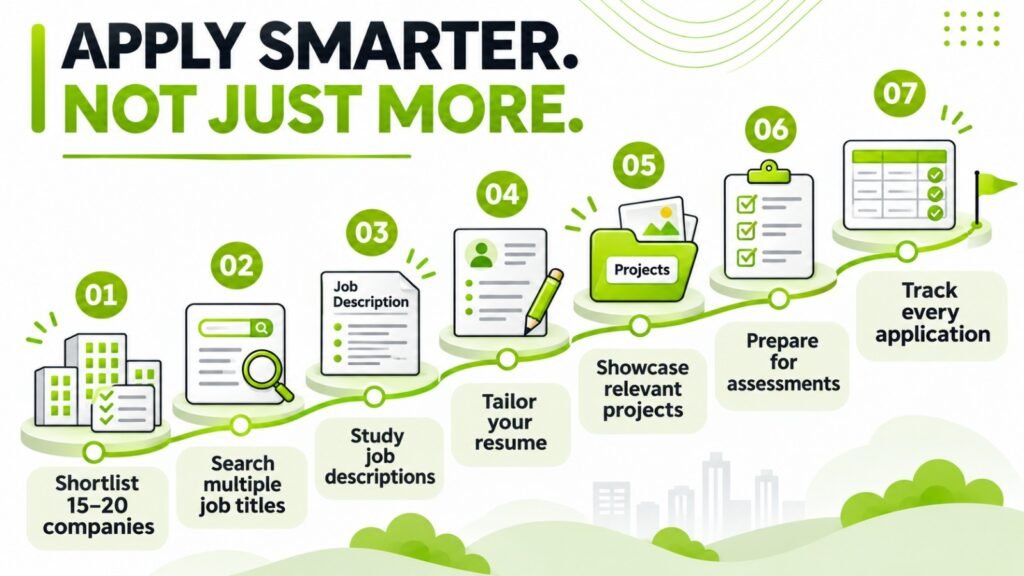
Here is one way to structure it:
- Step 1: pick the employers worth approaching. Aim for 15 to 20 companies across IT, analytics, finance and other sectors.
- Step 2: search with several keywords. Do not stop at Data Analyst. Look for trainee, junior, reporting and MIS roles too.
- Step 3: study the job requirements. Note the skills that keep coming up in the roles that suit your profile.
- Step 4: revise the CV accordingly. Highlight the relevant tools, projects, internships and results.
- Step 5: apply with your projects attached. Use a GitHub profile or a portfolio link.
- Step 6: prepare for the tests. Practise SQL queries, Excel tasks, basic statistics and questions about your own projects.
- Step 7: keep a record. A simple spreadsheet with company name, role, application date and follow-up status is enough.
Over time this shows you what employers are asking for and where you need to improve. Before sending out another round of applications, it is also worth checking these common reasons freshers do not get interview calls and how to address them.
How can FirstBit Solutions help freshers prepare for data analyst jobs?
Understanding what employers expect is the first step. Building the skills is the next one.
FirstBit Solutions runs a Data Analytics Course in Pune for anyone who would rather learn through a structured programme. It covers the concepts and tools used in data analytics and business intelligence.
The tools covered include Advanced Excel, SQL, Python, NumPy, Pandas, statistics, Power BI and Tableau. The programme works through practical datasets, assignments and projects on topics such as sales analytics, customer behaviour and business reporting.
The course is also built around career preparation. Guidance on CV writing, aptitude practice, project discussions and mock interviews gives students an idea of what to expect during placements.
FirstBit offers placement support and career guidance alongside the training. That can help while preparing for suitable openings, though it is not a job guarantee.
For someone without a technical background, having a place to learn, practise and get doubts cleared can make the process easier.
Start preparing for your data analytics career
Finding the right opportunity gets a lot simpler once you know what employers are looking for and prepare accordingly. Learning the tools, building projects and applying for the right roles is what moves an analytics career forward.
If you are looking for structured training and career support, FirstBit Solutions is a place to start.
Want to know whether the Data Analytics programme fits your career goals? Contact FirstBit Solutions to talk through the course, the training approach and the placement assistance.
Frequently asked questions
Yes. Freshers can explore junior analyst, trainee, internship, reporting and MIS positions. Eligibility and required skills vary across employers.
Candidates can explore IT services companies, analytics firms, consulting organisations, financial services companies and startups. Relevant employers include TCS, Infosys, Wipro, Cognizant and analytics-focused companies. They should verify current fresher vacancies through official career pages.
Yes. Some entry-level positions accept candidates without professional experience. Practical projects, internships, technical skills and the ability to explain analytical work can strengthen an application.
Commonly requested skills include Excel, SQL, data cleaning, basic statistics and data visualisation. Python and Power BI or Tableau are also useful, depending on the role.
Yes. Commerce graduates can explore analytics roles, particularly those involving financial reporting, sales analysis, business reporting and operations. They may need to develop technical skills in Excel, SQL and visualisation tools.
LinkedIn Jobs, Naukri, Indeed and Foundit are useful starting points. Company career pages and professional networking can also help candidates discover relevant openings.
Some employers ask candidates to explain academic or personal projects. Projects help demonstrate practical knowledge, especially when the candidate has limited professional experience.