You have finished Class 12, and everyone around you seems to be suggesting something different. One person says BCA. Another says learn coding. A third points at Data Science and Artificial Intelligence because both fields are growing.
With that many options in front of you, it is genuinely hard to work out which IT course after 12th teaches what, and which one belongs in your plan.
Here is something worth knowing at the outset: learning an IT skill and being eligible for an IT job are two different things. Plenty of companies still list a recognised graduation as a selection criterion in their fresher and campus recruitment drives.
The good news is that you do not need to understand technology before you step into it. What you need is a clear view of the paths open to you, the kind of work you would actually enjoy, and the learning route that fits your background and your academic plans.
This guide covers the different IT courses after 12th, the skills each one asks for, how your Class 12 stream affects your choices, and how to study and build practical skills at the same time.
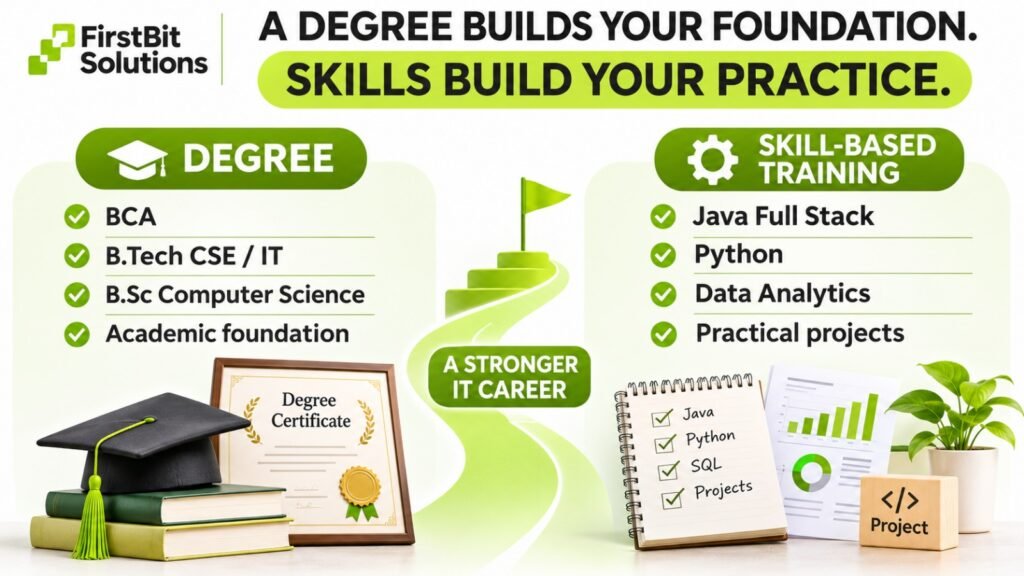
Quick answer: after Class 12, do two things. First, pick a degree that matches your interests and eligibility, such as BCA, B.Sc Computer Science or B.Tech Computer Science and IT. Second, build practical IT skills alongside it, in areas like Java Full Stack, Python or Data Analytics. A skill based course adds to your profile, but it does not replace a degree where an employer asks for one.
What are the different types of IT courses after 12th?
IT education does not come in one shape. Depending on your plans, you can take a college degree, a diploma, or a skill based training programme.
Here is how they differ:
| Course type | Examples | Main purpose |
|---|---|---|
| Degree courses | BCA, B.Tech Computer Science, B.Sc IT, B.Sc Computer Science | Build an academic foundation and a recognised qualification in computing |
| Diploma courses | Computer Applications, Software Development, IT | Develop technical knowledge through structured vocational learning |
| Skill based courses | Java Full Stack, Python, Data Analytics, Software Testing | Learn specific technologies and practise practical skills |
A degree usually runs three to four years, depending on the programme. Diplomas and skill based training vary in length from one institute to the next.
It helps to think of these as two parallel tracks rather than competing options:
- Formal education: a recognised degree course, chosen on your interests and your eligibility.
- Practical IT skills: programming, software development, data analysis or another technology, learned alongside your studies.
For a closer look at how employers treat each of them, read the FirstBit guide to Certificate Course vs Degree for IT Jobs in 2026.
Best IT courses after 12th for different career interests
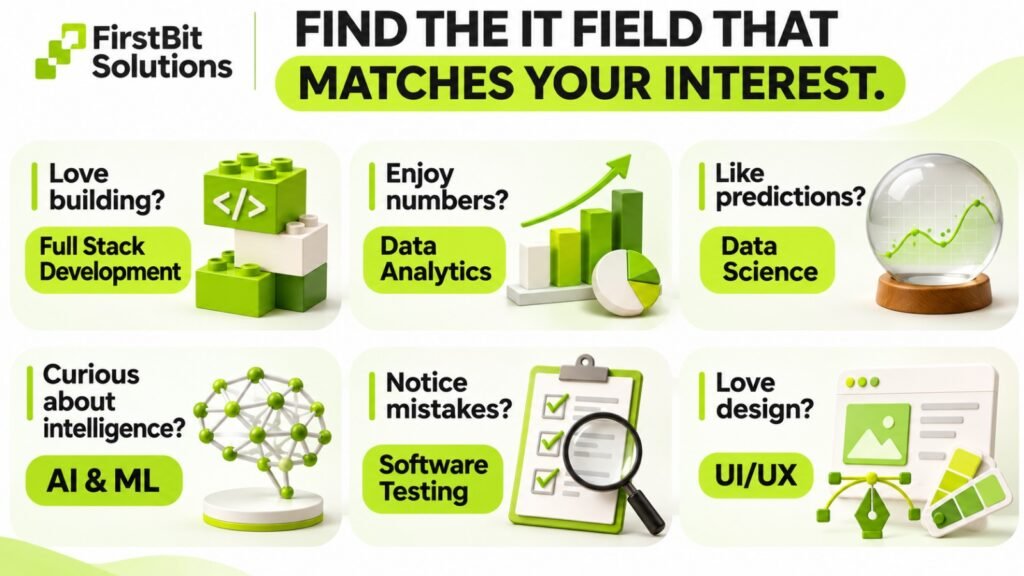
Before you pick a skill, think about the kind of work you would enjoy doing.
Do you like designing web pages? Are you the sort of person who cannot leave a set of numbers alone? Do you find yourself curious about how AI actually works?
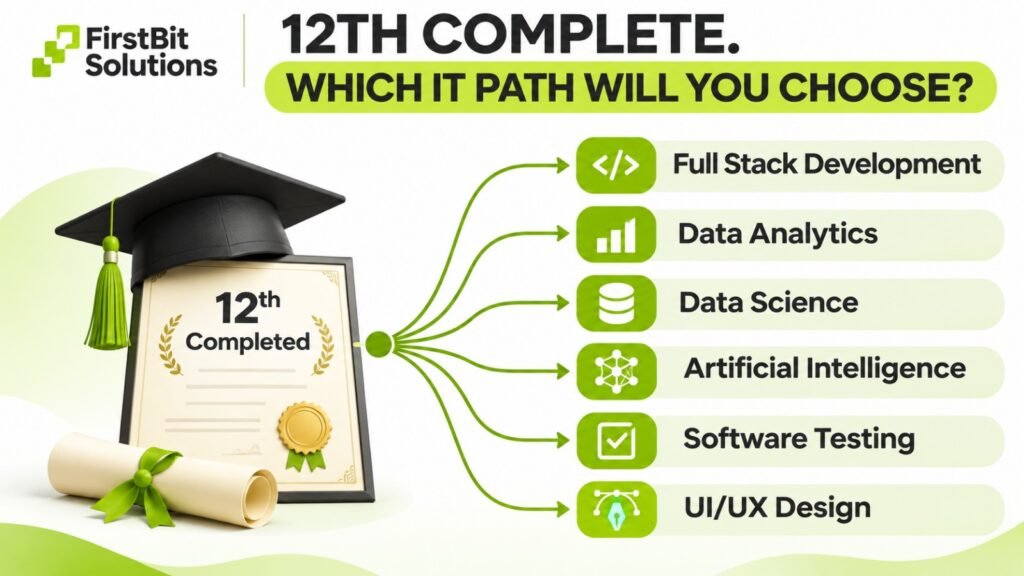
Different IT courses lead to different specialisations. Everything below sits on the practical skills track, and it works best taken alongside a degree.
1. Full Stack Development
Have you ever wondered what happens behind the single screen you see when you log into an app, search for a product or pay for something?
Quite a lot. The frontend is everything visible in the application. The backend is the logic and the database work happening on the server. Full Stack Development covers both sides.
What you typically cover:
- HTML and CSS to build web pages.
- JavaScript to make websites dynamic.
- A programming language such as Java or Python.
- SQL and databases for storing data.
- Frameworks such as Spring Boot, React, Angular, Django or Flask.
What can you do after learning Full Stack Development? Alongside the degree an employer asks for, you can look at roles such as Junior Web Developer, Java Developer, Python Developer or Junior Software Developer, depending on the technologies you have studied and what the job description sets out.
Who is it for? Full Stack Development tends to suit people who like building things, are interested in websites and applications, think logically, and are willing to write code regularly.
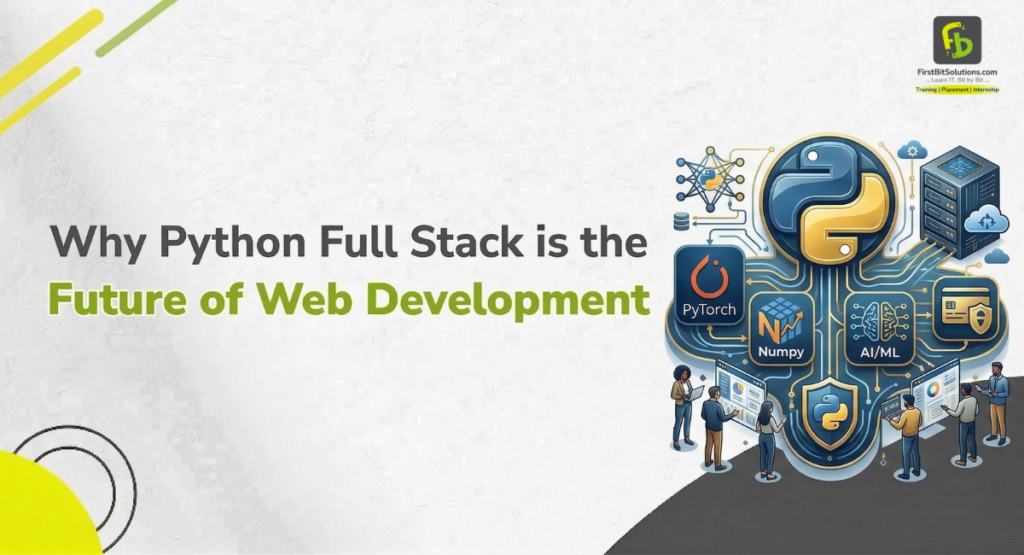
You do not have to be a confident coder before you start. A good beginner course teaches programming first and moves on to the heavier technologies after that. To see how this skill set is changing, read why Python Full Stack is the future of web development.
2. Data Analytics
Picture an e-commerce company trying to work out which products sell best, why certain customers stop buying, and which offers actually lift sales. It has all the data it needs, but only in raw form.
That is where Data Analytics comes in. A Data Analyst gathers and examines data to find patterns, then explains them to the people who have to act on them.
What you learn in Data Analytics:
- Excel for organising and analysing information.
- SQL for retrieving data from databases.
- Python for data cleaning and analysis.
- Power BI and Tableau for building dashboards.
- Basic statistics and data visualisation.
What can you do after learning Data Analytics? Depending on your level, entry level openings include Reporting Analyst, MIS Executive, Junior Data Analyst and Business Intelligence Analyst. For what employers ask for, see Data Analyst Jobs in Pune for Freshers. The differences between the entry roles are set out in this comparison of Business Analyst, Data Analyst and MIS Executive.
Who should consider it? Data Analytics may suit you if you enjoy numbers, spotting patterns and understanding how a business runs, more than building applications.
You do not need to be a mathematician to learn basic analytics. You do need to be willing to build your logic and numeracy along the way.
3. Data Science
Data analytics and data science overlap, but they are not the same thing. Data analytics is largely about understanding the data you already have and drawing insights from it. Data science brings in programming, statistical methods and machine learning algorithms to build models that predict and recognise patterns.
Take the same e-commerce site. Data analytics might explain last month’s sales. A data scientist might build a model that forecasts next month’s.
What you learn in Data Science:
- Python programming.
- SQL and database fundamentals.
- Statistics and probability.
- Data handling with libraries such as Pandas and NumPy.
- Machine Learning algorithms.
- Model evaluation and data visualisation.
What careers can you pursue? With the right qualification and enough practice, the directions include Junior Data Scientist, Data Analyst and Machine Learning roles.
Is Data Science for you? It tends to appeal to people who like mathematics and logical reasoning, enjoy the idea of predicting outcomes, and are comfortable working with large datasets.
One thing worth being clear about: Data Science is more than Python and a few tools. It asks for a working understanding of statistics, programming and analysis techniques, and that comes with practice.
4. Artificial Intelligence and Machine Learning (AI courses after 12th)
Artificial Intelligence has become part of everyday technology. Chatbots, recommendation systems, voice assistants and image recognition tools all use it. Machine Learning is one area within AI, concerned with building systems that learn patterns from data and use them to make predictions or decisions.
AI courses after 12th range from degree programmes with AI and Machine Learning specialisations, offered by some universities, through to shorter certification and skill based programmes. Be aware that learning to use an AI tool and learning to build an AI powered application are two very different things.
What you learn in AI and Machine Learning. A technical learning path generally covers:
- Python programming.
- Mathematics and statistics.
- Data handling and analysis.
- Machine Learning algorithms.
- Model training and evaluation.
- Deep Learning and neural networks.
- Generative AI and Large Language Models at the more advanced stages.
What career options could you pursue? Depending on your qualification and your experience with the technology, the directions include AI Developer, Machine Learning Engineer, Data Scientist and AI focused software development roles. For how these titles differ for freshers, see AI Engineer vs Data Scientist vs ML Engineer.
If AI interests you, there is no need to jump straight to the advanced technologies. Start with the programming and data fundamentals.
5. Other IT courses worth exploring
The industry has plenty of ground beyond development, analytics and AI. A few options worth a look:
| Course | What you learn | Possible career direction |
|---|---|---|
| Software Testing | Finding bugs, writing test cases, manual and automation testing | Software Tester, QA Tester |
| Cybersecurity | Network security, system protection and security fundamentals | Security Analyst, SOC Analyst |
| Cloud Computing | Cloud platforms, infrastructure and deployment | Cloud Support Associate |
| UI/UX Design | User research, wireframing and interface design | UI Designer, UX Designer |
| Web Designing | Website layouts, HTML, CSS and design fundamentals | Web Designer |
Each of these fields has its own learning requirements. Before you enrol anywhere, read the syllabus and work out which practical skills you will come away with.
Which IT courses can you choose after 12th based on your stream?
Your Class 12 stream can affect which college courses you are eligible for. It does not decide whether you can work in technology at all. Here is how the streams tend to line up.
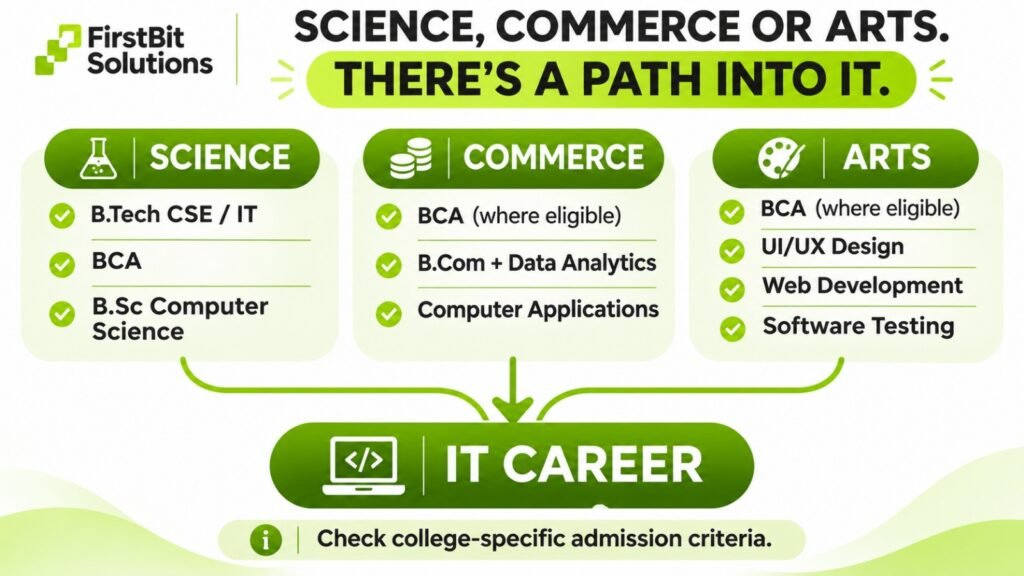
IT courses after 12th Science
Science students usually have the widest set of options, depending on their subjects and the admission criteria they meet. Common degrees include:
- B.Tech in Computer Science or IT.
- BCA, subject to the university’s eligibility criteria.
- B.Sc Computer Science.
- B.Sc Information Technology.
Diploma courses in computer science subjects are available too. Alongside any of these, you can take skill based courses in programming, Full Stack Development or Data Analytics.
Students who studied Mathematics generally have more engineering and technical degrees open to them.
IT courses after 12th Commerce
Technology is a realistic direction for commerce students as well. The usual options are:
- BCA, where the university allows entry.
- Computer Applications courses.
- B.Com combined with Data Analytics or programming skills.
Data Analytics is worth a serious look for commerce students, because business understanding, numeracy and comfort with information all help in analytical work. Knowing how to read sales figures, costs and customer behaviour gives you a practical grip on business data.
One point is worth remembering. B.Com with data analytics skills can fit reporting, MIS and business analysis positions. For fresher openings at IT companies, though, most recruiters still ask for a computing degree.
IT courses after 12th Arts
Arts students can take several IT routes too, subject to the institute’s requirements. The usual choices are:
- BCA, where eligible.
- Web Designing and UI/UX Design.
- Basic programming and Web Development.
- Software Testing.
If you are entirely new to technology, start with basic computing skills and specialise later. This account of a career switch to IT without a CS degree sets out what that route actually involves.
BCA or B.Tech CSE: which is better after 12th for an IT career?
This is one of the most common questions right after Class 12, and the honest answer is that both lead into the IT industry. The difference is structural.
B.Tech IT is a four-year programme and generally expects a science stream in Class 12. BCA is a three-year programme and is usually open to students from any stream, subject to the university’s own criteria.
- B.Tech CSE or IT: engineering and computer science subjects in more depth over four years. It suits students with Mathematics who want wider technical scope, and some technical roles specifically ask for a BE or B.Tech degree.
- BCA: a shorter course with more emphasis on software and application development. It suits students who want to enter IT sooner, including those from Commerce or Arts backgrounds.
Whichever degree you take, what you can actually do is what counts in the interview. Practical training alongside the degree programme is time well spent.
Can you do IT courses after 12th without maths?
Yes, you can learn plenty of IT skills without having taken Mathematics in Class 12. Eligibility for formal degree programmes, though, varies by college and by course.
Some B.Tech programmes require Mathematics and Physics in Class 12. BCA and other computing courses set their own criteria college by college, and many BCA syllabi include mathematics papers in the first year.
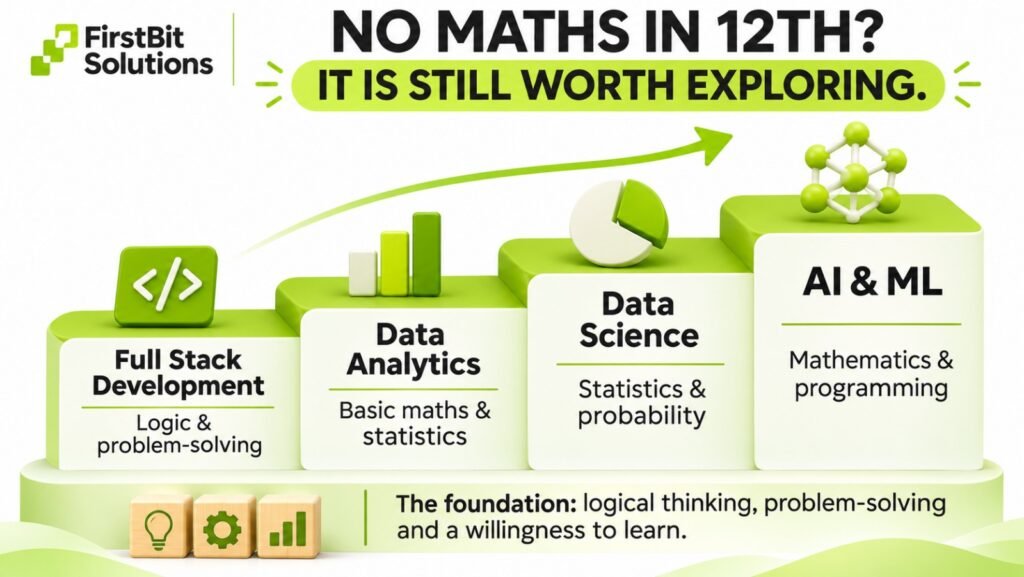
For skills, the picture is different. Most introductory programming and web development courses start from simple concepts and build up. Even so, it is worth knowing how much mathematics each path asks for:
- Full Stack Development: logical thinking and problem solving. Advanced mathematics is not usually the focus of beginner web development.
- Data Analytics: basic mathematics, statistics and numerical reasoning are useful.
- Data Science: mathematics, statistics and probability become important as you go further.
- AI and Machine Learning: a solid grasp of mathematics, statistics and programming is necessary for technical work.
Not having Mathematics in Class 12 does not rule IT out. Choose a path that matches your interests and be ready to build the foundations it needs. There is a fuller breakdown in this look at how much maths a data analytics course really needs.
Degree vs short-term IT course: what should you choose?
For someone fresh out of Class 12, this is one of the more consequential decisions to get right.
A degree and an IT course do different jobs. The degree is the academic qualification. The IT course gives you working knowledge of specific technologies.
| Factor | College degree | Skill based IT course |
|---|---|---|
| Main purpose | Academic foundation and recognised qualification | Practical knowledge of specific technologies |
| Duration | Usually three to four years | Depends on the programme |
| Learning | Structured academic curriculum | Focused, technology based syllabus |
| Qualification | Recognised university degree | Course completion certificate |
| Employment value | Meets formal degree requirements where specified | Adds practical skills to your profile |
Do IT companies require a degree?
Most established IT employers do ask for graduation when recruiting freshers. What they accept varies by role and by hiring programme. Some organisations accept BCA, B.Sc and similar degrees, while certain technical positions ask specifically for BE, B.Tech, MCA or an equivalent.
Smaller companies and startups can be more flexible, but it would be unwise to build your plan around that.
Campus hiring data points the same way. In the State of College Hiring in India 2026 report published by HirePro, just 21 percent of companies said they had adopted skills first hiring, while 51 percent were still using CGPA.
So the practical plan after Class 12 is to take a recognised degree that fits your interests and eligibility, and to learn job relevant IT skills alongside it. You might read for a BCA or another undergraduate course while building skills in Java Full Stack, Python or Data Analytics. If you are further along and already finishing a BCA, the next decision is covered in our guide to best courses after BCA for a software job.
Meeting the eligibility bar is not the whole story either. Skills carry weight. According to Deloitte India’s Campus Workforce Trends 2026, artificial intelligence and data skills carry a premium of 20 to 25 percent among campus recruits.
A short-term IT certification adds to your resume. Just do not treat it as a substitute for a graduation course where the employer asks for one.
How to choose the right IT course after 12th
By now it should be clear that each of these courses offers a different kind of learning. So how do you choose? Rather than picking the most popular course, start from what the work actually involves.
| If you enjoy… | Explore this path |
|---|---|
| Building websites and applications | Full Stack Development |
| Programming and solving logical problems | Software Development |
| Analysing numbers and business information | Data Analytics |
| Mathematics, statistics and predictive models | Data Science |
| Understanding intelligent systems | AI and Machine Learning |
| Finding errors and checking applications | Software Testing |
| Designing digital experiences | UI/UX Design |
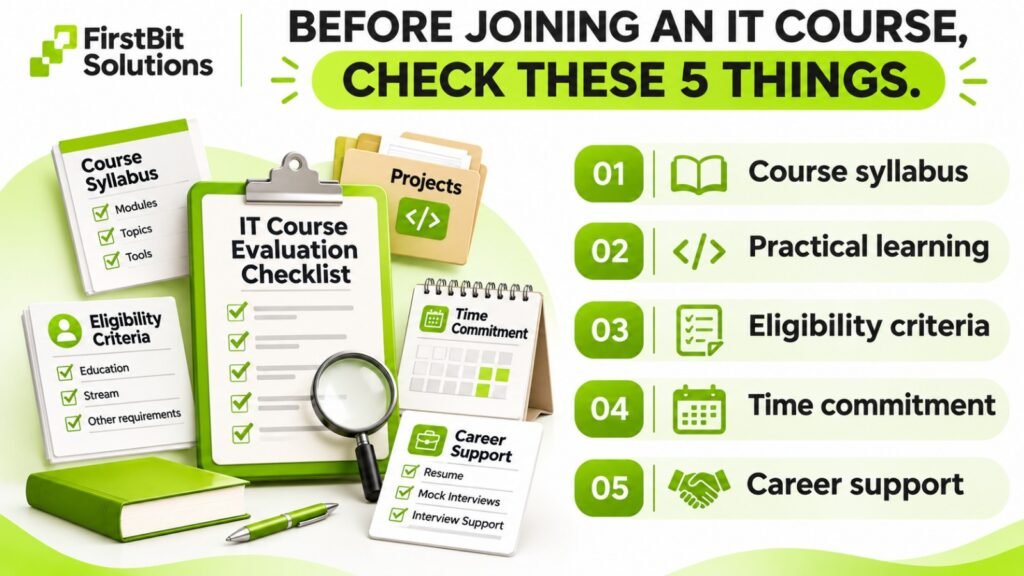
Once you have shortlisted a field, check these five things before you enrol at any IT training institute.
1. Examine the syllabus and the teaching method. Do not pick a programme just because it lists trendy technologies. Check that it covers the fundamentals, that topics are taught in a sensible order, and that there is a demo class so you can see how it is taught.
2. Look for practical learning. Technology is a hands-on subject. You should be getting chances to write code, work with datasets, build applications and complete projects.
3. Know the eligibility criteria. Check the criteria for your college course and for the training programme you are considering. They are not always the same.
4. Weigh up the time commitment. Technical skills need regular practice. Pick a course that fits around your college timetable and leaves you enough time to practise.
5. Ask about career services. If an institute offers placement support, ask what it actually includes, whether that is resume building, mock interviews, internships or interview opportunities. Placement assistance is not a job guarantee, so ask about the conditions as well. The checklist in IT Course With Internship in Pune: 7 Things to Check Before Enrolling covers this in more detail.
Not sure which IT path to choose?
If you are still weighing up Full Stack Development, Data Analytics, and Python with Data Science and AI, a conversation about your qualifications and eligibility will make the decision easier. A FirstBit counsellor can explain what each programme involves and which one fits your situation.
Request a free callback from FirstBit Solutions and get your questions answered before you decide.
Practical IT training in Pune alongside your degree
FirstBit Solutions is an IT training institute in Pune. It runs skill based courses designed to sit alongside your academics. They are built to develop your skills, not to replace your graduation or to guarantee you a job.
- Java Full Stack: for anyone who wants to learn software and application development. It covers programming fundamentals, Java, databases, web technologies, Spring Boot and frontend frameworks.
- Python Full Stack with Data Science and AI: for anyone who wants Python programming, web development, data analysis, Machine Learning and AI concepts.
- Data Analytics Master Program: for anyone who wants to analyse information and produce business reports and dashboards using Excel, SQL, Python, Power BI and Tableau.
All three programmes run around five to six months, and online or classroom availability differs by programme.
Eligibility matters here. FirstBit’s placement support is offered only to candidates who hold, or are studying for, a BE, B.Tech, MCA, BCA or B.Sc Computer Science degree. Candidates in the first two years of any of those courses can take the training alongside their college curriculum. Candidates from other streams or from diploma backgrounds can study the course material, but placement shortlisting will be very limited.
Final thoughts: plan your degree and your skills together
Choosing a direction after Class 12 does not have to be guesswork. Treat your formal studies and your practical IT skills as two separate decisions. Take a recognised degree that matches your eligibility, and build programming or development skills alongside it.
If you want to see what practical IT training looks like before you decide, book a free demo with FirstBit Solutions and talk your education and goals through with the team.
Frequently asked questions
There is no single best IT course for everyone. A practical approach is to choose a recognised degree such as BCA or B.Tech and add skills alongside it. Full Stack Development suits students who enjoy building applications, Data Analytics suits those who enjoy working with information, and Data Science and AI suit those interested in programming and statistics.
Commerce students can explore BCA where eligible, along with Data Analytics, programming fundamentals and web development skills. Data Analytics may be particularly interesting if you enjoy numbers, business information and reports.
Yes. Many skill-based IT courses, including beginner programming and web development, can be learned without having studied Mathematics in Class 12. However, formal degree eligibility varies, and Data Science or Machine Learning requires mathematical foundations as you progress.
Job prospects depend on the combination of a recognised degree, practical skills, projects and interview performance. Full Stack Development, Data Analytics and Software Testing are common skill areas for entry-level IT opportunities, and they work best alongside a degree.
Both lead to IT careers. B.Tech CSE is a four-year programme with deeper engineering fundamentals, while BCA is a three-year programme focused on applications and is usually open to students from any stream. Choose based on your subjects, eligibility and goals.
Yes. You can begin with programming fundamentals and gradually learn a language such as Java or Python. Practise regularly, understand basic logic and build small projects before moving to advanced frameworks.
They serve different purposes. BCA is a formal undergraduate degree, while a short-term IT course focuses on specific technical skills. If you are eligible, pursuing a degree and learning practical technologies alongside it is a useful combination.
AI is an expanding technology field, but building AI systems requires programming, mathematics, statistics and practical experience. Students can begin by learning Python and computer science fundamentals before exploring Machine Learning and advanced AI topics.