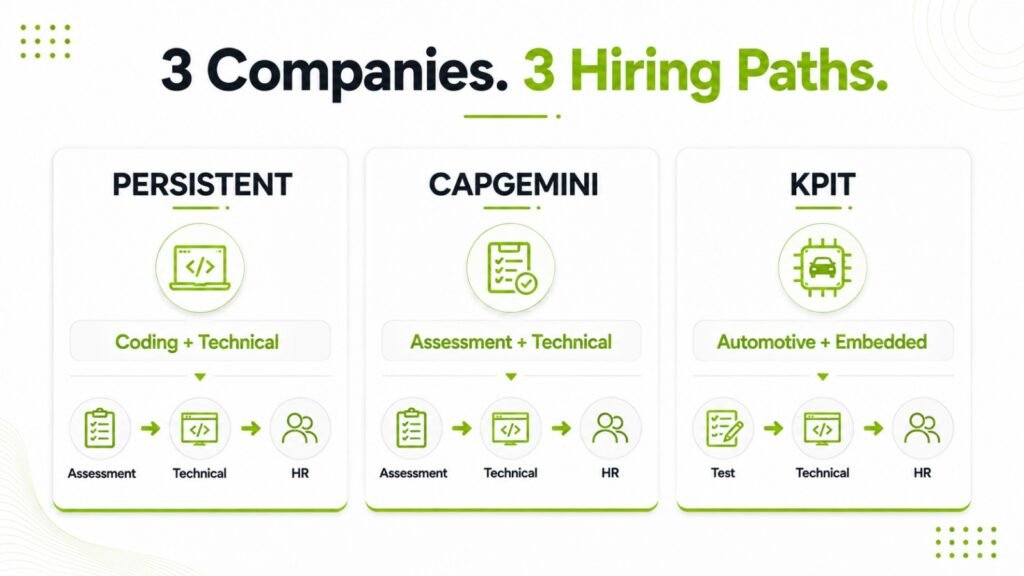
Persistent, Capgemini and KPIT all hire freshers in Pune, but the skills they look for are genuinely different. Persistent’s software roles lean toward programming and digital engineering skills. Capgemini uses broader assessments and technical screening across a wide range of roles. KPIT is the outlier, focused on automotive and embedded engineering, not typical web development.
Three different companies, three different things to prepare for. Here’s what each one actually looks like.
Note: fresher hiring processes can change by role, hiring drive, and graduation batch. What’s below reflects commonly reported recent patterns for each company; always confirm the exact rounds and eligibility against the specific job posting or recruitment email you receive.
Persistent vs Capgemini vs KPIT: What’s Actually Different?
| Company | Typical hiring stages | What to prepare | Best fit |
| Persistent Systems | Online assessment, technical interview(s), HR | Programming fundamentals and role-specific technical skills | Software and full-stack candidates |
| Capgemini | Application review, assessments where applicable, technical/HR interviews | Aptitude, coding and technical fundamentals | General IT and software candidates |
| KPIT | Online assessment, technical interview, HR | Programming/DSA or embedded concepts depending on background | Automotive, embedded and software candidates |
Now let’s go company by company, since the table only tells you so much.
Why These Three Companies Matter for Pune Freshers
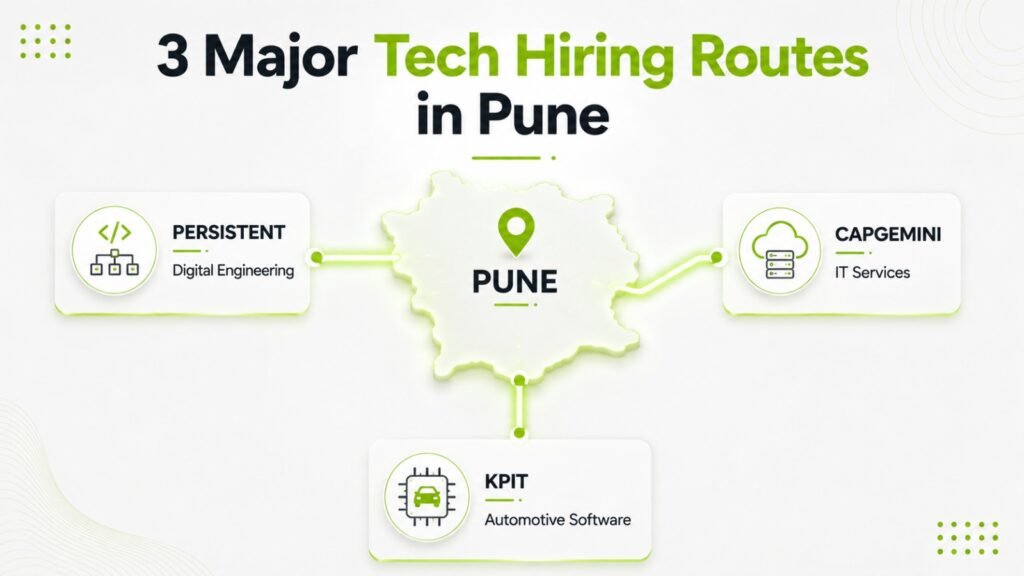
Persistent’s registered office and several of its offices, including Bhageerath and its Hinjawadi campus, are based right here in Pune. KPIT is also Pune-headquartered. Capgemini isn’t headquartered here, but it has a substantial presence in Pune as part of its India delivery network. All three are genuinely relevant names for Pune-based freshers, though what they’re hiring for is quite different, which is exactly why treating them as interchangeable doesn’t help your prep.
If you’re switching into IT from a non-technical background and this whole hiring landscape feels unfamiliar, we’ve written a full breakdown on making that switch without a CS degree that’s worth reading before you get into company-specific prep.
Persistent Systems Hiring Process for Freshers
Recent recruitment guides have reported an online assessment covering verbal ability, quantitative aptitude, and logical reasoning, followed by one or, for certain roles, two technical interview rounds, and an HR discussion.
What actually gets tested depends heavily on the specific position. Persistent is positioned around digital engineering and software work, so for software roles, expect programming fundamentals and role-relevant technical questions. Backend concepts, APIs, and cloud basics can become important depending on which team you’re being considered for, so it’s worth checking the job description closely rather than assuming every interview covers the same ground.
Capgemini Hiring Process for Freshers
Capgemini’s own recruitment page describes its process simply as application review, interviews, and assessments, with the exact sequence varying by role. In practice, recent fresher drives have commonly included a game-based assessment, a technical or coding-focused online test, and one or more technical and HR interviews. Some candidates report the game-based round catches them off guard specifically because it’s an unfamiliar format compared to a standard aptitude test, so it’s worth knowing that going in.
Some recent fresher drives have used academic cut-offs in the 60 to 65 percent range across qualifying exams, along with backlog restrictions, but eligibility varies by drive and role, so always check the specific criteria listed for the opening you’re applying to. Coding assessments may use languages such as Java, Python, or C++, depending on the assessment and hiring drive, generally with some choice involved, so lean into whichever you’re strongest in. Capgemini hires across a genuinely wide range of roles and profiles, making it a solid option if you want broad IT services exposure rather than committing to one specialisation early.
If SQL is a weak spot, it’s worth revising before the technical round. We’ve got a dedicated breakdown of the SQL questions that actually trip up full stack developers in Pune interviews if you want to check where you stand.
KPIT Hiring Process for Freshers
This is the one most guides get lazy about, copying the same generic “online test, technical round, HR round” template without mentioning what actually makes KPIT different.
KPIT builds automotive software across areas such as AUTOSAR, ADAS, EV powertrain systems, and embedded engineering, not typical web or enterprise applications. Walking in expecting a standard web-development interview can leave you underprepared.
Recent KPIT placement-test patterns reported by preparation platforms describe around 52 questions in 90 minutes, covering aptitude, technical, and verbal sections, although the exact pattern can vary by drive and candidate profile. The technical section branches by background: if you’re from CSE, prioritise programming, DSA, and DBMS. If you’re from ECE or EEE, add embedded C and digital electronics to your preparation. After the online round, expect two interview stages: a technical discussion and an HR round, with coding questions generally staying foundational, including array manipulation, string handling, and basic search algorithms, rather than competitive-programming level.
One area candidates shouldn’t treat as an afterthought is “why KPIT?” and “why automotive software?” Both are worth preparing for properly, since KPIT operates in a specialised automotive technology domain and looks for engineers genuinely interested in staying in it, not using the role as a stepping stone into generic IT.
Eligibility Criteria for Persistent, Capgemini & KPIT Freshers
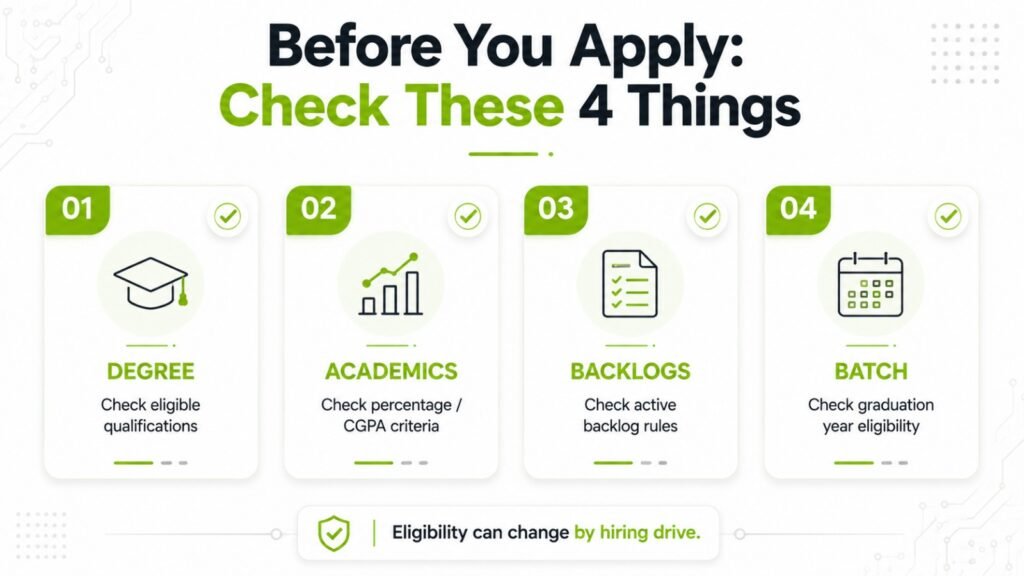
Before you spend weeks prepping for a company, it’s worth checking whether you’d even clear the eligibility bar. Here’s what’s publicly known for each, though as with everything else in this piece, always cross-check against the specific drive you’re applying to.
| Company | Eligible Degrees | Academic Requirement | Backlogs | Batch Eligibility |
| Persistent Systems | B.E, B.Tech, M.E, M.Tech, MCA, M.Sc, mainly CS, IT, Electronics, Electrical | No single fixed percentage publicly confirmed; a consistently good academic record is generally expected | Backlogs typically need to be cleared before applying | Usually current or recent passout batches, varies by drive |
| Capgemini | B.E, B.Tech, M.E, M.Tech, MCA, M.Sc and related qualifications | Around 60 to 65 percent across 10th, 12th, and degree in many recent drives | No active backlogs at the time of application | 2023 to 2026 batches have all been included in recent drives |
| KPIT | B.E, B.Tech, M.E, M.Tech, MCA, M.Sc | No fixed percentage widely confirmed; CSE and ECE/EEE branches are both actively hired | Not consistently specified; confirm per drive | Recent and upcoming passout batches |
Capgemini is the only one of the three with a clearly and consistently reported percentage cutoff. For Persistent and KPIT, treat “a strong, consistent academic record” as the safer benchmark rather than chasing an exact number that isn’t reliably published.
Which Company Should You Actually Prepare For First?
If your interest and background sit in software or full stack development, Persistent is the closer fit and probably deserves your first pass at prep. If you want broad exposure and don’t mind starting in a generalist role while you figure out your specialisation, Capgemini’s range of openings makes it a reasonable first target too. If you’re from ECE, EEE, or genuinely drawn to how software runs inside a vehicle rather than a browser, don’t rule out KPIT just because it sounds unfamiliar; it might be the best match you haven’t considered yet.
How To Prepare, Company By Company
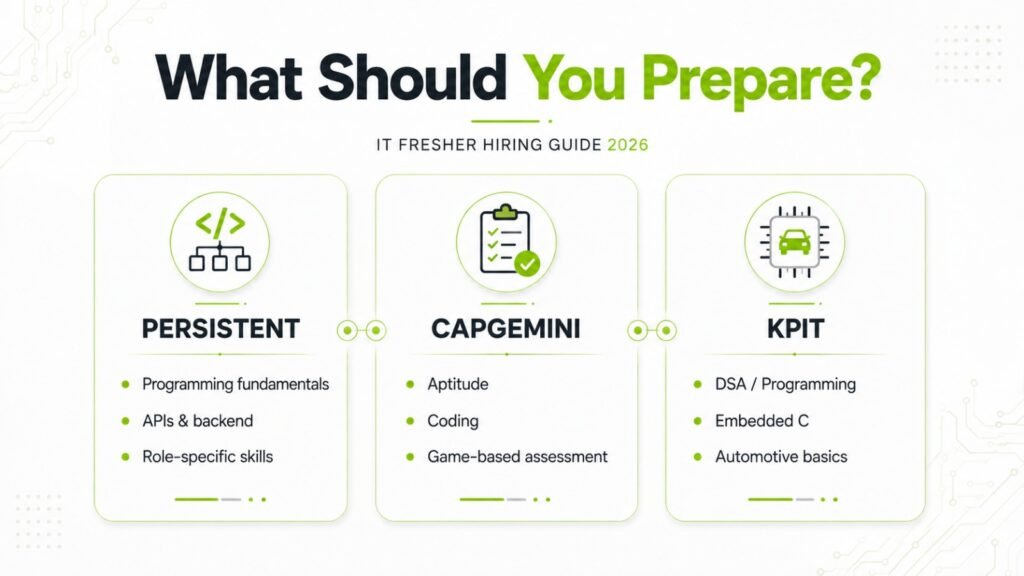
For Persistent, get comfortable with programming fundamentals and check the specific job description for backend, API, or cloud requirements before assuming what’s covered. For Capgemini, practice speed and pattern recognition for the game-based assessment specifically, since that catches people off guard more than the technical rounds do, alongside solid DSA fundamentals in whichever language you’re most confident in. For KPIT, prep according to your actual stream: CSE candidates should prioritise programming and DSA, ECE and EEE candidates should add embedded C, and research the automotive domain seriously before the interview, since that’s genuinely where prepared candidates fall short.
What to Prepare 7 Days Before the Interview
The last week is where a lot of prep either gets wasted on the wrong things or actually pays off. Here’s how we’d spend it.
Days 7 to 6: get your foundation solid
- Revisit core DSA topics: arrays, strings, basic sorting and searching; don’t chase anything advanced this late
- Pull up the exact job description again and note which specific skills it mentions, not what you assume the role needs
- If it’s KPIT, start reading up on the automotive domain now, not the night before
Days 5 to 4, go company-specific
- Persistent, revise Java or your core language fundamentals plus basic REST API concepts
- Capgemini, run a couple of practice game-based assessments so the format doesn’t catch you off guard
- KPIT, go stream-specific: CSE candidates on programming and DBMS, ECE/EEE candidates on embedded C and digital electronics
Days 3 to 2, practice out loud, not just on paper
- Do at least one mock interview, even if it’s just explaining your projects to a friend
- Prepare a clean, honest answer for “why this company.” This genuinely matters more than people expect, especially for KPIT
- Rebuild your resume around your strongest 2 to 3 projects, not a long list of half-finished ones
The day before
- Re-read the job description one final time
- Keep your prep light; cramming new topics 24 hours out usually does more harm than good
- Get your documents, resume copies, and ID proof sorted the night before, not that morning
On the day
- Reach with buffer time, especially for in-person rounds
- Carry a calm, clear explanation of your projects ready to go; this is what most interviews actually hinge on
- Don’t over-explain the “why I’m switching” or background story if it comes up; keep it short and let your preparation speak for itself
Alt text: Seven-day preparation plan for IT fresher interviews in Pune
What If You Get Rejected? Can You Reapply?
Worth knowing before you walk in, not after.
Capgemini’s own recruitment FAQ page states it plainly: if you’re unsuccessful at any stage, you can reapply six months after your initial application (Source: Capgemini India, Application and Shortlisting Process FAQs). That’s an official, confirmed number, not a guess floating around a forum.
For Persistent and KPIT, neither has a publicly confirmed cooldown period as clear as Capgemini’s, but a six-month gap before reapplying is the common norm across most large IT services and product companies in India, so it’s a reasonable default to plan around unless a recruiter tells you otherwise.
What actually matters more than the wait, though, is what you do with it. Reapplying with the exact same prep that got you rejected rarely changes the outcome. Use the gap to genuinely close the specific gap that came up, whether that’s DSA fundamentals, a role-specific skill like Spring Boot or embedded C, or simply building a couple of real projects you didn’t have the first time around.
The Real Takeaway
Three companies, three genuinely different hiring focuses, and treating them like one generic “IT company interview” is exactly why well-prepared candidates sometimes prepare for the wrong things. Know which door you’re walking toward before you start prepping for it.
Not sure which preparation path fits your background? Book a free demo class and get help choosing the right track before you spend weeks preparing for the wrong roles, or explore our courses directly if you already know where you’re headed.
If you are still deciding which role to target, you may also want to read why software testing is a high demand career.