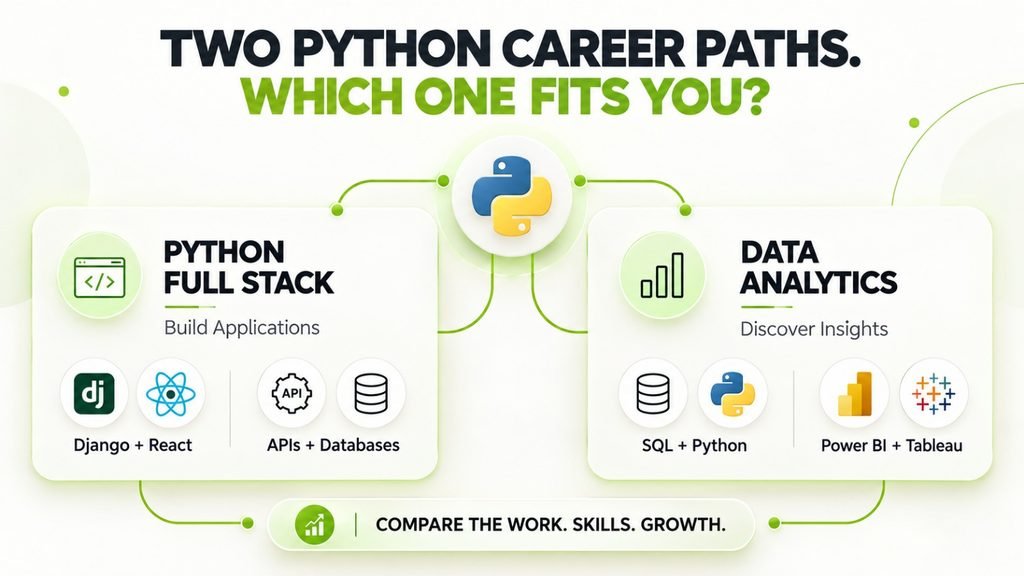
You picked Python. Excellent. But now there is a fork in the road, and it is a little frustrating because both roads look good. One leads to building web apps as a full-stack developer. The other is working with data as an analyst, making dashboards and maybe getting into machine learning down the line. Pune has jobs in both, so that’s not the problem. The trouble is they pay differently, suit different kinds of people, and grow at their own rate. This blog provides a real answer, not a “it is contingent upon your passion.”
Quick answer: Python full stack developer vs data analyst in Pune, 2026
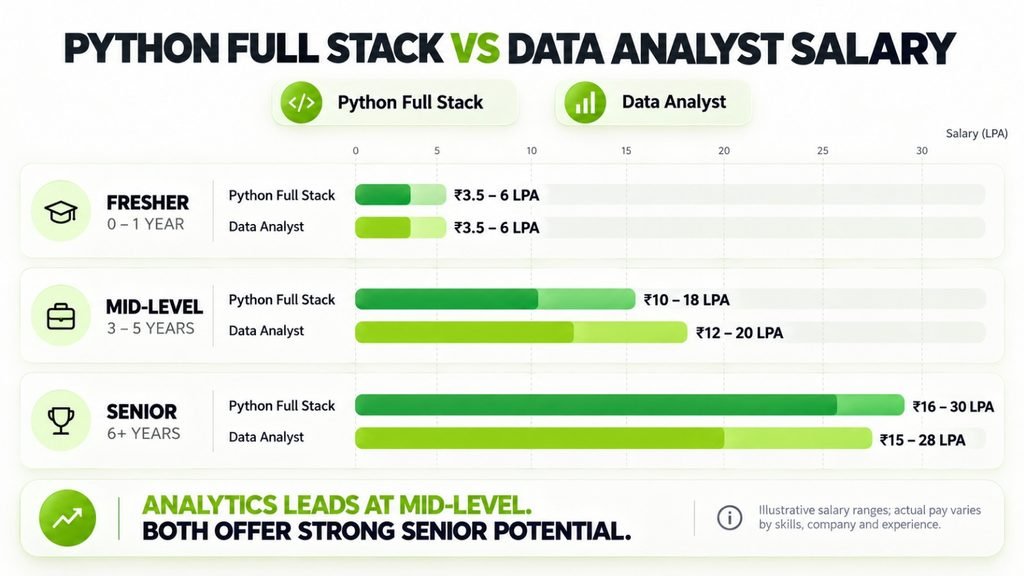
Glassdoor India puts the average Python full stack developer salary at ₹5.3 LPA, with most people earning between ₹3.32 and ₹7.25 LPA. Data analysts average roughly ₹6.5 LPA across experience levels. Freshers in both roles start at about the same place. By the mid-level, analysts who know SQL, Python, and Power BI usually move ahead, while full-stack developers get more openings to choose from. At the senior level, the two meet again, somewhere around ₹15 to 30 LPA.
What Does a Python Full Stack Developer Do vs a Data Analyst?
Job descriptions are boring, so let’s skip those and look at a normal Tuesday instead.
You get a ticket as a Python full-stack developer: build a new profile page for the product. So first, the Django view, the URL, and the database model. Then it connects to the React frontend and pokes the API in Postman until it works. Push to Git. Wait for review. Fix a comment or two. A real person is using a page that didn’t exist on Monday by Friday. This is the kind of developer startups around Hinjewadi and Baner love, the kind that can take a feature from idea to live without five people.
Now imagine a data analyst on the same Tuesday. Operations pings them: Why did conversion drop 8% last month? The analyst extracts data using SQL, cleans it in Python/Excel, and segments it by channel, city, and device. Maybe mobile users from a region just dropped off a cliff. It’s obvious in a Power BI dashboard, and then the meeting comes where someone has to explain it without jargon. It’s not so much about building things; it’s about understanding things.
Python Full Stack Developer vs Data Analyst Salary in India
Glassdoor India’s July 2026 data on Python full stack developers comes from 46 submitted salaries and lands at an average of ₹5.3 LPA. For analytics, AccioJob’s data analyst jobs India 2026 guide says freshers get ₹3.5 to 6 LPA, and the average across all experience levels is ₹6.5 LPA.
| Experience | Python Full Stack Developer | Data Analyst | Notes |
| Fresher (0 to 1 yr) | ₹3.5 to 6 LPA | ₹3.5 to 6 LPA | Comparable at entry level |
| Junior (1 to 3 yrs) | ₹6 to 10 LPA | ₹6 to 12 LPA | Data analyst edges ahead |
| Mid-level (3 to 5 yrs) | ₹10 to 18 LPA | ₹12 to 20 LPA | Analyst premium with a multi-tool stack |
| Senior (6+ yrs) | ₹16 to 30 LPA | ₹15 to 28 LPA | Converges at senior level |
These figures reflect market data and vary by company, skills, portfolio, and location. IT services companies tend to sit at the lower end of each band, while product companies and GCCs in Pune’s Kharadi and Hinjewadi corridors pay toward the higher end. Anyone searching for a Python developer salary in Pune or a data analyst salary in Pune in 2026 should expect that same spread.
Why data analytics pays more at mid-level
It all comes down to skill stacking. There are a lot of people who know how to use SQL. Fewer people know SQL, Python, Power BI, and Tableau, which is why that combination pays 25% to 35% more than a one-tool setup, even at the same level of experience. Full-stack developers face the opposite situation. The pool of talent is big, which is why mid-level packages have an upper limit unless the developer possesses something unique. If you’re curious what a fresh graduate can realistically expect after finishing a course, this breakdown of data analyst salary after a course in Pune has the details.
Why Python full stack has the higher raw ceiling at senior level
Flip to the senior end, and the story changes a little. Developers who add React, microservices, AWS, and Gen AI integration to their Python base, and who land at product companies or GCCs, can reach ₹25 to 37.5 LPA according to Glassdoor trajectory data. That ceiling is real, but it demands technical depth that plenty of developers never build, so it isn’t the default outcome. For more on how the enterprise side pays, here’s how Java full-stack salaries compare in Pune.
Python developer jobs in Pune vs data analyst jobs in Pune: where the demand is
India is projected to create over 11 million data jobs by 2026, according to industry estimates cited by AccioJob, and Power BI shows up in 72% of data analyst job postings. SQL is still the foundation, and Python keeps appearing in job descriptions for both careers, particularly from mid-level upward. That alone makes data analyst career scope in India look healthy, but raw demand is only half the story.
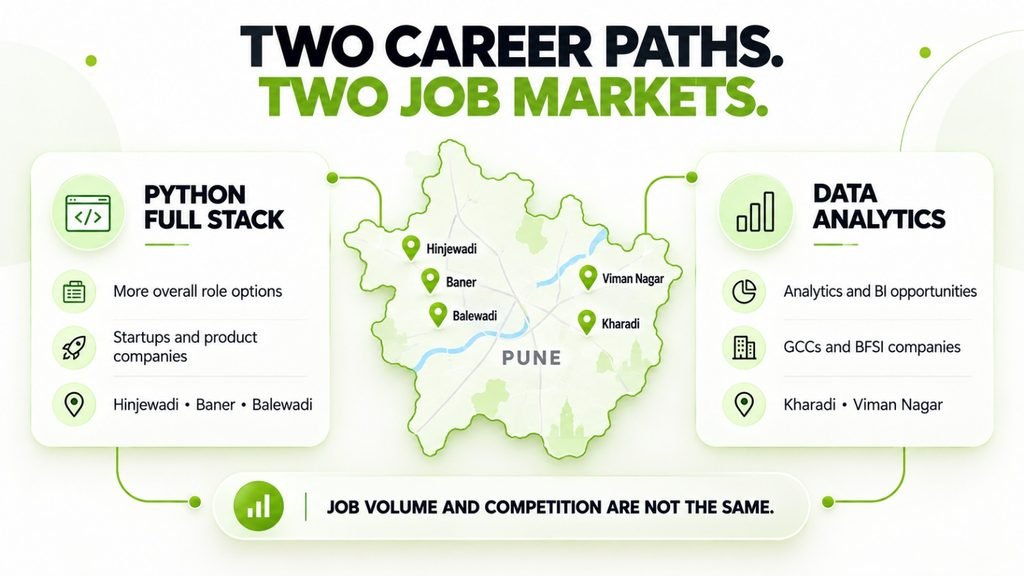
Full stack wins on volume. Every startup, product company, and IT services firm that builds anything for the web needs backend developers, and the belt running through Baner, Balewadi, and Hinjewadi hires steadily. There are simply more companies to apply to, which is good news for anyone hunting Python developer jobs in Pune as a fresher. The flip side is that this is also the track most freshers pick, so every opening attracts a crowd.
Analytics has fewer postings overall, but each one tends to draw fewer equally qualified candidates. The GCC belt around Kharadi and Viman Nagar is where it gets interesting, especially BFSI companies, where business intelligence is a core function rather than a side project. A data analyst with SQL, Power BI, and Python is interviewing against a thinner field than a Python developer with Django and React, and anyone who brings some finance or operations knowledge to the table gets noticed quickly.
So which is better for Pune specifically? If the goal is the largest number of options, full stack. If it’s a better ratio of quality to competition, analytics, particularly at companies that value domain knowledge alongside tool skills. Whichever one fits, the next question is how hard each path is to actually get into.
Which Python career is harder to break into?
Neither is as scary as it looks from the outside, though they’re difficult in different places.
Python full stack
A Python Django developer career in India starts with a layered climb. FirstBit’s 4- to 6-month path covers Django, React, MySQL, REST APIs, Git, and cloud deployment basics, and each layer connects to the one before it. What trips people up usually isn’t a single tool. It’s the mental shift from writing individual functions to understanding how an entire application hangs together. Anyone with prior coding exposure finds the rhythm faster, while complete beginners start slow and, more often than not, catch up by month two.
Data analytics
The 5- to 6-month data analytics path covers Excel, SQL, Python, Power BI, Tableau, ML basics, and Gen AI, and nobody needs prior programming to start. SQL feels strange for two or three weeks and then, quite suddenly, doesn’t. The Python in this course leans toward Pandas and Matplotlib rather than software development, which makes it far friendlier for non-coders than the full stack version. The one rough patch is the DAX formula week in Power BI, which catches most students off guard. After that, dashboards start to click.
Who finds each path easier?
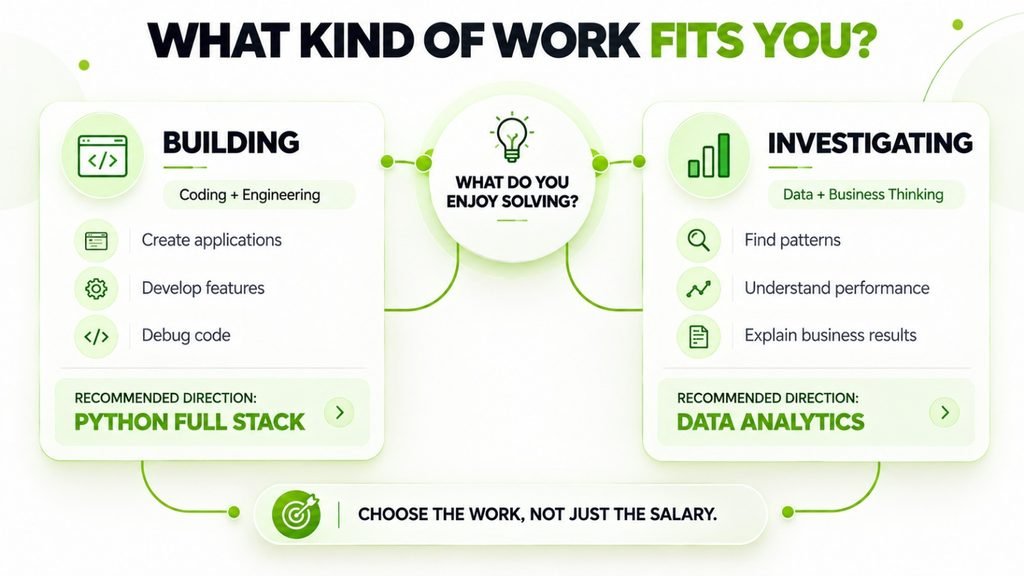
Students from commerce, business, or other non-technical backgrounds consistently find analytics less steep in the first month. Students with some coding history or a naturally logical way of thinking tend to feel at home in full stack. Neither path is easier in absolute terms. They just reward different starting points.
Python full stack vs data analytics: which to choose, side by side
For anyone who wants the whole comparison in one glance, this table covers the eight factors that usually decide it.
| Factor | Python Full Stack Developer | Data Analyst |
| Course duration at FirstBit | 4 to 6 months | 5 to 6 months |
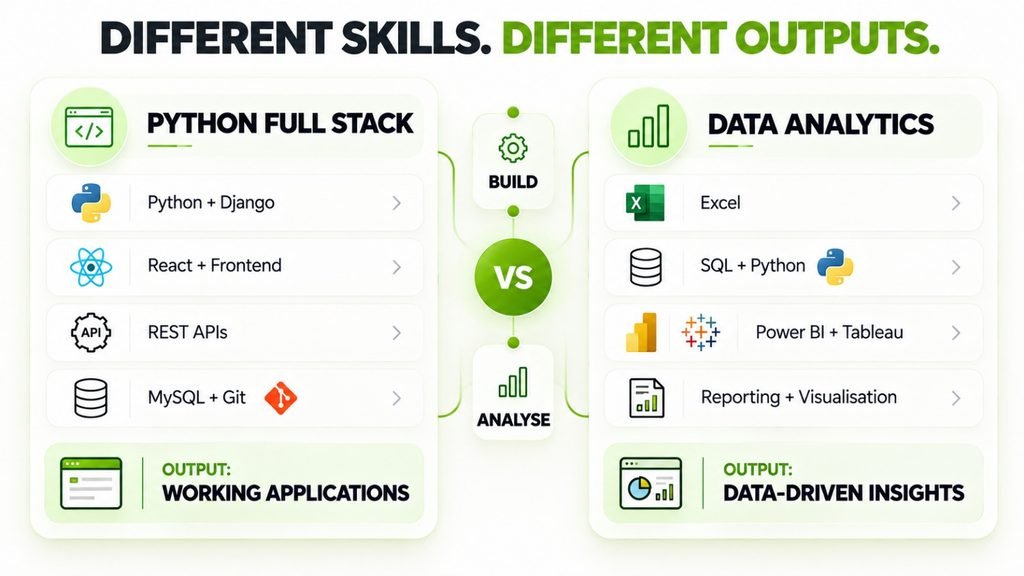
| Core tools | Django, React, MySQL, REST APIs | Excel, SQL, Python, Power BI, Tableau |
| Programming required | Yes, Python throughout | Light, Python added mid-course |
| Fresher salary India | ₹3.5 to 6 LPA | ₹3.5 to 6 LPA |
| Mid-level salary | ₹10 to 18 LPA | ₹12 to 20 LPA |
| Senior salary | ₹16 to 30 LPA | ₹15 to 28 LPA |
| Job volume in Pune | Higher | Lower but less competitive |
| Best for | Builders, product-focused, comfortable with code | Analysts, business-focused, non-technical entry |
Salary rows reflect market data and vary by company, skills, portfolio, and location.
So which Python career is better in India for you?
There’s no fence-sitting here. Both paths are good, and the right one depends on who’s reading.
Choose Python full stack if
You enjoy building things that people actually interact with. Not dashboards and reports, but working applications. You have some coding exposure, or at least logic-based thinking comes naturally. And you’re aiming at Pune’s startup and product company ecosystem, where Django and React backends are common and speed of development matters, in places like Baner, Hinjewadi, and Balewadi, where full stack developers are in consistent demand.
The Python full-stack course at FirstBit Pune covers Django, React, MySQL, and REST APIs, with live project work throughout the full duration and placement assistance along the way.
Choose data analytics if
You come from commerce, business, arts, or any non-CS degree, and you’d rather not make programming your first hurdle. You catch yourself more curious about why something happened in the data than about how to build the feature that produced it. Your targets are BFSI companies, GCCs, IT services analytics practices, or any organisation where reporting and business intelligence sit at the centre.
The data analytics course at FirstBit Pune packs Excel, SQL, Python, Power BI, Tableau and Gen AI tools into a single 5 to 6 month programme built for beginners, again with placement assistance.
What if you genuinely can’t decide?
Try this. Would you rather explain why something happened in the data, or build the system that generates the data? The first is analytics. The second is full stack. Most people have a stronger pull toward one of those; they just haven’t framed it that way before.
Both courses run at FirstBit in Pune with weekday and weekend batches. If this comparison has pointed you in a direction and you’d like to see the curriculum before enrolling, book a free demo and sit in on a live session. One class tells you more than any comparison article can.
Can you switch between these two paths later?
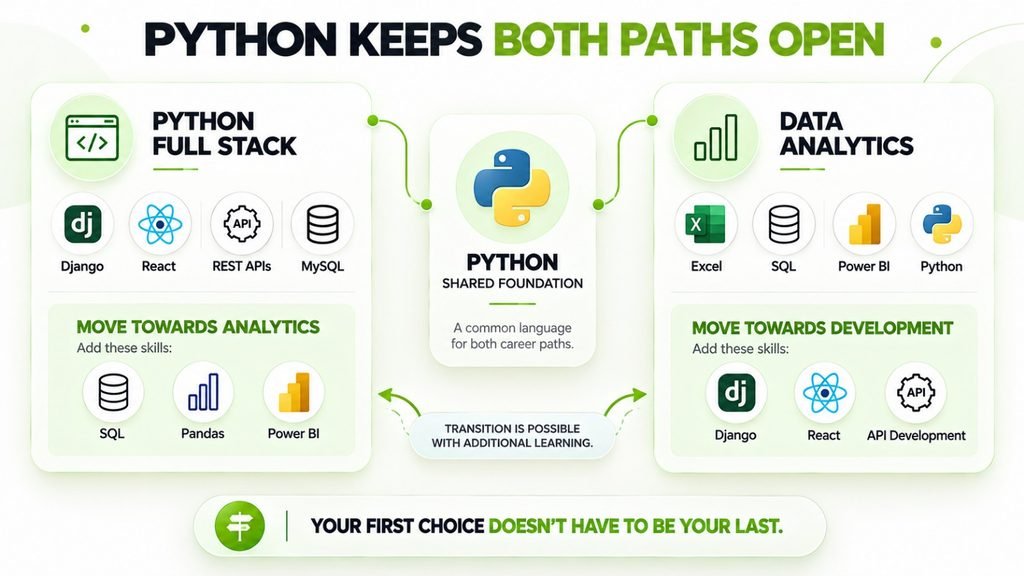
Yes, and Python is the reason it works. The time invested in learning it properly carries over to both careers, so a first choice doesn’t lock anyone in.
A full stack developer who wants to move toward analytics already knows the language, which means adding Pandas, SQL, Power BI, and statistical thinking is a 3- to 4-month upskill rather than a restart. Plenty of developers make this move after 12 to 18 months of web development, usually when they realise they’re more interested in the data their applications generate than in the applications themselves.
The reverse is less common but very doable. A data analyst heading toward full stack needs Django, React, and database management beyond SQL, which realistically takes 4 to 6 months of focused learning on top of a solid Python foundation. Python sits at the centre of both careers, so learning it well for one path keeps the door to the other open.
Final thoughts
At fresher level, the salary gap between these two careers is tiny, since both start in the ₹3.5 to 6 LPA range. What isn’t tiny is the difference in the type of work, the type of thinking, and the type of person each path suits. One builds products. The other makes sense of them. Both are in demand in Pune, and both are taught at FirstBit. The choice really comes down to which kind of work you want to get better at over the next five years, and booking a free demo at FirstBit Solutions is the easiest way to feel the difference before committing.