Depends where you’re applying. That’s the real answer, and if you came here hoping for a clean yes or no, we’d rather give you something that’s actually true. A certificate course is enough for most private companies and startups today. It is not enough for government jobs, PSUs, or campus drives at most big MNCs. Two very different worlds, two very different answers.
Let’s get into which one you’re standing in.
Certificate vs Degree: What’s the Actual Difference?
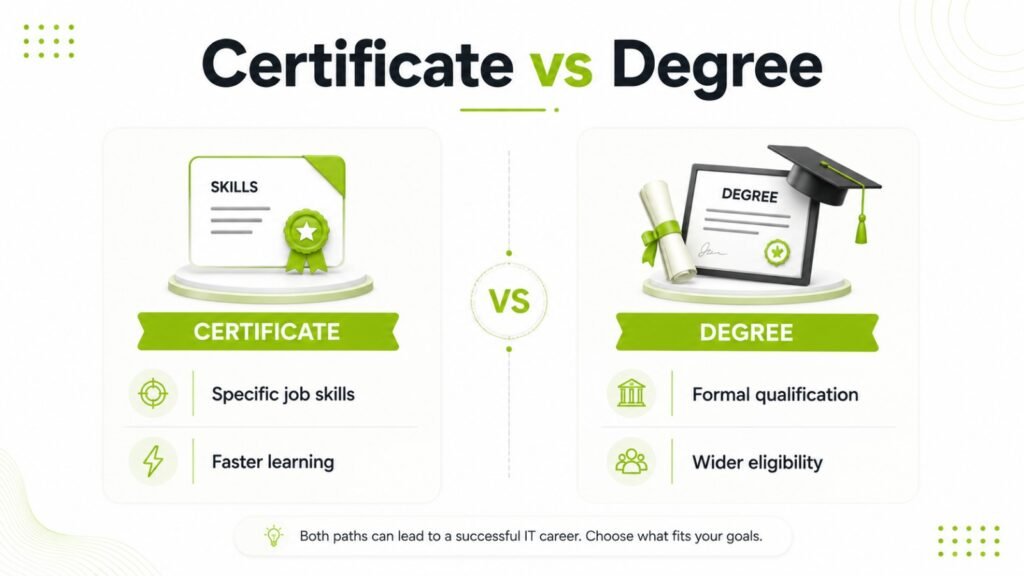
A certificate and a degree prove different things. A certificate shows that you’ve completed training in a specific skill or technology, while a degree is a formal academic qualification. Employers can value both, but they don’t treat them as interchangeable for every role.
A certificate can help you become job-ready faster, particularly for skill-based IT roles. A degree gives you access to opportunities where formal educational qualifications are part of the eligibility criteria. The right choice depends on the job you actually want.
The Question Nobody Says Out Loud
Here’s what’s actually going on when someone asks, “Is a certificate enough?” It’s rarely just curiosity. It’s usually a parent who spent three years watching their kid finish a B.Com and now can’t understand why a four-month course matters more. Or it’s a student who already paid for a certificate program and is quietly terrified they wasted money on something HR will laugh at.
We get why. Certificate courses got a bad name for a while. Too many of them promised jobs, delivered a PDF, and vanished. So the skepticism is fair. It’s also outdated, at least for the companies that actually matter for your career path.
Where a Certificate Alone Genuinely Works
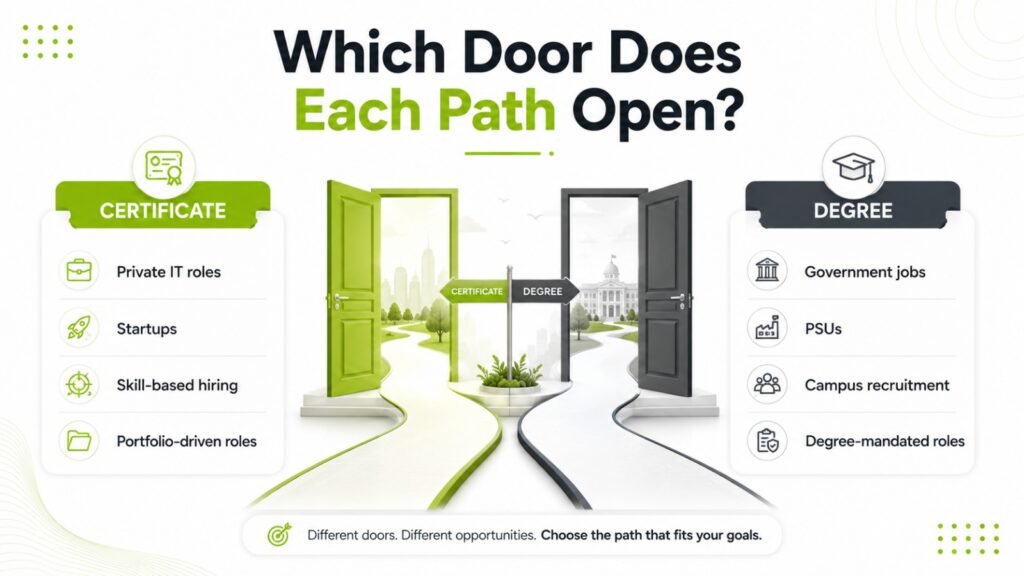
IT services companies and smaller technology firms hire for a wide range of entry-level roles, but their eligibility requirements vary by recruitment program. Some assess coding, technical knowledge, aptitude and projects, while others still require a formal degree before you can apply.
Startups can sometimes be more flexible, particularly when hiring managers care more about what you can actually build and demonstrate. A strong portfolio can therefore make a certificate more useful, but it does not automatically remove an employer’s degree requirement.
Same story at most product startups. Nobody at a 40-person startup is checking whether your degree is a B.Sc. or a B.Com if you can actually build the thing they’re asking you to build in the interview.
Roles like software testing, data analytics, and full stack development are where this shows up most clearly. These are skill-first roles by nature. You either know SQL or you don’t. You either can debug a broken API or you can’t. A certificate that actually teaches you to do these things, with real projects attached, holds up fine here.
In Pune specifically, this plays out a little differently than people expect. A lot of the hiring volume comes from IT services companies and Global Capability Centres, the kind of setups that run internal skill tests as part of their interview process anyway. For them, a certificate that maps to what they’re already testing for is genuinely useful. It’s not a magic ticket in, but it stops being a disadvantage the moment you can back it up.
Where You Still Need a Degree, No Way Around It
We’re not going to pretend this doesn’t exist, because plenty of blogs do and it does readers a disservice.
Government IT jobs and PSU recruitment almost always require a formal degree, often a specific one, and this isn’t changing anytime soon. Campus placement drives at most large MNCs work through college partnerships, so if you’re not enrolled in a degree program, you’re not walking through that particular door regardless of skill. And a few specialised, regulated roles come with licensing requirements that a short course simply can’t satisfy.
If any of these are your specific goal, a certificate course is a supplement, not a replacement. Plan accordingly.
So Is the Money Actually Worth It?
Fair question, and worth answering directly instead of dodging it.
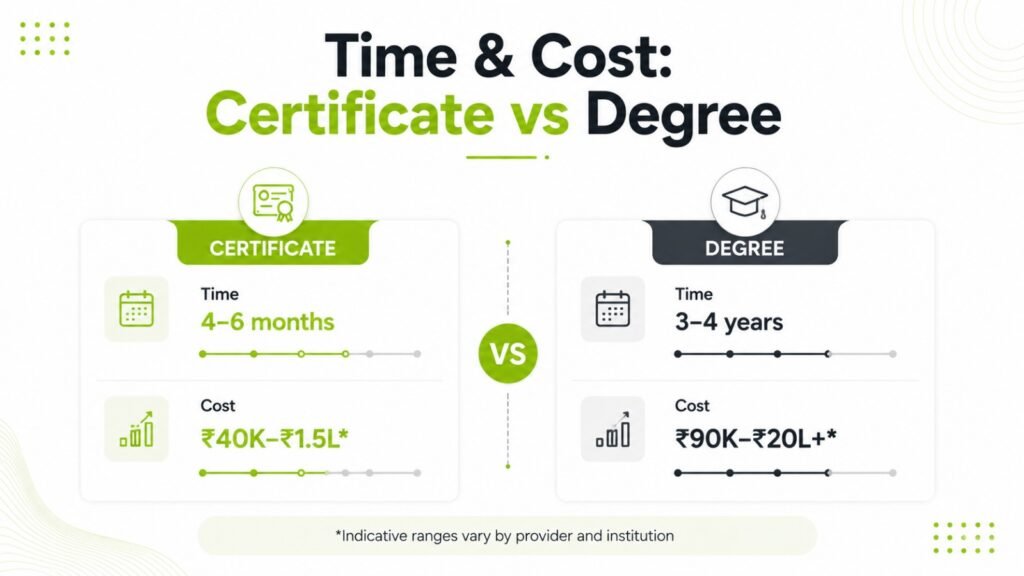
A certificate course is worth it when it comes with real, graded projects you can show an interviewer, not just video lectures you watch and forget. It’s worth it when there’s an actual placement support structure behind it, not a vague “job assistance” line in the brochure. And it’s worth it faster than most people expect, because a four to six-month structured course, done properly, gets you interview-ready roughly around the same time a final-year degree student is still finishing exams.
It is not worth it if you’re doing it as a shortcut without putting in the work. No certificate, expensive or cheap, replaces actually building things.
What a Certificate Actually Costs vs a Degree
Let’s put real numbers next to each other instead of leaving this vague.
The cost of certificate programs varies widely by provider, course length, instructor support, and placement services. For example, some structured programs can fall in the ₹40,000 to ₹1,50,000 range, but this should be treated as an indicative range rather than a standard market price.
Compare that to a formal degree. Undergraduate and postgraduate programs in India can run anywhere from ₹90,000 on the low end to well over ₹20 lakh at private institutions, per IIM Skills’ fee breakdown, stretched across three to four years, plus the opportunity cost of not earning during that time.
Neither number is “the” number; your actual cost depends entirely on which institute or college you pick. But the gap in both money and time is real enough that for someone trying to get employed quickly, it’s worth sitting with honestly before deciding.
Still Studying? Should You Start a Certificate Now or Wait?
If you’re currently in your second or third year of a non-CS degree, this question comes up a lot, and the answer is almost always start now, not later.
Doing a certificate course alongside your final years of college means you walk out with a degree and a portfolio at the same time, instead of graduating and only then starting from zero. It also gives you actual proof of interest and initiative when interviewers eventually ask why you’re pivoting, since “I started building this two years ago” lands very differently than “I decided last month.”
The only real reason to wait is if your current semester load genuinely leaves no room for anything else. Even then, a lighter, self-paced option in that gap is usually better than doing nothing until graduation and starting the entire clock from scratch.
How to Tell a Real Certificate Program From a Waste of Money
A few honest markers, since this matters more than people realise before they enrol.
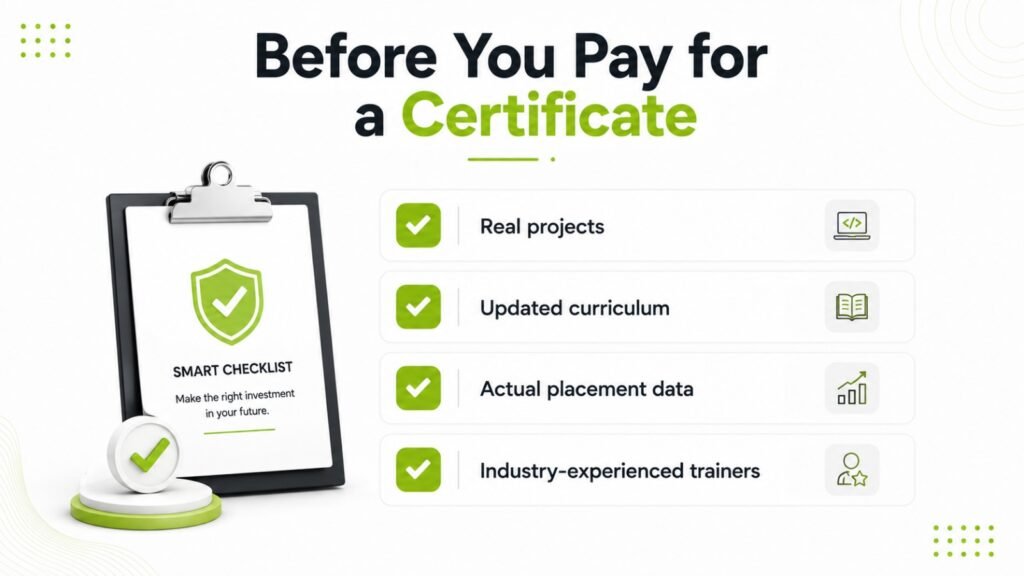
Check whether the program has you building actual projects you’ll walk away with, something you can show, not just a certificate PDF at the end. Ask what their placement numbers actually look like, and ask for specifics, not a vague claim. Look at whether the curriculum gets updated regularly; tech moves fast enough that a syllabus from three years ago is already behind. And talk to someone who’s actually gone through it if you can. That conversation tells you more than any brochure will.
One more thing worth asking directly. Who’s actually teaching the course, and have they worked in the industry recently, or are they reading off the same slides they’ve used for five years? A trainer who’s actually built and shipped software brings something a recorded video course never will: the ability to answer the weird, specific question you’ll actually get asked in an interview.
How Long Should the Job Search Realistically Take
Nobody likes this answer, but here it is. After finishing a solid certificate program with real projects, most students in Pune take somewhere between six weeks and three months to land their first role, assuming they’re actively applying and interviewing, not just applying once a week and waiting.
That range depends heavily on which path you picked. Software testing tends to move faster since the hiring volume is high and the skill bar for entry roles is more standardised. Full stack roles can take a little longer simply because the competition is thicker. Either way, if it’s been six months with no traction, that’s usually a sign to revisit the portfolio and interview prep, not to assume the certificate itself failed you.
Certificate, Degree, or Both: Which Should You Choose?
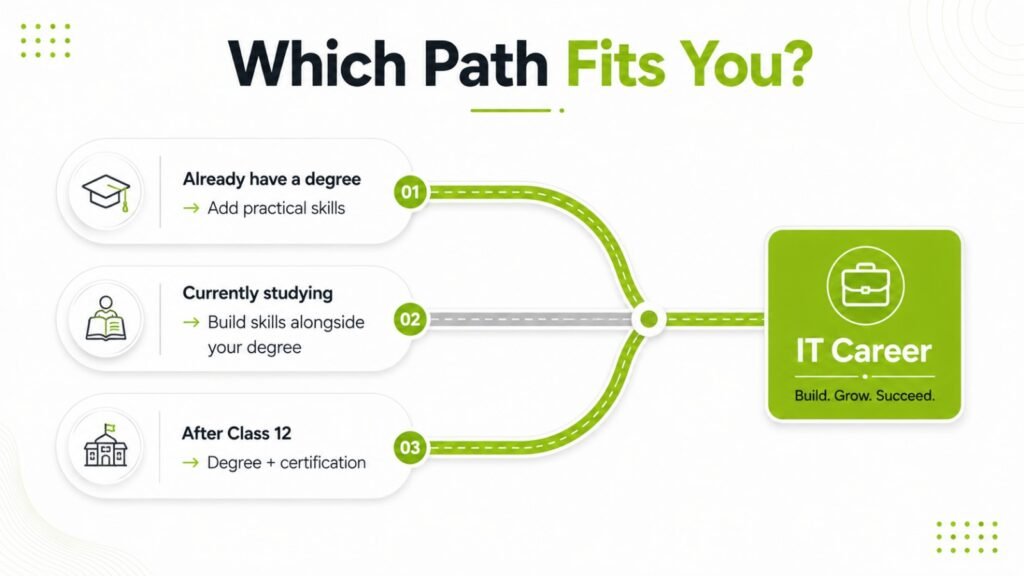
If you already have a degree:
- A certificate can help you switch into IT faster.
- Focus on practical skills and portfolio projects.
- Check whether your target employers accept your existing degree.
If you’re currently pursuing a degree:
- Start building technical skills alongside it.
- Graduate with both a degree and job-ready skills.
- This gives you more options during recruitment.
If you’re choosing your education after Class 12:
- A degree gives you broader eligibility.
- Add certifications or practical training alongside it.
- This is usually the strongest combination for long-term flexibility.
Certificate, Degree, or Both, Side by Side
| Path | Best suited for | Main advantage | Main limitation |
| Certificate alone | Graduates switching into IT, skill-based private roles | Faster and cheaper skill training | Doesn’t satisfy degree requirement |
| Degree alone | Students starting after Class 12, government/PSU paths | Broader eligibility | May leave practical skill gaps |
| Degree + certificate | Students who want maximum flexibility | Formal qualification + job-ready skills | More time and effort |
There isn’t a universally “right” column here. There’s the one that matches what you’re actually trying to walk into.
Not sure which path fits your situation? Book a free demo class to understand which skills, course, and career path make sense for your goals.
What the Data Actually Says
Two numbers worth knowing before you decide anything.
According to HirePro’s State of College Hiring in India 2026 report, only 21 percent of Indian corporates have fully shifted to skills-first hiring so far. Fifty-one percent still let CGPA and degree background influence decisions. That’s the honest state of things, not fully flipped, but shifting fast enough that skill-first is no longer the exception.
And the shortage backing this shift is real too. Deloitte’s report with Nasscom on AI skills puts India’s AI talent pool at roughly 600,000 to 650,000 people right now, needing to grow past 1.25 million by 2027. The broader point is that employers increasingly need candidates who can demonstrate practical technical skills, particularly in areas affected by fast-moving technology and AI adoption. That makes skills-based training useful alongside, rather than automatically instead of, traditional education.
What Actually Gets You Hired, Certificate or Not
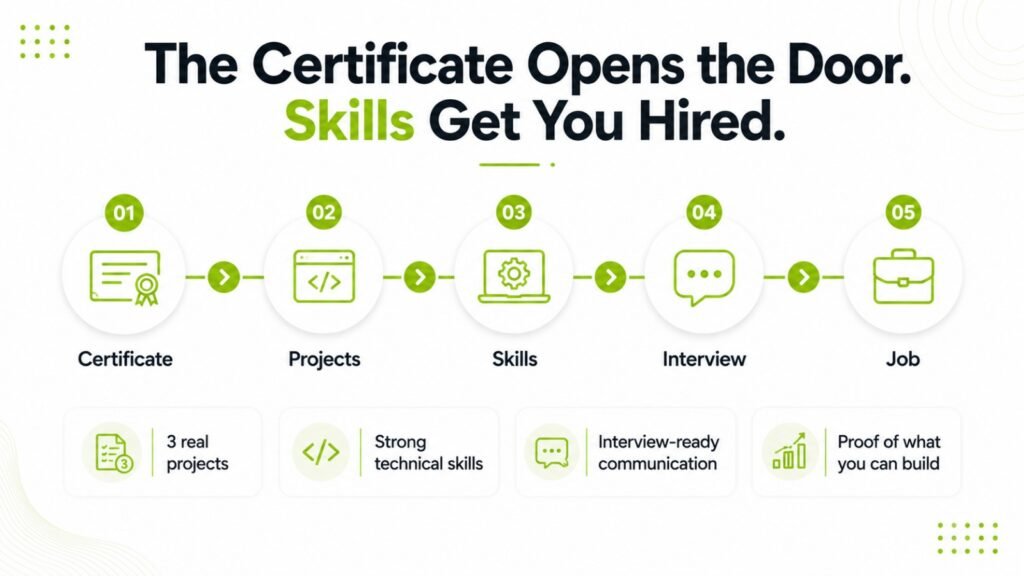
Here’s the part almost nobody tells you plainly. The certificate is not the thing that gets you hired. The projects you build with it are.
Two people can finish the exact same course. One walks out with three solid projects they can explain in detail and a GitHub link. The other has a certificate and not much else. Guess who gets the callback. If you’re worried about surviving the early learning curve enough to get to that project stage, we’ve written honestly about why beginners quit learning Java in the first 30 days, worth a read before you start.
And if you’re coming into this from a completely non-technical background and wondering whether the whole switch even makes sense for you, we’ve laid that out separately in our piece on switching to IT without a CS degree.
How to Talk About It in the Interview
If you’re walking in with a certificate and no degree in the field, expect the question. Someone will ask, directly or indirectly, why you didn’t go the traditional route. Don’t get defensive about it, and don’t over-explain either.
The strongest answer is usually the simplest one. Something like, you wanted to learn by building rather than sitting through years of theory that wouldn’t get you job-ready any faster. Then let your projects do the actual convincing. Interviewers care far less about your reasoning for skipping a degree than they do about whether you can do the job in front of them. Spend more prep time on your project walkthrough than on rehearsing an explanation nobody’s going to press you on for more than thirty seconds.
Bottom Line
A certificate course can absolutely get you an IT job in 2026. Just not every IT job, and pretending otherwise helps nobody. Know which door you’re trying to walk through first, then pick the path that actually opens it.
Ready to figure out which path is yours? Explore our courses and let’s map it out properly.
If testing is one of the roles you are considering, it is also worth reading why software testing is a high demand career.