If you searched this “python full stack development” because you are trying to decide whether to spend the next few months learning it, here is what you probably want to know. Can you actually learn this without a computer science background? Will it get you a job? How hard is it compared to what you have heard? And what does it even pay once you get there?
Fair questions. And most articles on this topic answer none of them. They explain what backend and frontend mean, throw in a definition, and stop right there. This one is not going to do that.
By the time you finish reading, you should know exactly what a Python Full Stack Developer does day to day, what separates this role from a general “Python Developer” title, which skills actually matter versus which ones are just noise, what it pays in India, and whether it is a realistic path for someone starting from zero. If you are in Pune and weighing a structured program against teaching yourself from YouTube, that comparison is here too.
The Short Version
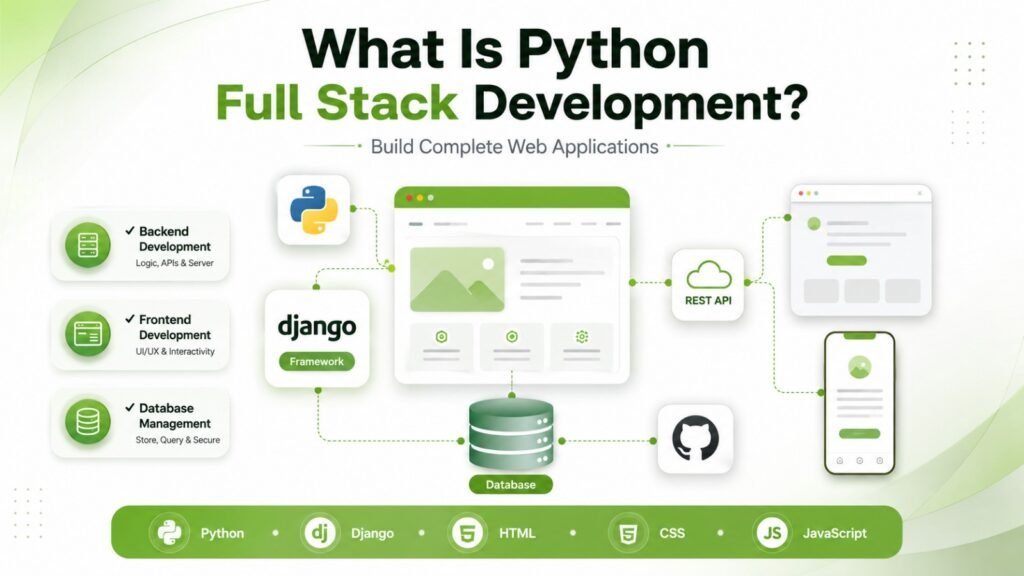
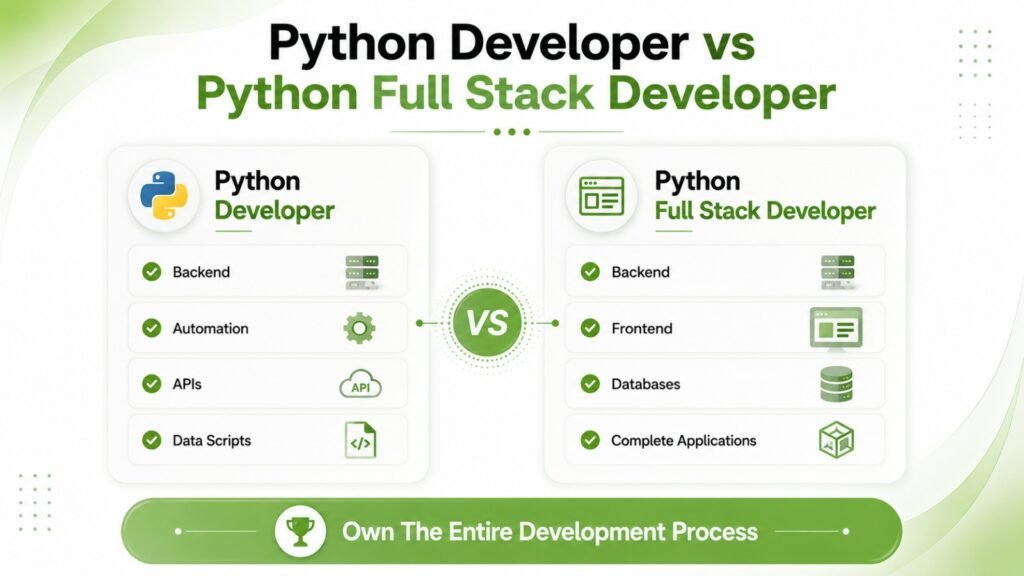
A Python Full Stack Developer builds both halves of a web application. The backend, meaning the server-side logic, database connections, and application programming done in Python, usually with a framework like Django or Flask. And the frontend, meaning the part users actually see and click around in their browser. A “Python developer” more broadly might work purely on backend systems, automation scripts, or data tasks without ever touching a user interface. A full stack developer owns the whole thing, top to bottom.
That distinction matters more than it sounds, because it’s exactly where most of the confusion starts.
What Happens on the Backend
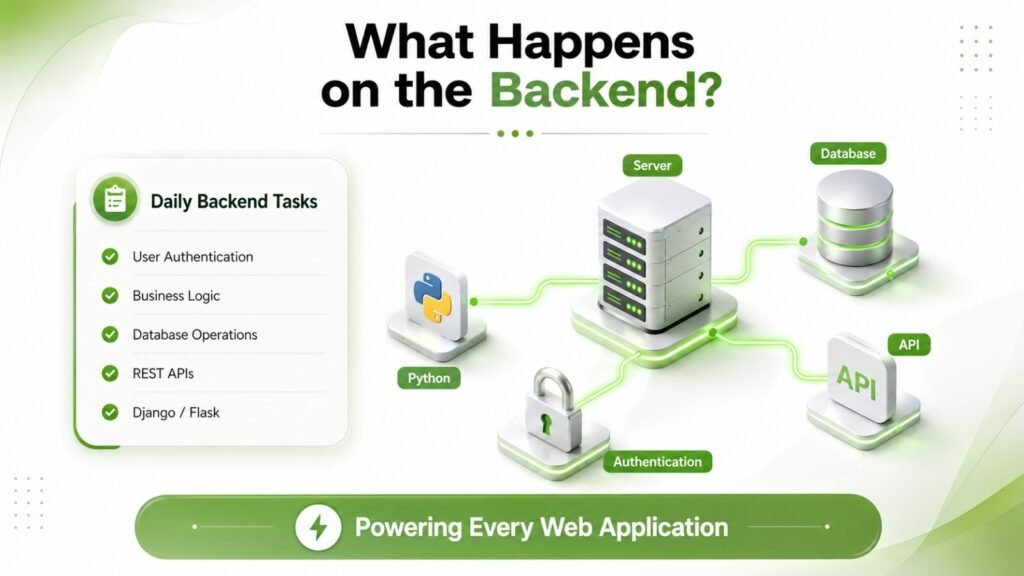
This is normally where the meat of the technical challenge lies. Backend-wise, a Python Full Stack developer builds the logic of the application, from handling the login process, processing form submissions, applying the business logic, and linking everything back into the database so that nothing disappears once the browser tab is closed.
A good part of the backend work is done within a framework, not built from scratch. The most common choice here would be Django, mostly due to the fact that it includes a lot of pre-built solutions for routing, administration, database operations, and organizing the application itself. According to Django’s official documentation, the framework itself is made to provide fast development without compromising the structure needed by a bigger application in the future, and this is indeed what most developers experience while using Django. Flask goes a completely different route: a lightweight solution for building applications with more freedom at the price of building the project on your own. Which one of these is learned at university or required by a specific job is definitely worth checking.
What Happens on the Frontend
The frontend side covers the usual trio: HTML for structure, CSS for styling, and JavaScript for interactivity, the same fundamentals that show up in pretty much every full stack role no matter what backend language sits behind it. Some Python Full Stack programs pair these basics with a JavaScript framework for building more dynamic interfaces, not unlike how Java Full Stack tracks often pair backend learning with Angular or React later on.
The exact frontend stack taught varies quite a bit from program to program, so it’s worth checking what’s actually included before enrolling anywhere rather than assuming every “Python Full Stack” course covers identical ground. They genuinely don’t.
The Skills That Actually Matter
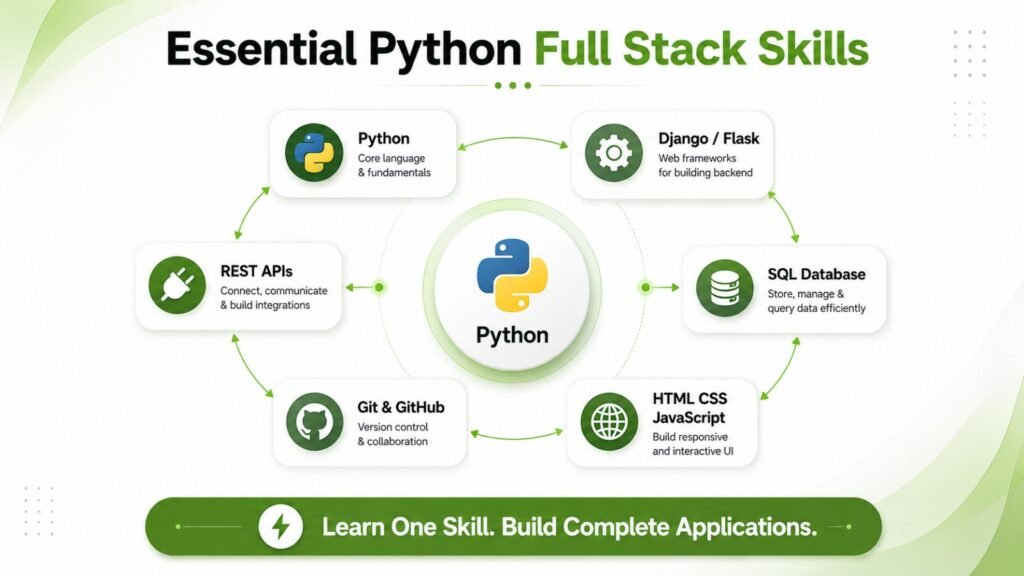
Enough students ask for a plain list of Python full stack developer skills instead of another paragraph that it’s worth just laying it out clearly.
| Skill Area | What It Covers | Why It Matters |
| Python fundamentals | Core language, functions, object-oriented programming | Everything else gets built on top of this |
| Backend framework | Django or Flask | Handles the application’s actual server-side logic |
| Database and SQL | Connecting Python apps to a database | Nearly every real application needs to store and pull data |
| Frontend basics | HTML, CSS, JavaScript | Builds what users actually see and interact with |
| Version control | Git and GitHub | Needed for working inside any real development team |
| APIs | Building and consuming REST APIs | Connects the frontend and backend cleanly |
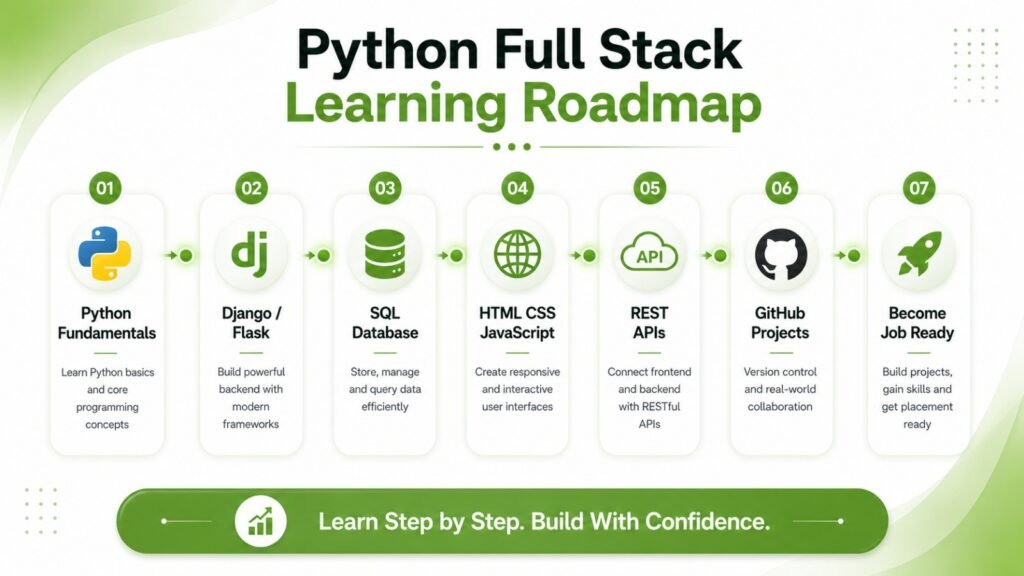
Same advice that applies to any full stack path, Java included, applies here too. Learning these in a sensible order matters far more than trying to absorb everything at once. Python fundamentals first, then a backend framework, then database work, then frontend basics, then tying it all together in a small project that actually does something.
Who This Career Path Actually Suits
This is worth being honest about before anyone spends time or money on it. A Python Full Stack path tends to fit well if you are one of the following.
- A college student who wants practical, job-ready skills alongside a degree
- A non-IT graduate switching into tech for the first time
- A working professional looking to move into software development
- Someone preparing for placement season and wanting an edge
- Anyone in Pune specifically looking for a career path with local hiring demand
If you recognized yourself in that list, the next section on jobs and salary is the one to pay attention to.
What Jobs Can You Actually Get?
People do not really buy a course. They buy an outcome, and the outcome here is a job title and a paycheck, so it is worth being specific about both.
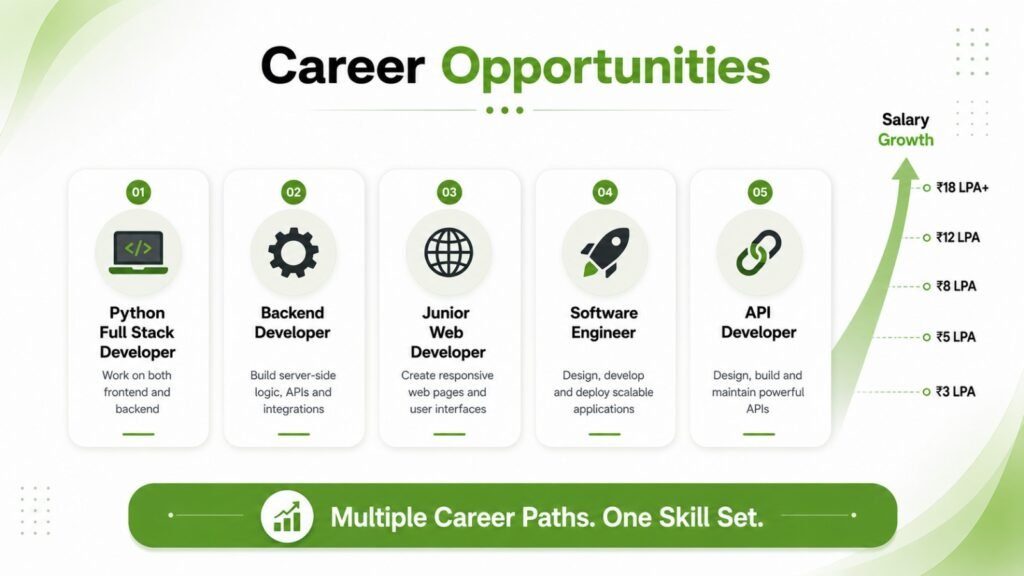
With this skill set, the realistic entry points include:
- Python Full Stack Developer
- Backend Developer
- Junior Web Developer
- Software Engineer (Trainee level)
- API Developer
These roles are not locked into one industry either. Companies in fintech, healthcare, edtech, SaaS products, and ecommerce all hire for this skill combination, since backend logic, database work, and basic frontend competence apply the same way regardless of what the company actually sells.
Python Full Stack Developer Salary in India
This is one of the most searched questions around this career, and it deserves an honest answer instead of a suspiciously specific number pulled out of nowhere. Here is roughly where things stand based on industry salary data from 2026.
| Experience Level | Typical Annual Salary (India) |
| Fresher (0 to 1 year) | ₹3 to ₹6 LPA |
| 2 to 4 years | ₹6 to ₹12 LPA |
| 5-plus years | ₹12 LPA and above |
A few things worth knowing alongside these numbers.
- The exact figure shifts based on city, hiring company, and how strong your project work is
- Product companies and larger tech hubs like Bengaluru or Pune tend to sit at the higher end
- Smaller service companies often start closer to the lower end
- Pay climbs noticeably past two to three years, where a solid project and a clean GitHub history genuinely help
Nobody can promise you a specific number before you have interviewed anywhere, and treat any course that does with suspicion. What actually moves the number is skill depth, project quality, and how you perform in the interview itself.
Not sure if you’re ready to become a Python Full Stack Developer? Join a free demo class at FirstBit, meet the trainers, see how live sessions work, and get personalised guidance based on your background before making any decision.
Is Python Full Stack Development a Good Career Choice?
This comes up in almost every counseling conversation, and it’s a fair question to ask before handing over time and money to any course. Is Python full stack developer a good career choice, or is it just another trending title that sounds impressive online without much behind it? Worth answering honestly instead of just cheerleading.
Python itself has stayed consistently relevant for years, and not only in web development. It shows up across data work, automation, and scripting too, which is part of what makes it such a flexible language to build a career around. Python’s official documentation reflects a language still under active, ongoing development with a genuinely large surrounding community, and that tends to translate into steady, real demand for developers who know it well. Full stack developers benefit from this flexibility twice over, since they’re not boxed into backend-only or frontend-only work, which keeps a wider range of roles open when it’s time to apply.
It also helps that these skills aren’t locked into one narrow industry. The same core ability- backend logic, database work, basic frontend competence- applies whether someone ends up at a product company, a services company, or a small startup building something from nothing. That breadth is a big part of why so many career switchers land here instead of picking a narrower specialization right out of the gate.
That said, “good career” still comes down to whether the actual daily work suits you, moving between backend logic and frontend polish rather than staying inside one narrow lane. If that variety sounds energizing rather than scattered, this is a genuinely solid direction to commit to.
Python Full Stack vs Just “Python Developer”
This is usually where the earlier confusion finally clicks into place. A general “Python Developer” title can mean almost anything: backend API work, data pipeline scripting, automation tooling, sometimes even work that leans toward data science, depending entirely on the company. A Python Full Stack Developer is more narrowly and clearly defined: responsible for both the backend and frontend of a web application, full stop.
Worth knowing plainly, companies aren’t always consistent with how they use these titles, the same way “Data Analyst” and “Data Scientist” blur together in some postings too. When comparing roles, reading the actual list of responsibilities tells you far more than the job title ever will.
A Few Things People Get Wrong Early On
A handful of misunderstandings show up again and again in these conversations, and clearing them up early saves a lot of unnecessary worry later.
One of the biggest is thinking you need to be some kind of math genius to work with Python. Not for full stack development, at least. Python’s syntax is genuinely approachable, which is exactly why it’s such a common starting language for people with zero prior coding background.
Another is assuming “full stack” means being equally expert at everything, all the time. In practice, most working full stack developers lean stronger on one side, backend or frontend, while staying comfortably competent on the other. Depth in one area paired with solid working knowledge of the rest is completely normal, and honestly more realistic than trying to be equally brilliant at both.
There’s also a habit of thinking there’s only one correct way to structure a Python full-stack application. Django and Flask take genuinely different approaches, and both get used successfully in real, production applications every day. It’s not about finding the single right answer; it’s about understanding the tradeoffs and picking what fits.
And one that’s easy to fall into if you’re just starting to look at options, assuming a search for a Python full-stack course near me automatically points you to the best choice. Proximity is convenient, sure, but it’s worth actually checking the curriculum, the project work, and the mentorship structure of a program rather than choosing purely because it’s the closest one on the map.
Where to Actually Start Learning
Start with core Python fundamentals before touching any framework at all: loops, functions, object-oriented basics, and enough comfort with the language that syntax stops being the thing you’re consciously thinking about. From there, move into a backend framework, work through a couple of small exercises inside it, then add basic database work so your application can actually hold onto something real between sessions.
Once the backend feels reasonably steady, shift over to frontend basics, and finally bring it all together in one small project, something like a simple to-do list app with a working database sitting behind it. This mirrors the same phase-by-phase structure laid out in our Java Full Stack learning order. The language and tools differ, sure, but the underlying logic, fundamentals before frameworks, holds true across both paths.
Learning on your own is possible, but many beginners struggle because they don’t know what to learn next. FirstBit’s Python Full Stack course follows this exact roadmap through live classes, practical projects, and mentor support so you can focus on learning instead of searching for the next tutorial.
What a Genuinely Useful First Project Looks Like
Reading about such pieces in isolation will not take you very far. The best way to really understand how they work together is by building something relatively simple from scratch.
A decent first project could be something like a task tracker where users can create tasks, mark them as complete, delete them, and have everything saved in a real database rather than disappear every time the page is refreshed. Doing this project will force you to get hands-on experience with all the pieces mentioned above: writing backend code for creating, reading, updating, and deleting tasks, tying your backend code to a database, and making a simple frontend to interact with all this.
It does not have to be polished. The idea is to learn how the request flows from the browser to backend code, to the database, and back as something that the user can see. Only when you understand how all this works will larger framework-heavy projects stop seeming scary.
How FirstBit’s Python Full Stack Program Approaches This
FirstBit’s Python Full Stack program follows this same structured, phase-by-phase approach rather than throwing every topic at students all at once. Classes run live, instructor-led, with hands-on project work built into each major stage, so students end up building real, working applications instead of just following along with slides.
Alongside the technical training, the program includes Placement Assistance once students are job-ready, along with the kind of practical guidance that comes from years of watching students move from feeling completely lost about where to even begin, to actually landing their first developer role.
Final Thoughts
Python Full Stack development isn’t some vague, catch-all label people throw around loosely. It’s a specific, well-defined role that combines backend logic, database work, and frontend interfaces into one cohesive skill set, built up in a sensible order rather than absorbed all at once. Whether it’s the right path really comes down to whether that variety, building the complete picture of an application instead of one narrow slice of it, genuinely appeals to you.
Every software developer starts somewhere. The difference is having the right roadmap and guidance. If you’re serious about building a career in software development, don’t rely on random tutorials alone. Join FirstBit’s free demo class to experience a live session, meet the trainers, understand the course structure, and get personalised guidance based on your background. You’ll also learn how the program prepares you with real projects, interview preparation, and Placement Assistance to help you confidently apply for your first developer role.