
You’ve been through Core Java. Spring Boot finally clicked. You’ve even built a couple of small projects and pushed them to GitHub. Then, halfway through an interview, someone asks you to write a query joining two tables and explain your logic out loud, and suddenly you’re staring at the screen as you’ve never seen SQL before in your life.
If that’s ever happened to you, or you’re worried it will, you’re not alone, and it’s not because SQL is secretly hard. It’s because interview-style SQL questions test something a little different from what you practice while coding day to day. This is Phase 3 of our full Java Full Stack learning order, and it deserves more attention than most people give it.
This post pulls together the SQL interview questions for freshers and working developers alike that come up most often around Java Full Stack SQL interview rounds in Pune, along with answers written the way you’d actually say them out loud, not textbook definitions you’d forget the moment you’re nervous.
Quick Answer: What Kind of SQL Questions Actually Come Up?
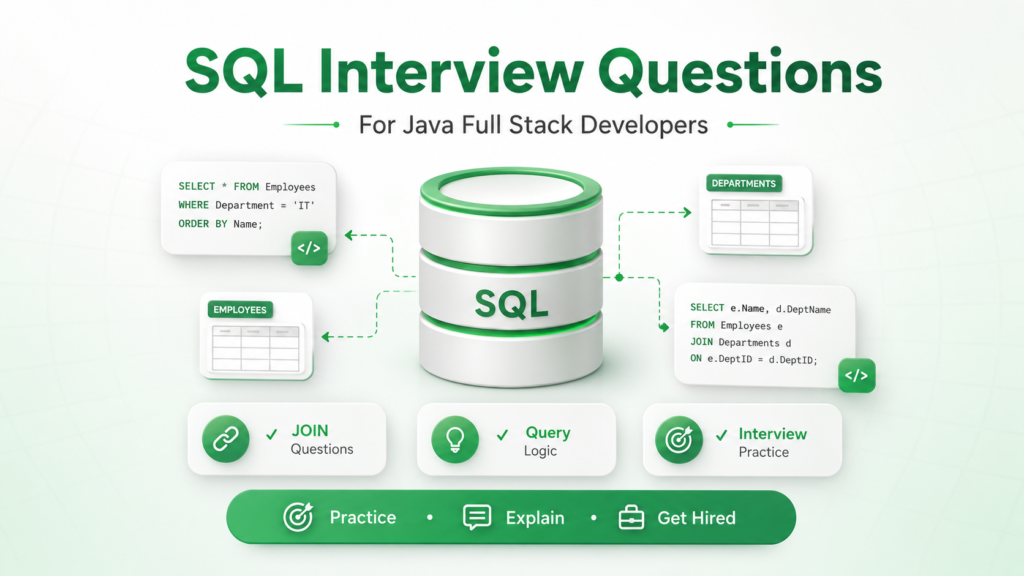
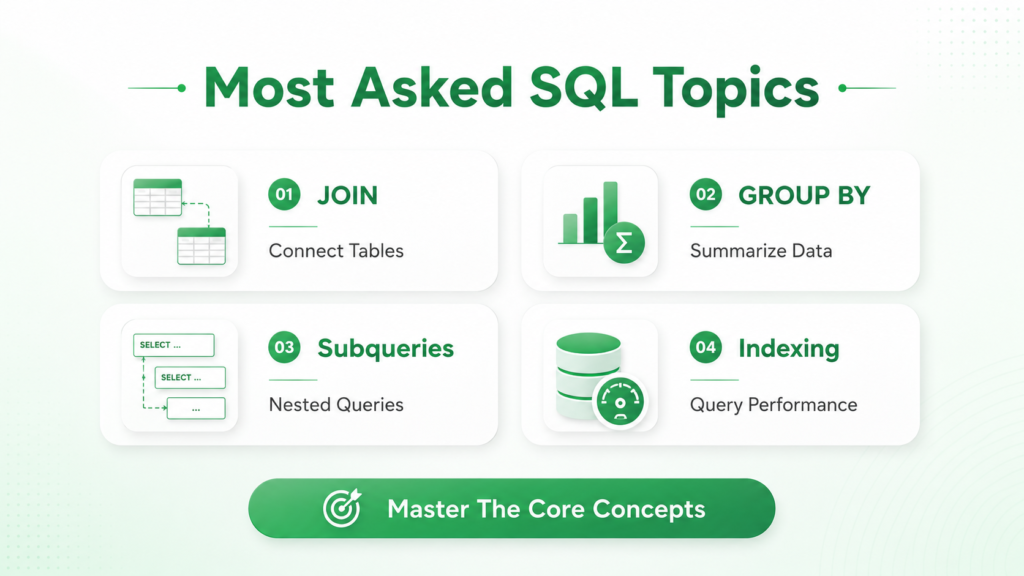
If you’re short on time, here’s the shape of it. Most SQL interview questions for full-stack developer roles fall into four buckets: JOIN logic, aggregate functions with GROUP BY and HAVING, subqueries, and a basic awareness of indexing and query performance. Interviewers almost never expect DBA-level expertise from a full-stack candidate. What they’re actually testing is whether you can reason through a query out loud and explain your thinking, not whether you’ve memorized syntax perfectly.
Here’s the same thing at a glance:
| Question Type | What It’s Really Testing | Typical Example |
| JOIN logic | Whether you pick the right JOIN for the situation | “Find customers who’ve never placed an order” |
| GROUP BY and HAVING | Whether you know when filtering happens, before or after grouping | “Find customers with more than five orders” |
| Subqueries | Whether you know when a subquery beats a JOIN | “Find products priced above the average price” |
| Indexing basics | Whether you have a sense of why queries slow down | “How would you speed up this slow query?” |
Keep this table in mind as you read through the rest of this post; each section below matches one row.
Why Full Stack Candidates Specifically Struggle With SQL Interviews
Here’s the honest pattern we see over and over. Full-stack developers spend most of their actual coding time in Java, not SQL. Queries get written occasionally, often with an IDE quietly suggesting the next word before you’ve even finished typing it. That’s a very different skill from being asked, out loud, in front of someone watching, to write a query from scratch with no autocomplete and no chance to Google anything.
It’s not that your SQL knowledge disappears. It’s that interview conditions strip away every crutch you didn’t realize you were leaning on. The fix isn’t learning more SQL theory; it’s practicing this specific, slightly uncomfortable format on purpose, before it matters.
JOIN Questions You Should Expect
JOINs come up in almost every SQL interview, and for good reason, connecting data across tables is something you’ll do constantly in real full-stack work. The confusion usually isn’t about syntax; it’s about knowing which JOIN actually fits the situation.
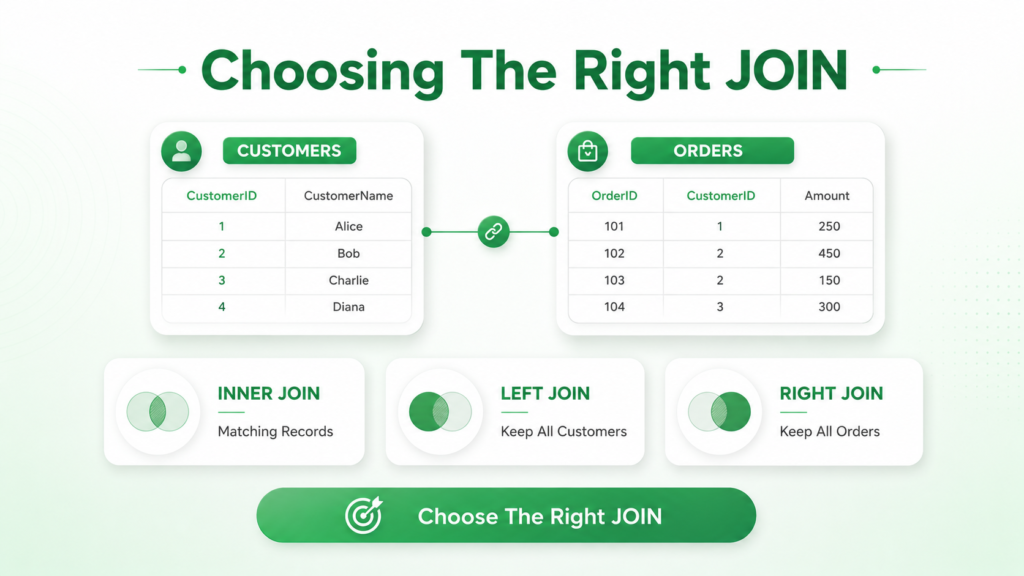
An INNER JOIN only returns rows that have a match in both tables. A LEFT JOIN returns everything from the left table, whether or not there’s a match on the right, filling in NULLs where nothing matches. Say you have a Customers table and an Orders table. If you want only customers who’ve placed at least one order, INNER JOIN does the job. If you want every customer, including the ones who’ve never ordered anything, you need a LEFT JOIN.
A typical interview question might sound like this: “Write a query to find all customers who have never placed an order.” The trick isn’t the JOIN itself; it’s recognizing you need a LEFT JOIN from Customers to Orders and then filtering for rows where the Orders side is NULL. Say that reasoning out loud as you write it. Interviewers are usually more interested in hearing you think through it than in a syntactically perfect first attempt.
GROUP BY and HAVING Questions You Should Expect
This is where a lot of candidates freeze, mostly because WHERE and HAVING look like they do the same thing until you actually need both in the same query.
WHERE filters rows before they get grouped. HAVING filters groups after they’ve already been formed. As MySQL’s own reference manual explains, HAVING conditions are evaluated against the aggregated results a GROUP BY clause produces, not against individual rows. So if someone asks you to find customers who’ve placed more than five orders, WHERE simply can’t do that job; “more than five orders” only exists once counting has already happened. You’d GROUP BY customer, use COUNT() on the orders, and then filter that count with HAVING.
A common interview question here is exactly that: “Write a query to find customers with more than five orders.” If you can explain why WHERE won’t work for this and HAVING will, you’re already ahead of most candidates who just try to remember the syntax without understanding why it exists.
Subquery Questions You Should Expect
Subqueries are tricky not because they are difficult to implement but rather because applicants are unsure about when to use a subquery instead of a JOIN.
A rule of thumb would be that whenever your filtering involves calculating some values, such as “customers who have spent more than the average,” a subquery is preferable to a JOIN since you will be comparing something with just one value. JOIN becomes more preferable when you are fetching related columns from two different tables.
An example of a problem that requires a subquery would be: “Fetch all products that cost more than the average cost of the product.” You would calculate the average in the inner subquery and compare the product cost with that value in the outer query. It might happen that an interviewer would ask you to rewrite it using JOINs, just to check your understanding of the difference between them.
Basic Indexing and Query Performance Questions You Should Expect
You won’t be expected to explain database internals at a deep level for a full-stack role, but a basic sense of why queries slow down matters.
An index is essentially a lookup shortcut. Without one, the database has to scan through every row to find what you’re asking for. With an index in the right column, it can jump almost straight to the matching rows instead. According to MySQL’s own documentation on how JOIN operations are processed, the way tables are structured and indexed directly affects how efficiently a query runs, which is exactly why interviewers sometimes ask a simple follow-up like “how would you speed this query up” after you’ve written something correct but unoptimized.
A common question: “This query is running slowly on a large table; what would you check first?” A reasonable answer is to check whether the columns used in your WHERE clause or JOIN condition are indexed. You don’t need to go deeper than that at this stage, showing that instinct is usually enough.
Want to actually practice these out loud with real feedback instead of just reading through answers? Book a free demo class and run through a mock SQL round with a trainer before your next real interview.
Watch One Full Answer Worked Through, Start to Finish
Reading isolated tips only helps so much. Here’s what actually working through one of these MySQL interview questions for developers looks like, end to end.
Say the question is: “Write a query to find the top three customers by total order value.” Here’s how that plays out, step by step, the way you’d genuinely talk through it in the room.
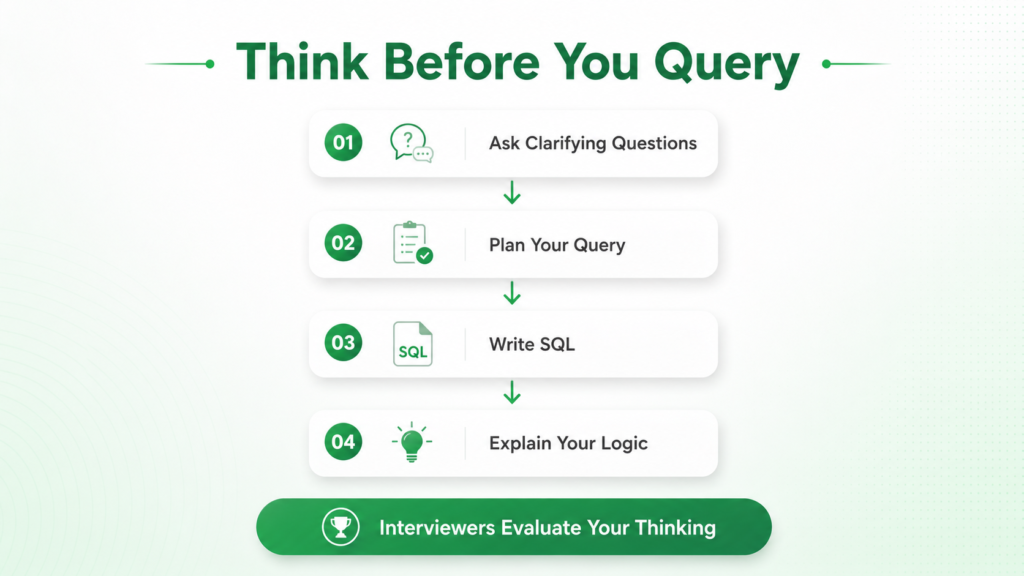
- Ask a clarifying question first. Something like “should this include cancelled orders, or only completed ones?” That single question already signals you’re thinking about the data, not just the syntax.
- Say your plan out loud before writing anything. Join Orders to Customers, sum the order value grouped by customer, sort that in descending order, limit it to the top three rows.
- Only then write the query itself.
Notice what happened there. The clarifying question came first, the plan came second, and the actual SQL came last. That order, more than the query itself, is usually what separates a candidate who looks confident from one who looks like they’re guessing their way through it.
A Simple Way to Practice SQL Interview Questions on Your Own
The single best thing you can do is stop practicing SQL only inside an IDE. Pick two tables, either from a personal project or the database module from your course, and write five new queries a week covering the categories above: one JOIN question, one GROUP BY and HAVING question, one subquery, and so on.
Write the query by hand first, or say your approach out loud before you type anything, the same way you did in the “how do you know you’re ready for the next phase” checkpoints in our roadmap post. If you can explain your reasoning clearly without the query already in front of you, you’re genuinely ready. If you’re only comfortable once autocomplete fills in the next word, that’s your sign to slow down and practice this specific format a bit more before your next interview. This applies whether you’re a fresher working through basic SQL interview questions for the first time or someone brushing up before a Java Full Stack SQL interview round here in Pune.
Once SQL feels solid, the next decision most learners run into is picking a frontend framework, and we’ve covered exactly that in our Angular vs React comparison, if you’re not sure which direction to take your backend skills next.
Common Mistakes Candidates Make in SQL Interviews
A handful of patterns come up constantly, and most are easy to fix once you’re aware of them.
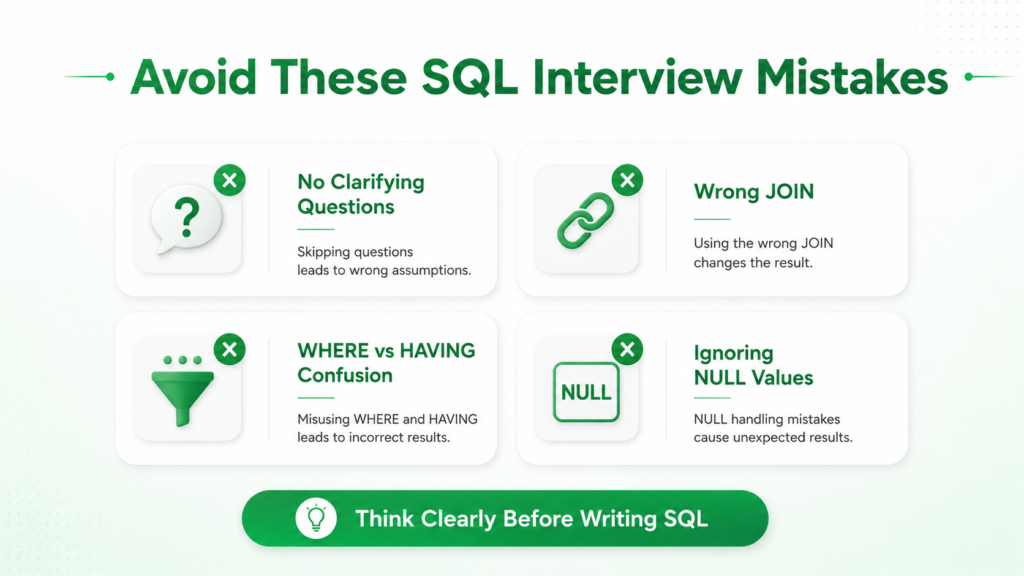
- Jumping straight into writing a query without asking a single clarifying question about the schema. Real interview problems are often intentionally a bit vague, and asking “Does a customer always have an order, or can that be empty?” shows you’re thinking like someone who’d actually build reliable software, not just someone racing to type something.
- Forgetting NULL values inside JOIN logic, especially with LEFT JOINs, which is exactly where a lot of “find customers with no orders” style questions live.
- Confusing WHERE and HAVING, usually because candidates memorized “HAVING goes with GROUP BY” without ever internalizing why.
- Over-explaining every single step before writing anything. It’s usually more effective to write the query first, even an imperfect one, and then walk through your reasoning, rather than narrating your thought process for two minutes before typing a single line.
Do Freshers and Experienced Candidates Get Asked Different SQL Questions?
To some extent, yes, and it is important to distinguish between these things so that you do not overprepare for the wrong exam.
SQL interview questions for freshers will be somewhat closer to those things that were mentioned above: simple JOIN, GROUP BY/HAVING, and subqueries. The interviewers want to make sure that you understand the basic principles of things and can explain them.
More experienced people will be asked about multi-table joins (three or four tables simultaneously), how you will improve the specific query performance-wise, or something like that. So for freshers, this information is definitely good news. Learning the basics of SQL listed in this post will make you well-prepared for your interview.
How FirstBit’s Java Full Stack Program Builds This Skill
SQL isn’t treated as a side topic in our Java Full Stack program; it’s its own dedicated phase with real, hands-on practice, not just slides explaining syntax. Later in the program, mock interview sessions specifically include SQL rounds, so students get comfortable with the out-loud, no-autocomplete format well before it matters in a real interview, and the same set of SQL interview questions and answers gets revisited throughout the course, not crammed in once and forgotten.
Alongside SQL specifically, the broader program includes live instructor-led classes, project work, and Placement Assistance once you’re job-ready, so this kind of interview prep isn’t happening in isolation from everything else you’re learning.
Final Thoughts
SQL interview questions aren’t testing some rare, hidden talent. They’re testing a specific, practicable skill, reasoning through a query out loud, under a bit of pressure, without your usual tools. That gap closes fast with the right kind of deliberate practice, and it’s genuinely one of the highest-return things you can prepare for as a full-stack candidate.
If you’d rather build this skill with real feedback instead of guessing whether your answers actually hold up out loud, our Java Full Stack program includes SQL as a dedicated phase with hands-on practice and mock interview rounds built in. See the full Java Full Stack course details to see how it fits into your prep.