Go search “Java Full Stack Developer” on any job portal and look at the requirements. Java, SQL, HTML, CSS, JavaScript, Spring Boot, Angular, Git, Docker, sometimes even Kubernetes. For someone just starting out, that list alone is enough to make you close the tab.
Here’s the part nobody tells you: you’re not supposed to learn all of it at once. And you’re definitely not supposed to learn it in whatever order YouTube recommends it to you. There’s a sequence that actually makes sense, one thing builds on the next, and by the time you reach the end, you’re not just “familiar” with these tools, you can actually use them together.
This is that sequence. It’s based on a real, structured Java Full Stack curriculum, not a list someone put together from scattered blog posts. If you’re a fresher, switching careers, or just tired of jumping between tutorials that don’t connect to each other, this should give you something to actually follow.
Quick stop before the roadmap itself: let’s talk about what this job even looks like day to day, because that context makes the “why” behind each phase a lot clearer.
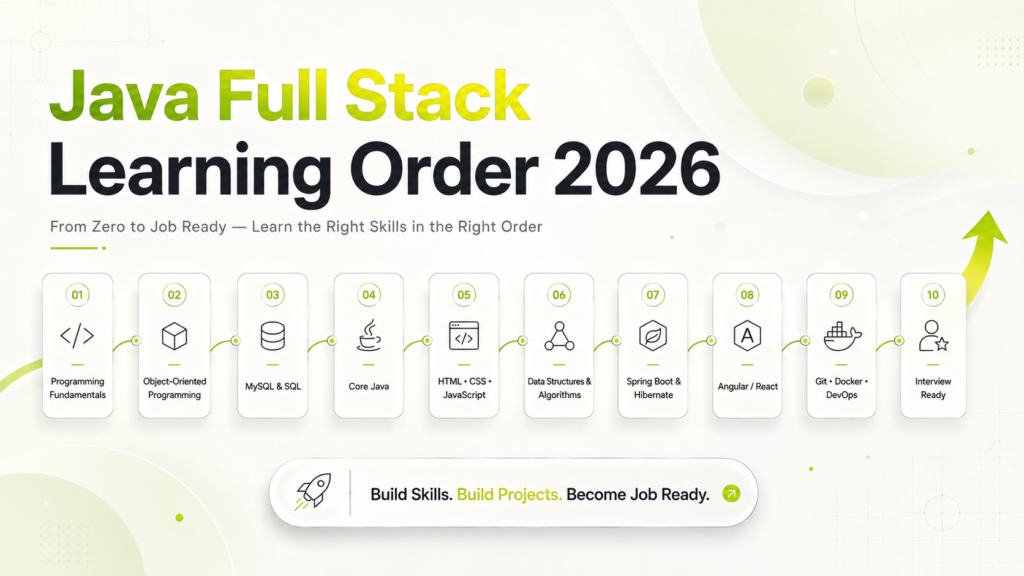
Quick Overview: The 10 Phases at a Glance
If you just want the shape of the whole roadmap before reading the details, here it is:
- Programming fundamentals
- Object-oriented programming
- Databases with MySQL
- Core Java
- Web programming basics (HTML, CSS, JavaScript)
- Data structures and algorithms
- Advanced Java and frameworks (Spring Boot, Hibernate)
- A frontend framework (Angular or React)
- Git, GitHub, and DevOps basics
- Interview readiness
Keep this list in mind as a checkpoint. If you can honestly say you’re comfortable through a given phase, you’re ready to move on. If you can’t, that’s your answer on where to slow down.
What Does a Java Full Stack Developer Actually Do?
The term full stack simply translates to being able to work on both ends of an application.
For example, your typical day as a full-stack developer may entail writing Java code related to order processing, building a RESTful API that can help the frontend communicate with the backend, executing a SQL query to retrieve information, editing screens in Angular or React, trying to resolve a bug that emerged during the night shift, and attending a code review for the pull request made by one of your teammates. There is usually never a singular activity you do on a day-to-day basis.
If you want the fuller picture of the role itself, we’ve broken it down separately here: What Is a Java Full Stack Developer?
Alright, let’s get into the actual order to learn things in.

The Java Full Stack Learning Order, Step by Step
A few things before you dive in. Each phase here builds on the one before it, so resist the urge to skip ahead just because a topic sounds boring. And a lot of these do sound boring at first. Interviewers can tell almost immediately when someone’s fundamentals are shaky, no matter how polished their final project looks.
Phase 1: Programming Fundamentals
Before Java, before anything, you need basic programming logic down. That means working through syntax, functions, pointers, dynamic memory allocation, arrays, strings, and structures, usually wrapped up with a small mini-project, so it’s not just theory.
This phase isn’t really about the specific language. It’s about getting your brain used to thinking in steps and logic, which honestly matters more than any single syntax rule you’ll memorize. Some people breeze through this. Others find it genuinely tough. Both are normal, so don’t read too much into how easy or hard it feels for you personally.
Phase 2: Object-Oriented Programming
As Java is an OOP-based language, this is not an auxiliary topic but the base itself. Classes, objects, abstraction, encapsulation, inheritance, polymorphism, everything is there.
If some terms seem obscure to you, don’t worry. For instance, you will be able to understand what is meant by encapsulation only once you use it in practice, i.e., in Phase 4. No need to feel nervous right away.
Phase 3: Databases Using MySQL
It would be hard to find an application without databases. And this is what SQL is needed for. Topics include: database normalization, basic SQL commands, DDL & DML commands, SELECT statement using GROUP BY, HAVING, joins and subqueries, string & date functions, views, indexes, and PL/SQL including procedures, functions, cursors, and triggers. The transactions close this phase.
There is one very common mistake in relation to SQL; everybody tends to skip it in favor of the programming part because writing code is way more interesting than writing queries. But your poor SQL skills may become apparent precisely at the wrong moment when you debug a slow query the night before the deadline.
Phase 4: Core Java
Here you start seeing more of Java programming than preparations for it. Here you will practice OOP concepts, work with interfaces, final/static variables, exception handling, file handling, and the Collection Framework.
All phases that come after this one depend on Core Java, especially those of Phase 7. This is a phase when it is recommended to slow down and focus a bit more.
Phase 5: Introduction to Web Programming
Before you start working with any frontend framework, you should understand how things really work behind a website. This means HTML5, CSS3, JavaScript, jQuery, and Bootstrap. Even if your specialization turns out to be backend, you’ll have to read and edit frontend code anyway.
Phase 6: Data Structures and Algorithms
Let me be honest with you; your motivation will likely drop significantly at this point. It is also the most interview-relevant phase of all on this list. Algorithm analysis, searching and sorting methods, stacks, queues, singly, doubly, and circular linked lists, trees, graphs, multithreading, socket programming, and garbage collection will follow.
Interviewers will certainly ask about data structures and algorithms wherever you’re applying. These will be asked not because they want to know what the “correct” answer is, but to evaluate your problem-solving skills.
Phase 7: Advanced Java and Frameworks
In this phase, you start doing what professionals do in the industry. Application stack design, servlets, designing a full stack application, Hibernate and HQL for object-relational mapping, and finally Spring Boot, Spring Core, Spring Dependency Injection, and Spring with JDBC and DAO.
Spring Boot specifically is one of the most requested skills in Java backend job postings right now, and the official Spring Boot documentation is genuinely worth bookmarking, even after you’ve moved past the basics. Fair warning, this phase usually takes longer than the ones before it. That’s expected. There’s just a lot happening here.
Phase 8: Frontend Framework: TypeScript using Angular and/or React
Now that the backend is in place, it’s time to design a real user interface for your software. Generally speaking, in almost all scenarios, there are only two possibilities available to you.
If you pick Angular 17, then you will learn about the TypeScript features, which include types, classes, and generics, and then Angular CLI, components, binding, forms, services, dependency injection, routing, and RXJS. However, if you pick ReactJS, then you will have to learn about ReactJS, components, props and state, events, routing, hooks, and creation/deployment of a CRUD application.
Just keep in mind that, generally speaking, most organizations tend to pick one over the other. Hence, you are not required to learn about both. Simply take a look at the target organizations or just ask your instructor.
Phase 9: Git, GitHub, and Basic DevOps
No matter how good you are at programming, being able to operate within a development workflow is crucial. The topics of this phase include Git’s workflow, cloning and committing, branch creation, pull requests on GitHub, and the basics of DevOps, CI/CD workflows, Docker, and Kubernetes.
Even a basic understanding of what Docker and Kubernetes are will give you an edge compared to all those other programmers who just have never bothered thinking about how their code is actually deployed anywhere.
Phase 10: Interview Prep
Being good at programming doesn’t guarantee getting a job, unfortunately. The topics of this phase include aptitudes (percentages, ratios, time and work, probability, etc.), analytics, communication skills, resume building, mock interviews, technical quizzing, and presenting projects.
Here is when the role of the mentor/trainer comes into play, since conducting mock interviews and providing objective feedback on resumes becomes impossible without any assistance.
Would you rather have someone guide you through all this instead of piecing it together solo? Book a free demo class and see how the actual training works before deciding on anything.
Skills You Need at Each Stage
If you’d rather see the whole thing at a glance, here’s a quick table.
| Skill | Why It Matters | Where You’ll Use It |
| Core Programming Logic | Builds your problem-solving foundation | Every phase, every project |
| Object-Oriented Programming | Java itself is built around OOP | Core Java, Advanced Java |
| SQL and Database Design | Almost every app needs to store data | Backend development, real projects |
| Core Java | Foundation for frameworks and interviews | Advanced Java, Spring Boot |
| HTML, CSS, JavaScript | Basic building blocks of the web | Frontend development |
| Data Structures and Algorithms | Tested heavily in technical interviews | Interviews, performance optimization |
| Spring Boot and Hibernate | Industry-standard Java backend frameworks | Real-world backend projects |
| Angular or React | Builds modern, interactive user interfaces | Frontend development |
| Git and GitHub | Required for working in any development team | Every job, every project |
| Docker and Kubernetes basics | Makes you deployment-ready, not just code-ready | DevOps-adjacent roles, bonus skill |
Handy trick: if a job posting lists a skill you haven’t covered yet, this table tells you exactly which phase to go back and revisit.
Tools and Technologies in a 2026 Java Full Stack Toolkit
By now, you are quite familiar with a variety of technologies. Languages: Java, TypeScript, SQL. Back end: Spring Boot, Spring Core, Hibernate. Front-end: HTML5, CSS3, JavaScript, Angular 17 or ReactJS. Database: MySQL. Version control: Git and GitHub. When it comes to DevOps knowledge, Docker, Kubernetes, and CI/CD must also be known.
It is not mandatory to be proficient in all of them before going through your job applications. Companies mostly prefer employees with strong fundamentals and proficiency in any tool of a specific tech stack.
Project Ideas to Practice What You’re Learning
Reading about Spring Boot won’t teach you Spring Boot. Building something, even something small and a little rough around the edges, is where the actual learning happens.
If you’re stuck on where to start, we’ve put together a full list of project ideas from beginner to advanced, all using Spring Boot: 5 Java Spring Boot Projects You Must Build. Try building two or three of these as you work through Phases 7 and 8, so by the time you’re interviewing, you’ve got real projects to talk about instead of just a list of topics you technically “covered.”
Common Mistakes Beginners Make on This Roadmap
A handful of patterns show up over and over with people following this path, and knowing them in advance can save you months of frustration.
The big one: skipping DSA because it feels disconnected from “real” development. It almost always comes back to bite you in interviews.
Close second: jumping into Spring Boot before Core Java is actually solid when frameworks make a lot more sense once fundamentals stop requiring conscious effort. A lot of learners also wait until “after the theory” to start a project, when starting small and early is what actually builds confidence. Git gets pushed off until the first job way too often, even though it takes very little time to learn and every team uses it. And SQL, more than almost anything on this list, is something you learn by writing queries yourself, not by reading about them.
If you catch yourself doing one of these, that’s your cue to slow down and go back a phase before pushing forward.

How to Know You’re Actually Ready for the Next Phase
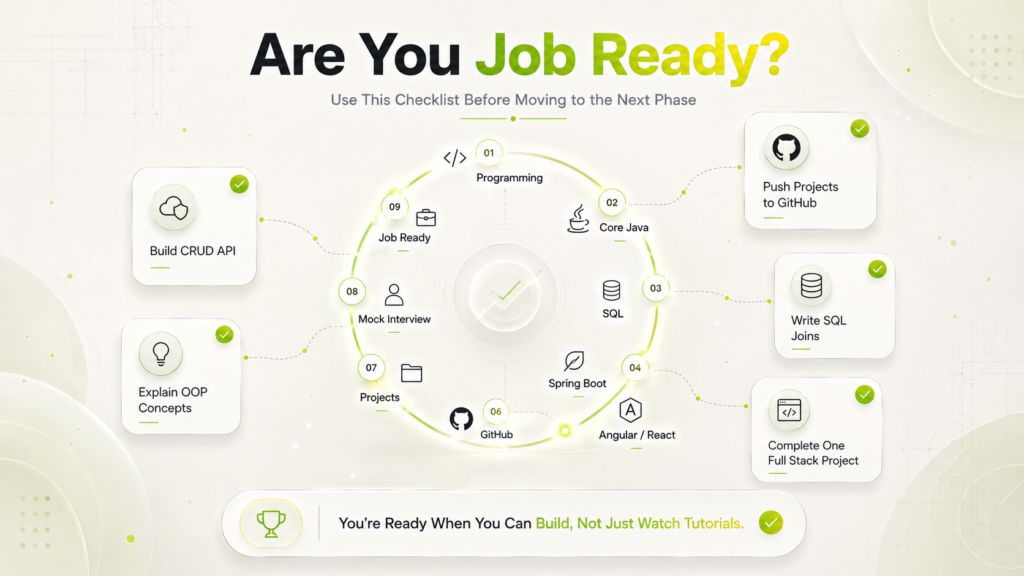
One thing people ask us all the time is how to know whether or not they’re “good enough” to continue on. While there isn’t really a definitive measure, a few questions will tell you much more than you might expect.
After Phases 1 & 2, you should be able to design an entirely new piece of software (without using any template code) that makes proper use of at least one class and one loop. At this point, if you’re still having trouble understanding how many times a loop should run, perhaps you should consider spending another week in this phase.
After Phase 3, take a shot at creating five different SQL queries for a database of your choosing, without referencing anything. Make sure there’s at least one join and one GROUP BY. If you feel confident about that, then you’re ready for Core Java. If not, keep working on SQL, trust me, it’s worth it.
Beyond Phase 6, the litmus test would be if you can orally state the difference between a stack and a queue and how they’re used. This might seem trivial, but it’s something that needs to be second nature – not something that requires you to look up a definition from memory.
Beyond Phase 7, the true litmus test would be if you could write your own CRUD API without referring to the tutorial all the time. Even something as simple as a to-do list API will do the trick. It doesn’t mean that you’ve failed if you can only do it with the tutorial right beside you, because you simply need one or two more builds before you go to the frontend phase.
None of these are official tests; they’re merely ways to gauge weaknesses before an interviewer finds them for you.
Want feedback on where you actually stand right now, instead of guessing? Book a free demo class, and a trainer can walk through this with you directly, no pressure, no obligation to enroll.
How FirstBit’s Java Full Stack Program Follows This Roadmap
Our Java Full Stack program is constructed along the very same lines, from basic programming to the interview preparation process. The classes are live and taught by instructors and are coupled with project assignments at every step of the way, not just lecture presentations.
In addition to the technical subjects, the students go through courses on aptitude and communication skills, mock interviews, resume preparation, and finally placement assistance. The overall methodology focuses on the application aspects over theoretical knowledge acquisition.
Final Thoughts
Becoming a Java Full Stack Developer isn’t about cramming ten technologies into your head at once. It’s about following a sequence that actually makes sense, building real things as you go, and giving each phase enough time before rushing to the next one.
If you’d rather work through this with a trainer, live projects, and structured Placement Assistance instead of figuring it all out solo, take a look at our Java Full Stack course details and see if it fits where you’re starting from.
Do I need to know coding before starting this roadmap?
No. It starts from basic programming fundamentals, so it works whether you’re a complete beginner or switching careers into tech from something unrelated.
Is Angular or React better for Java Full Stack development?
Both are widely used, and most companies only expect you to know one, not both. Angular tends to show up more in enterprise applications, React more with startups and product companies. Check postings from companies you’re targeting, or just ask a trainer what’s trending locally.
What’s the difference between Core Java and Advanced Java in this roadmap?
Core Java covers the foundations, OOP, exception handling, and collections. Advanced Java builds on top of that with servlets, application design, and full-stack concepts, which then lead into Spring Boot and Hibernate.
Can a non-IT graduate follow this roadmap?
Yes. It starts from programming basics, so it doesn’t assume a computer science background. Consistency and hands-on practice matter a lot more than your degree.
What comes after learning Spring Boot?
Usually, frontend development with Angular or React, then Git, GitHub, and basic DevOps tools like Docker, followed by focused interview preparation.
Do I need to learn Docker and Kubernetes as a beginner?
A basic working understanding is enough at this stage. It’s not the core focus of a full-stack role, but knowing the fundamentals makes you a noticeably stronger, more deployment-aware candidate.