
If you have been researching career options, you have probably stumbled on the same three titles more than once: Business Analyst, Data Analyst and MIS Executive. All three deal with information, reports and business decisions, so the confusion is understandable.
There are real differences, though.
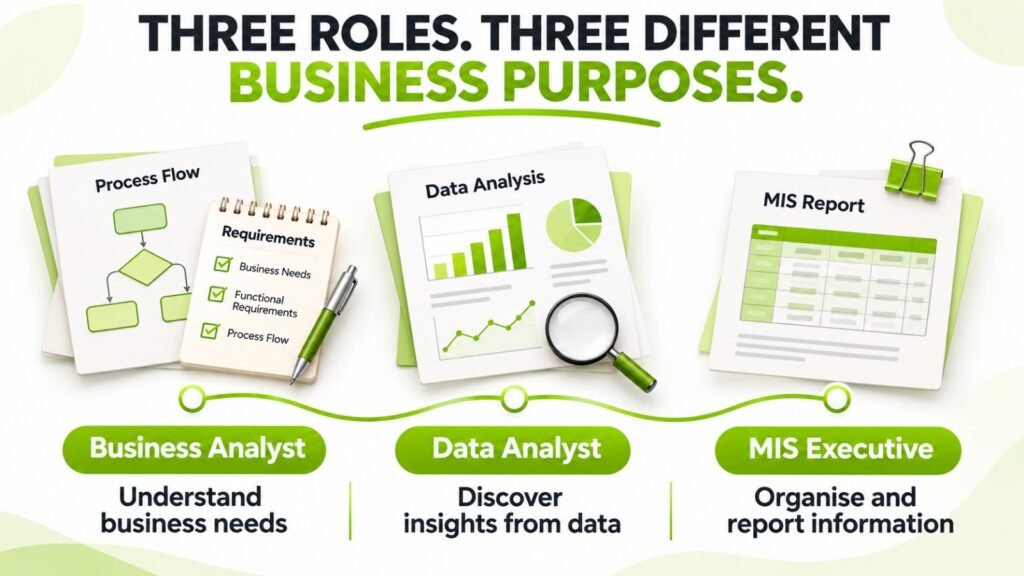
The thing that separates them is the kind of problem each one solves. A Business Analyst works out what the business needs and helps find a solution. A Data Analyst digs into data to find patterns worth acting on. An MIS Executive prepares and maintains the reports that let teams track how things are going.
So which one should a fresher aim for? Here is what each role involves, what skills it asks for, and how to decide.
Business Analyst vs Data Analyst vs MIS Executive: key differences
Before the detail, here is a quick comparison of the three roles.
| Factor | Business Analyst | Data Analyst | MIS Executive |
|---|---|---|---|
| Main focus | Business needs and process improvements | Analysing data and finding insights | Reporting and maintaining information |
| Daily work | Discussions, requirements and documentation | Data cleaning, queries and dashboards | Updating spreadsheets and preparing reports |
| Common tools | Excel, Jira, Confluence | Excel, SQL, Power BI, Python | Excel, PivotTables, sometimes Power BI |
| Main output | Requirements and recommendations | Analysis reports and dashboards | Regular business reports and trackers |
| Important skills | Communication and problem solving | Analytical thinking and technical skills | Excel, accuracy and attention to detail |
The simplest way to tell them apart: the Business Analyst asks what the business needs, the Data Analyst asks what the data shows, and the MIS Executive makes sure everyone can see where things stand.
The roles do overlap in places. A Business Analyst may write SQL, and an MIS Executive may build dashboards.
What does a Business Analyst do?
Picture a company getting more customer complaints than usual. Management knows something is wrong but cannot say where.
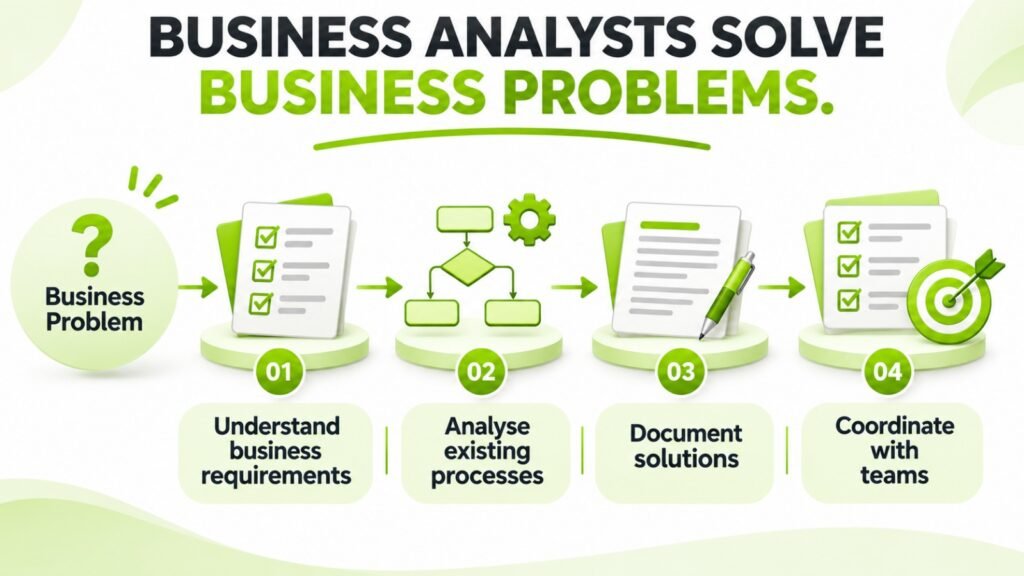
The Business Analyst works with the different teams to pin down the problem, identify what needs to change, and help the company arrive at a workable solution.
Responsibilities
A Business Analyst may:
- Identify business problems and gather requirements from stakeholders.
- Discuss needs with clients, managers and internal teams.
- Analyse existing processes and suggest improvements.
- Document requirements, process flows and user stories.
- Work with other teams, including developers and testers.
- Check whether the proposed solution actually meets the business requirement.
The job calls for an understanding of people and processes as much as the technical side.
Skills and tools required
Communication, critical thinking, problem solving and documentation sit at the centre of the role. Excel is useful for organising information and handling straightforward data.
Depending on the position, employers may also look for Jira and Confluence, process mapping, Agile practices and basic SQL.
Not every Business Analyst needs to code. More technical positions, though, may expect knowledge of databases, APIs or software development in general.
Who should consider this role? If you enjoy talking to people, understanding how companies work, structuring information and solving problems, business analysis may suit you.
What does a Data Analyst do?
Take the same company trying to understand why complaints have gone up. There are files full of customer details, order records, delivery data and feedback.
The Data Analyst goes through that data and pulls out answers the numbers actually support.
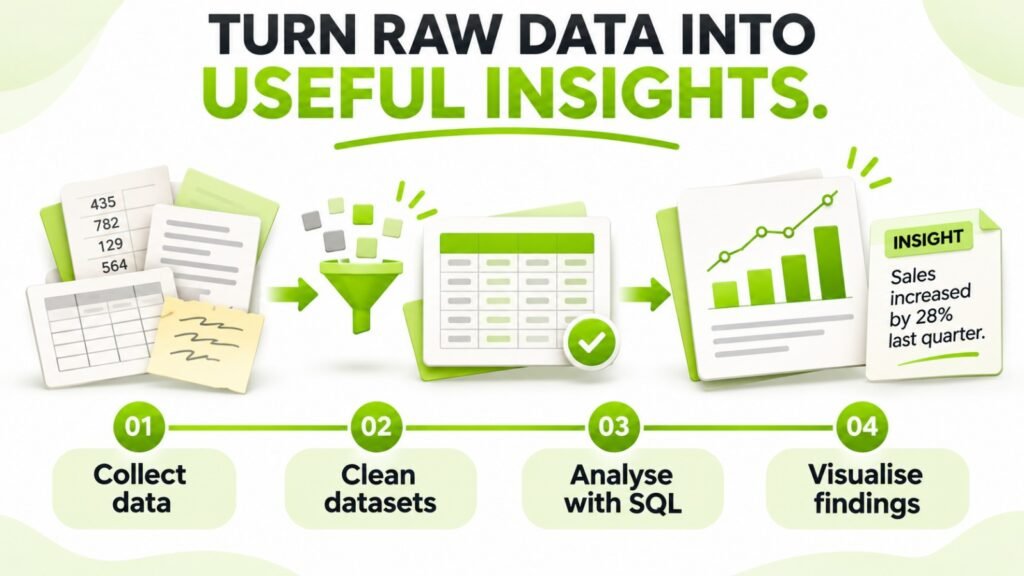
Key tasks of a Data Analyst
- Gathering data from spreadsheets, databases and other sources.
- Cleaning data and fixing problems in it.
- Using SQL to extract and organise data.
- Spotting trends and discrepancies across datasets.
- Building reports and visualisations.
- Explaining what the data means to business stakeholders.
It is more than making charts. An analyst has to interpret the results and judge whether they answer the business question at all. A good part of that work happens in SQL, and this guide to the SQL concepts data analysts actually use covers what matters at the start.
Skills and tools required
- Excel: organising data and running analysis with formulas, PivotTables and similar features.
- SQL: retrieving, filtering and summarising data held in databases.
- Power BI or Tableau: building reports and dashboards.
- Python: working with larger datasets.
- Statistics: basic statistics to make sense of averages, trends, comparisons and patterns.
You do not have to master all of these before you start. A beginner can build a foundation with Excel, SQL and one visualisation tool. Microsoft’s Power BI Data Analyst role, for instance, centres on preparing, modelling, visualising and analysing data for business insight.
Not sure which tool to learn first? Read our comparison of Power BI vs Tableau to understand the differences.
Who should consider this role? Data analytics may suit you if you like working with numbers, finding patterns, asking questions and using tools to work out why something is happening.
What does an MIS Executive do?
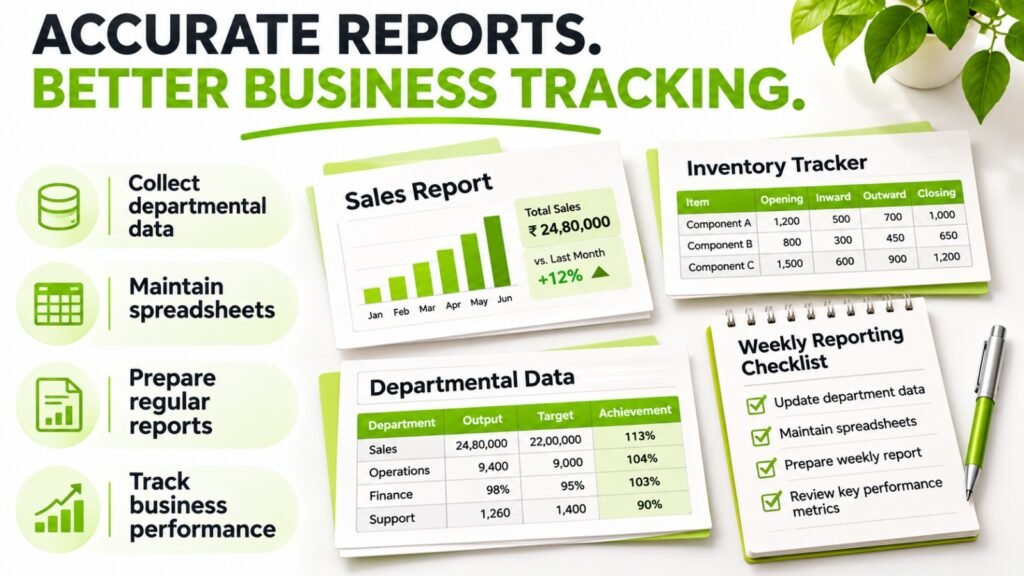
The MIS Executive handles business information and prepares the reports that let a company track how its processes are running.
Think of a sales department with 20 people. Every one of them submits daily sales figures. Someone has to collect those numbers, check them, update the spreadsheet and prepare a report.
That is where the MIS Executive comes in.
Duties of an MIS Executive
An MIS Executive may:
- Collect data from different departments.
- Maintain spreadsheets, data and databases.
- Prepare daily, weekly and monthly reports.
- Update sales, inventory, attendance and performance trackers.
- Check reports for incomplete or inaccurate information.
- Pass reports on to managers and other departments.
The role is common in sales, operations, finance, logistics and administration.
Skills and tools required
Excel is the central tool here. Useful abilities include:
- VLOOKUP, XLOOKUP and other lookup functions.
- IF, SUMIF and SUMIFS formulas.
- PivotTables and Pivot Charts.
- Data cleaning and formatting.
- Reporting and basic visualisation.
- Power BI or SQL, where the job calls for it.
An MIS Executive does not usually run analysis as involved as a Data Analyst’s. The job is to keep information structured, accurate and available whenever the company needs it.
Who should consider this role? If you are comfortable in spreadsheets, like keeping records in order and do not mind preparing reports on a regular cycle, MIS Executive is worth a look.
Business Analyst vs Data Analyst vs MIS Executive: salary comparison
Salary is one more thing to weigh up, though it depends on your experience, location, industry, technical skills and responsibilities.
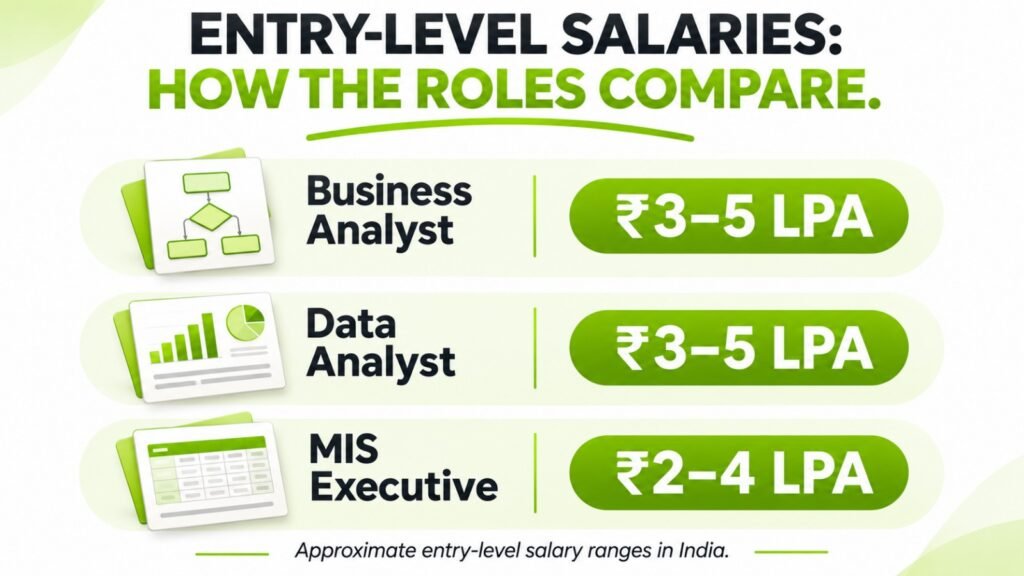
Here is a broad view of entry-level pay in India:
| Role | Approximate fresher salary |
|---|---|
| Business Analyst | ₹3 to 5 LPA |
| Data Analyst | ₹3 to 5 LPA |
| MIS Executive | ₹2 to 4 LPA |
These are approximate ranges. Actual starting salaries vary a good deal from company to company and city to city.
MIS Executive roles tend to start a little lower, though strong Advanced Excel, SQL and Power BI skills open up analysis work. Business Analyst pay can be higher in certain industries, particularly once you build domain knowledge. The same holds for Data Analysts who develop their SQL, Python and visualisation skills. There is a fuller breakdown in this look at salaries after a data analytics course in Pune.
Rather than picking a career on starting salary alone, think about the skills you want to build and the kind of work you want to do.
Which role is better for freshers?
There is no single answer. The right role depends on your skills and on what employers are asking for.
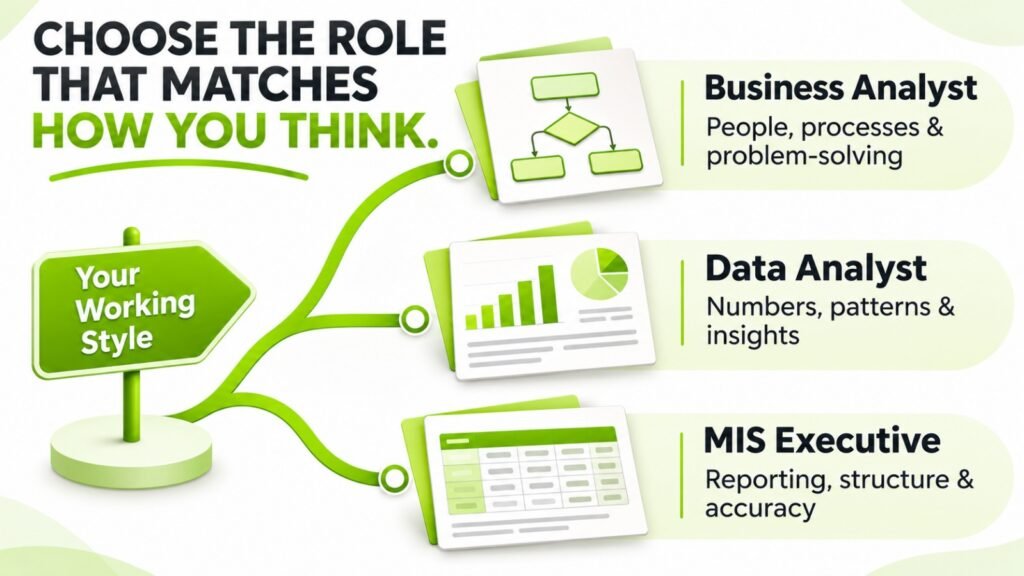
| Your situation or interest | Role to explore |
|---|---|
| You enjoy communication, business processes and solving problems | Business Analyst |
| You enjoy working with data, SQL and dashboards | Data Analyst |
| You are comfortable with Excel and structured reporting | MIS Executive |
MIS Executive roles can be easier for a fresh graduate to step into, since much of the work is Excel and reporting. Even so, some employers ask for prior experience or advanced Excel.
A Data Analyst role asks for more analytical ability alongside Excel, SQL and Power BI. Without work experience, projects are the way to show what you can do. If you are already heading in that direction, this guide to data analyst jobs in Pune for freshers covers the employers worth approaching and how their hiring process tends to work.
Business Analyst roles can also suit freshers, although some organisations prefer someone with an internship or experience of working with business requirements.
One point matters more than most: do not go by the job title. Read the job description. Two companies can advertise the same title for very different work.
Thinking about building your skills for a Data Analyst role? Explore FirstBit Solutions’ Data Analytics Course in Pune to see the tools, the practical learning approach and the projects included in the programme.
What should you learn to prepare for these roles?
Once you know roughly which direction you are heading in, the next step is building the skills. You do not need all of them at once.
If you want to become a Business Analyst
Start with communication, Excel and an understanding of business processes. Learn requirement gathering, problem identification, building process flows and working with stakeholders.
Depending on the position you are aiming at, you can gradually pick up Agile principles, Jira, Confluence and basic SQL.
If you want to become a Data Analyst
Start with Excel and get comfortable organising, cleaning and analysing data. Move on to SQL, then Power BI for reporting and visualisation.
Once the basics are in place, you can explore Python libraries such as Pandas and NumPy, along with basic statistics.
Project work helps too. A sales dashboard, a customer analysis report or an employee attrition analysis all make reasonable starting points.
If you want to become an MIS Executive
Start with Excel. Practise formulas, lookups, PivotTables, data validation and report building.
Take any sales, inventory or employee dataset and build reports from it. Once you feel confident, try Power BI and basic SQL if the jobs you want ask for them.
What counts is not the number of tools you can list on a CV, but whether you can use them and explain what you did.
Can you apply for these roles without an IT or engineering degree?
Yes. A computer science or engineering degree is not an eligibility requirement for every Business Analyst, Data Analyst or MIS Executive position.
Graduates from BCom, BBA, BSc, BA and other streams can qualify too, subject to the criteria a company sets and the demands of the job profile.
A commerce graduate, for example, already has some grounding in accounts, business practices and financial data. That knowledge is useful when working with business datasets.
The degree on its own will not be enough, though. You have to be able to do the work.
For a Data Analyst role that means showing your Excel, SQL and Power BI skills through projects. For an MIS role it means showing you can prepare accurate reports. For a Business Analyst role it means showing how you analyse a problem and propose a solution.
Start from what the job asks for and work towards it step by step. If you are weighing up how to learn those skills, this comparison of an online certificate against a classroom course sets out what each one does and does not give you.
How to choose between Business Analyst, Data Analyst and MIS Executive
Still undecided? Think about what you would enjoy doing day to day, rather than the title itself.
- Business analysis fits if you like picking apart business problems, talking to people and looking for ways to improve how things run.
- Data analytics fits if you like working with numbers, digging into data, writing SQL queries and building dashboards.
- MIS fits if you like systematic work, Excel, reporting, and keeping data structured and in order.
It also helps to read 10 to 15 job descriptions for each role. Note the skills and tools that keep coming up. That gives you a clearer picture of what employers in your area actually expect.
Still not sure? Try a small task in each area. Build an Excel sales report, analyse a small dataset, or write a short document describing how a business process could be improved. See which one you enjoy more.
Ready to take your first step towards a data analytics career?
Choosing a direction is only the first step. The next one is building the skills through practical learning.
If data analytics is the direction you want, the Data Analytics Course in Pune at FirstBit Solutions is worth a look. It covers Excel, SQL, Python, Power BI and Tableau, worked through with practical datasets and projects.
Want to know whether the programme fits what you are aiming at? Contact FirstBit Solutions to talk through the course content, the training approach and the support available.
Frequently asked questions
A Business Analyst focuses on business needs, requirements and process improvements. A Data Analyst works with datasets to identify patterns and insights. Neither is universally better. Choose based on whether you prefer business problem solving or hands-on data analysis.
It can be a useful starting point because MIS work develops Excel, reporting and data-handling skills. To move towards Data Analyst responsibilities, you will need to build additional skills in SQL, data visualisation and analytical thinking.
Yes. A BCom graduate can work towards entry-level Data Analyst roles by learning Excel, SQL, Power BI, basic statistics and practical data analysis. The eligibility requirements will depend on the employer and vacancy.
Not every Business Analyst position requires coding. Many focus on communication, requirements and business processes. However, technical Business Analyst roles may expect SQL, database knowledge or familiarity with software development.
Excel is useful in all three roles, but it is especially central to many MIS Executive positions. Data Analysts use it alongside SQL and visualisation tools, while Business Analysts may use it for organising information and basic analysis.
Yes, it is possible. An MIS Executive can build on existing reporting and Excel experience by learning SQL, Power BI, data cleaning and analytical techniques. Practical projects can help demonstrate readiness for more analysis-focused responsibilities.