
Learning Python? The first career that strikes your mind must be Web Development. Learn Python, develop sites or applications and land up as a developer. Seems simple enough, right?
But what if you are not too keen on website development?
Maybe you love playing around with numbers. Maybe you are interested in AI. Maybe you just want to see where Python can take you apart from developing web applications before investing months into learning it.
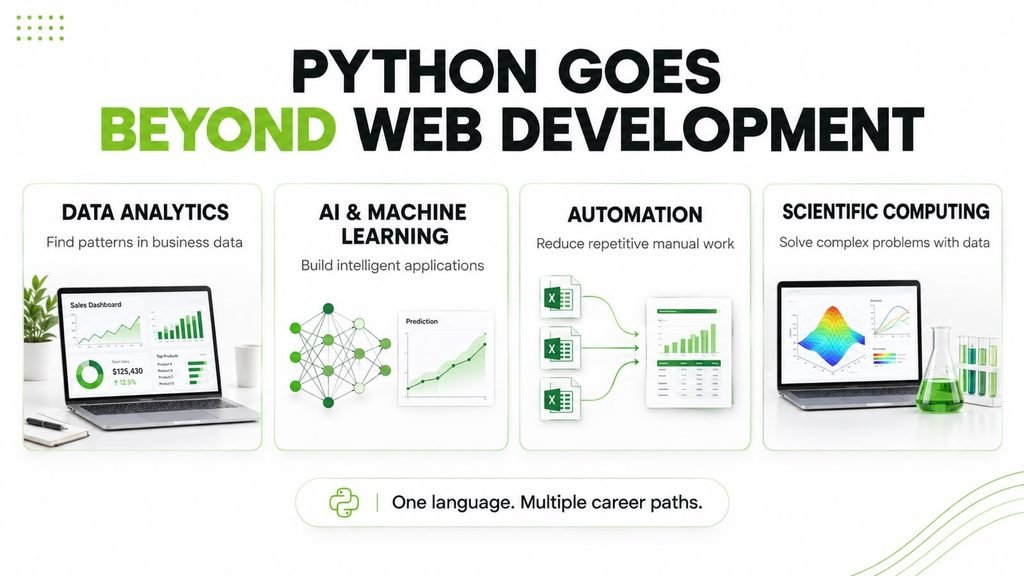
This is where it gets exciting. Python is used in various domains in technology such as data analytics, machine learning, automation and scientific computing. It means you don’t have to necessarily stick with the developer role just because you picked up the language to learn.
What you need to know here is what each of these careers entail and what is required for them.
So, if you are looking at various career options after learning Python in India as a beginner or fresher, let’s find out more!
Is Python Only Used for Web Development?
Absolutely not. Python is a general purpose programming language. This means that programmers can apply it for various tasks based on the set of tools and libraries they master.
Let us consider the case of an online store for a while.
Somebody needs to develop the website and ensure that the checkout procedure functions correctly. Somebody needs to analyze the selling products, understand why customers abandon their carts and what new products the company should have in the future. Somebody can automate the report generation task which used to be done manually by employees before.
These are three different tasks. Python can help in resolving all three of them.
The official Python website lists applications ranging from web development and scientific computing to software development and business applications.
However, the language itself is just a starting point. It is your skills that define the kind of job you will be able to do.
Here is a brief overview of the main career paths based on Python you can choose.
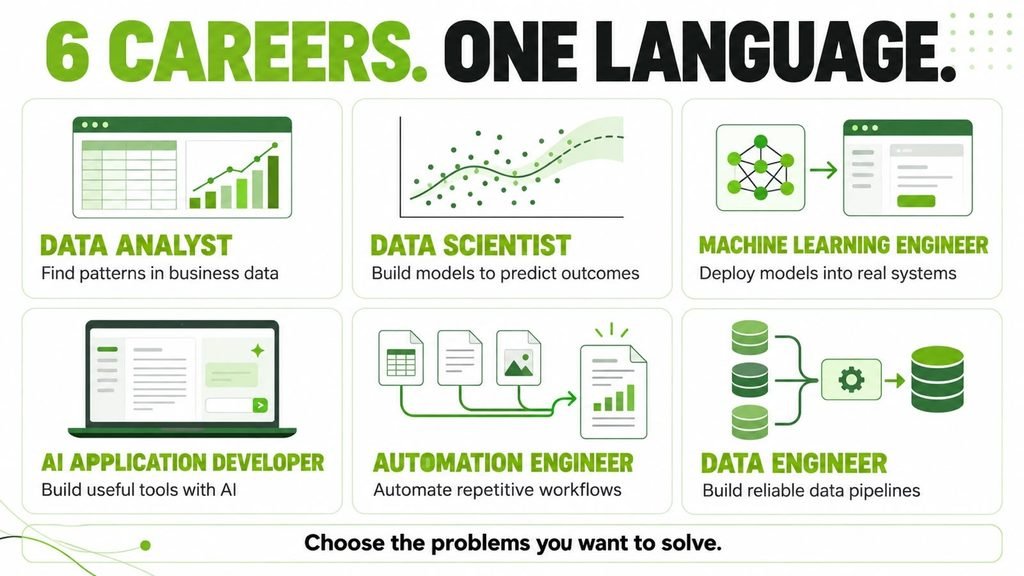
6 Python Career Options Beyond Web Development
1. Data Analyst
Consider the owner of a supermarket looking at their sales figures from the previous month and thinking about where things have gone wrong. Was there a drop in the number of customers coming in? Is one of the bestsellers running out of stock? Have consumers switched to a less expensive brand?
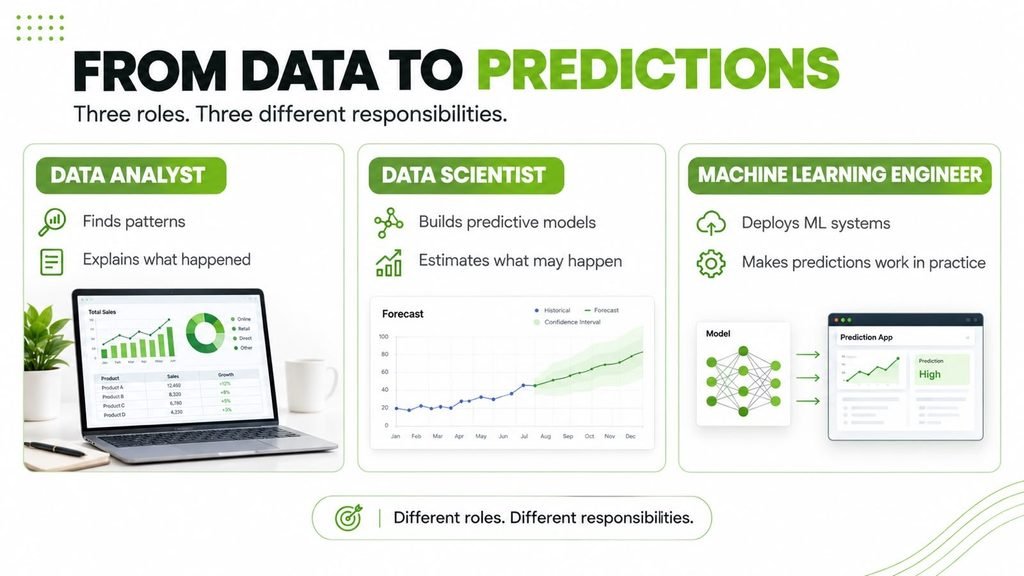
That’s exactly the job of the data analyst.
Data collection, cleaning, finding patterns and describing them in simple terms to allow the firm to make a decision is what it all comes down to. With Python, this becomes far easier, particularly with thousands of rows of data or analysis which needs to be done every month.
An analyst could leverage Python to analyze thousands of sales figures, compute the monthly difference and identify products that are underperforming. SQL is used to retrieve the data from the database while Power BI or Tableau helps present the insights into dashboards that people actually like looking at.
Skills you need: Python, SQL, Excel, data visualization and basic statistics.
This can be a practical starting point if you enjoy understanding why something happened rather than simply looking at the final numbers.
You can also read FirstBit’s guide to Data Analyst vs Data Scientist to understand how these two roles differ.
2. Data Scientist
An analyst would try to understand why the decline in sales took place last month. A data scientist would take it one step further and develop a model that will allow calculating the sales volume for the coming month.
This is a simplified case, of course. The tasks of analysts and data scientists may intersect in real firms.
A data scientist uses programming, statistics, and machine learning to study difficult situations and to create models based on data. They may work on forecasting customers’ needs, finding any peculiarities in transactions or forecasting which customers will stop using the services.
The library Pandas can be helpful in organizing the data while machine learning libraries help build models.
You will need more than the syntax of Python to work in this area. The statistics, preparation of the data, model evaluation and problem solving are parts of the learning process.
Skills to learn: Python, statistics, Pandas, NumPy, data visualisation and machine learning fundamentals.
If you are curious about patterns, predictions and how businesses can use historical information to make better decisions, data science may be worth exploring.
3. Machine Learning Engineer
Did you ever receive a product recommendation that felt very much aligned with your interests?
The system may use machine learning to detect certain patterns and make predictions based on user behavior. Machine learning can be applied to various fields such as fraud detection, image recognition and demand prediction.
Machine learning engineers design and implement such systems into applications. Depending on the position the responsibilities may involve data preparation, training the models, testing and ensuring its robust performance in real-world applications.
Python is one of the most popular languages for this task with libraries like Scikit-learn that implement machine learning functions.
Nevertheless, it is not the right step for the person who has just learned basic Python.
First of all, you have to be able to program, know how to work with data, know statistics and machine learning. Also, the more advanced positions may require additional skills in software engineering, cloud technologies and model deployment.
Skills to master: Python, statistics, machine learning, data preprocessing, model validation and software development fundamentals.
If you enjoy technical problem-solving and want to get to know about predictive systems – it may become your career path.
4. AI Application Developer
AI has introduced another opportunity where the knowledge of Python would come in handy.
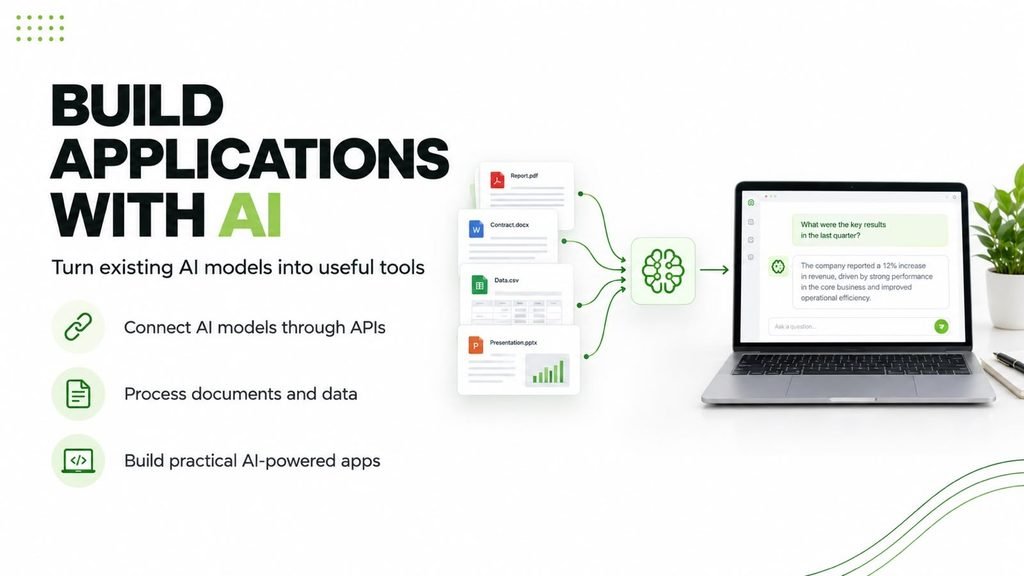
Imagine a firm that holds thousands of its own documents inside. People work in the firm and have to search through the documents to find certain policies, directions or answers to certain questions.
An AI developer could assist in making an application where people can ask questions in natural language and get responses in return using the mentioned documents.
The developer might have to use Python programming to integrate an already existing AI model into the application, to get the necessary data and process user queries.
It is important to understand the difference between the two things – creating an application that works with an already existing AI model and researching and training a new big AI model.
The skills needed for the project are determined by the type of project, but Python programming, APIs, data processing, and AI fundamentals would give some background.
Skills to learn: Python, APIs, data processing, AI fundamentals and application development. Some specializations might need knowledge of machine learning, deep learning or NLP.
This path may interest you if you want to build useful applications around AI rather than focus exclusively on traditional websites.
5. Automation Engineer
Not every Python project needs to involve AI or complicated algorithms.
Sometimes, the most useful thing you can build is a small program that saves someone hours of repetitive work.
Suppose an employee receives 30 Excel files every morning. They have to open each file, copy the relevant information into one spreadsheet, check for missing entries and prepare a report.
A Python script could automate much of that process.
Automation engineers and developers use scripts and other tools to reduce manual work, run repeatable processes and improve reliability. The actual responsibilities vary by company and may overlap with software development, testing or IT operations.
Python is particularly useful for tasks involving files, spreadsheets, APIs and routine data processing.
Skills to learn: Python fundamentals, file handling, scripting, APIs and testing.
You do not necessarily need to start with advanced mathematics or machine learning for this path. A good understanding of programming logic and the ability to identify repetitive tasks can take you a long way.
6. Data Engineer
Here’s a challenge that businesses have to tackle when gathering their data from various sources.
Their sales data could be stored in one database, customer details in another, and web traffic in yet another. For analysis, the gathered data will need cleaning, preparation, combining and storing.
Here comes the data engineer.
These specialists create and operate the pipelines that transfer the data between locations and make it ready for analysis. Python, along with SQL, databases and cloud technologies, is used to perform data processing and pipeline development.
The data engineers, then, are the ones responsible for making sure that the data becomes accessible for other teams.
Key skills: Python, SQL, databases, data pipelines and cloud computing.
In terms of technicalities, this is more engineering-oriented than the entry-level data analyst role. It could become an option to consider as you develop your skills in programming and databases.
Python Jobs for Freshers: Where Should You Start?
If you are a fresher, then you might want to know which out of all these career options would be available to you once you learn Python.
The answer to this question lies in the set of skills that you will acquire along with Python.
For instance, someone who acquires the skillset of Python, SQL, Excel and Power BI can begin exploring options in the field of entry-level data analysis and reporting jobs. An individual who masters the art of Python in addition to Django, database, APIs and frontend technologies can consider options such as junior Python developer and backend developer jobs.
Jobs like machine learning engineer and data scientist can involve some specialized knowledge too, based on the employer’s requirements.
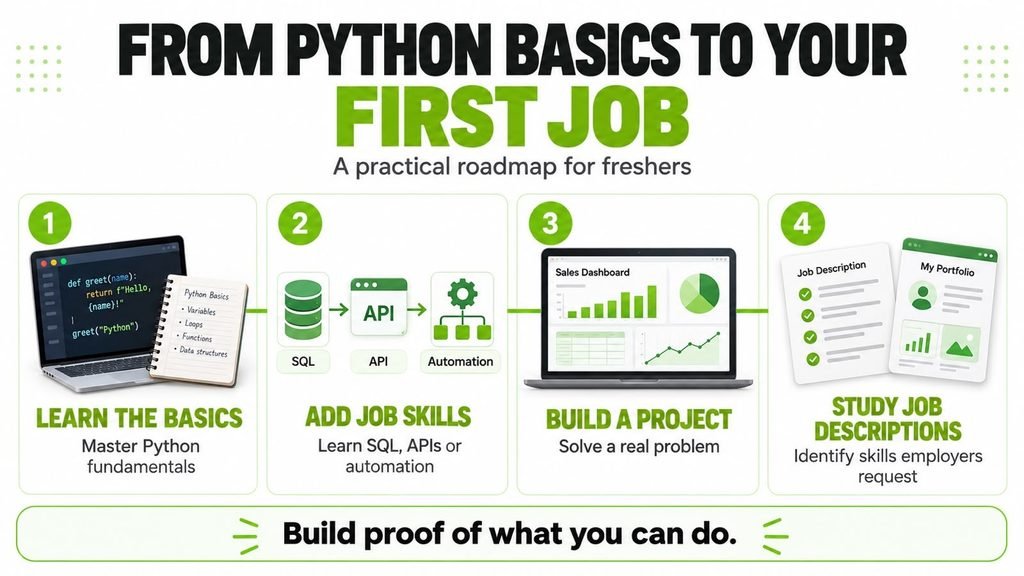
Consider the requirements from employers prior to submitting your CV. Study several job descriptions for your chosen position and take notice of the skills which are common.
Develop the corresponding projects.
In case of data analysis, you may consider analyzing the sales data and explaining your findings. In case of Python development, you may develop an application with a database and APIs. As for automation, it can be a script which unites several files into one report.
This project will provide a solid background for discussion during an interview. But the most important thing is that it will help you learn if you really understand the topic after watching some tutorials.
If you are unsure how much preparation you might need, FirstBit’s guide on how long it takes to learn Python for a job explains the difference between learning the basics and becoming ready to apply.
Want to learn Python through a structured programme? Explore FirstBit Solutions’ Python classes in Pune to see how Python programming connects with development, data science and AI. Review the curriculum and practical project work to decide whether the learning path fits your goals.
Python Data Science vs Web Development: Which Career Should You Choose?
Let’s bring this back to the decision many beginners face.
You have started learning Python, and now you need to decide what to learn next. Should you move towards full stack development or data science?
Neither option is automatically better. They involve different kinds of work.
| Factor | Python Full Stack Development | Data Science |
| Main focus | Building web applications | Analysing data and developing models |
| Typical work | Creating features, connecting databases and developing APIs | Cleaning data, finding patterns and testing predictions |
| Important skills | Python, Django, databases, APIs and frontend technologies | Python, statistics, data analysis and machine learning |
| Beginner project | A web application with user login and database functionality | A sales analysis project with visualisations |
| Possible career path | Junior Python developer, backend developer, full stack developer | Data analyst, followed by more specialised data science roles with additional skills |
A quick test helps: imagine a regular Tuesday at work.
Someone who pictures themselves building a feature, fixing bugs and watching an app slowly come to life will probably enjoy full stack development.
Someone who would rather open a spreadsheet, chase down why a number changed and answer questions with data is better suited to data analytics, with data science as the next step.
The good news is that no one has to decide forever on day one. Trying a small project in each area is enough. A couple of weeks in, it becomes clear which one a learner would happily keep doing.
What Should You Learn After Python Basics?
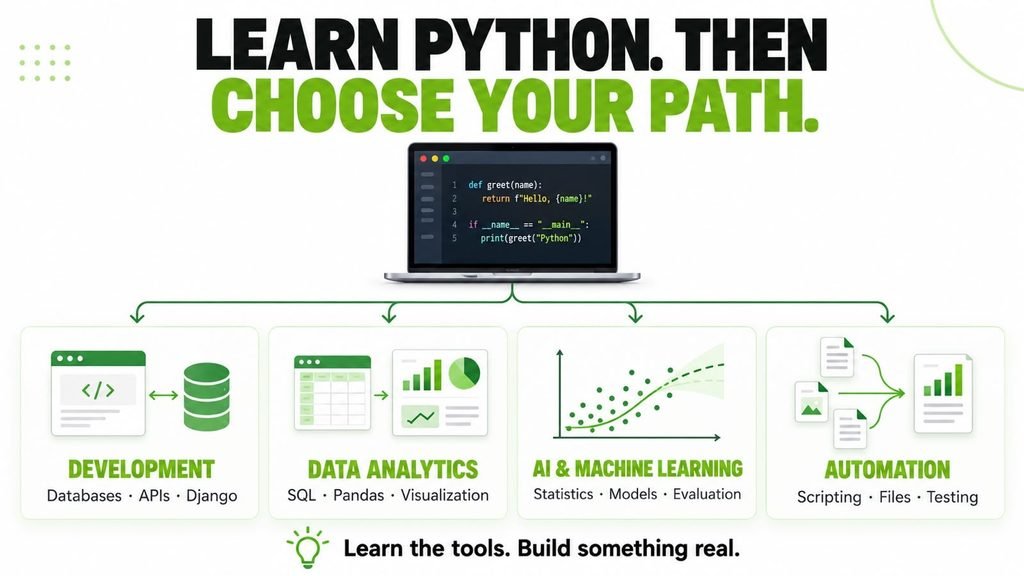
When variables, loops, functions and basic logic seem comfortable, it’s time to stop learning Python as some kind of random thing and start relating the language to tasks which a learner really wants to perform.
- For developers: learn how to use databases, APIs and frameworks such as Django for creation of the whole working application.
- For data analysts: deal with real data sets, learn SQL and clean data with Pandas; use Excel or any other visualisation method to show the results of the analysis.
- For data science/machine learning: combine all the data analyst skills with statistics, training of models and evaluation.
- For automation: choose some repetitive task that a person does manually and analyse how much of this process could be automated with Python code.
No matter which way a person chooses, practice is the key element here. The learner must be able to describe his project, its aims and solutions of the problems he faced while working on it. This is exactly what recruiters will remember.
You can explore FirstBit’s Python Data Science course in Pune if you want to understand how programming, data analysis, machine learning and AI fit into a structured learning path.
Final Thoughts
Learning Python doesn’t lock anyone into web development. It can lead to analysing business data, automating boring tasks or building apps powered by AI.
Still, learning a language and learning a profession are two separate steps. Once the basics are down, the next move is to pick a direction, learn the tools that go with it and build projects that prove the skills are real.
For those still torn between development and data, comparing the curricula in the Python programmes at FirstBit Solutions is a sensible next step.
No one needs to learn every Python tool out there. The goal is to find the kind of problem worth solving, and then start learning how to solve it.