Scroll through job portals for a bit, and you’ll notice something strange. Some “Data Analyst” and “Data Scientist” postings read like completely different jobs. Others read like the exact same job with a fancier title stapled onto one of them. If you’re trying to decide which one to actually train for, that inconsistency alone makes the whole thing feel more confusing than it should be.
So let’s actually sort this out. Not with vague buzzwords about “working with data,” but with what each role really looks like on a Tuesday afternoon, so you can pick based on fit instead of a coin flip, whether you’re looking at a data analytics course in Pune or a data science course in Pune specifically.
Why the Confusion Exists in the First Place
Honestly, a lot of it comes down to companies not being consistent with these titles. A smaller company might hire one “Data Analyst” who ends up doing a bit of everything, some reporting, a little light modeling, maybe automating a report nobody wants to build by hand every week, simply because there’s no one else around to split the work with. A bigger company might draw a hard line between the two roles, with entirely separate teams and almost no overlap. So when you’re comparing job listings side by side, you’re not always comparing the same job. That’s the trap.
The more useful question isn’t “which title sounds more impressive.” It’s “which kind of daily work am I actually being asked to do?” That’s what the rest of this is about.
Quick Answer: What’s the Real Difference?
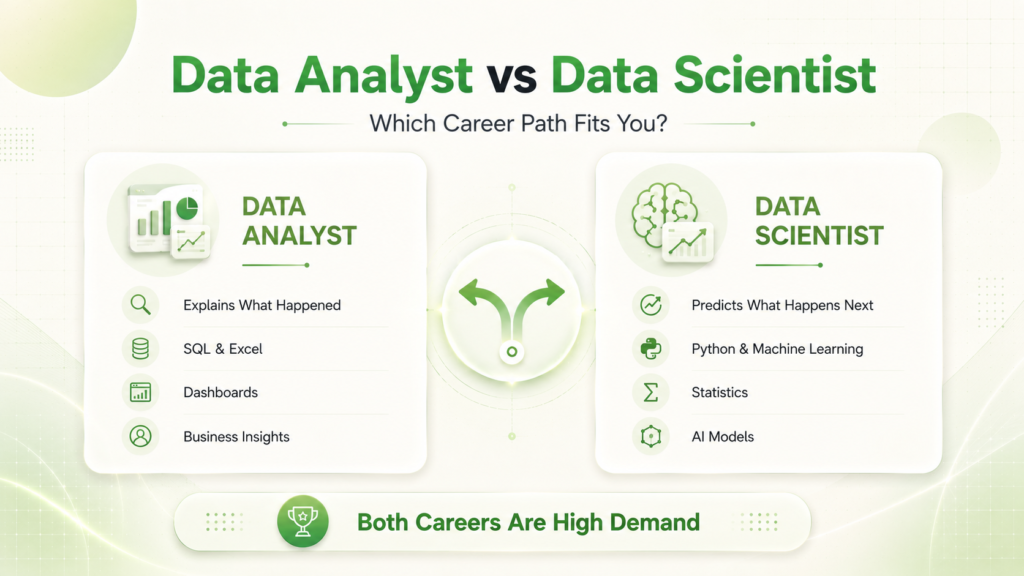
Short version, if you’re in a hurry: a Data Analyst works with data that already exists to explain what happened and why, using tools like SQL, Excel, and dashboards. A Data Scientist goes further and builds models that try to predict what happens next, leaning on statistics, programming, and machine learning. Analysts look backward and explain. Scientists look forward and predict. Neither one is the “lesser” version of the other; they’re genuinely different jobs that just happen to share a few tools.
What a Data Analyst Actually Does Day to Day
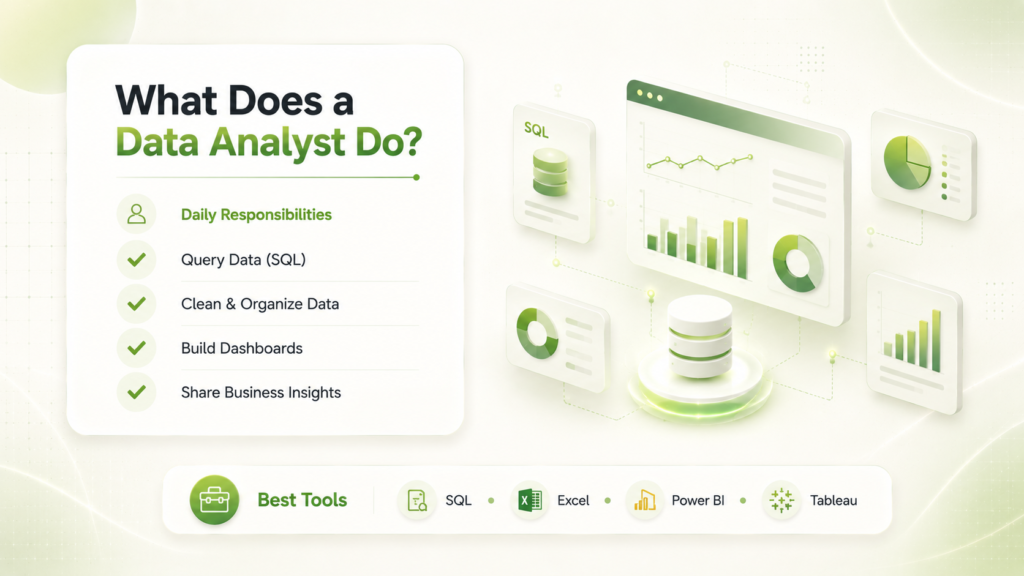
Say you became a data analyst tomorrow. Your week would probably involve pulling data out of a database with SQL, cleaning it up because raw data is almost never as tidy as it looks in a tutorial, building a dashboard or report in something like Power BI or Tableau, and then explaining what you found to people who don’t live and breathe data the way you do. A surprising amount of this job is communication, not analysis. You could spot the single most interesting trend in the entire dataset, but if you can’t explain it clearly to a marketing manager who’s skimming your slide during a meeting, it doesn’t really land.
The core toolkit usually includes SQL for pulling and querying data, Excel for quick turnaround work, a visualization tool for dashboards, and often some basic Python for automating the repetitive parts. Compared to data science, the technical bar to get started is lower, which is a big reason this path tends to be a more realistic entry point if you’re switching careers or don’t come from a heavy programming background.
If you’re interested in starting with analytics, our Data Analytics Course in Pune covers SQL, Excel, Power BI, Python fundamentals, and hands-on projects designed for beginners and career switchers.
What a Data Scientist Actually Does Day to Day
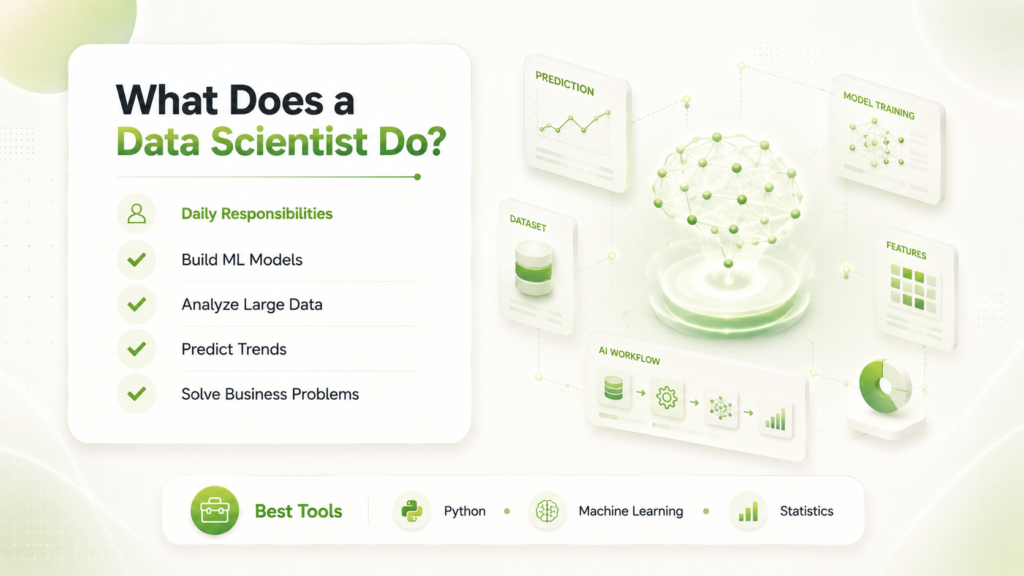
A data scientist’s day looks different in a few real ways. Instead of mostly working with clean, structured data, you’re often stuck untangling messy, large, or straight-up unstructured datasets before you can do anything useful with them. And instead of just explaining what already happened, you’re building and testing models that try to predict outcomes, things like which customers are about to churn, what demand will look like next quarter, or which transactions look off.
This role leans more heavily on programming, usually Python, plus statistics and machine learning, and it typically expects a stronger technical and math foundation before you even walk in the door. That doesn’t make it “harder” in some abstract, universal sense. It’s a different kind of hard, more about building and validating models than communicating findings, though let’s be honest, communication still matters here too. It’s just not the whole job the way it is for analysts.
If building predictive models and working with AI interest you, explore our Data Science Course in Pune to see the complete curriculum, tools, and real-world projects included in the program.
Data Analyst vs Data Scientist: Side by Side
If you’d rather see the whole comparison at once:
| Factor | Data Analyst | Data Scientist |
| Core focus | Explaining what happened | Predicting what will happen |
| Typical tools | SQL, Excel, Power BI, or Tableau | Python, statistics, and machine learning libraries |
| Math and stats depth | Foundational | Deeper, ongoing |
| Common entry point | Often faster, especially for career switchers | Usually needs a stronger technical background first |
| Typical output | Dashboards, reports, insights | Predictive models, automated systems |
For a lot of people starting from zero, especially career switchers, Data Analyst tends to be the more realistic first lane. The learning curve is gentler, and plenty of analysts move into data science later once their technical foundation is stronger. Think of it less as two separate destinations and more like two points on the same road. You can always keep walking.
Which One Should You Choose? A Simple Self-Check
Instead of trying to decide this in the abstract, ask yourself a few honest questions.
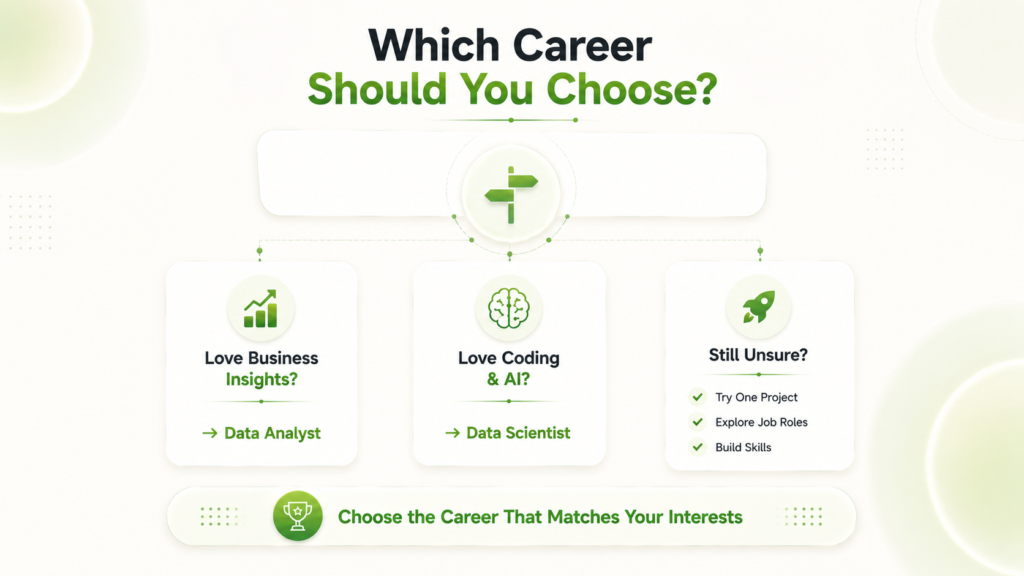
Do you like figuring out “why” something happened and then explaining it clearly to someone else? That’s a decent signal toward analyst work, where communication and business context matter just as much as the technical part.
Are you more pulled toward writing code, working through statistics, and building something that predicts an outcome rather than just describing a past one? That leans toward data science, where the daily work is closer to experimentation.
Genuinely not sure yet? That’s fine, and honestly, more common than people admit. Data Analyst is usually the safer starting point precisely because it’s a real stepping stone, not a dead end. You build transferable skills, SQL, statistics, working with actual messy datasets, while keeping the door open to data science later if that direction ends up pulling at you.
One more tip that actually helps: go check real, current job postings for both titles around Pune. See which one shows up more for the kind of companies you’d want to work at. That tells you more about right now than any general comparison ever could, including this one. If you’re still weighing training options, it’s also worth comparing what a data science class in Pune actually teaches versus a data analytics course in Pune, since the course structure itself is usually a pretty honest reflection of the job you’d be training for.
Mistakes People Make When Choosing Between These Two Paths
A few patterns keep showing up with people wrestling with this decision, and most of them are avoidable once you know to look out for them.
The first is chasing the title that sounds more impressive, instead of the actual daily work behind it. “Data Scientist” has a certain shine to it online, but that shine doesn’t tell you whether you’ll actually enjoy spending eight hours tuning a model versus presenting insights to a room full of stakeholders. Those are very different experiences, and only one of them will feel right to you.
The second is assuming you have to pick the “harder” path to prove something to yourself or anyone else. Data Analyst work isn’t some watered-down version of data science. It’s its own discipline, and it gets genuinely demanding once you’re dealing with messy real data and stakeholders who want answers yesterday.
The third, and this one’s sneaky, is trying to learn both paths at once right from day one. Sounds efficient on paper. In practice, it usually means shallow exposure to everything and real depth in nothing. Pick a lane, get properly good at it, and let a possible switch happen later, once you actually have experience to make that call from.
The fourth catches a lot of career switchers off guard: underestimating how much communication matters for analysts, or overestimating how much of the data scientist’s job is “just coding all day.” Both roles need you to explain what you found, or built to people who don’t share your technical background. If that part of the job sounds miserable to you, it’s worth sitting with that honestly, for either path, not just one.
Getting Started: What a First Project Looks Like for Each Path
Reading comparisons only gets you so far. The clearest way to actually feel out which path fits is to try a small taste of both.
For the Data Analyst route, grab a public dataset, retail sales, a sports league’s stats, public transport numbers, whatever interests you, and build a simple dashboard that answers three or four specific business-style questions. Which product category is slipping? Which region is outperforming? What time of day sees the most activity? The point isn’t a polished dashboard. It’s practicing the full loop of pulling data, cleaning it, and landing on a clear takeaway.
For the Data Scientist route, try a small prediction project instead. Predicting house prices from a public dataset, or guessing whether a customer is likely to churn based on their past behavior, is a fine starting point. It doesn’t need to be sophisticated. What matters is feeling what it’s actually like to frame a prediction problem, prep the data for a model, and figure out whether your model’s output is even useful.
Pay attention to how different these two exercises feel while you’re doing them. That gut reaction, more than any comparison chart, is usually the clearest signal of which lane genuinely fits you.
Common Myths About Data Analyst and Data Scientist Roles
A few misconceptions keep floating around, so let’s clear them out.
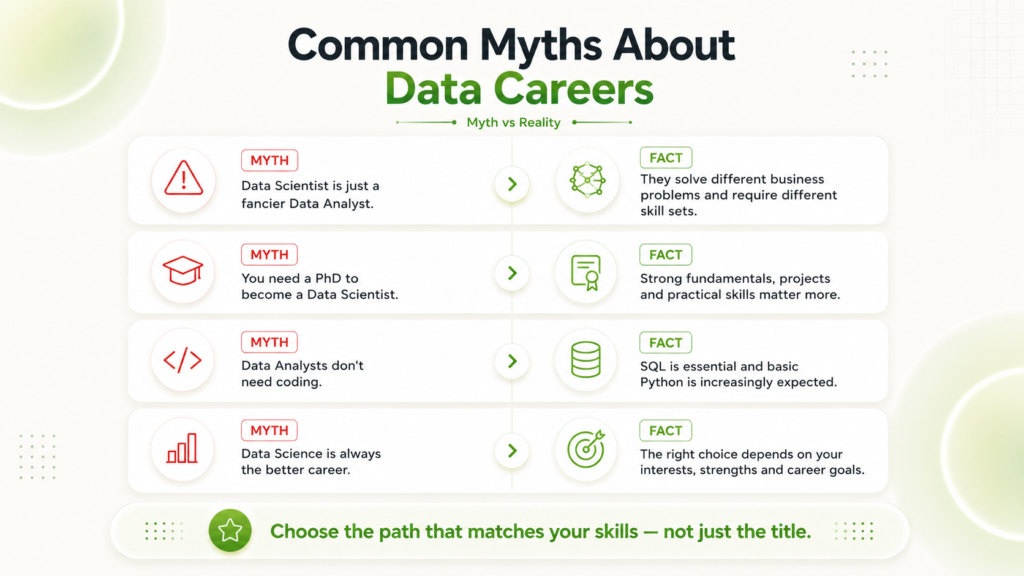
“Data Scientist is just a fancier title for Data Analyst.” Not really. There’s tool overlap, sure, but the core skill set, especially statistics, programming depth, and machine learning, is genuinely different.
“You need a PhD to become a data scientist.” Not true, though a solid technical and statistical foundation absolutely matters. Plenty of working data scientists come from structured, project-based training rather than advanced degrees, as long as the fundamentals hold up.
“Data Analysts don’t need to code at all.” This used to be closer to true. These days, basic SQL is essentially assumed, and increasingly, some Python for automating the boring parts too.
“Data Science is automatically the better choice because it pays more.” Compensation can trend higher for data science roles, sure, but “better” depends entirely on what kind of work you’d actually want to be doing five days a week. A well-paid job that bores you isn’t really a win, no matter what the offer letter says.
A comparison published by Coursera points out that both data analysts and data scientists consistently rank among the most in-demand, well-compensated roles in recent global jobs reports. So this isn’t really “safe choice vs risky choice.” Both paths have real staying power.
How FirstBit’s Data Programs Fit Into This
Because this decision trips up so many people, our Data Analytics and Data Science programs are built around these two distinct skill paths instead of blurring them into one generic track. If you’ve been searching for the best data analyst course in Pune or comparing it against a data science option, that’s usually a sign you’re already at this exact fork in the road. Classes are live and instructor-led, with hands-on work on real datasets, not just demos you watch someone else run. Trainers help students figure out which lane actually fits their background and goals, instead of nudging everyone toward whichever course sounds more impressive.
Alongside the technical training, both programs include real project work and Placement Assistance once you’re job-ready, so the goal isn’t just ticking off tools on a list. It’s being able to sit in an interview and talk through real work you’ve actually done.
Final Thoughts
There’s no universally “correct” answer between data analyst and data scientist, only the one that actually fits how you like to work. Enjoy digging into a business question, building a clean dashboard, and explaining what it means to a room full of people? Lean analytics. More drawn to writing code, testing models, and chasing answers nobody’s found yet? Lean data science. Either way, the skills you build here are real, and they transfer if you ever decide to shift direction later.
Ready to start your data career? Explore our Data Analytics and Data Science programs to compare the curriculum, career outcomes, and projects included in each course. If you’re still unsure, book a free demo class and speak with an expert trainer who can help you choose the right learning path based on your background and career goals.